SFI SYSTEM Lack of Power
| DTC Code | DTC Name |
|---|---|
| Lack of Power |
DESCRIPTION
Problem Symptom |
Suspected Area |
Trouble Area |
|
|---|---|---|---|
Strong engine vibration due to above symptoms |
|
Ignition system |
|
Fuel system |
|
||
Intake and exhaust systems |
|
||
Other control systems |
|
||
Engine |
|
||
High load from another system |
|
||
If any other DTCs are output, perform troubleshooting for those DTCs first.
Make sure to reproduce the conditions present when the malfunction occurred.
Using the GTS, read the Data List to confirm the engine operating conditions. This information can be useful when troubleshooting.
If the problem symptoms do not recur, attempt to reproduce the symptoms and conditions when the malfunction occurred based on the result of the customer problem analysis. Place the priority on confirming the symptoms.
SYMPTOM AND CAUSE OF SYSTEM MALFUNCTION
Tip:The following are descriptions of the characteristics of each system malfunction. After understanding the link between the causes and symptoms, perform the inspection of each component. Even if the problem symptom does not recur, signs of the malfunction may be found in the Data List.
Ignition system
Table 1. Spark plug Main cause of malfunction
Performance degradation (wear, existence of foreign matter, etc.)
Symptom
Engine speed fluctuation due to abnormal combustion
Data List
Cylinder #1 Misfire Count to Cylinder #4 Misfire Count
Tip:If the spark plug of the malfunctioning cylinder is abnormally wet with fuel, a leaking fuel injector assembly is suspected.
Table 2. Ignition coil assembly Main cause of malfunction
Internal malfunction
Problem symptom
Engine speed fluctuation due to abnormal combustion
Data List
Cylinder #1 Misfire Count to Cylinder #4 Misfire Count
Fuel system
Table 3. Fuel injector assembly Main cause of malfunction
Blockage
Problem symptom
Engine speed fluctuation due to abnormal combustion
Idle speed too low or high
Data List
Short FT #1
Long FT #1
Fuel System Status #1
Target Air-Fuel Ratio
AF Lambda B1S1
A/F Learn Value Idle #1
A/F Learn Value Low #1
A/F Learn Value Mid1 #1
A/F Learn Value Mid2 #1
A/F Learn Value High #1
Total FT #1
Tip:If the engine malfunction disappears when the fuel injection volume is increased or decreased using the Control the Injection Volume, the respective cylinder may be malfunctioning.
Table 4. Fuel system Tip:If the air fuel ratio becomes lean only when the engine is running under a high load and at a high engine speed, clogging of the fuel pump or fuel filter is suspected.
Table 5. Fuel quality Main cause of malfunction
Fuel degradation due to age or water contamination
Low fuel quality
Addition of fuel additive
Problem symptom
Engine speed fluctuation due to abnormal combustion
Idle speed too low or high
Engine is difficult to start
Intake and exhaust systems
Table 6. Mass air flow meter sub-assembly Main cause of malfunction
Performance degradation (existence of foreign matter, etc.)
Problem symptom
Lack of power
Data List
MAF
Tip:If the value of the Data List item "MAF" is abnormal, a malfunction of the mass air flow meter sub-assembly is suspected.
Table 7. Throttle system Main cause of malfunction
Inappropriate trim volume adjustment due to accumulation of deposits
Problem symptom
Engine speed fluctuation due to abnormal combustion
Idle speed too low or high
Data List
ISC Learning Value
ISC Flow
ISC Feedback Value
Electric Load Feedback Val
Air Conditioner FB Val
Eng Stall Control FB Flow
Table 8. Air fuel ratio sensor, Heated oxygen sensor Main cause of malfunction
Deviation in sensor characteristics
Problem symptom
Abnormal combustion due to deviation of actual air fuel ratio from calculated ratio
Data List
AFS Voltage B1S1
O2S B1S2
Fuel System Status #1
Engine
Table 9. Engine assembly Main cause of malfunction
Compression loss
Accumulation of deposits
(Combustion chamber, intake valve or intake manifold)
Problem symptom
Engine speed fluctuation due to abnormal combustion
Idle speed too low or high
Hesitation during acceleration or stalling
Tip:If deposits have accumulated in the combustion chamber or on an intake valve, the engine may stall when deposits are caught on an intake valve.
When performing the Active Test "Check the Cylinder Compression", if the speed of one cylinder is higher than the others, the cylinder may have a compression loss.
If deposits accumulate on the intake valves, the supply of fuel may be delayed due to adherence of the fuel to the deposits, causing a rough idle.
Data List Items Related to Lack of Power
Tip:Depending on the vehicle model, the applicable Data List items may vary. Data List items other than the ones used in the diagnostic procedure are for reference only.
ISC Learning Value
ISC Flow
ISC Feedback Value
Electric Load Feedback Val
Air Conditioner FB Val
Eng Stall Control FB Flow
Short FT #1
Long FT #1
Fuel System Status #1
Target Air-Fuel Ratio
AF Lambda B1S1
A/F Learn Value Idle #1
A/F Learn Value Low #1
A/F Learn Value Mid1 #1
A/F Learn Value Mid2 #1
A/F Learn Value High #1
Total FT #1
MAF
Cylinder #1 Misfire Count to Cylinder #4 Misfire Count
AFS Voltage B1S1
O2S B1S2
PROCEDURE
INTERVIEW THE CUSTOMER
Interview the customer for details about the conditions when experiencing the lack of power.
Tip:If a lack of power occurs when the engine is running under a high load and at a high engine speed, the fuel filter may be clogged.
Result
Proceed to
NEXT
CHECK DTC OUTPUT
Connect the GTS to the DLC3.
Turn the ignition switch to ON.
Turn the GTS on.
Perform a road test.
Enter the following menus: Powertrain / Engine and ECT / Trouble Codes.
Read the DTCs.
Powertrain > Engine and ECT > Trouble Codes
Result
Result
Proceed to
DTCs are not output
A
DTC is output
(DTCs other than P1603, P1604 or P1605 are output)
B
SYMPTOM CONFIRMATION
Check if the problem symptoms reported in the customer problem analysis recur.
Tip:If the problem symptoms do not recur, attempt to reproduce the conditions when the malfunction occurred based on the result of the customer problem analysis.
Result
Result
Proceed to
The problem symptom recurs
A
The problem symptom does not recur (occurred in the past)
B
READ VALUE USING GTS (ISC LEARNING VALUE)
Connect the GTS to the DLC3.
Turn the ignition switch to ON.
Turn the GTS on.
Enter the following menus: Powertrain / Engine and ECT / Data List / ISC Learning Value.
Powertrain > Engine and ECT > Data List
Tester Display
ISC Learning Value
Read the value displayed on the GTS.
Result
Result
Proceed to
Less than 6.2 L/s
A
Other than above
B
B REMOVE FOREIGN OBJECT (CLEAN THROTTLE BODY ASSEMBLY)Click here
READ VALUE USING GTS (KNOCK CORRECT LEARN VALUE)
Connect the GTS to the DLC3.
Start the engine and warm it up until the engine coolant temperature reaches 75°C (167°F) or higher.
Turn the GTS on.
Idle the engine.
Enter the following menus: Powertrain / Engine and ECT / Data List / Knock Correct Learn Value.
Powertrain > Engine and ECT > Data List
Tester Display
Knock Correct Learn Value
Read the value.
Result
Knock Correct Learn Value
Proceed to
5 deg(CA) or more
A
Less than 5 deg(CA)
B
Tip:If the value shown in the Data List is less than 5 deg(CA), interview the customer to check if the malfunction is caused by the quality of the fuel being used.
If the result of the customer problem analysis is that improper fuel was not used or the type of fuel used is unknown, suggest that the customer refuel the vehicle with a different brand of fuel and then check if the malfunction symptoms disappear.
B CONFIRM FUEL
READ VALUE USING GTS (SHORT FT #1 AND LONG FT #1)
Connect the GTS to the DLC3.
Turn the ignition switch to ON.
Turn the GTS on.
Enter the following menus: Powertrain / Engine and ECT / Data List / Short FT #1 and Long FT #1.
Read the value displayed on the GTS.
Result
Data List
Result
Proceed to
Short FT #1 + Long FT #1
-15% or higher, or less than 15%
A
Other than above
B
Tip:"Total FT #1" is used to detect an abnormal air fuel ratio. As the value of "Total FT #1" is corrected by the ECM before it is displayed in the Data List, the displayed value may not be equal to the sum of the measured "Short FT #1" and "Long FT #1".
An abnormally lean or rich tendency can be checked by reading the following Data List items: A/F Learn Value Idle #1, A/F Learn Value Low #1, A/F Learn Value Mid1 #1, A/F Learn Value Mid2 #1 and A/F Learn Value High #1.
The following may cause a lean air fuel ratio (an operating range in which the air fuel ratio learned value correction is +15% or more):
-
Decrease in fuel injector assembly injection volume
Decrease in mass air flow meter sub-assembly output (due to existence of foreign matter)
Air leaks in intake system after mass air flow meter sub-assembly
Decrease in fuel pressure (at fuel filter, fuel pump or fuel pressure regulator assembly)
On vehicles which the learning value for each operating range can be checked, if the value of "A/F Learn Value High" only is corrected to the positive side, a malfunction in the fuel system (clogging of the fuel pump or fuel filter) is suspected.
On vehicles which the learning value for each operating range can be checked, if the value of "A/F Learn Value Idle #1" or "A/F Learn Value Low #1" only is corrected to the positive side, an air leak after the mass air flow meter sub-assembly is suspected.
The following may cause a rich air fuel ratio (an operating range in which the air fuel ratio learned value correction is -15% or less):
-
Increase in the fuel injector assembly injection volume
Purge VSV system
B READ VALUE USING GTS (MAF)Click here
PERFORM ACTIVE TEST USING GTS (CONTROL THE SELECT CYLINDER FUEL CUT)
Connect the GTS to the DLC3.
Turn the ignition switch to ON.
Turn the GTS on.
Start the engine.
Tip:Reproduce the vehicle conditions when the malfunction occurred. (such as after the engine is warmed up or after a cold start).
Enter the following menus: Powertrain / Engine and ECT / Active Test / Control the Select Cylinder Fuel Cut / Primary / Engine Speed.
Powertrain > Engine and ECT > Active Test
Active Test Display
Control the Select Cylinder Fuel Cut
Data List Display
Engine Speed
According to the display on the GTS, perform the Active Test and check for a malfunctioning cylinder.
Tip:Perform fuel-cut for each cylinder and check the change in the engine speed.
If the engine speed of a cylinder does not change while performing the Active Test, it can be determined that the cylinder is malfunctioning.
If the engine speed of all cylinders change while performing the Active Test, it can be determined that multiple cylinders are malfunctioning.
A cylinder for which the Data List item "Cylinder Misfire Count" increases may be malfunctioning.
Result
Result
Proceed to
One cylinder is malfunctioning
A
Multiple or all cylinders are malfunctioning, or the malfunctioning cylinder cannot be determined.
B
B READ VALUE USING GTS (MAF)Click here
PERFORM ACTIVE TEST USING GTS (CHECK THE CYLINDER COMPRESSION)
Tip:If the vehicle does not support the Active Test "Check the Cylinder Compression", measure the compression pressure. If the compression pressure is normal, go to step 9.
Warm up the engine.
Turn the ignition switch off.
Connect the GTS to the DLC3.
Turn the ignition switch to ON.
Turn the GTS on.
Enter the following menus: Powertrain / Engine and ECT / Active Test / Check the Cylinder Compression / Data List / Compression / Engine Speed of Cyl #1 to #4, Av Engine Speed of All Cyl.
Powertrain > Engine and ECT > Active Test
Active Test Display
Check the Cylinder Compression
Data List Display
Engine Speed of Cyl #1
Engine Speed of Cyl #2
Engine Speed of Cyl #3
Engine Speed of Cyl #4
Av Engine Speed of All Cyl
Tip:To display the entire Data List, press the pull down menu button next to Primary. Then select Compression.
While the engine is not running, press the RIGHT or LEFT button to change Check the Cylinder Compression to ON.
Tip:After performing the above procedure, Check the Cylinder Compression will start. Fuel injection for all cylinders is prohibited and each cylinder engine speed measurement enters standby mode.
Crank the engine for about 10 seconds.
Monitor the engine speed (Engine Speed of Cyl and Av Engine Speed of All Cyl) displayed on the GTS.
Tip:At first, the GTS displays extremely high cylinder engine speed values. After approximately 10 seconds of engine cranking, each cylinder engine speed measurement will change to the actual engine speed.
Note:Do not crank the engine continuously for 20 seconds or more.
If it is necessary to crank the engine again after Check the Cylinder Compression has been changed to ON and the engine has been cranked once, press Exit to return to the Active Test menu screen. Then change Check the Cylinder Compression to ON and crank the engine.
Use a fully-charged battery.
Stop cranking the engine, and then change "Check the Cylinder Compression" to OFF after the engine stops.
Note:If the Active Test is changed to OFF while the engine is being cranked, the engine will start.
When performing the Active Test, DTC P1604 (Startability Malfunction) may be stored.
After performing the Active Test, make sure to check and clear DTCs.
Read the value.
Tip:If the value of Data List item "Engine Speed of Cyl" of a cylinder is higher than other cylinders, the cylinder may be malfunctioning.
If the value of Data List item "Engine Speed of Cyl" is high for only one cylinder, compression loss is suspected.
Result
Result
Proceed to
There is no variation in "Engine Speed of Cyl"
(All cylinders display approximately the same value for "Engine Speed of Cyl")
A
There is variation in "Engine Speed of Cyl"
(Only one cylinder displays a value for "Engine Speed of Cyl" that differs considerably)
B
B CHECK CYLINDER COMPRESSION PRESSUREClick here
PERFORM ACTIVE TEST USING GTS (CONTROL THE INJECTION VOLUME)
Connect the GTS to the DLC3.
Turn the ignition switch to ON.
Turn the GTS on.
Start the engine and warm it up until the engine coolant temperature 75°C (167°F) or higher with all the accessories switched off.
Idle the engine.
Enter the following menus: Powertrain / Engine and ECT / Active Test / Control the Injection Volume.
Powertrain > Engine and ECT > Active Test
Tester Display
Control the Injection Volume
According to the display on the GTS, perform the Active Test and check the vehicle conditions when increasing and decreasing the fuel injection volume.
Tip:Change the fuel injection volume between the minimum and maximum range of correction (e.g. -12.5% to 12.5%).
Result
Result
Proceed to
Malfunction is still present even if the fuel injection volume is changed
A
Malfunction disappears when the fuel injection volume is changed
B
B REPLACE FUEL INJECTOR ASSEMBLYClick here
CHECK IGNITION SYSTEM
Check the ignition system.
Tip:Interchange the ignition coil assembly and spark plug of the malfunctioning cylinder with those of a known good cylinder and check if the malfunctioning cylinder returns to normal.
If the spark plug of the malfunctioning cylinder is abnormally wet with fuel even after the ignition coil assembly and spark plug are replaced, a leaking fuel injector assembly is suspected.
Result
Result
Proceed to
The malfunctioning cylinder does not return to normal
A
The malfunctioning cylinder returned to normal
B
B REPAIR OR REPLACE MALFUNCTIONING PARTSClick here
INSPECT OTHER RELATED COMPONENTS
Check the ignition coil assembly power source circuit, wire harness and connectors.
Result
Proceed to
NEXT
NEXT REPAIR OR REPLACE MALFUNCTIONING PARTSClick here
REMOVE FOREIGN OBJECT (CLEAN THROTTLE BODY ASSEMBLY)
Clean off any deposits from the inside of the throttle body assembly.
-
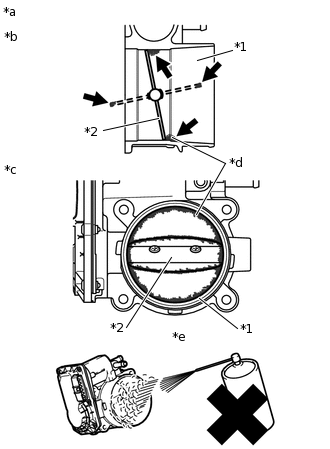
*1
Bore
*2
Valve
*a
Reference
*b
Throttle Body Assembly Cross-section Diagram
*c
When valve fully opened
*d
Deposits
*e
Do not directly apply cleaner
Push open the throttle valve and wipe off any carbon from the valve and bore using a piece of cloth soaked in non-residue solvent.
Note:Make sure that the cloth or your fingers do not get caught in the valve.
Make sure that foreign matter does not enter the throttle valve.
Do not directly apply non-residue solvent to the throttle body assembly or wash the throttle body assembly. Cleaning solvent may leak into the motor from the shaft and cause problems such as rust or valve movement problems.
If there is coating material on the edge of the valve, be careful not to remove it.
Tip:The illustrations are for reference only. Actual parts may differ.
Result
Proceed to
NEXT
PERFORM CONFIRMATION DRIVING PATTERN
Perform "Inspection After Repair" after cleaning the throttle body assembly (Click hereClick here).
Connect the GTS to the DLC3.
Turn the ignition switch to ON.
Turn the GTS on.
Start the engine and warm it up until the engine coolant temperature reaches 75°C (167°F) or higher.
Allow the engine to idle for 3 minutes or more and confirm that the engine speed is within the specified range.
Tip:If the engine is operated without performing learning value reset and idle learning after cleaning the deposits from the throttle body assembly, the idle speed may increase.
Result
Proceed to
NEXT
NEXT CONDUCT CONFIRMATION TESTClick here
CHECK CYLINDER COMPRESSION PRESSURE
Measure the cylinder compression pressure. If the compression pressure of a cylinder is low, inspect the engine assembly and repair or replace parts as necessary (Click hereClick here).
Result
Proceed to
NEXT
NEXT CONDUCT CONFIRMATION TESTClick here
REPLACE FUEL INJECTOR ASSEMBLY
Replace the fuel injector assembly of the malfunctioning cylinder (Click here).
Tip:If the air fuel ratio learned value is corrected to the positive side for all operating ranges due to low fuel injector assembly injection volume, replace the fuel injector assemblies of all cylinders.
Perform "Inspection After Repair" after replacing the fuel injector assembly (Click hereClick here).
Result
Proceed to
NEXT
NEXT CONDUCT CONFIRMATION TESTClick here
READ VALUE USING GTS (MAF)
Connect the GTS to the DLC3.
Turn the ignition switch to ON.
Turn the GTS on.
Start the engine and warm it up until the engine coolant temperature 75°C (167°F) or higher with all the accessories switched off.
Enter the following menus: Powertrain / Engine and ECT / Data List / MAF.
Powertrain > Engine and ECT > Data List
Tester Display
MAF
According to the display on the GTS, read the Data List when the ignition switch is turned to ON and while maintaining an engine speed of 3000 rpm.
Result
Result
Proceed to
Other than below
A
Ignition switch ON (engine stopped): 1 gm/sec or higher
Engine speed 3000 rpm (without load): Less than 7.6 gm/sec
B
B CHECK INTAKE SYSTEMClick here
PERFORM ACTIVE TEST USING GTS (CONTROL THE INJECTION VOLUME FOR A/F SENSOR)
Connect the GTS to the DLC3.
Turn the ignition switch to ON.
Turn the GTS on.
Start the engine and warm it up until the engine coolant temperature 75°C (167°F) or higher with all the accessories switched off.
Warm up the air fuel ratio sensor at an engine speed of 2500 rpm for 90 seconds.
Idle the engine.
Enter the following menus: Powertrain / Engine and ECT / Active Test / Control the Injection Volume for A/F Sensor / Data List / AFS Voltage B1S1 and O2S B1S2.
Powertrain > Engine and ECT > Active Test
Active Test Display
Control the Injection Volume for A/F Sensor
Data List Display
AFS Voltage B1S1
O2S B1S2
According to the display on the GTS, perform the Active Test and check the vehicle conditions when increasing and decreasing the fuel injection volume.
Note:The air fuel ratio sensor has an output delay of a few seconds and the heated oxygen sensor has a maximum output delay of approximately 20 seconds.
Read the output voltage immediately after warming up the air fuel ratio sensor and heated oxygen sensor to avoid an inaccurate reading due to a sensor cooling.
Tip:The Control the Injection Volume for A/F Sensor operation lowers the fuel injection volume by 12.5% or increases the injection volume by 12.5%.
Result
GTS Display
(Sensor)
Injection Volume
Voltage
AFS Voltage B1S1
(Air fuel ratio)
12.5%
Below 3.1 V
-12.5%
Higher than 3.4 V
O2S B1S2
(Heated oxygen)
12.5%
Higher than 0.55 V
-12.5%
Below 0.4 V
Result
Result
Proceed to
Output voltage values are abnormal
A
Malfunction disappears when fuel injection volume is increased
B
Malfunction is still present when fuel injection volume is increased, even if output voltage values are normal
C
B REPLACE FUEL INJECTOR ASSEMBLYClick here
C PERFORM ACTIVE TEST USING GTS (CONTROL THE FUEL PUMP / SPEED)Click here
REPLACE AIR FUEL RATIO SENSOR AND HEATED OXYGEN SENSOR
Replace the air fuel ratio sensor (Click here).
Tip:Perform "Inspection After Repair" after replacing the air fuel ratio sensor (Click hereClick here).
Replace the heated oxygen sensor (Click here).
Result
Proceed to
NEXT
NEXT CONDUCT CONFIRMATION TESTClick here
REPLACE FUEL INJECTOR ASSEMBLY
Replace the fuel injector assemblies of all cylinders (Click here).
Tip:Perform "Inspection After Repair" after replacing the fuel injector assembly (Click hereClick here).
Result
Proceed to
NEXT
NEXT CONDUCT CONFIRMATION TESTClick here
CHECK INTAKE SYSTEM
Check for air leaks or blockage in the intake system components. If a connection problem or foreign matter is found, repair the connection or remove the foreign matter.
Tip:If there is foreign matter in the intake system components, remove it before proceeding to the next step.
If there is no foreign matter in the intake system components, check for foreign matter in the mass air flow meter sub-assembly. If there is foreign matter in the mass air flow meter sub-assembly, remove it.
Perform "Inspection After Repair" after repairing or replacing the intake system (Click hereClick here).
Result
Proceed to
NEXT
NEXT CONDUCT CONFIRMATION TESTClick here
PERFORM ACTIVE TEST USING GTS (CONTROL THE FUEL PUMP / SPEED)
Connect the GTS to the DLC3.
Turn the ignition switch to ON.
Turn the GTS on.
Enter the following menus: Powertrain / Engine and ECT / Active Test / Control the Fuel Pump / Speed.
Powertrain > Engine and ECT > Active Test
Tester Display
Control the Fuel Pump / Speed
When performing the Active Test, check for an operating sound from the fuel pump.
OK
Control the Fuel Pump / Speed
Specified Condition
ON
Operating sound heard
OFF
Operating sound not heard
Result
Result
Proceed to
Normal
A
Abnormal
B
B INSPECT FUEL PUMP CONTROL SYSTEMClick here
INSPECT FUEL PUMP
Attach a fuel pressure gauge and check the fuel pressure when cranking the engine and after stopping the engine (Click here).
Standard
Vehicle State
Specified Condition
Cranking engine
304 to 343 kPa (3.1 to 3.5 kgf/cm2, 44 to 50 psi)
5 minutes after stopping engine
147 kPa (1.5 kgf/cm2, 21 psi) or higher
Tip:If there is foreign matter such as iron particles on the fuel pump, remove it.
Make sure that there are no leaks from the fuel lines, signs of fuel leakage or fuel odors.
If the air fuel ratio becomes lean only when the engine is running under a high load and at a high engine speed, clogging of the fuel filter is suspected.
Result
Result
Proceed to
Abnormal
A
Normal
B
B INSPECT OTHER RELATED COMPONENTSClick here
INSPECT RELATED PARTS
Inspect the following fuel pump related parts:
Fuel pump
Fuel pressure regulator assembly
Fuel lines and connecting parts
Fuel filter
Result
Proceed to
NEXT
NEXT REPAIR OR REPLACE MALFUNCTIONING PARTSClick here
INSPECT OTHER RELATED COMPONENTS
Inspect other related components.
Tip:If the malfunctioning part could not be determined by performing the preceding inspections, one of the following malfunctions is suspected.
Engine mount deterioration
Deposits in the intake manifold or on an intake valve
Delay in fuel supply due to adherence of the fuel to the deposits
Result
Proceed to
NEXT
REPAIR OR REPLACE MALFUNCTIONING PARTS
Repair or replace the malfunctioning part.
Perform "Inspection After Repair" after repairing or replacing the malfunctioning part (Click hereClick here).
Result
Proceed to
NEXT
CONDUCT CONFIRMATION TEST
Check that the engine has returned to normal.
Result
Proceed to
NEXT
NEXT END
INSPECT FUEL PUMP CONTROL SYSTEM
Inspect the fuel pump control system.
Result
Proceed to
NEXT
NEXT REPAIR OR REPLACE MALFUNCTIONING PARTSClick here