CAN COMMUNICATION SYSTEM DIAGNOSIS SYSTEM
ECUS OR SENSORS WHICH COMMUNICATE THROUGH CAN COMMUNICATION SYSTEM
V Bus
Combination meter assembly
Certification ECU (smart key ECU assembly)*1
Steering sensor (spiral cable sub-assembly)
Radio and display receiver assembly*2
Airbag sensor assembly
Power steering ECU assembly
Air conditioning control assembly*3
Skid control ECU (brake actuator assembly)
Engine stop and start ECU*4
ECM
Pre-collision city sensor*5
CHECK FOR INSTALLED SYSTEMS (ECUS AND SENSORS) THAT USE CAN COMMUNICATION
The systems (ECUs and sensors) that use CAN communication vary depending on the vehicle and optional equipment. Check which systems (ECUs and sensors) are installed to the vehicle.
ECU/Sensor Name
GTS Display
Applicability
ECM
ECM (Engine)
TCM*
Installed on all vehicles
Combination meter assembly
Combination Meter
Installed on all vehicles
Power steering ECU assembly
Power Steering (EPS)
Installed on all vehicles
Steering sensor (spiral cable sub-assembly)
Spiral cable (Steering Angle Sensor)
Installed on all vehicles
Airbag sensor assembly
Airbag
Installed on all vehicles
Skid control ECU (brake actuator assembly)
Skid Control (ABS/VSC/TRAC)
Installed on all vehicles
Air conditioning control assembly
Air Conditioning Amplifier
Vehicles with Automatic Air Conditioning System
Certification ECU (smart key ECU assembly)
Certification (Smart)
Vehicles with Entry and Start System
Radio and display receiver assembly
Display and Navigation (AVN1)
Vehicles with Radio and Display Type
Engine stop and start ECU
Stop and Go/Start
Vehicles with Stop and Start System
Pre-collision city sensor
Front Camera Module
Vehicles with Toyota Safety Sense
Tip:The names of ECUs and sensors shown on the GTS display may differ from those shown in the DTC Table by ECU section.
*: w/ Multi-mode Manual Transaxle System
CAN BUS CHECK
CAN Bus Check
Tip:The ECUs and sensors that are properly connected to the CAN communication system can be displayed using the GTS.
Using the GTS, select the CAN Bus Check screen.
Note:It may be possible to select buses that do not have ECUs or sensors from the bus selection pull-down menu. This is not a malfunction. (This occurs when optional devices are not on a sub bus that is monitored by a gateway function equipped ECU.)
In the bus selection pull down menu, all buses applicable to the model are displayed (e.g. LIN communication buses are also displayed). Therefore, refer to the wiring diagrams to check the names of sub buses for CAN communication.
Tip:Different connection statuses are indicated by the background color of ECUs and sensors that are displayed.
Table 1. Explanation of CAN Bus Check Screen Bus Type
Background Color
Connection Status
V Bus
White
Communication has been normal since the start of the CAN bus check.
Yellow
Communication stop occurred at least once since the start of the CAN bus check, but communication is currently occurring (unstable communication).
Red
Communication was established at least once since the start of the CAN bus check, but communication is currently not occurring (unstable communication).
Not displayed
Communication stop has continued since the start of the CAN bus check.*1
Sub Bus
(gateway function equipped ECU that does not have history of connected ECUs)*2
White
Communication has been normal since the start of the CAN bus check.
Yellow
Communication stop occurred at least once since the start of the CAN bus check, but communication is currently occurring (unstable communication).
Red
Communication was established at least once since the start of the CAN bus check, but communication is currently not occurring (unstable communication).
Not displayed
Communication stop has continued since the start of the CAN bus check.*1
Sub Bus
(gateway function equipped ECU that has history of connected ECUs)*3
White
Communication has been normal since the start of the CAN bus check.
Yellow
Communication stop occurred at least once since the start of the CAN bus check, but communication is currently occurring (unstable communication).
Red
Currently not communicating (either of the following):
Communication stop has continued since the start of the CAN bus check.
Communication was established at least once since the start of the CAN bus check, but communication is currently not occurring.
Not displayed
Either of the following:
If a gateway function equipped ECU cannot communicate, the sub bus and ECUs connected to the sub bus will not be displayed.
If no ECUs are connected to the sub bus, "There is no system found on the Communication Bus" will be displayed.
Tip:Gateway function equipped ECUs relay signals between the ECUs connected to the different buses.
*1: ECUs that are present in the vehicle but are not displayed on the CAN Bus Check screen.
*2: Gateway function equipped ECU that does not memorize the sub bus ECUs that are connected to it.
*3: Gateway function equipped ECU that memorizes the sub bus ECUs that are connected to it.
If none of the connected ECUs are displayed, or there is no response from the vehicle to the GTS, check the DLC3 branch and the V bus main bus lines for a malfunction.
Observe the connection response screen for approximately 2 minutes to check for a change in connection status of the connected ECUs and sensors.
Tip:If an open occurs in one of the lines of a CAN branch (except DLC3), output from the other branch line (the line that is not open) will be unstable and it may interfere with the response (display) of other ECUs and sensors.
If the connection status changes during the inspection, repair the open in the branch line of the ECU or sensor that does not respond (is not detected) and then perform the CAN bus check again.
HOW TO INTERPRET CAN BUS CHECK SCREEN
When a communication stop is currently occurring, the probable malfunctioning part can be determined from the CAN bus check and by using the following methods.
Note:The following CAN bus wiring diagram is provided only as an example. This wiring diagram is different from the actual wiring diagram for this vehicle.
Tip:When a communication stop is currently occurring, it is easier to determine the probable malfunctioning part from the CAN bus check rather than from communication DTCs.
Wait for approximately 2 minutes after turning the ignition switch to ON (or simulating the driving conditions that enable the malfunction to be reproduced) and select "CAN Bus Check". Then observe the communication status of each ECU on the screen.
If a communication error of only 1 ECU or sensor is indicated on the CAN Bus Check screen, a communication stop of the ECU or sensor is suspected.
Example: Open in both CAN branch lines of ECU B on the V bus
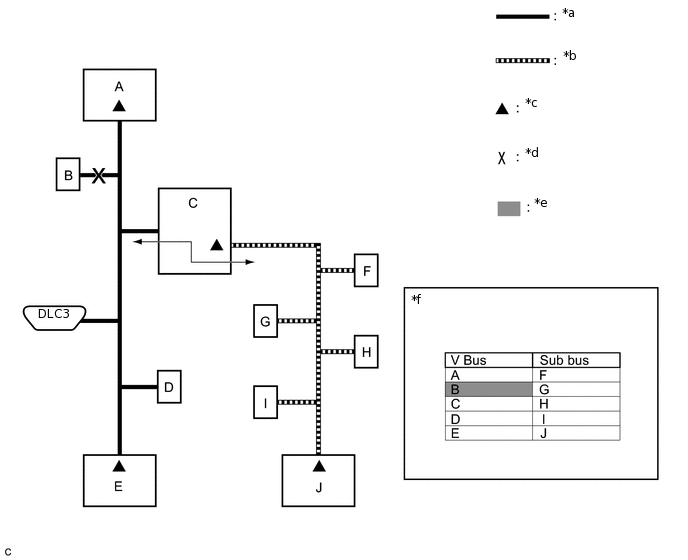
*a
V Bus
*b
Sub Bus
*c
Terminating Resistor
*d
Location of Malfunction
*e
Not displayed or background color changes to red or yellow
*f
CAN Bus Check Screen
Tip:When there are communication stops, ECUs are present in the vehicle even though they are not displayed on the CAN Bus Check screen.
-
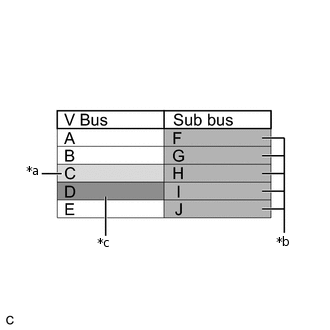
*a
Background color periodically changes to yellow or red
*b
Not displayed or background color is yellow or red
*c
Not displayed
If communication errors for multiple ECUs or sensors are indicated on the CAN Bus Check screen, then a communication stop of the ECU or sensor that shows a more serious communication stop (an ECU or sensor which is not displayed) is suspected.
Example: Open in a CAN branch line for ECU D on the V bus
Table 2. Explanation of CAN Bus Check Screen Bus Type
Background Color
Connection Status
V Bus
White
Communication has been normal since the start of the CAN bus check.
Yellow
Communication stop occurred at least once since the start of the CAN bus check, but communication is currently occurring (unstable communication).
Red
Communication was established at least once since the start of the CAN bus check, but communication is currently not occurring (unstable communication).
Not displayed
Communication stop has continued since the start of the CAN bus check.*1
Sub Bus
(gateway function equipped ECU that does not have history of connected ECUs)*2
White
Communication has been normal since the start of the CAN bus check.
Yellow
Communication stop occurred at least once since the start of the CAN bus check, but communication is currently occurring (unstable communication).
Red
Communication was established at least once since the start of the CAN bus check, but communication is currently not occurring (unstable communication).
Not displayed
Communication stop has continued since the start of the CAN bus check.*1
Sub Bus
(gateway function equipped ECU that has history of connected ECUs)*3
White
Communication has been normal since the start of the CAN bus check.
Yellow
Communication stop occurred at least once since the start of the CAN bus check, but communication is currently occurring (unstable communication).
Red
Currently not communicating (either of the following):
Communication stop has continued since the start of the CAN bus check.
Communication was established at least once since the start of the CAN bus check, but communication is currently not occurring.
Not displayed
Either of the following:
If a gateway function equipped ECU cannot communicate, sub bus and ECUs connected to the sub bus will not be displayed.
If no ECUs are connected to the sub bus, "There is no system found on the Communication Bus" will be displayed.
Tip:Gateway function equipped ECUs relay signals between the ECUs connected to the different buses.
*1: ECUs that are present in the vehicle but are not displayed on the CAN Bus Check screen.
*2: Gateway function equipped ECU that does not memorize the sub bus ECUs that are connected to it.
*3: Gateway function equipped ECU that memorizes the sub bus ECUs that are connected to it.
The example of the CAN Bus Check screen in the illustration shows the result of electrical noise on the CAN bus which is caused by an open in a CAN branch line of ECU D (output from the other branch line is unstable) and the communication of ECU C is also unstable. In addition, in this example, ECU C is equipped with a gateway function. Therefore, communication is also unstable between the sub bus ECUs of ECU C and the V bus.
The example in the illustration shows that ECU D is not displayed on the CAN Bus Check screen. This indicates a more significant communication stop. In this case, a communication stop of ECU D is suspected.
-
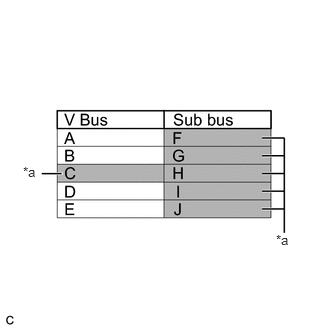
*a
Not displayed or background color changes to red
If a communication error is indicated on both the V bus and sub bus on the CAN Bus Check screen, suspect any communication stop displayed for the V bus first.
Example: Open in both CAN branch lines of ECU C on the V bus
Tip:In the CAN bus check, it is possible to confirm the communication status of ECUs connected to the V bus after connecting the GTS to the DLC3. As for sub buses, it is possible to confirm which sub bus connected ECUs can communicate with a gateway function equipped ECU on the V bus.
If a gateway function equipped ECU has a communication error, ECUs connected to the gateway function equipped ECU are also affected, and communication stops will be indicated.
The CAN Bus Check screen in the illustration shows that ECU C has a gateway function and a communication stop in ECU C is suspected.
-
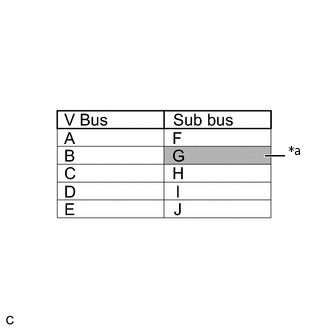
*a
Background color changes to red
If the CAN Bus Check screen indicates a communication stop only in the sub bus, a communication stop in the sub bus is suspected.
Example: Open in both CAN branch lines of ECU G on the sub bus
Tip:A communication error in a sub bus does not affect the V bus or other buses.
When a gateway function equipped ECU has memorized the ECUs that are connected to the sub bus, if any of the ECUs connected to the gateway function equipped ECU has a communication error, the background color changes to yellow or red. (The displayed name will not disappear.)
If both of the V bus main bus lines are open, ECUs or sensors that are located farther away from the DLC3 than the open part will be displayed as a communication stop on the CAN Bus Check screen.
(In this case, ECU A and B are not displayed or their background color changes to red.)
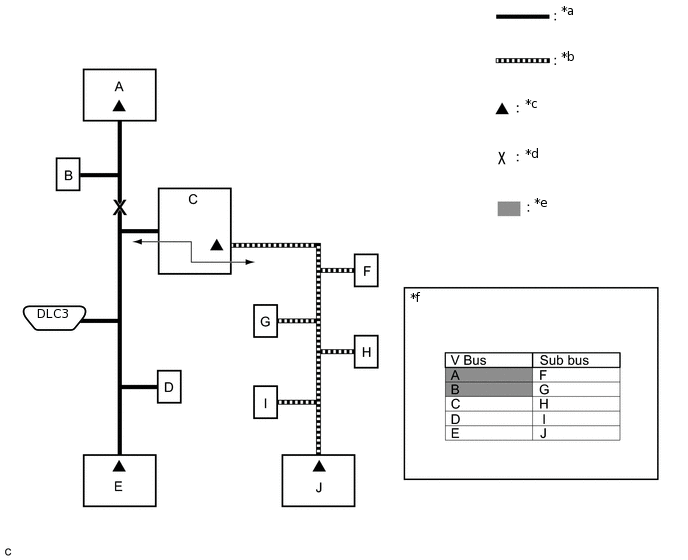
*a
V Bus
*b
Sub Bus
*c
Terminating Resistor
*d
Location of Malfunction
*e
Not displayed or background color is red
*f
CAN Bus Check Screen
Tip:If a communication error occurs in an ECU, it is not displayed on the CAN Bus Check screen even though the ECU is present.
If both of the sub bus main bus lines are open, ECUs that are located farther away from the gateway function equipped ECU than the open part will be displayed as a communication stop on the CAN Bus Check screen.
(In this case, ECU I and J are not displayed or their background color changes to red.)
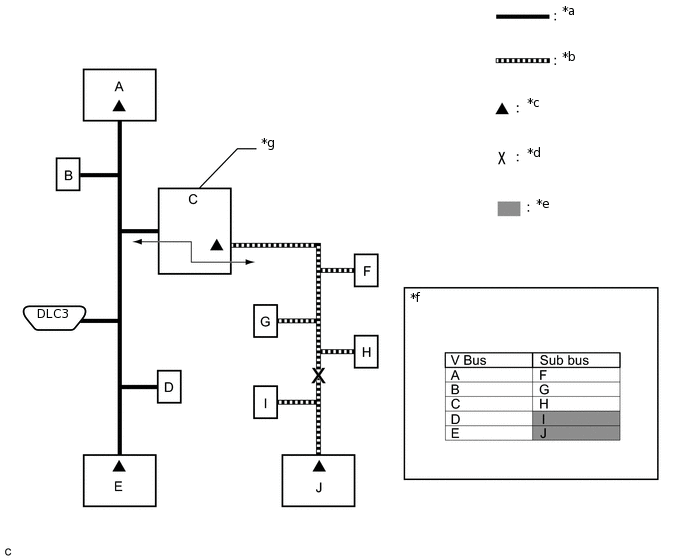
*a
V Bus
*b
Sub Bus
*c
Terminating Resistor
*d
Location of Malfunction
*e
Not displayed or background color is red
*f
CAN Bus Check Screen
*g
Gateway Function Equipped ECU
-
-
-
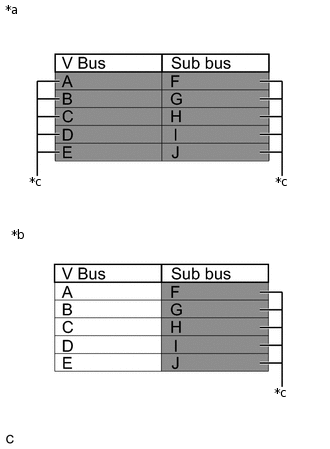
*a
When any of the following malfunctions occur on the V bus
*b
When any of the following malfunctions occur on a sub bus
*c
Not displayed
When any of the following malfunctions occur, CAN communication cannot be established and almost all ECUs and sensors on the bus show a communication error on the CAN Bus Check screen.
Table 3. Details of Malfunction Short between CAN lines (CANH and CANL)
Short between a CAN line (CANH or CANL) and +B
Short between a CAN line (CANH or CANL) and ground
Open in a CAN main bus line
Tip:When a malfunction occurs on the V bus, almost all ECUs and sensors on the V bus and sub bus indicate a communication error (almost all ECUs are not displayed). As communication with the gateway function equipped ECU that is connected to the V bus stops, communication from the ECUs connected to the sub bus that is monitored by the gateway function equipped ECU also stops (these ECUs are not displayed).
When a malfunction occurs in a sub bus, almost all ECUs connected to the sub bus indicate a communication error.
A communication error in a sub bus does not affect the V bus or other buses.
The malfunctioning part can be determined by checking for a short circuit between CAN bus lines or between a CAN bus line and ground or +B short using an electrical tester.
HOW TO INTERPRET COMMUNICATION DTCS (DTCS THAT START WITH U)
If a CAN communication error cannot be reproduced, determine the suspected malfunctioning part using the DTCs stored in ECUs that are connected to the CAN buses by following the procedure below.
Tip:Communication DTCs (DTCs that start with U) indicate a communication error between the ECU that stores the DTC and the ECU that is indicated by the DTC.
If multiple ECUs store a communication DTC for a particular ECU, a communication stop of the ECU is suspected.
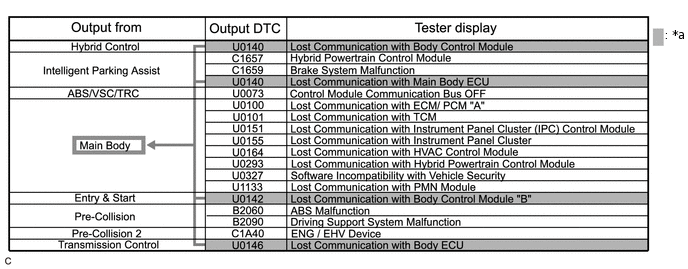
*a
Items to be Checked
-
-
Note:This DTC table is from another model, and is only used here to show an example of DTCs that are output when there is an open in a CAN branch line for the main body ECU. This table does not show DTCs applicable to this vehicle.
Even though a DTC title may indicate a communication error with a specific ECU, the ECU name used in the DTC name on the GTS may differ depending on the ECU that stores the DTC. (Regarding output DTCs, refer to step 6 and the DTC chart for each ECU.)
Tip:As multiple ECUs indicate a communication stop with the main body ECU, the possibility of a communication stop of the main body ECU is high.
If almost all of the communication DTCs of an ECU are stored, a communication stop of the ECU is suspected.
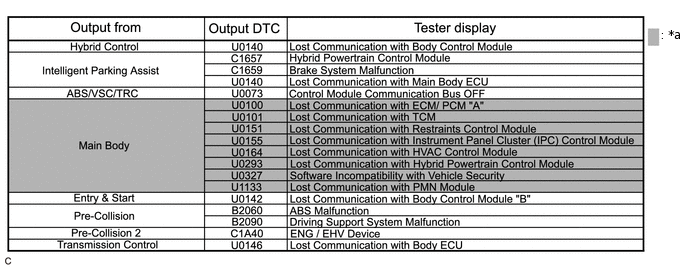
*a
Items to be Checked
-
-
Note:This DTC table is from another model, and is only used here to show an example of DTCs that are output when there is an open in a CAN branch line for the main body ECU. This table does not show DTCs applicable to this vehicle.
Tip:If almost all of the DTCs of the main body ECU are stored, the possibility of a communication stop of the main body ECU is high.
When a CAN communication error occurs, many DTCs are output. DTCs other than communication error DTCs (such as DTCs that start with C or B) and communication DTCs for the ABS system are important DTCs, however it may be easier to determine the malfunctioning part by examining the overall situation without considering these DTCs.
To help determine the part of the sub bus that has a communication error, prioritize the communication stop DTCs stored in the gateway function equipped ECU.
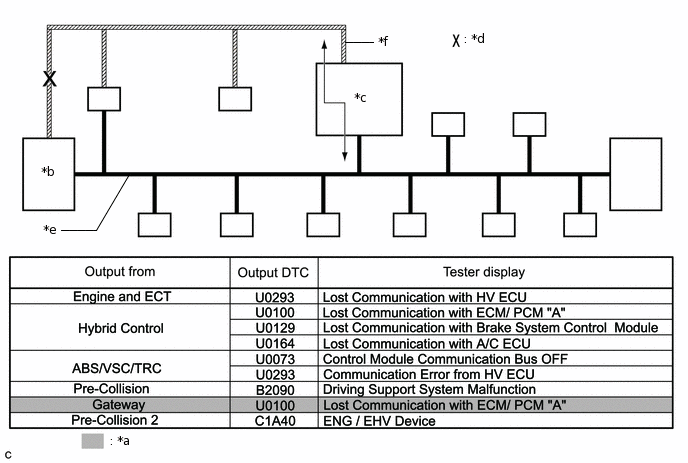
*a
Items to be Checked
*b
ECM
*c
Gateway Function Equipped ECU
*d
Location of Malfunction
*e
V Bus
*f
Sub Bus
Note:This DTC table is from another model, and is only used here to show the ECUs connected to both a V bus and a sub bus. It shows DTCs output when there is an open in the main bus lines for the ECM on the sub bus. This table does not show DTCs applicable to this vehicle.
Tip:As gateway function equipped ECUs (sub bus monitor ECU) monitor signals from all ECUs that are connected to sub buses, gateway function equipped ECUs can detect ECUs with a communication stop more accurately.
When there is a communication stop for the gateway function equipped ECU (gateway), communication with ECUs connected to other buses such as the V bus stops. Therefore, communication DTCs for ECUs connected to other buses are also stored.
When any of the following malfunctions occurs, many DTCs are likely to be output from many ECUs. Because of this, it may be difficult to determine the probable malfunctioning part.
Short between CAN lines (CANH and CANL)
Short between a CAN line (CANH or CANL) and ground
Short between a CAN line (CANH or CANL) and +B
Open in a CAN branch line (CANH or CANL) of an ECU or sensor
Open in a CAN main bus line (CANH or CANL) between 2 ECUs that have a terminating resistor
DTC TABLE BY ECU
Tip:In the CAN communication system, the CAN communication DTCs of each ECU can be displayed using the GTS.
If CAN communication system DTCs are output, the malfunction cannot be determined only by the DTCs. Perform troubleshooting according to How to Proceed with Troubleshooting.
If the system function temporarily returns to normal, DTCs may not be output again even though the following DTC check procedures are used.
ECM / GTS Display "Engine and ECT"
Powertrain > Engine and ECT > Trouble Codes
Tip:This ECU uses the CAN communication system for DTC communication.
*1: Refer to SFI System
*2: w/ Stop and Start System
Table 4. ECM / GTS Display "Engine and ECT" DTC
Detection Item
DTC Detection Condition
DTC Detection Pre-condition
DTC Check Procedure
Warning Indication in Meter
DTC Storage Method
U0101*1
Lost Communication with TCM
The ECM does not receive data from the TCM for 0.49 seconds or more.
Both conditions are met:
The ignition switch is ON for 1 second or more.
The power source voltage of the ECM is 10 V or more.
Turn the ignition switch to ON and wait at least 2 seconds.
MIL illuminates.
DTC is stored until it is cleared using the GTS.
U0129
Lost Communication with Brake System Control Module
The ECM does not receive data from the skid control ECU (brake actuator assembly) for 0.7 seconds or more.
Both conditions are met:
The ignition switch is ON for 2 seconds or more.
The power source voltage of the ECM is 10 V or more.
Turn the ignition switch to ON and wait at least 3 seconds.
MIL illuminates.
DTC is stored until it is cleared using the GTS.
U1103*2
Lost Communication with Stop and Start Control Module
The ECM does not receive data from the engine stop and start ECU for 0.76 seconds or more.
Both conditions are met:
The ignition switch is ON for 1 second or more.
The power source voltage of the ECM is 10 V or more.
Turn the ignition switch to ON and wait at least 2 seconds.
MIL illuminates.
DTC remains stored only while malfunction is occurring.
TCM (w/ Multi-mode Manual Transaxle System) / GTS Display "Multi-Mode M/T"
Powertrain > Multi-Mode M/T > Trouble Codes
Tip:This ECU uses the CAN communication system for DTC communication.
*: Refer to Multi-mode Manual Transaxle System
Table 5. TCM / GTS Display "Multi-Mode M/T" DTC
Detection Item
DTC Detection Condition
DTC Detection Pre-condition
DTC Check Procedure
Warning Indication in Meter
DTC Storage Method
U0100*
Lost Communication with ECM / PCM "A"
The TCM does not receive data from the ECM for 0.7 seconds or more.
Both conditions are met:
The ignition switch is ON for 1 second or more.
The power source voltage of the TCM is 10.5 V or more.
Turn the ignition switch to ON and wait at least 1.7 seconds.
MIL illuminates.
Multi-mode manual transaxle warning light illuminates.
DTC is stored until it is cleared using the GTS.
Skid Control ECU (Brake Actuator Assembly) / GTS Display "ABS/VSC/TRC"
Chassis > ABS/VSC/TRC > Trouble Codes
Tip:This ECU uses the CAN communication system for DTC communication.
*: w/ Tire Pressure Warning System
Table 6. Skid Control ECU (Brake Actuator Assembly) / GTS Display "ABS/VSC/TRC" DTC
Detection Item
DTC Detection Condition
DTC Detection Pre-condition
DTC Check Procedure
Warning Indication in Meter
DTC Storage Method
U0073
Control Module Communication Bus OFF
Bus off is judged for 0.1 seconds or more.
Both conditions are met:
The ignition switch is ON for 1 second or more.
The power source voltage (+BS terminal voltage) of the skid control ECU (brake actuator assembly) is between 9.6 and 16.5 V.
Turn the ignition switch to ON and check that the initial light check illumination turns off, and then wait at least 3 seconds.
ABS warning light illuminates.
Slip indicator light illuminates.
Brake warning light illuminates.
Tire pressure warning light (w/ tire pressure warning system) blinks for 63 seconds and then remains on.*
DTC is stored until it is cleared using the GTS.
U0100
Lost Communication with ECM / PCM
The skid control ECU (brake actuator assembly) does not receive data from the ECM for 2.5 seconds or more.
All conditions are met:
The ignition switch is ON for 1 second or more.
Vehicle speed is 6 km/h (4 mph) or more.
The power source voltage (+BS terminal voltage) of the skid control ECU (brake actuator assembly) is between 9.6 and 16.5 V.
Turn the ignition switch to ON and drive the vehicle at a speed of 6 km/h (4 mph) or more for 6 seconds or more. Check that the warning light remains off after turning off following the initial light check.
Slip indicator light illuminates.
Tire pressure warning light (w/ tire pressure warning system) blinks for 63 seconds and then remains on.*
DTC is stored until it is cleared using the GTS.
U0123
Lost Communication with Yaw Rate Sensor Module
The skid control ECU (brake actuator assembly) does not receive data from the airbag sensor assembly for 1.1 seconds or more.
All conditions are met:
The ignition switch is ON for 1 second or more.
Vehicle speed is 6 km/h (4 mph) or more.
The power source voltage (+BS terminal voltage) of the skid control ECU (brake actuator assembly) is between 9.6 and 16.5 V.
Turn the ignition switch to ON and drive the vehicle at a speed of 6 km/h (4 mph) or more for 3 seconds or more. Check that the warning light remains off after turning off following the initial light check.
Slip indicator light illuminates.
Tire pressure warning light (w/ tire pressure warning system) blinks for 63 seconds and then remains on.*
DTC is stored until it is cleared using the GTS.
U0126
Lost Communication with Steering Angle Sensor Module
The skid control ECU (brake actuator assembly) does not receive data from the steering sensor (spiral cable sub-assembly) for 1.1 seconds or more.
All conditions are met:
The ignition switch is ON for 1 second or more.
Vehicle speed is 6 km/h (4 mph) or more.
The power source voltage (+BS terminal voltage) of the skid control ECU (brake actuator assembly) is between 9.6 and 16.5 V.
Turn the ignition switch to ON and drive the vehicle at a speed of 6 km/h (4 mph) or more for 3 seconds or more. Check that the warning light remains off after turning off following the initial light check.
Slip indicator light illuminates.
Tire pressure warning light (w/ tire pressure warning system) is off.*
DTC is stored until it is cleared using the GTS.
Power Steering ECU Assembly / GTS Display "EMPS"
Chassis > EMPS > Trouble Codes
Tip:This ECU uses the CAN communication system for DTC communication.
Table 7. Power Steering ECU Assembly / GTS Display "EMPS" DTC
Detection Item
DTC Detection Condition
DTC Detection Pre-condition
DTC Check Procedure
Warning Indication in Meter
DTC Storage Method
U0100
Lost Communication with ECM / PCM "A"
The power steering ECU assembly does not receive data from the ECM for 6.42 seconds or more.
All conditions are met:
The ignition switch is ON for 2 seconds or more.
Vehicle speed is 20 km/h (12 mph) or more.
The power source voltage of the power steering ECU assembly is 9 V or more.
Drive the vehicle at a speed of 20 km/h (12 mph) or more for 8.42 seconds or more.
EPS warning light: When an error occurs during steering assist, the warning light does not illuminate. For errors that occur before assist (at the time of the decision to start assist), the warning light illuminates.
DTC remains stored only while malfunction is occurring.
U0129
Lost Communication with Brake System Control Module
The power steering ECU assembly does not receive data from the skid control ECU (brake actuator assembly) for 2.42 seconds or more.
Both conditions are met:
The ignition switch is ON for 3 seconds or more.
The power source voltage of the power steering ECU assembly is 9 V or more.
Turn the ignition switch to ON and wait at least 5.42 seconds.
EPS warning light illuminates.
DTC remains stored only while malfunction is occurring.
Engine Stop and Start ECU (w/ Stop and Start System) / GTS Display "Stop and Start"
Powertrain > Stop and Start > Trouble Codes
Tip:This ECU uses the CAN communication system for DTC communication.
*: for Automatic Air Conditioning System
Table 8. Engine Stop and Start ECU (w/ Stop and Start System) / GTS Display "Stop and Start" DTC
Detection Item
DTC Detection Condition
DTC Detection Pre-condition
DTC Check Procedure
Warning Indication in Meter
DTC Storage Method
U0100
Lost Communication with ECM/PCM "A"
The engine stop and start ECU does not receive data from the ECM for 0.9 seconds or more.
Both conditions are met:
The ignition switch is ON for 1 second or more.
The power source voltage of the engine stop and start ECU is 10.5 V or more.
Turn the ignition switch to ON and wait at least 1.9 seconds.
Stop and start indicator light flashes.
DTC is stored until it is cleared using the GTS.
U0121
Lost Communication with Anti-Lock Brake System (ABS) Control Module
The engine stop and start ECU does not receive data from the skid control ECU (brake actuator assembly) for 2.2 seconds or more.
Both conditions are met:
The ignition switch is ON for 2.1 seconds or more.
The power source voltage of the engine stop and start ECU is 10.5 V or more.
Turn the ignition switch to ON and wait at least 4.3 seconds.
Stop and start indicator light flashes.
DTC is stored until it is cleared using the GTS.
U0131
Lost Communication with Power Steering Control Module
The engine stop and start ECU does not receive data from the power steering ECU assembly for 0.8 seconds or more.
Both conditions are met:
The ignition switch is ON for 1 second or more.
The power source voltage of the engine stop and start ECU is 10.5 V or more.
Turn the ignition switch to ON and wait at least 1.8 seconds.
Stop and start indicator light flashes.
DTC is stored until it is cleared using the GTS.
U0151
Lost Communication with SRS Airbag ECU
The engine stop and start ECU does not receive data from the airbag sensor assembly for 10.6 seconds or more.
Both conditions are met:
The ignition switch is ON for 1 second or more.
The power source voltage of the engine stop and start ECU is 10.5 V or more.
Turn the ignition switch to ON and wait at least 11.6 seconds.
Stop and start indicator light flashes.
DTC is stored until it is cleared using the GTS.
U0155
Lost Communication with Instrument Panel Cluster Control Module (Combination Meter)
The engine stop and start ECU does not receive data from the combination meter assembly for 3.6 seconds or more.
Both conditions are met:
The ignition switch is ON for 1 second or more.
The power source voltage of the engine stop and start ECU is 10.5 V or more.
Turn the ignition switch to ON and wait at least 4.6 seconds.
Stop and start indicator light flashes.
DTC is stored until it is cleared using the GTS.
U0164*
Lost Communication with HVAC Control Module
The engine stop and start ECU does not receive data from the air conditioning control assembly for 10.6 seconds or more.
Both conditions are met:
The ignition switch is ON for 1 second or more.
The power source voltage of the engine stop and start ECU is 10.5 V or more.
Turn the ignition switch to ON and wait at least 11.6 seconds.
Stop and start indicator light flashes.
DTC is stored until it is cleared using the GTS.
Certification ECU (Smart Key ECU Assembly) (w/ Entry and Start System) / GTS Display "Entry&Start"
Body Electrical > Entry&Start > Trouble Codes
Tip:This ECU uses the CAN communication system for DTC communication.
Table 9. Certification ECU (Smart Key ECU Assembly)(w/ Entry and Start System) / GTS Display "Entry&Start" DTC
Detection Item
DTC Detection Condition
DTC Detection Pre-condition
DTC Check Procedure
Warning Indication in Meter
DTC Storage Method
U0100
Lost Communication with ECM / PCM
The certification ECU (smart key ECU assembly) does not receive data from the ECM for 10 seconds or more.
Both conditions are met:
Power source status change (+B OFF → ON, ACC ON ←→ OFF, IG ON ←→ OFF) is detected and 10 seconds or more elapse.
The power source voltage of the certification ECU (smart key ECU assembly) is 10 V or more.
Turn the ignition switch to ON and wait at least 20 seconds.
-
DTC is stored until it is cleared using the GTS.
U0155
Lost Communication with Combination Meter
The certification ECU (smart key ECU assembly) does not receive data from the combination meter assembly for 10 seconds or more.
Both conditions are met:
Power source status change (+B OFF → ON, ACC ON ←→ OFF, IG ON ←→ OFF) is detected and 10 seconds or more elapse.
The power source voltage of the certification ECU (smart key ECU assembly) is 10 V or more.
Turn the ignition switch to ON and wait at least 20 seconds.
-
DTC is stored until it is cleared using the GTS.
Certification ECU (Smart Key ECU Assembly) (w/ Entry and Start System) / GTS Display "Power Source Control"
Body Electrical > Power Source Control > Trouble Codes
Tip:This ECU uses the CAN communication system for DTC communication.
*: w/ Stop and Start System
Table 10. Certification ECU (Smart Key ECU Assembly)(w/ Entry and Start System) / GTS Display "Power Source Control" DTC
Detection Item
DTC Detection Condition
DTC Detection Pre-condition
DTC Check Procedure
Warning Indication in Meter
DTC Storage Method
U0100
Lost Communication with ECM / PCM
The certification ECU (smart key ECU assembly) does not receive data from the ECM for 3.1 seconds or more.
Both conditions are met:
The ignition switch is ON.
The power source voltage of the certification ECU (smart key ECU assembly) is 9.5 V or more.
Turn the ignition switch to ON and wait at least 3.1 seconds.
-
DTC is stored until it is cleared using the GTS.
U0140
Lost Communication with Body Control Module
The certification ECU (smart key ECU assembly) does not receive data from the combination meter assembly for 3 seconds or more.
Both conditions are met:
The ignition switch is ON.
The power source voltage of the certification ECU (smart key ECU assembly) is 9.5 V or more.
Turn the ignition switch to ON and wait at least 3 seconds.
-
DTC is stored until it is cleared using the GTS.
U0155
Lost Communication with Combination Meter
The certification ECU (smart key ECU assembly) does not receive data from the combination meter assembly for 3.1 seconds or more.
Both conditions are met:
The ignition switch is ON.
The power source voltage of the certification ECU (smart key ECU assembly) is 9.5 V or more.
Turn the ignition switch to ON and wait at least 3.1 seconds.
-
DTC is stored until it is cleared using the GTS.
U1103*
Lost Communication with Stop and Start Control Module
The certification ECU (smart key ECU assembly) does not receive data from the engine stop and start ECU for 5 seconds or more.
Both conditions are met:
The ignition switch is ON.
The power source voltage of the certification ECU (smart key ECU assembly) is 9.5 V or more.
Turn the ignition switch to ON and wait at least 5 seconds.
-
DTC is stored until it is cleared using the GTS.
Certification ECU (Smart Key ECU Assembly) (w/ Entry and Start System) / GTS Display "Starting Control"
Body Electrical > Starting Control > Trouble Codes
Tip:This ECU uses the CAN communication system for DTC communication.
Table 11. Certification ECU (Smart Key ECU Assembly) (w/ Entry and Start System) / GTS Display "Starting Control" DTC
Detection Item
DTC Detection Condition
DTC Detection Pre-condition
DTC Check Procedure
Warning Indication in Meter
DTC Storage Method
U0100
Lost Communication with ECM / PCM
The certification ECU (smart key ECU assembly) does not receive data from the ECM for 2 seconds or more.
Both conditions are met:
The ignition switch is ON.
The power source voltage of the certification ECU (smart key ECU assembly) is 10.5 V or more.
Turn the ignition switch to ON and wait at least 2 seconds.
-
DTC remains stored only while malfunction is occurring.
Air Conditioning Control Assembly (for Automatic Air Conditioning System) / GTS Display "Air Conditioner"
Body Electrical > Air Conditioner > Trouble Codes
Tip:This ECU uses the CAN communication system for DTC communication.
Table 12. Air Conditioning Control Assembly (for Automatic Air Conditioning System) / GTS Display "Air Conditioner" DTC
Detection Item
DTC Detection Condition
DTC Detection Pre-condition
DTC Check Procedure
Warning Indication in Meter
DTC Storage Method
U11DA
The Combined Calculator is Confirmed Absent
The air conditioning control assembly does not receive data from the combination meter assembly for 1.5 seconds or more.
The ignition switch is ON for 3 seconds or more.
Turn the ignition switch to ON and wait at least 4.5 seconds.
-
DTC is stored until it is cleared using the GTS.
U11DB
The Motor Calculator is Confirmed Absent
The air conditioning control assembly does not receive data from the ECM for 0.2 seconds or more.
The ignition switch is ON for 3 seconds or more.
Turn the ignition switch to ON and wait at least 3.2 seconds.
-
DTC is stored until it is cleared using the GTS.
U11DC
The Airbag Calculator is Confirmed Absent
The air conditioning control assembly does not receive data from the airbag sensor assembly for 3 seconds or more.
The ignition switch is ON for 3 seconds or more.
Turn the ignition switch to ON and wait at least 6 seconds.
-
DTC is stored until it is cleared using the GTS.
Radio and Display Receiver Assembly (for Radio and Display Type) / GTS Display "Navigation System"
Body Electrical > Navigation System > Trouble Codes
Tip:This ECU uses the CAN communication system for DTC communication.
Table 13. Radio and Display Receiver Assembly (for Radio and Display Type) / GTS Display "Navigation System" DTC
Detection Item
DTC Detection Condition
DTC Detection Pre-condition
DTC Check Procedure
Warning Indication in Meter
DTC Storage Method
U0073
Sending Malfunction (Navigation to APGS)
The radio and display receiver assembly does not send/receive data for 5 seconds or more.
Both conditions are met:
The ignition switch is ON.
The power source voltage of the radio and display receiver assembly is 9.5 V or more.
Turn the ignition switch to ON and wait at least 6 seconds.
Displays messages on the multi-information display.
DTC is stored until it is cleared using the GTS.
U0100
Engine ECU Communication
The radio and display receiver assembly does not receive data from the ECM for 4 seconds or more.
Both conditions are met:
The ignition switch is ON for 1 second or more.
The power source voltage of the radio and display receiver assembly is 9.5 V or more.
Turn the ignition switch to ON and wait at least 5 seconds.
-
DTC is stored until it is cleared using the GTS.
U0129
VSC (ECB) ECU Communication
The radio and display receiver assembly does not receive data from the skid control ECU (brake actuator assembly) for 1 second or more.
Both conditions are met:
The ignition switch is ON for 1 second or more.
The power source voltage of the radio and display receiver assembly is 9.5 V or more.
Turn the ignition switch to ON and wait at least 2 seconds.
-
DTC is stored until it is cleared using the GTS.
U0140
Lost Communication with Body Control Module
The radio and display receiver assembly does not receive data from the combination meter assembly for 10 seconds or more.
Both conditions are met:
The ignition switch is ON for 1 second or more.
The power source voltage of the radio and display receiver assembly is 9.5 V or more.
Turn the ignition switch to ON and wait at least 11 seconds.
-
DTC is stored until it is cleared using the GTS.
U0155
Meter ECU Communication
The radio and display receiver assembly does not receive data from the combination meter assembly for 30 seconds or more.
Both conditions are met:
The ignition switch is ON for 1 second or more.
The power source voltage of the radio and display receiver assembly is 9.5 V or more.
Turn the ignition switch to ON and wait at least 31 seconds.
-
DTC is stored until it is cleared using the GTS.
Combination Meter Assembly / GTS Display "Combination Meter"
Body Electrical > Combination Meter > Trouble Codes
Tip:This ECU uses the CAN communication system for DTC communication.
*1: w/ Tire Pressure Warning System
*2: w/ Toyota Safety Sense
Table 14. Combination Meter Assembly / GTS Display "Combination Meter" DTC
Detection Item
DTC Detection Condition
DTC Detection Pre-condition
DTC Check Procedure
Warning Indication in Meter
DTC Storage Method
U0100
Lost Communication with ECM / PCM "A"
The combination meter assembly does not receive data from the ECM for 2 seconds or more.
Both conditions are met:
The ignition switch is ON.
The power source voltage of the combination meter assembly is between 9.5 and 11.5 V.
Turn the ignition switch to ON and wait at least 2 seconds.
-
DTC is stored until it is cleared using the GTS.
U0129
Lost Communication with Brake System Control Module
The combination meter assembly does not receive data from the skid control ECU (brake actuator assembly) for 3 seconds or more.
Both conditions are met:
The ignition switch is ON.
The power source voltage of the combination meter assembly is between 9.5 and 11.5 V.
Turn the ignition switch to ON and wait at least 3 seconds.
ABS warning light illuminates.
Slip indicator light illuminates.
Brake warning light illuminates.
DTC is stored until it is cleared using the GTS.
U0131
Lost Communication with Power Steering Control Module
The combination meter assembly does not receive data from the power steering ECU assembly for 3 seconds or more.
Both conditions are met:
The ignition switch is ON.
The power source voltage of the combination meter assembly is between 9.5 and 11.5 V.
Turn the ignition switch to ON and wait at least 3 seconds.
EPS warning light illuminates.
DTC is stored until it is cleared using the GTS.
U0142*1
Lost Communication with Body Control Module "B"
The combination meter assembly does not receive data from the skid control ECU (brake actuator assembly) for 10 seconds or more.
Both conditions are met:
The ignition switch is ON.
The power source voltage of the combination meter assembly is between 9.5 and 11.5 V.
Turn the ignition switch to ON and wait at least 10 seconds.
-
DTC is stored until it is cleared using the GTS.
U0151
Lost Communication with Restraints Control Module
The combination meter assembly does not receive data from the airbag sensor assembly for 10 seconds or more.
Both conditions are met:
The ignition switch is ON.
The power source voltage of the combination meter assembly is between 9.5 and 11.5 V.
Turn the ignition switch to ON and wait at least 10 seconds.
SRS warning light illuminates.
DTC is stored until it is cleared using the GTS.
U023A*2
Lost Communication with Front Camera Module
The combination meter assembly does not receive data from the pre-collision city sensor for 10 seconds or more.
Both conditions are met:
The ignition switch is ON.
The power source voltage of the combination meter assembly is between 9.5 and 11.5 V.
Turn the ignition switch to ON and wait at least 10 seconds.
Lane departure alert indicator light (yellow) illuminates.
PCS OFF warning light flashes.
DTC is stored until it is cleared using the GTS.
Airbag Sensor Assembly / GTS Display "SRS Airbag"
Tip:The airbag sensor assembly is connected to the CAN communication system, but the airbag sensor assembly does not store or output CAN communication DTCs.
Steering Sensor (Spiral Cable Sub-assembly) / GTS Display "-"
Tip:The steering sensor (spiral cable sub-assembly) is connected to the CAN communication system, but the steering sensor (spiral cable sub-assembly) does not store or output CAN communication DTCs.
Pre-collision City Sensor (w/ Toyota Safety Sense) / GTS Display "PCS/LDA/RSA/LVN"
Chassis > PCS/LDA/RSA/LVN > Trouble Codes
Tip:This ECU uses the CAN communication system for DTC communication.
The pre-collision city sensor incorporates the pre-collision system and lane departure alert system.
*: Only when the lane departure alert system is operating.
Table 15. Pre-collision City Sensor (w/ Toyota Safety Sense) / GTS Display "PCS/LDA/RSA/LVN" DTC
Detection Item
DTC Detection Condition
DTC Detection Pre-condition
DTC Check Procedure
Warning Indication in Meter
DTC Storage Method
U0100
Lost Communication with ECM / PCM "A"
The pre-collision city sensor does not receive data from the ECM for 8 seconds or more.
All conditions are met:
The ignition switch is ON for 3 seconds or more.
Vehicle speed is 5 km/h (3 mph) or more.
The power source voltage of the pre-collision city sensor is 10 V or more.
Drive the vehicle at a speed of 5 km/h (3 mph) or more for 8 seconds or more.
PCS OFF warning light flashes.
Lane departure alert indicator light (yellow) illuminates.*
DTC is stored until it is cleared using the GTS.
U0123
Lost Communication with Yaw Rate Sensor Module
The pre-collision city sensor does not receive data from the airbag sensor assembly for 1 second or more.
Both conditions are met:
The ignition switch is ON for 3 seconds or more.
The power source voltage of the pre-collision city sensor is 10 V or more.
Turn the ignition switch to ON and wait at least 4 seconds.
PCS OFF warning light flashes.
Lane departure alert indicator light (yellow) illuminates.*
DTC is stored until it is cleared using the GTS.
U0126
Lost Communication With Steering Angle Sensor Module
The pre-collision city sensor does not receive data from the steering sensor (spiral cable sub-assembly) for 1 second or more.
Both conditions are met:
The ignition switch is ON for 3 seconds or more.
The power source voltage of the pre-collision city sensor is 10 V or more.
Turn the ignition switch to ON and wait at least 4 seconds.
PCS OFF warning light flashes.
Lane departure alert indicator light (yellow) illuminates.*
DTC is stored until it is cleared using the GTS.
U0129
Lost Communication with Brake System Control Module
The pre-collision city sensor does not receive data from the skid control ECU (brake actuator assembly) for 8 seconds or more.
Both conditions are met:
The ignition switch is ON for 3 seconds or more.
The power source voltage of the pre-collision city sensor is 10 V or more.
Turn the ignition switch to ON and wait at least 11 seconds.
PCS OFF warning light flashes.
Lane departure alert indicator light (yellow) illuminates.*
DTC is stored until it is cleared using the GTS.
U0155
Lost Communication With Instrument Panel Cluster (IPC) Control Module
The pre-collision city sensor does not receive data from the combination meter assembly for 80 seconds or more.
Both conditions are met:
The ignition switch is ON for 3 seconds or more.
The power source voltage of the pre-collision city sensor is 10 V or more.
Turn the ignition switch to ON and wait at least 83 seconds.
PCS OFF warning light flashes.
Lane departure alert indicator light (yellow) illuminates.*
DTC is stored until it is cleared using the GTS.
U023A
Lost Communication with Front Camera Module
The skid control ECU (brake actuator assembly) does not receive data from the pre-collision city sensor for 2 seconds or more.
Both conditions are met:
The ignition switch is ON for 3 seconds or more.
The power source voltage of the pre-collision city sensor is 10 V or more.
Turn the ignition switch to ON and wait at least 5 seconds.
PCS OFF warning light flashes.
DTC is stored until it is cleared using the GTS.
DTC COMBINATION TABLE (OPEN OR SHORT IN V BUS, PAST COMMUNICATION ERROR)
Regarding a past communication error of an ECU and sensor connected to the V bus (in this case, normal is displayed when performing the CAN bus check, but communication DTCs are output), the probable CAN bus line(s) that had a malfunction can be determined based on the following DTC combination table.
Tip:Based on the table below and DTCs output from ECUs connected via CAN communication, the probable part for which communication stop occurred can be determined.
Regarding an open in a CAN branch and a communication stop that is currently occurring, the malfunctioning part can be confirmed easily by performing the CAN bus check using the GTS because the ECU or sensor connected to the CAN branch does not respond (the ECU or sensor name will not be displayed on the screen).
If an open in a CAN main bus line, a short between the CAN bus lines (CANH and CANL) or a +B or ground short in the CAN bus occurs, DTCs of almost all ECUs (or sensors) on the CAN bus may be output, or a message indicating a communication error may be displayed on the GTS screen. In this case, check the resistance of the CAN bus (steps 7 to 9) first.
○: DTC is output.
-: DTC is not output.
*: DTC U0073 may be stored when communication is lost.
-
Trouble Mode (Open in Both CAN Branch Lines)
V Bus
Output ECU
Output DTC
Center Airbag Sensor Communication Stop Mode
Air Conditioning Amplifier Communication Stop Mode
Radio Receiver Assembly Communication Stop Mode
Engine Stop and Start ECU Communication Stop Mode
V Bus
Airbag Sensor Assembly
-
-
-
-
-
Air Conditioning Control Assembly
U11DA
-
○
-
-
U11DB
-
○
-
-
U11DC
○
○
-
-
Radio and Display Receiver Assembly*
U0100
-
-
○
-
U0129
-
-
○
-
U0140
-
-
○
-
U0155
-
-
○
-
Engine Stop and Start ECU
U0100
-
-
-
○
U0121
-
-
-
○
U0131
-
-
-
○
U0151
○
-
-
○
U0155
-
-
-
○
U0164
-
○
-
○
V Bus
Power Steering ECU Assembly
U0100
-
-
-
-
U0129
-
-
-
-
Certification ECU (Smart Key ECU Assembly)
(Entry function)
U0100
-
-
-
-
U0155
-
-
-
-
Certification ECU (Smart Key ECU Assembly)
(Power source switching function)
U0100
-
-
-
-
U0140
-
-
-
-
U0155
-
-
-
-
U1103
-
-
-
○
Certification ECU (Smart Key ECU Assembly)
(Start function)
U0100
-
-
-
-
Combination Meter Assembly
U0100
-
-
-
-
U0129
-
-
-
-
U0131
-
-
-
-
U0142
-
-
-
-
U023A
-
-
-
-
ECM
U0129
-
-
-
-
U1103
-
-
-
○
Skid Control ECU (Brake Actuator Assembly)*
U0100
-
-
-
-
U0123
○
-
-
-
U0126
-
-
-
-
Pre-collision City Sensor
U0100
-
-
-
-
U0123
○
-
-
-
U0126
-
-
-
-
U0129
-
-
-
-
U0155
-
-
-
-
Steering Sensor (Spiral Cable Sub-assembly)
-
-
-
-
-
DLC3
-
-
-
-
-
-
Trouble Mode (Open in Both CAN Branch Lines)
V Bus
Output ECU
Output DTC
Brake Actuator (Skid Control ECU) Communication Stop Mode
DLC3
Power Steering ECU Communication Stop Mode
Certification ECU Communication Stop Mode
V Bus
Airbag Sensor Assembly
-
-
-
-
-
Air Conditioning Control Assembly
U11DA
-
-
-
-
U11DB
-
-
-
-
U11DC
-
-
-
-
Radio and Display Receiver Assembly*
U0100
-
-
-
-
U0129
○
-
-
-
U0140
-
-
-
-
U0155
-
-
-
-
Engine Stop and Start ECU
U0100
-
-
-
-
U0121
○
-
-
-
U0131
-
-
○
-
U0151
-
-
-
-
U0155
-
-
-
-
U0164
-
-
-
-
Power Steering ECU Assembly
U0100
-
-
○
-
U0129
○
-
○
-
Certification ECU (Smart Key ECU Assembly)
(Entry function)
U0100
-
-
-
○
U0155
-
-
-
○
Certification ECU (Smart Key ECU Assembly)
(Power source switching function)
U0100
-
-
-
○
U0140
-
-
-
○
U0155
-
-
-
○
U1103
-
-
-
○
Certification ECU (Smart Key ECU Assembly)
(Start function)
U0100
-
-
-
○
Combination Meter Assembly
U0100
-
-
-
-
U0129
○
-
-
-
U0131
-
-
○
-
U0142
○
-
-
-
U023A
-
-
-
-
ECM
U0129
○
-
-
-
U1103
-
-
-
-
V Bus
Skid Control ECU (Brake Actuator Assembly)*
U0100
○
-
-
-
U0123
○
-
-
-
U0126
○
-
-
-
Pre-collision City Sensor
U0100
-
-
-
-
U0123
-
-
-
-
U0126
-
-
-
-
U0129
○
-
-
-
U0155
-
-
-
-
Steering Sensor (Spiral Cable Sub-assembly)
-
-
-
-
-
DLC3
-
-
-
-
-
-
Trouble Mode (Open in Both CAN Branch Lines)
Trouble Mode (Open in Both CAN Main Bus Lines)
V Bus
V Bus
Output ECU
Output DTC
Steering Angle Sensor Communication Stop Mode
Front Camera Module Communication Stop Mode
Combination Meter ECU Communication Stop Mode
ECM Communication Stop Mode
V Bus
Airbag Sensor Assembly
-
-
-
-
-
Air Conditioning Control Assembly
U11DA
-
-
○
-
U11DB
-
-
-
○
U11DC
-
-
-
-
Radio and Display Receiver Assembly*
U0100
-
-
-
○
U0129
-
-
-
-
U0140
-
-
-
-
U0155
-
-
○
-
Engine Stop and Start ECU
U0100
-
-
-
○
U0121
-
-
-
-
U0131
-
-
-
-
U0151
-
-
-
-
U0155
-
-
○
-
U0164
-
-
-
-
Power Steering ECU Assembly
U0100
-
-
-
○
U0129
-
-
-
-
Certification ECU (Smart Key ECU Assembly)
(Entry function)
U0100
-
-
-
○
U0155
-
-
○
-
V Bus
Certification ECU (Smart Key ECU Assembly)
(Power source switching function)
U0100
-
-
-
○
U0140
-
-
○
-
U0155
-
-
○
-
U1103
-
-
-
-
Certification ECU (Smart Key ECU Assembly)
(Start function)
U0100
-
-
-
○
Combination Meter Assembly
U0100
-
-
○
○
U0129
-
-
○
-
U0131
-
-
○
-
U0142
-
-
○
-
U023A
-
○
○
-
ECM
U0129
-
-
-
-
U1103
-
-
-
○
Skid Control ECU (Brake Actuator Assembly)*
U0100
-
-
-
○
U0123
-
-
-
-
U0126
○
-
-
-
Pre-collision City Sensor
U0100
-
○
-
○
U0123
-
○
-
-
U0126
○
○
-
-
U0129
-
○
-
-
U0155
-
○
○
-
Steering Sensor (Spiral Cable Sub-assembly)
-
-
-
-
-
DLC3
-
-
-
-
-
-
Trouble Mode (CAN Bus Lines Short Circuit or Short to GND)
V Bus
Output ECU
Output DTC
CANH to CANL
CANH to Ground Short
CANL to Ground Short
V Bus
Airbag Sensor Assembly
-
-
-
-
Air Conditioning Control Assembly
U11DA
○
○
○
U11DB
○
○
○
U11DC
○
○
○
Radio and Display Receiver Assembly*
U0100
○
○
○
U0129
○
○
○
U0140
○
○
○
U0155
○
○
○
Engine Stop and Start ECU
U0100
○
○
○
U0121
○
○
○
U0131
○
○
○
U0151
○
○
○
U0155
○
○
○
U0164
○
○
○
V Bus
Power Steering ECU Assembly
U0100
○
○
○
U0129
○
○
○
Certification ECU (Smart Key ECU Assembly)
(Entry function)
U0100
○
○
○
U0155
○
○
○
Certification ECU (Smart Key ECU Assembly)
(Power source switching function)
U0100
○
○
○
U0140
○
○
○
U0155
○
○
○
U1103
○
○
○
Certification ECU (Smart Key ECU Assembly)
(Start function)
U0100
○
○
○
Combination Meter Assembly
U0100
○
○
○
U0129
○
○
○
U0131
○
○
○
U0142
○
○
○
U023A
○
○
○
ECM
U0129
○
○
○
U1103
○
○
○
Skid Control ECU (Brake Actuator Assembly)*
U0100
○
○
○
U0123
○
○
○
U0126
○
○
○
Pre-collision City Sensor
U0100
○
○
○
U0123
○
○
○
U0126
○
○
○
U0129
○
○
○
U0155
○
○
○
Steering Sensor (Spiral Cable Sub-assembly)
-
-
-
-
DLC3
-
-
-
-
CAN BUS WAVEFORMS
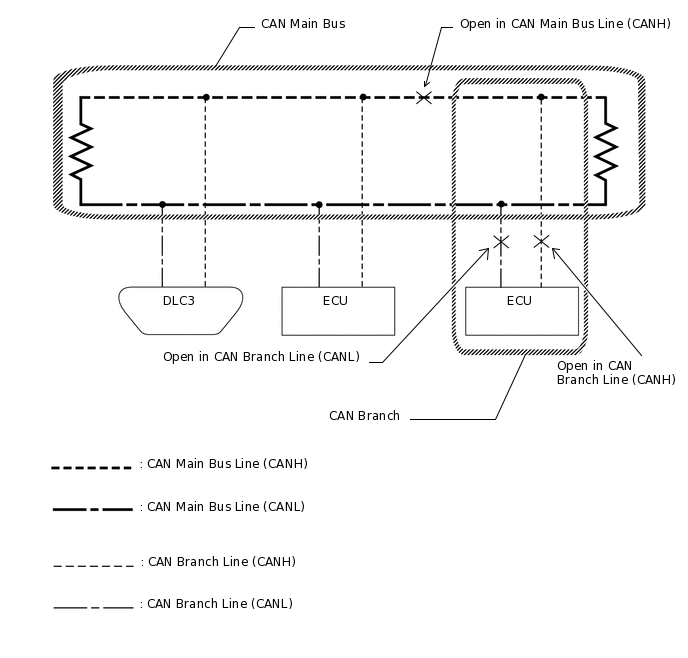 Tip:
Tip:The following waveforms are measured between terminals CANH and GND, and terminals CANL and GND of the DLC3. (Use this as a reference for diagnosis of CAN communication lines.)
When malfunctions in multiple ECUs are suspected based on the CAN bus check and DTCs checked using the GTS, check the resistance of the CAN bus using an ohmmeter first. If no problems are found, check the following waveforms.
If a waveform is not similar to one of the following 3 patterns (Group 1), then an open in a CAN main bus line, an open in a CAN branch line, or a short between a CAN line (CANH or CANL) and ground is suspected (Group 2).
Wiggle the connector and wire harness to check if the waveform changes.
CAN bus waveforms (Group 1)
-
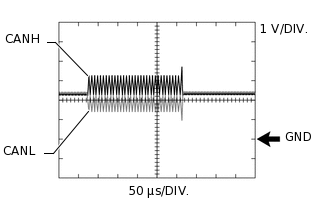
Normal waveform
-
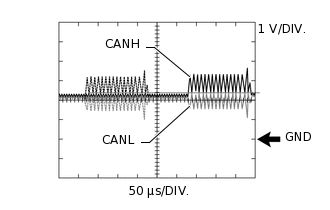
Open in both of the lines (CANH and CANL) of a CAN branch
Tip:Waveforms (waveforms shown using dotted lines) are not present from an ECU or sensor connected to a CAN branch with an open circuit in both lines. (Waveforms from other ECUs or sensors are normal.)
Because this waveform is similar to a normal waveform, instead of using the waveform, the malfunctioning part can be narrowed down by performing a CAN bus check.
-
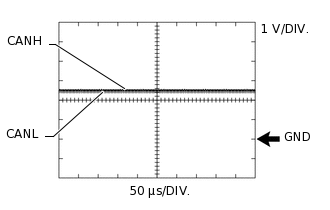
Short between the CAN bus lines (CANH and CANL)
Tip:Waveforms disappear.
If the malfunction is in an ECU, disconnecting the ECU will change the waveform. If the waveform does not change, a malfunction in the wire harness is suspected.
-
CAN bus waveforms (reference) (Group 2)
Note:The following CAN bus waveforms can be used only as reference. The actual measured waveform may differ significantly depending on the location of the open or short circuit.
-
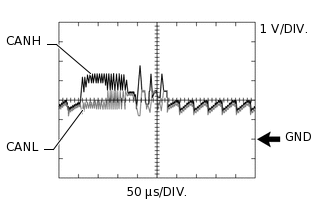
Open in a CAN branch line (CANH)
Tip:An abnormal waveform is output from an ECU with an open in one of its CAN branch lines. Because this abnormal output interferes with the signals from other ECUs, the output of other ECUs will also appear abnormal.
Narrow down the malfunctioning part by checking DTCs or performing a CAN bus check, or by checking waveform changes when ECUs or sensors are disconnected. The waveform will change to one for an open in both sides of a CAN branch when the ECU or sensor with an open CAN branch line is disconnected.
-
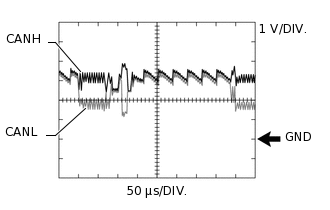
Open in a CAN branch line (CANL)
Tip:An abnormal waveform is output from an ECU with an open in one of its CAN branch lines. Because this abnormal output interferes with the signals from other ECUs, the output of other ECUs will also appear abnormal.
Narrow down the malfunctioning part by checking DTCs or performing a CAN bus check, or by checking waveform changes when ECUs or sensors are disconnected. The waveform will change to one for an open in both sides of a CAN branch when the ECU or sensor with an open CAN branch line is disconnected.
-
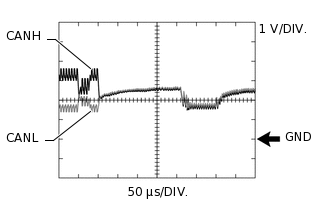
Open in a CAN main bus line (CANH)
Tip:Waveforms of ECUs or sensors that are closer to the DLC3 than the open part are almost normal.
Waveforms of ECUs or sensors that are on the opposite side of the DLC3 from the open part are abnormal.
An open in a CAN main bus line can be confirmed by measuring the resistance between the CANH and CANL terminals of any CAN branch.
-
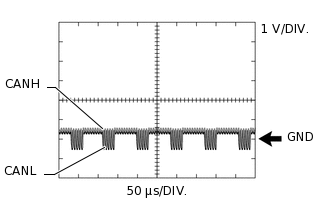
Short between a CAN bus line (CANH) and ground
Tip:Narrow down the shorted part by checking for waveform changes when disconnecting connectors from the CAN junction connectors or when disconnecting ECUs or sensors.
A short to ground in the CANH line can be confirmed by measuring the resistance between CANH and ground using an ohmmeter.
-
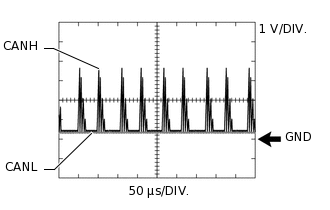
Short between a CAN bus line (CANL) and ground
Tip:Narrow down the shorted part by checking for waveform changes when disconnecting connectors from the CAN junction connectors or when disconnecting ECUs or sensors.
A short to ground in the CANL line can be confirmed by measuring the resistance between CANL and ground using an ohmmeter.
-
DATA SENDING/RECEIVING TABLE
Data sending/receiving table
Tip:If Data List items related to sent/received data are not displayed properly, the part for which communication is interrupted can be determined using the table below.
Data content
Data Detected and Sent by
Data Received by
(Can be Checked in the Data List)
Data Received by
(Cannot be Checked in the Data List)
Relevant Data List Item
[Selected System]
Accelerator position
ECM
Skid control ECU (brake actuator assembly)
Engine stop and start ECU
Airbag sensor assembly
Pre-collision city sensor
Accel Sens. No.1 Volt % [Engine and ECT]
Accel Sens. No.2 Volt % [Engine and ECT]
Accelerator Opening Angle % [ABS/VSC/TRC]
Accelerator Position [Stop and Start]
Engine speed
ECM
Skid control ECU (brake actuator assembly)
Power steering ECU assembly
Combination meter assembly
Engine stop and start ECU
Air conditioning control assembly
Certification ECU (smart key ECU assembly)
Airbag sensor assembly
Radio and display receiver assembly
Pre-collision city sensor
Engine Speed [Engine and ECT]
Engine Revolutions [ABS/VSC/TRC]
Engine Revolution [EMPS]
Engine Rpm [Combination Meter]
Engine Spd (ECM) [Stop and Start]
ENGINE_SPEED [Air Conditioner]
Engine coolant temperature
ECM
Combination meter assembly
Engine stop and start ECU
Air conditioning control assembly
-
Coolant Temp [Engine and ECT]
Coolant Temperature [Combination Meter]
Coolant Temp [Stop and Start]
ENGINE_WATER_TEMP [Air Conditioner]
Vehicle speed
Skid control ECU (brake actuator assembly)
Power steering ECU assembly
Combination meter assembly
Engine stop and start ECU
Radio and display receiver assembly
Airbag sensor assembly
Pre-collision city sensor
Vehicle Speed [ABS/VSC/TRC]
Meter Vehicle Velocity [EMPS]
Vehicle Speed Meter [Combination Meter]
Vehicle Spd1 (ABS/VSC) [Stop and Start]
Vehicle Speed [Navigation System]
Combination meter assembly*3
Certification ECU (smart key ECU assembly)
Air conditioning control assembly
-
Vehicle Speed Meter [Combination Meter]
Vehicle Speed Signal [Power Source Control]
VEHICLE_SPEED [Air Conditioner]
Wheel speed
Skid control ECU (brake actuator assembly)
ECM
Engine stop and start ECU
Pre-collision city sensor
FR Wheel Speed [ABS/VSC/TRC]
FL Wheel Speed [ABS/VSC/TRC]
RR Wheel Speed [ABS/VSC/TRC]
RL Wheel Speed [ABS/VSC/TRC]
Vehicle Speed [Engine and ECT]
Wheel Speed Malfunction [Stop and Start]
Ambient temperature
Combination meter assembly
ECM
Engine stop and start ECU
Air conditioning control assembly
Radio and display receiver assembly
Skid control ECU (brake actuator assembly)
Pre-collision city sensor
Ambient Temperature [Combination Meter]
Ambient Temp for A/C [Engine and ECT]
Ambient Temp Sensor [Stop and Start]
AMBIENT_TEMP [Air Conditioner]
Door courtesy switch
Combination meter assembly*2
Engine stop and start ECU
ECM
Certification ECU (smart key ECU assembly)
D Courtesy Switch Signal [Stop and Start]
Eco drive control mode
Engine stop and start ECU
Power steering ECU assembly
ECM
Skid control ECU (brake actuator assembly)
Certification ECU (smart key ECU assembly)
Air conditioning control assembly
Radio and display receiver assembly
Stop&Start of Eng State [Stop and Start]
Stop&Start Ctrl Mode [EMPS]
Stop light switch signal
Skid control ECU (brake actuator assembly)
-
Airbag sensor assembly
Pre-collision city sensor
Engine stop and start ECU
Stop Light SW (ABS/VSC) [Stop and Start]
Steering angle sensor
Steering sensor (spiral cable sub-assembly)
Skid control ECU (brake actuator assembly)
ECM
Airbag sensor assembly
Pre-collision city sensor
Steering Angle Sensor [ABS/VSC/TRC]
Yaw rate sensor
Airbag sensor assembly
Skid control ECU (brake actuator assembly)
Pre-collision city sensor
Yaw Rate Sensor [ABS/VSC/TRC]
Deceleration sensor
Airbag sensor assembly
Skid control ECU (brake actuator assembly)
Engine stop and start ECU
ECM
Pre-collision city sensor
Deceleration Sensor [ABS/VSC/TRC]
Deceleration Sensor2 [ABS/VSC/TRC]
Deceleration Sensor Movement [Stop and Start]
Side turn signal
Combination meter assembly*2
-
Pre-collision city sensor
Turn Signal Switch (Right) [Combination Meter]
Turn Signal Switch (Left) [Combination Meter]
ECM power source voltage*1
ECM
-
-
Battery Voltage [Engine and ECT]
Combination meter assembly power source voltage*1
Combination meter assembly
-
-
+B Voltage Value [Combination Meter]
Skid control ECU (brake actuator assembly) power source voltage*1
Skid control ECU (brake actuator assembly)
-
-
IG1 Voltage Value [ABS/VSC/TRC]
Power steering ECU assembly power source voltage*1
Power steering ECU assembly
-
-
IG Power Supply [EMPS]
Radio and display receiver assembly power source voltage*1
Radio and display receiver assembly
-
-
Battery Voltage [Navigation System]
Engine stop and start ECU power source voltage*1
Engine stop and start ECU
-
-
Battery Voltage [Stop and Start]
Driver door trigger switch*1
Certification ECU (smart key ECU assembly)
-
-
D-Door Trigger Switch [Entry&Start]
Air conditioning control assembly power source voltage*1
Air conditioning control assembly
-
-
BATTERY_VOLTAGE [Air Conditioner]
*1: Whether the ECU that sends data is functioning or not can be judged by using the GTS to check items such as switches or sensors that send signals to the ECU via direct lines.
*2: Although the received contents cannot be checked in the Data List, whether or not the data is received normally can be checked by observing the combination meter assembly.
*3: The combination meter assembly receives a vehicle speed signal from the skid control ECU (brake actuator assembly) and sends the signal to other ECUs.
Details of relevant Data List items (Selected system: Engine and ECT)
Note:In the table below, the values listed under "Normal Condition" are reference values. Do not depend solely on these reference values when deciding whether a part is faulty or not.
Tip:Using the GTS to read the Data List allows the values or states of switches, sensors, actuators and other items to be read without removing any parts. This non-intrusive inspection can be very useful because intermittent conditions or signals may be discovered before parts or wiring is disturbed. Reading the Data List information early in troubleshooting is one way to save diagnostic time.
Normal Condition: If no conditions are specifically stated for "idling", the shift lever should be in N (neutral) or P, the A/C switch should be off and all accessory switches should be off.
Warm up the engine.
Turn the A/C switch off.
Turn the ignition switch off.
Connect the GTS to the DLC3.
Turn the ignition switch to ON.
Turn the GTS on.
Enter the following menus: Powertrain / Engine and ECT / Data List.
According to the display on the GTS, read the "Data List".
Powertrain > Engine and ECT > Data List
Tester Display
Measurement Item
Range
Normal Condition
Diagnostic Note
Vehicle Speed
Vehicle speed
Min.: 0 km/h (0 mph), Max.: 255 km/h (158 mph)
Actual vehicle speed
This is the current vehicle speed.
The vehicle speed is detected using the wheel speed sensors.
-
Vehicle speed data is delayed when it is displayed. Therefore, even if the vehicle speed listed in the freeze frame data is 0 km/h (0 mph), this does not always mean that the malfunction occurred when the vehicle was stopped.
Engine Speed
Engine speed
Min.: 0 rpm, Max.: 16383 rpm
790 to 890 rpm: Idling
When the crankshaft position sensor is malfunctioning, "Engine Speed" is approximately 0 rpm or varies greatly from the actual engine speed.
Coolant Temp
Coolant temperature
Min.: -40°C (-40°F), Max.: 140°C (284°F)
75 to 100°C (167 to 212°F): After warming up
This is the engine coolant temperature.
Tip:After warming up the engine, the engine coolant temperature is 75 to 100°C (167 to 212°F).
After a long soak, the engine coolant temperature, intake air temperature and ambient air temperature are approximately equal.
If the value is -40°C (-40°F), or 140°C (284°F), the sensor circuit is open or shorted.
Battery Voltage
Battery voltage
Min.: 0 V, Max.: 65.535 V
11 to 14 V: Idling
If 11 V or less, characteristics of some electrical components may change.
Accel Sens. No.1 Volt %
Absolute accelerator pedal position No. 1
Min.: 0%, Max.: 100%
10 to 25%: Accelerator pedal fully released
50 to 100%: Accelerator pedal fully depressed
The No. 1 accelerator pedal position sensor output is converted using 5 V = 100%.
Tip:If there are no accelerator pedal position sensor DTCs stored, it is possible to conclude that the accelerator pedal position sensor system is normal.
Accel Sens. No.2 Volt %
Absolute accelerator pedal position No. 2
Min.: 0%, Max.: 100%
20 to 45%: Accelerator pedal fully released
68 to 100%: Accelerator pedal fully depressed
The No. 2 accelerator pedal position sensor output is converted using 5 V = 100%.
Ambient Temp for A/C
Ambient temperature for A/C
Min.: -40°C (-40°F), Max.: 215°C (419°F)
-
-
Details of relevant Data List items (Selected system: ABS/VSC/TRC)
Note:In the table below, the values listed under "Normal Condition" are reference values. Do not depend solely on these reference values when deciding whether a part is faulty or not.
Tip:Using the GTS to read the Data List allows the values or states of switches, sensors, actuators and other items to be read without removing any parts. This non-intrusive inspection can be very useful because intermittent conditions or signals may be discovered before parts or wiring is disturbed. Reading the Data List information early in troubleshooting is one way to save diagnostic time.
Warm up the engine.
Turn the ignition switch off.
Connect the GTS to the DLC3.
Turn the ignition switch to ON.
Turn the GTS on.
Enter the following menus: Chassis / ABS/VSC/TRC / Data List.
According to the display on the GTS, read the "Data List".
Chassis > ABS/VSC/TRC > Data List
Tester Display
Measurement Item
Range
Normal Condition
Diagnostic Note
Deceleration Sensor
Acceleration sensor reading
Min.: -18.525 m/s2, Max.: 18.387 m/s2
-
During deceleration/acceleration: Changes continuously
Deceleration Sensor2
Acceleration sensor 2 reading
Min.: -18.525 m/s2, Max.: 18.387 m/s2
-
During deceleration/acceleration: Changes continuously
Yaw Rate Sensor
Yaw rate sensor
Min.: -128°/s, Max.: 127°/s
Vehicle stopped: 0 °/s
Turning right: -128 to 0 °/s
Turning left: 0 to 127 °/s
-
Steering Angle Sensor
Steering angle sensor
Min.: -3276.8°, Max.: 3276.7°
Turning left: Increases
Turning right: Decreases
-
FR Wheel Speed
Front wheel speed sensor RH reading
Min.: 0 km/h (0 mph), Max.: 326 km/h (202 mph)
Vehicle stopped: 0 km/h (0 mph)
When driving at constant speed: No large fluctuations
FL Wheel Speed
Front wheel speed sensor LH reading
Min.: 0 km/h (0 mph), Max.: 326 km/h (202 mph)
Vehicle stopped: 0 km/h (0 mph)
When driving at constant speed: No large fluctuations
RR Wheel Speed
Rear wheel speed sensor RH reading
Min.: 0 km/h (0 mph), Max.: 326 km/h (202 mph)
Vehicle stopped: 0 km/h (0 mph)
When driving at constant speed: No large fluctuations
RL Wheel Speed
Rear wheel speed sensor LH reading
Min.: 0 km/h (0 mph), Max.: 326 km/h (202 mph)
Vehicle stopped: 0 km/h (0 mph)
When driving at constant speed: No large fluctuations
Vehicle Speed
Maximum wheel speed sensor reading
Min.: 0 km/h (0 mph), Max.: 326 km/h (202 mph)
Vehicle stopped: 0 km/h (0 mph)
When driving at constant speed: No large fluctuations
Engine Revolutions
Engine speed
Min.: 0 rpm, Max.: 65535 rpm
Engine stopped: 0 rpm
When engine speed is constant: No large fluctuations
Accelerator Opening Angle %
Percentage of accelerator pedal opening angle
Min.: 0.0%, Max.: 127.5%
Accelerator pedal released: 0%
During accelerator pedal operation: Changes in proportion with the pedal movement
IG1 Voltage Value
IG1 voltage value
Min.: 0.00 V, Max.: 20.00 V
-
Changes in proportion to battery voltage
Details of relevant Data List items (Selected system: EMPS)
Note:In the table below, the values listed under "Normal Condition" are reference values. Do not depend solely on these reference values when deciding whether a part is faulty or not.
Tip:Using the GTS to read the Data List allows the values or states of switches, sensors, actuators and other items to be read without removing any parts. This non-intrusive inspection can be very useful because intermittent conditions or signals may be discovered before parts or wiring is disturbed. Reading the Data List information early in troubleshooting is one way to save diagnostic time.
Turn the ignition switch off.
Connect the GTS to the DLC3.
Turn the ignition switch to ON.
Turn the GTS on.
Enter the following menus: Chassis / EMPS / Data List.
According to the display on the GTS, read the "Data List".
Chassis > EMPS > Data List
Tester Display
Measurement Item
Range
Normal Condition
Diagnostic Note
Meter Vehicle Velocity
Vehicle speed from speedometer
Min.: 0.0 km/h (0.0 MPH)
Max.: 300.0 km/h (186.4 MPH)
0 km/h (0 MPH): Engine running and vehicle stopped
No significant fluctuation: Engine running and vehicle driven at constant speed
-
Engine Revolution
Engine speed
Min.: 0 rpm
Max.: 12800 rpm
No significant fluctuation
Engine running at a constant speed
IG Power Supply
IG power source voltage
Min.: 0.0000 V
Max.: 20.1531 V
8 to 16 V
Ignition switch ON
Stop&Start Ctrl Mode
Status of the record of stop and start control mode
IG, Run, Stopreq, Stop or Restart
-
-
Details of relevant Data List items (Selected system: Combination Meter)
Note:In the table below, the values listed under "Normal Condition" are reference values. Do not depend solely on these reference values when deciding whether a part is faulty or not.
Tip:Using the GTS to read the Data List allows the values or states of switches, sensors, actuators and other items to be read without removing any parts. This non-intrusive inspection can be very useful because intermittent conditions or signals may be discovered before parts or wiring is disturbed. Reading the Data List information early in troubleshooting is one way to save diagnostic time.
Warm up the engine.
Turn the ignition switch off.
Connect the GTS to the DLC3.
Turn the ignition switch to ON.
Turn the GTS on.
Enter the following menus: Body Electrical / Combination Meter / Data List.
According to the display on the GTS, read the "Data List".
Body Electrical > Combination Meter > Data List
Tester Display
Measurement Item
Range
Normal Condition
Diagnostic Note
Vehicle Speed Meter
Vehicle speed
Min.: 0 km/h (0 mph), Max.: 255 km/h (158 mph)
Almost the same as actual vehicle speed
-
Engine Rpm
Engine speed
Min.: 0 rpm, Max.: 12750 rpm
Almost the same as actual engine speed
-
Coolant Temperature
Engine coolant temperature
Min.: 0°C (32°F), Max.: 127.5°C (261.5°F)
75 to 100°C (167 to 212°F): After warming up engine
-
+B Voltage Value
Battery voltage
Min.: 0 V, Max.: 25.5 V
11 to 14 V
-
Ambient Temperature
Outside temperature
Min.: -40°C (-40°F), Max.: 87.5°C (189.5°F)
Almost the same as actual outside temperature
The temperature displayed on the multi-information display is -40 to 50°C (-40 to 122°F)
Turn Signal Switch (Right)
RH turn signal switch
OFF or ON
OFF: RH turn signal switch off
ON: RH turn signal switch on
-
Turn Signal Switch (Left)
LH turn signal switch
OFF or ON
OFF: LH turn signal switch off
ON: LH turn signal switch on
-
Details of relevant Data List items (Selected system: Power Source Control)
Note:In the table below, the values listed under "Normal Condition" are reference values. Do not depend solely on these reference values when deciding whether a part is faulty or not.
Tip:Using the GTS to read the Data List allows the values or states of switches, sensors, actuators and other items to be read without removing any parts. This non-intrusive inspection can be very useful because intermittent conditions or signals may be discovered before parts or wiring is disturbed. Reading the Data List information early in troubleshooting is one way to save diagnostic time.
Turn the ignition switch off.
Connect the GTS to the DLC3.
Turn the ignition switch to ON.
Turn the GTS on.
Enter the following menus: Body Electrical / Power Source Control / Data List.
According to the display on the GTS, read the "Data List".
Body Electrical > Power Source Control > Data List
Tester Display
Measurement Item
Range
Normal Condition
Diagnostic Note
Vehicle Speed Signal
Vehicle being driven or stopped
Stop or Run
Stop: Vehicle stopped
Run: Vehicle being driven at 5 km/h (3 mph) or more
-
Details of relevant Data List items (Selected system: Air Conditioner) (for Automatic Air Conditioning System)
Tip:Using the GTS to read the Data List allows the values or states of switches, sensors, actuators and other items to be read without removing any parts. This non-intrusive inspection can be very useful because intermittent conditions or signals may be discovered before parts or wiring is disturbed. Reading the Data List information early in troubleshooting is one way to save diagnostic time.
Turn the ignition switch off.
Connect the GTS to the DLC3.
Turn the ignition switch to ON.
Turn the GTS on.
Enter the following menus: Body Electrical / Air Conditioner / Data List.
According to the display on the GTS, read the "Data List".
Body Electrical > Air Conditioner > Data List
Tester Display
Range
BATTERY_VOLTAGE
Min.: 0.0 V
Max.: 24.0 V
AMBIENT_TEMP
Min.: -40°C (-40°F)
Max.: 51°C (123.8°F)
ENGINE_SPEED
Min.: 0.0 Rpm
Max.: 10000.0 Rpm
ENGINE_WATER_TEMP
Min.: -47.25°C (-53.05°F)
Max.: 143.25°C (289.85°F)
VEHICLE_SPEED
Min.: 0 km/h
Max.: 255 km/h
Details of relevant Data List items (Selected system: Entry&Start)
Note:In the table below, the values listed under "Normal Condition" are reference values. Do not depend solely on these reference values when deciding whether a part is faulty or not.
Tip:Using the GTS to read the Data List allows the values or states of switches, sensors, actuators and other items to be read without removing any parts. This non-intrusive inspection can be very useful because intermittent conditions or signals may be discovered before parts or wiring is disturbed. Reading the Data List information early in troubleshooting is one way to save diagnostic time.
When using the GTS with the ignition switch off to troubleshoot:
Connect the GTS to the DLC3 and turn a courtesy light switch on and off at 1.5-second intervals until communication between the GTS and vehicle begins.
Turn the ignition switch off.
Connect the GTS to the DLC3.
Turn the ignition switch to ON.
Turn the GTS on.
Enter the following menus: Body Electrical / Entry&Start / Data List.
According to the display on the GTS, read the "Data List".
Body Electrical > Entry&Start > Data List
Tester Display
Measurement Item
Range
Normal Condition
Diagnostic Note
D-Door Trigger Switch
Driver door trigger switch
ON or OFF
ON: Driver door trigger switch pressed
OFF: Driver door trigger switch not pressed
Displays whether the trigger switch is on or off (even if the trigger switch is pressed and held, ON is displayed only momentarily).
Use this Data List item to help determine if there is a trigger switch malfunction when the entry lock function does not operate.
Details of relevant Data List items (Selected system: Stop and Start)
Note:In the table below, the values listed under "Normal Condition" are reference values. Do not depend solely on these reference values when deciding whether a part is faulty or not.
Tip:Using the GTS to read the Data List allows the values or states of switches, sensors, actuators and other items to be read without removing any parts. This non-intrusive inspection can be very useful because intermittent conditions or signals may be discovered before parts or wiring is disturbed. Reading the Data List information early in troubleshooting is one way to save diagnostic time.
Turn the ignition switch off.
Connect the GTS to the DLC3.
Turn the ignition switch to ON.
Turn the GTS on.
Enter the following menus: Powertrain / Stop and Start / Data List.
Read the Data List according to the display on the GTS.
Powertrain > Stop and Start > Data List
Tester Display
Measurement Item
Range
Normal Condition
Diagnostic Note
Coolant Temp
Engine coolant temperature
Min.: 16°C (60.8°F), Max.: 127°C (260.6°F)
75 to 100°C (167 to 212°F): Idling after engine warmed up
This is sent from the ECM.
Engine Spd (ECM)
Engine speed signal from ECM via CAN communication
Min.: 0 rpm, Max.: 12800 rpm
600 to 700 rpm: Idling after engine warmed up
This is sent from the ECM.
Battery Voltage
Battery voltage
Min.: 0 V, Max.: 20 V
9 to 14 V: Idling
-
D Courtesy Switch Signal
Driver door courtesy switch signal
ON/OFF
ON: Driver side door open
OFF: Driver side door closed
-
Stop Light SW (ABS/VSC)
Stop light switch assembly signal from brake system
ON/OFF
ON: Brake pedal depressed
OFF: Brake pedal released
This is sent from the skid control ECU (brake actuator assembly).
Vehicle Spd1 (ABS/VSC)
Vehicle speed signal from skid control ECU via CAN communication
Min.: 0 km/h (0 mph), Max.: 327.67 km/h (203.6 mph)
0 km/h (0 mph): Vehicle stopped
-
Ambient Temp Sensor
Ambient temperature
Min.: -30°C (-22°F), Max.: 50°C (122°F)
Close to ambient temperature
-
Stop&Start of Eng State
Stop and start control status
IG / Run / Stopreq / Stop / Restart
IG: Before engine started
Run: Engine running
Stopreq: Engine stop requested
Stop: Engine stopped (by stop and start control)
Restart: Engine restarted
-
Accelerator Position
Accelerator pedal position
Min.: 0%, Max.: 127.5%
Actual accelerator pedal position
-
Wheel Speed Malfunction
Wheel speed sensor malfunction status
ON/OFF
OFF: Input value from speed sensor is normal
ON remains displayed when any input values from the wheel speed sensors are abnormal.
Deceleration Sensor Movement
Sticking of the deceleration sensor
Normal/Abnormal
Normal: Deceleration sensor not stuck
-
Details of relevant Data List items (Selected system: Navigation System)
Note:In the table below, the values listed under "Normal Condition" are reference values. Do not depend solely on these reference values when deciding whether a part is faulty or not.
Tip:Using the GTS to read the Data List allows the values or states of switches, sensors, actuators and other items to be read without removing any parts. This non-intrusive inspection can be very useful because intermittent conditions or signals may be discovered before parts or wiring is disturbed. Reading the Data List information early in troubleshooting is one way to save diagnostic time.
Turn the ignition switch off.
Connect the GTS to the DLC3.
Turn the ignition switch to ON.
Turn the GTS on.
Enter the following menus: Body Electrical / Navigation System / Data List.
Read the Data List according to the display on the GTS.
Body Electrical > Navigation System > Data List
Tester Display
Measurement Item
Range
Normal Condition
Diagnostic Note
Battery Voltage
Battery voltage
Min.: 0 V, Max.: 24 V
11 to 14 V
-
Vehicle Speed
Maximum wheel speed sensor reading
Min.: 0 km/h (0 mph), Max.: 255 km/h (158 mph)
Vehicle stopped: 0 km/h (0 mph)
When driving at constant speed: No large fluctuations
*1: w/ Entry and Start System
*2: for Radio and Display Type
*3: for Automatic Air Conditioning System
*4: w/ Stop and Start System
*5: w/ Toyota Safety Sense