FUEL INJECTOR(for Port Injection) REMOVAL

CAUTION / NOTICE / HINT
The necessary procedures (adjustment, calibration, initialization or registration) that must be performed after parts are removed and installed, or replaced during port fuel injector assembly removal/installation are shown below.
| Replaced Part or Performed Procedure | Necessary Procedure | Effect/Inoperative Function when Necessary Procedure not Performed | Link |
|---|---|---|---|
| Battery terminal is disconnected/reconnected | Perform steering sensor zero point calibration | Lane departure alert system (w/ Steering Control) | |
| Pre-collision system | |||
| Memorize steering angle neutral point | Parking assist monitor system | ||
|
Inspection after repair |
|
Click here for A25A-FKS (w/ Canister Pump Module) Click here for A25A-FKS (w/o Canister Pump Module) |
CAUTION:
-
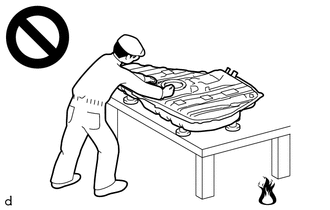
Never perform work on fuel system components near any possible ignition sources.
-
Vaporized fuel could ignite, resulting in a serious accident.
-
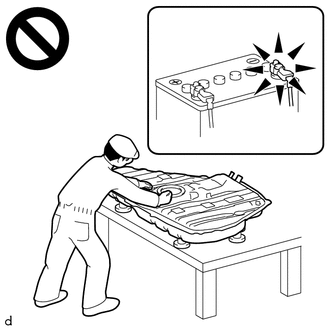
Do not perform work on fuel system components without first disconnecting the cable from the negative (-) battery terminal.
-
Sparks could cause vaporized fuel to ignite, resulting in a serious accident.
Note
This procedure includes the removal of small-head bolts. Refer to Small-Head Bolts of Basic Repair Hint to identify the small-head bolts.
PROCEDURE
-
PRECAUTION
Note
After turning the ignition switch off, waiting time may be required before disconnecting the cable from the negative (-) battery terminal. Therefore, make sure to read the disconnecting the cable from the negative (-) battery terminal notices before proceeding with work.
-
DISCHARGE FUEL SYSTEM PRESSURE
-
DISCONNECT CABLE FROM NEGATIVE BATTERY TERMINAL
Note
When disconnecting the cable, some systems need to be initialized after the cable is reconnected.
-
REMOVE INTAKE MANIFOLD
-
REMOVE NO. 1 FUEL PIPE SUB-ASSEMBLY
-
DISCONNECT FUEL TUBE SUB-ASSEMBLY
-
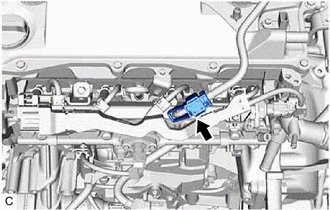
Remove the fuel pipe clamp from the fuel tube connector.
-
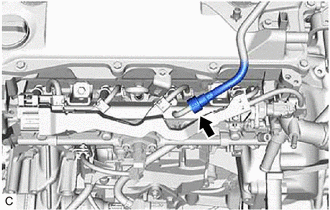
Disconnect the fuel tube sub-assembly from the fuel delivery pipe with sensor assembly.
-
-
REMOVE FUEL DELIVERY PIPE WITH SENSOR ASSEMBLY
-
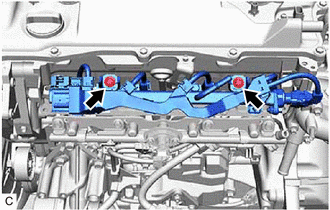
Remove the 2 bolts and fuel delivery pipe with sensor assembly with the 4 port fuel injector assemblies from the cylinder head sub-assembly.
Note
Be careful not to drop the port fuel injector assemblies when removing the fuel delivery pipe with sensor assembly.
-
-
REMOVE NO. 1 DELIVERY PIPE SPACER
-
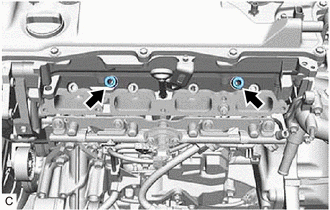
Remove the 2 No. 1 delivery pipe spacers from the cylinder head sub-assembly.
-
-
REMOVE INJECTOR VIBRATION INSULATOR
-
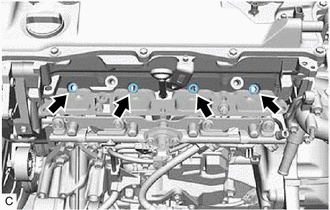
Remove the 4 injector vibration insulators from the cylinder head sub-assembly.
-
-
REMOVE NO. 5 ENGINE WIRE
-
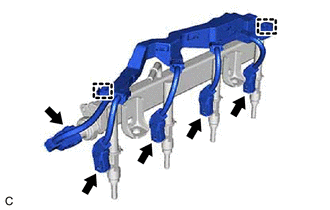
Disconnect the 4 port fuel injector assembly connectors and fuel pressure sensor connector.
-
Disengage the 2 clamps to remove the No. 5 engine wire from the fuel delivery pipe with sensor assembly.
-
-
REMOVE PORT FUEL INJECTOR ASSEMBLY
-
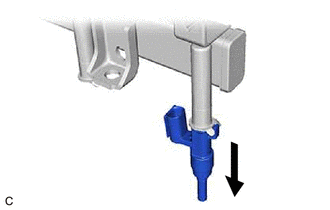
Pull the 4 port fuel injector assemblies out of the fuel delivery pipe with sensor assembly.
-
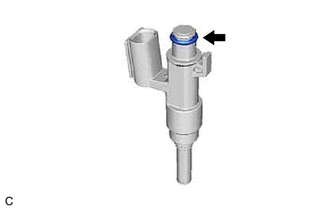
Remove the O-ring from each port fuel injector assembly.
-
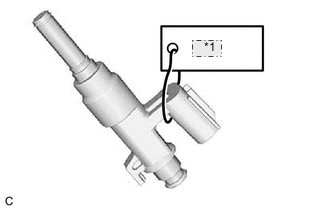
*1 No. 1 Attach a tag or label with the corresponding cylinder number to each port fuel injector assembly so that they can be installed to their original locations.
Note
Cover the port fuel injector assemblies with plastic bags to prevent damage and contamination.
-