SFI SYSTEM(w/ GPF) Turbocharger Noise
DESCRIPTION
Tech Tips
Turbocharger noise is classified into two types. These are whistling sound and chattering sound. During troubleshooting, first determine the type of noise.
| Type of Abnormal Noise | Outline of Abnormal Noise | Major Trouble Area |
|---|---|---|
| Whistling sound (airflow sound) | The whistling sound volume and pitch are proportional to the turbocharger or engine speed. The abnormal noise level becomes clear when the engine speed is increased. |
|
| Chattering sound (metallic sound) | The chattering sound pitch is lower than the whistling sound pitch. Has a comparatively constant pitch that is independent of the engine speed and vehicle speed. | Turbocharger Tech Tips
|
-
Faults and Symptoms of Diesel Engine Components
Turbocharger system Main fault
-
Unstable turbocharger turbine shaft (interference, seizing, poor balance, etc.)
-
Poor installation or defective operation of the waste gate valve.
-
Poor installation or defective operation of the air by-pass valve assembly.
Symptom
-
High-pitched whistling sound
Tech Tips
The volume and pitch are proportional to the turbocharger speed.
-
Metallic sound due to looseness
Intake system Main fault Leak Symptom Abnormal noise during intake leak Transmission gears Symptom Gear noise
Tech Tips
The volume and pitch are proportional to the transmission gear speed.
-
PROCEDURE
-
CONFIRM CONDITION IN WHICH NOISE OCCURRED
-
Confirm with the customer the condition when noise occurred.
Tech Tips
To clearly understand the conditions in which the noise occurred, the items in the table below are useful.
Item Note Engine speed Engine speed range Vehicle speed Vehicle speed range Transaxle gear Which gear? Accelerator pedal position During acceleration or deceleration? Temperature
-
Ambient temperature
-
Engine temperature (cold, warmed up, etc.)
Road conditions
-
City or highway driving
-
Uphill or downhill
Noise level
-
Did the noise occur suddenly, or build gradually?
-
Has the noise gradually been getting louder?
Other symptoms
-
Lack of power
-
High fuel consumption, etc.
Noise recognition What made the customer determine that the sound was a malfunction? Result Proceed to NEXT -
NEXT 
-
-
CHECK DTC OUTPUT
-
Connect the GTS to the DLC3.
-
Turn the engine switch on (IG).
-
Turn the GTS on.
-
Enter the following menus: Powertrain / Engine / Trouble Codes.
-
Check the DTCs.
Powertrain > Engine > Trouble CodesResult Result Proceed to DTC is not output A DTCs are output B Tech Tips
-
Check whether a DTC is stored related to the boost pressure sensor or atmospheric pressure sensor (in ECU).
-
If a DTC is stored related to the boost pressure sensor or atmospheric pressure sensor (in ECU), defective actuator control related to the turbocharger may be the cause of the turbocharger noise.
-
B 
GO TO DTC CHART Click here
A
-
-
PERFORM SIMULATION TEST
-
Check whether the noise described by the customer occurs.
Tech Tips
If an abnormal noise is heard, check whether it matches the noise described by the customer.
-
If an abnormal noise is confirmed, determine which system emits it.
Result Result Proceed to Noise occurs (ticking or rattling (metallic sound) during idling) A Noise occurs (squealing (metallic sound) when driving) B Noise occurs (hissing (airflow sound) when driving) C Noise occurs (squeaking or chuffing (airflow sound) during deceleration) D Noise occurs (whistling or foghorn-like (airflow sound) during acceleration) E Noise occurs (whistling (airflow sound) during deceleration) F The noise described by the customer could not be confirmed. G
B 
CHECK COMPRESSOR WITH BEARING HOUSING SUB-ASSEMBLY Click here
C
CHECK TURBOCHARGER SUB-ASSEMBLY Click here
D
CHECK AIR BY-PASS VALVE ASSEMBLY Click here
E
CHECK COMPRESSOR WITH BEARING HOUSING SUB-ASSEMBLY Click here
F
CHECK GEAR NOISE Click here
G
EXPLAIN TO CUSTOMER THAT SOUND IS NORMAL Click here
A
-
-
CHECK WASTE GATE VALVE ACTUATOR WITH BRACKET ASSEMBLY
-
Check the installation condition of the E-ring on the link connection of the waste gate valve actuator with bracket assembly and turbine with valve housing sub-assembly.
Tech Tips
Replace the E-ring if the installation condition is abnormal.
-
When the actuator rod of the waste gate valve actuator with bracket assembly is pushed down, check whether there is a change in the abnormal noise.
Tech Tips
If there is a change in abnormal noise when the actuator rod is pushed down, the noise may be a metallic sound from increased rattle due to wear.
Result Result Proceed to There is no change in the abnormal noise when the actuator rod is pushed down. A There is a change in the abnormal noise when the actuator rod is pushed down. B
B
REPLACE WASTE GATE VALVE ACTUATOR WITH BRACKET ASSEMBLY Click here
A
-
-
CHECK COMPRESSOR WITH BEARING HOUSING SUB-ASSEMBLY
-
Check for damage to the compressor impeller.
-
Check for interference between the compressor impeller and the compressor housing.
Result Result Proceed to No damage or interference A Damage or interference exists B
A
END (CAUSE CHECK EXCEPT THE TURBO CHARGER)
B
REPLACE COMPRESSOR WITH BEARING HOUSING SUB-ASSEMBLY Click here
-
-
CHECK COMPRESSOR WITH BEARING HOUSING SUB-ASSEMBLY
-
Check that the turbine shaft rotates smoothly, without catching.
-
Check for loose turbine mounting nuts and for axial play in the turbine shaft.
Tech Tips
If the turbine shaft catches or if there no play or excessive play, it could indicate poor sliding due to seal damage due to seizing or a deposit build-up.
Standard value 0.10 mm (0.00394 in.) or less Result Result Proceed to No turbine shaft malfunction A Turbine shaft malfunction B
B
REPLACE COMPRESSOR WITH BEARING HOUSING SUB-ASSEMBLY Click here
A
-
-
CHECK COMPRESSOR WITH BEARING HOUSING SUB-ASSEMBLY
-
Check for damage to the compressor impeller.
-
Check for interference between the compressor impeller and the compressor housing.
Result Result Proceed to No damage or interference A Damage or interference exists B
B
CHECK COMPRESSOR WITH BEARING HOUSING SUB-ASSEMBLY Click here
A
-
-
CHECK AIR BY-PASS VALVE ASSEMBLY
-
On-vehicle inspect the air by-pass valve assembly.
-
Inspect the air by-pass valve assembly.
Tech Tips
-
The abnormal noise may be caused by defective operation of the air by-pass valve assembly.
-
If the previous checks find no malfunction, replace the compressor with bearing housing sub-assembly and determine if the noise improved.
Result Proceed to OK NG -
NG
REPLACE AIR BY-PASS VALVE ASSEMBLY Click here
OK
-
-
REPLACE COMPRESSOR WITH BEARING HOUSING SUB-ASSEMBLY
-
Replace the compressor with bearing housing sub-assembly.
Result Proceed to NEXT
NEXT
-
-
PERFORM SIMULATION TEST
-
Check that the abnormal noise has disappeared.
Result Proceed to NEXT
NEXT
END
-
-
CHECK COMPRESSOR WITH BEARING HOUSING SUB-ASSEMBLY
-
Check for interference between the turbine wheel and the turbine housing.
Tech Tips
If interference exists between the turbine wheel and turbine housing, replace the compressor with bearing housing sub-assembly and turbine with valve housing sub-assembly as a set.
Result Result Proceed to No damage or interference A Damage or interference exists B
A
REPLACE COMPRESSOR WITH BEARING HOUSING SUB-ASSEMBLY Click here
B
REPLACE COMPRESSOR WITH BEARING HOUSING SUB-ASSEMBLY AND TURBINE WITH VALVE HOUSING SUB-ASSEMBLY Click here
-
-
CHECK TURBOCHARGER SUB-ASSEMBLY
-
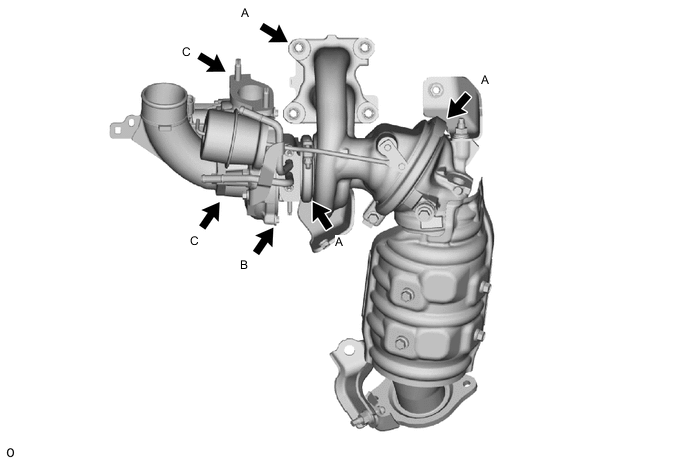
Check that no soot or oil adheres to the turbocharger sub-assembly connectors.
Tech Tips
If adhering soot or an oil leak exists, air leaking at that position may be the cause of the abnormal noise.
Result Result Proceed to No adhering soot or an oil A Soot adhering around the turbine housing, flange, or V band (A in the illustration) B Oil leak from the contact surface between the compressor housing and the seal plate or between the seal plate and the bearing housing (B in the illustration) C Oil adhering to the compressor flange (C in the illustration) D
B
CHECK EXHAUST MANIFOLD CONVERTER SUB-ASSEMBLY Click here
C
REPLACE COMPRESSOR WITH BEARING HOUSING SUB-ASSEMBLY Click here
D
REPLACE GASKET
A
-
-
CHECK WASTE GATE VALVE ACTUATOR WITH BRACKET ASSEMBLY
-
Check if the waste gate valve actuator with bracket assembly operates normally when a negative pressure is applied to it.
Tech Tips
If the negative pressure leaks and the actuator rod is not maintained when negative pressure is applied to the waste gate valve actuator with bracket assembly, there may be an air leak due to a tear in the actuator diaphragm.
Result Proceed to OK NG
NG
REPLACE WASTE GATE VALVE ACTUATOR WITH BRACKET ASSEMBLY Click here
OK
-
-
CHECK AIR BY-PASS VALVE ASSEMBLY
-
Check for wear or deformation of the air by-pass valve assembly contact surface.
Tech Tips
-
Wear or deformation on the air by-pass valve assembly contact surface may allow air to leak from the damaged position.
-
If the previous checks find no malfunction, replace the compressor with bearing housing sub-assembly and determine if the noise improved.
Standard Wear or deformation does not exceed 0.5 mm (0.0196 in.) Result Proceed to OK NG -
NG
REPLACE AIR BY-PASS VALVE ASSEMBLY Click here
OK
-
-
REPLACE COMPRESSOR WITH BEARING HOUSING SUB-ASSEMBLY
-
Replace the compressor with bearing housing sub-assembly.
Result Proceed to NEXT
NEXT
-
-
PERFORM SIMULATION TEST
-
Check that the abnormal noise has disappeared.
Result Proceed to NEXT
NEXT
END
-
-
CHECK EXHAUST MANIFOLD CONVERTER SUB-ASSEMBLY
-
Check for deformation or cracks in the mounting surfaces on the exhaust manifold converter sub-assembly and the turbine with valve housing sub-assembly.
Tech Tips
Deformation or cracks on a mounting surface may allow exhaust gas to leak from the damaged position.
Standard No deformation or cracks on a mounting surface Result Result Proceed to No problem with the mounting surface A Deformation or cracks on the exhaust manifold converter sub-assembly mounting surface B Deformation or cracks on the turbine with valve housing sub-assembly mounting surface C
B
REPLACE EXHAUST MANIFOLD CONVERTER SUB-ASSEMBLY
C
REPLACE TURBINE WITH VALVE HOUSING SUB-ASSEMBLY Click here
A
-
-
REPLACE EXHAUST PIPE CLAMP AND GASKET
-
Replace the exhaust pipe clamp and the gasket.
Result Proceed to NEXT
NEXT
-
-
PERFORM SIMULATION TEST
-
Check that the abnormal noise has disappeared.
Result Proceed to NEXT
NEXT
END
-
-
CHECK AIR BY-PASS VALVE ASSEMBLY
-
On-vehicle inspect the air by-pass valve assembly.
-
Inspect the air by-pass valve assembly.
Tech Tips
The abnormal noise may be caused by defective operation of the air by-pass valve assembly.
Result Proceed to OK NG
NG
REPLACE AIR BY-PASS VALVE ASSEMBLY Click here
OK
-
-
READ VALUE USING GTS (ATMOSPHERIC PRESSURE)
-
Connect the GTS to the DLC3.
-
Turn the engine switch on (IG).
-
Enter the following menus: Powertrain / Engine / Data List / Atmospheric Pressure.
Powertrain > Engine > Data ListTester Display Atmospheric Pressure -
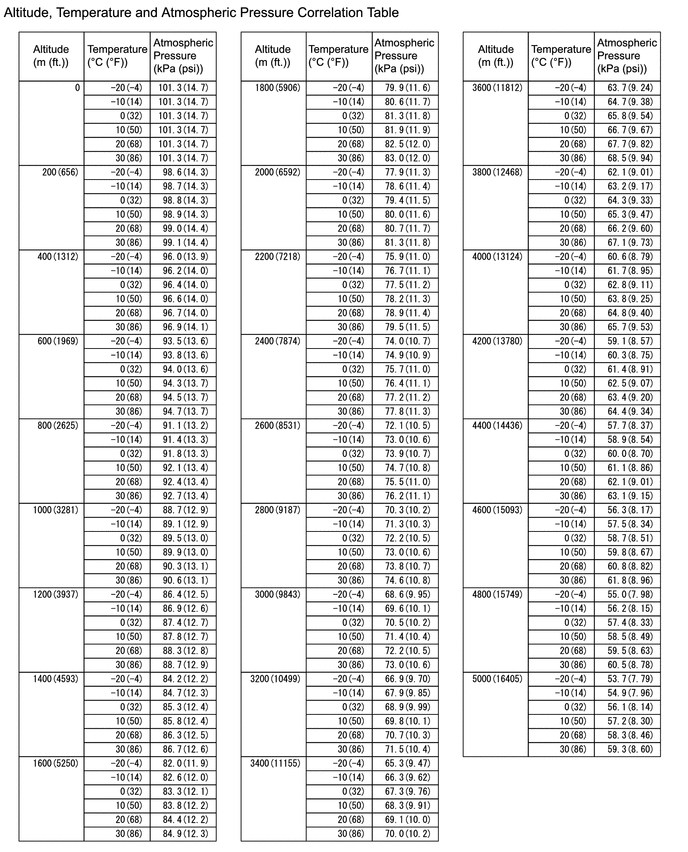
Using the table, read the normal atmospheric pressure value for the applicable altitude and temperature.
Tech Tips
-
Standard atmospheric pressure is approximately 101 kPa(abs) (15 psi(abs)).
-
For every 100 m (328 ft.) increase in altitude, atmospheric pressure drops by approximately 1 kPa (0.15 psi). This varies by weather.
-
-
Compare the Atmospheric pressure value in the Data List with the normal atmospheric value from the table.
Result Result Proceed to Other than the following A Difference between Atmospheric Pressure in the Data List and normal atmospheric pressure value is 10 kPa (1.45 psi) or more. B
B
REPLACE ECM Click here
A
-
-
CHECK NO. 2 TURBO PRESSURE SENSOR
-
On-vehicle inspect the No. 2 turbo pressure sensor.
Result Proceed to OK NG
OK
REPLACE ECM Click here
NG
REPLACE NO. 2 TURBO PRESSURE SENSOR Click here
-
-
CHECK COMPRESSOR WITH BEARING HOUSING SUB-ASSEMBLY
-
Check that the turbine shaft rotates smoothly, without catching.
-
Check for loose turbine mounting nuts and for axial play in the turbine shaft.
Tech Tips
If the turbine shaft catches or if there no play or excessive play, it could indicate poor sliding due to seal damage due to seizing or a deposit build-up.
Standard value 0.10 mm (0.00394 in.) or less Result Result Proceed to No turbine shaft malfunction A Turbine shaft malfunction B
B
REPLACE COMPRESSOR WITH BEARING HOUSING SUB-ASSEMBLY Click here
A
-
-
CHECK COMPRESSOR WITH BEARING HOUSING SUB-ASSEMBLY
-
Check for damage to the compressor impeller.
-
Check for interference between the compressor impeller and the compressor housing.
Tech Tips
If the previous checks find no malfunction, replace the compressor with bearing housing sub-assembly and determine if the noise improved.
Result Result Proceed to No damage or interference A Damage or interference exists B
B
CHECK COMPRESSOR WITH BEARING HOUSING SUB-ASSEMBLY Click here
A
-
-
REPLACE COMPRESSOR WITH BEARING HOUSING SUB-ASSEMBLY
-
Replace the compressor with bearing housing sub-assembly.
Result Proceed to NEXT
NEXT
-
-
PERFORM SIMULATION TEST
-
Check that the abnormal noise has disappeared.
Result Proceed to NEXT
NEXT
END
-
-
CHECK COMPRESSOR WITH BEARING HOUSING SUB-ASSEMBLY
-
Check for interference between the turbine wheel and the turbine housing.
Tech Tips
If interference exists between the turbine wheel and turbine housing, replace the compressor with bearing housing sub-assembly and turbine with valve housing sub-assembly as a set.
Result Result Proceed to No damage or interference A Damage or interference exists B
A
REPLACE COMPRESSOR WITH BEARING HOUSING SUB-ASSEMBLY Click here
B
REPLACE COMPRESSOR WITH BEARING HOUSING SUB-ASSEMBLY AND TURBINE WITH VALVE HOUSING SUB-ASSEMBLY Click here
-
-
CHECK GEAR NOISE
-
Check if gear noise is the source of the abnormal noise (not noise from the turbocharger).
Result Proceed to NEXT
NEXT
ELIMINATE THE CAUSE OF THE NOISE
-
-
EXPLAIN TO CUSTOMER THAT SOUND IS NORMAL
-
Explain to the customer that the sound described by the customer is not a malfunction.
Tech Tips
To convince the customer, it is helpful to drive the customer in a different vehicle.
Result Proceed to NEXT
NEXT
END
-