MULTI-MODE MANUAL TRANSAXLE SYSTEM Shift Lock Solenoid Circuit
| DTC Code | DTC Name |
|---|---|
| Shift Lock Solenoid Circuit |
DESCRIPTION
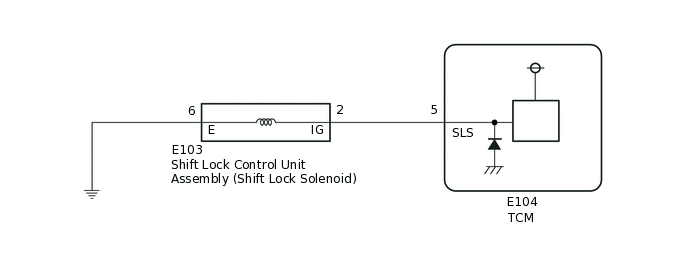
The shift lock solenoid is built into the shift lock control unit assembly. When the ignition switch is off, or when the shift lever is in N without depressing the brake pedal although the ignition switch is ON, the shift lock solenoid restricts the shift lever movement.
The TCM sends the shift lock cancellation signal to the shift lock solenoid to cancel the shift lock when the multi-mode manual transaxle system conditions are satisfied.
WIRING DIAGRAM
PROCEDURE
INSPECT SHIFT LOCK CONTROL UNIT ASSEMBLY (SHIFT LOCK SOLENOID)
-
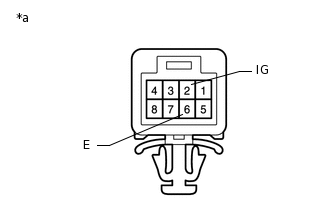
*a
Component without harness connected
(Shift Lock Control Unit Assembly)
Disconnect the shift lock control unit assembly connector.
Measure the resistance according to the value(s) in the table below.
Standard Resistance
Tester Connection
Condition
Specified Condition
2 (IG) - 6 (E)
20°C (68°F)
30 to 35 Ω
Result
Proceed to
OK
NG
-
CHECK HARNESS AND CONNECTOR (SHIFT LOCK SOLENOID - TCM, BODY GROUND)
Disconnect the TCM connector.
Measure the resistance according to the value(s) in the table below.
Standard Resistance
Tester Connection
Condition
Specified Condition
E104-5 (SLS) - E103-2 (IG)
Always
Below 1 Ω
E103-6 (E) - Body ground
Always
Below 1 Ω
E104-5 (SLS) - Body ground
Always
10 kΩ or higher
Result
Proceed to
OK
NG
NG REPAIR OR REPLACE HARNESS OR CONNECTOR
INSPECT TCM
Reconnect the TCM connector.
Reconnect the shift lock control unit connector.
-
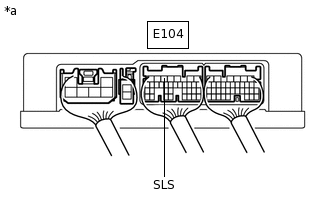
*a
Component with harness connected
(TCM)
Turn the ignition switch to ON.
Measure the voltage according to the value(s) in the table below.
Standard Voltage
Tester Connection
Condition
Specified Condition
E104-5 (SLS) - Body ground
Brake pedal depressed
11 to 14 V
Brake pedal released
Below 1 V
Result
Proceed to
OK
NG
REPLACE TCM
Replace the TCM.
for LHD:Click hereClick here
for RHD:Click hereClick here
Result
Proceed to
NEXT
PERFORM INITIALIZATION
Perform the initialization and learning procedure.
Result
Proceed to
NEXT
NEXT END