METER / GAUGE SYSTEM Fuel Receiver Gauge Display Malfunction
| DTC Code | DTC Name |
|---|---|
| Fuel Receiver Gauge Display Malfunction |
DESCRIPTION
FUEL RECEIVER GAUGE OPERATION
OPERATION
The combination meter assembly uses the fuel sender gauge assembly to detect the amount of fuel remaining in the fuel tank sub-assembly. The fuel sender gauge assembly has a variable resistor whose resistance changes according to the amount of fuel remaining. The gauge assembly receives voltage from the combination meter assembly and changes the voltage based on the resistance that changes according to the amount of fuel remaining in the fuel tank sub-assembly. The combination meter assembly detects the voltage between the variable resistor and the resistor in the combination meter assembly, and operates the fuel receiver gauge.
FUEL RECEIVER GAUGE READING
During normal driving:
As the fuel level in the fuel tank sub-assembly changes when driving on a hill or applying the brakes, the fuel receiver gauge reading is updated according to the fuel injection volume during normal driving. However, as the fuel injection volume measurement has a margin of error, the value is indicated after correction by input values from the fuel sender gauge assembly.
During refueling:
The fuel level in the fuel tank sub-assembly rises rapidly when fuel is added. If the averaging process that is used during normal driving is used in this case, the fuel receiver gauge reading cannot be updated promptly. Therefore, when it is judged that fuel is being added to the vehicle based on the changes in the fuel level, output values from the fuel sender gauge assembly are immediately reflected in the fuel receiver gauge reading. This control is called refueling judgment.
REFUELING JUDGMENT CONDITIONS
Note:Add fuel with the ignition switch off to ensure safety and to enable refueling judgment so that an appropriate fuel receiver gauge reading is obtained. If it is necessary to add fuel with the ignition switch ON, stop the vehicle.
Normal judgment condition (When normal refueling method is used)
With the ignition switch off, the fuel sender gauge assembly detects a change of 5.0 liters (5.3 US qts, 4.4 Imp. qts) or more in the fuel level.
Other judgment conditions (When other refueling method is used)
With the vehicle and engine stopped and the ignition switch ON, the fuel sender gauge assembly detects a change of 5.0 liters (5.3 US qts, 4.4 Imp. qts) or more in the fuel level.
PRECAUTION FOR REFUELING
The fuel sender gauge assembly cannot detect changes in the fuel level within certain ranges (around points E and F). Therefore, even if 5.0 liters (5.3 US qts, 4.4 Imp. qts) or more of fuel is added, refueling judgment may not be performed and the fuel receiver gauge reading may not change when the fuel level is within such ranges.
The fuel sender gauge reading takes approximately 30 seconds to rise from point E to F. If the vehicle is driven while the fuel sender gauge reading is rising, the fuel sender gauge reading will stop rising. After the fuel sender gauge reading stops rising, normal fuel sender gauge reading operation begins. The fuel sender gauge reading takes approximately 90 seconds per 1 liter (1.1 US qts, 0.9 Imp. qts) to rise while the vehicle is being driven, and takes approximately 10 minutes per 1 liter (1.1 US qts, 0.9 Imp. qts) to rise while the vehicle is stopped.
FORCED RESET OF FUEL RECEIVER GAUGE
When driving at 1.8 km/h (1 mph) or more, if the output value from the fuel sender gauge assembly is different from the fuel receiver gauge reading by 15.0 liters (15.9 US qts, 13.2 Imp. qts) or more for approximately 5 minutes, the output value from the fuel sender gauge assembly is immediately reflected in the fuel receiver gauge reading to compensate for a situation when refueling judgment cannot be made.
WIRING DIAGRAM
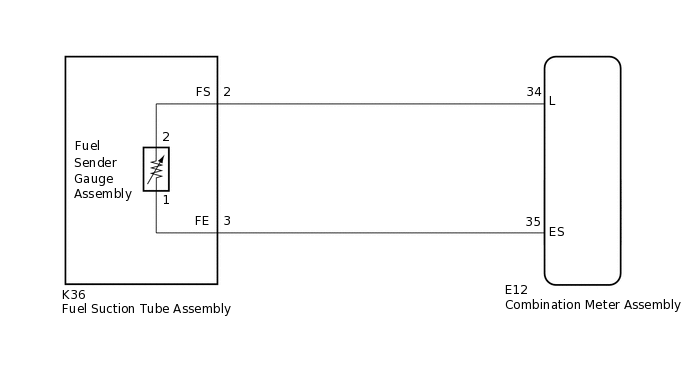
CAUTION / NOTICE / HINT
When it is necessary to replace the combination meter assembly, be sure to replace it with a new one.
The fuel level warning light will come on when the fuel level is below 5.25 liters (5.5 US qts, 4.6 Imp. qts).
PROCEDURE
CHECK SYMPTOMS
Ask the customer about the problem symptoms.
Result
Result
Proceed to
Malfunction occurs when adding fuel (Even after adding fuel, reading does not increase at all or increases very slowly, etc.)
A
Malfunction occurs during normal driving (The reading does not change, decreases quickly or decreases when the vehicle is not being driven, etc.) (The problem symptom recurs)
B
Malfunction occurs during normal driving (The reading does not change, decreases quickly or decreases when the vehicle is not being driven, etc.) (The problem symptom does not recur)
C
PERFORM ACTIVE TEST USING GTS (Fuel Meter Operation)
Connect the GTS to the DLC3.
Turn the ignition switch to ON.
Turn the GTS on.
Enter following menus: Body Electrical / Combination Meter / Active Test.
Perform the Active Test according to the display on the GTS.
Body Electrical > Combination Meter > Active Test
Tester Display
Measurement Item
Control Range
Diagnostic Note
Fuel Meter Operation
Fuel receiver gauge
OFF, Sender E, Empty, Warning, 1/4, 1/2, 3/4, Full, Sender F
-
Body Electrical > Combination Meter > Active Test
Tester Display
Fuel Meter Operation
OK
Fuel receiver gauge indication is normal.
Result
Proceed to
OK
NG
CHECK FOR DTC
Check if SFI system DTCs are output.
for 1KR-FE:Click here
for 1PP:Click here
Powertrain > Engine and ECT > Trouble Codes
Result
Result
Proceed to
SFI system DTCs are not output.
A
SFI system DTCs are output.
B
CHECK FOR DTC
Check if anti-lock brake system or vehicle stability control system DTCs are output.
for Anti-lock Brake System:Click here
for Vehicle Stability Control System:Click here
Chassis > ABS/VSC/TRC > Trouble Codes
Result
Result
Proceed to
DTCs are not output.
A
DTCs are output (for Anti-lock Brake System).
B
DTCs are output (for Vehicle Stability Control System).
C
CHECK FUEL RECEIVER GAUGE OPERATION BY ADDING FUEL
Record the fuel receiver gauge reading.
If the fuel tank sub-assembly is almost full, drain 20 liters (21.1 US qts, 17.6 Imp. qts) or more of fuel. (This is not necessary when the fuel tank sub-assembly is sufficiently below full.)
Disconnect the cable from the negative (-) battery terminal to reset the fuel receiver gauge.
Tip:Check that the ignition switch is turned off before disconnecting the cable from the negative (-) battery terminal.
Connect the cable to the negative (-) battery terminal and turn the ignition switch ON.
Check that the fuel receiver gauge has been reset.
Drive the vehicle at 1.75 km/h (1 mph) or more, then move the shift lever to P and turn the ignition switch off.
Add 5.0 liters (5.3 US qts, 4.4 Imp. qts) or more of fuel, turn the ignition switch ON, and check that the fuel receiver gauge reading increases in proportion to the amount of fuel added.
Result
Result
Proceed to
Fuel receiver gauge reading increases in proportion to the amount of fuel added
A
Fuel receiver gauge reading does not change even when fuel is added
B
B READ VALUE USING GTS (Fuel Input)Click here
INSPECT FUEL TANK SUB-ASSEMBLY
Tip:Inspect the fuel tank sub-assembly for deformation, foreign matter or an improperly installed fuel receiver gauge, as this may be the cause of the fuel receiver gauge malfunction.
Visually check the fuel tank sub-assembly for any abnormalities.
Check if there is an excessive amount of foreign matter in the fuel tank sub-assembly.
Check the installation condition of the fuel tank sub-assembly and fuel sender gauge assembly.
Result
Result
Proceed to
Normal
A
Appearance of the fuel tank sub-assembly is abnormal.
B
There is an excessive amount of foreign matter in the fuel tank sub-assembly.
C
The fuel tank sub-assembly or fuel sender gauge assembly is not installed correctly.
D
C CLEAN INSIDE OF FUEL TANK SUB-ASSEMBLY
D INSTALL FUEL TANK SUB-ASSEMBLY OR FUEL SENDER GAUGE ASSEMBLY CORRECTLY
READ VALUE USING GTS (Fuel Input)
Connect the GTS to the DLC3.
Turn the ignition switch to ON.
Turn the GTS on.
Enter following menus: Body Electrical / Combination Meter / Data List.
Read the Data List according to the display on the GTS.
Body Electrical > Combination Meter > Data List
Tester Display
Measurement Item
Range
Normal Condition
Diagnostic Note
Fuel Input
Fuel input
Min.: 0 L, Max.: 127.5 L
6th segment comes on: 30.4 to 33.1
5th segment comes on: 24.3 to 30.4
4th segment comes on: 18.6 to 24.3
3rd segment comes on: 12.3 to 18.6
2nd segment comes on: 6.23 to 12.3
1st segment comes on: 4.61 to 6.23
Unit: Liter
Body Electrical > Combination Meter > Data List
Tester Display
Fuel Input
Result
Result
Proceed to
Fuel level data displayed on the GTS is almost the same as the fuel receiver gauge indication.
A
Fuel level data displayed on the GTS differs from the fuel receiver gauge indication.
B
CHECK HARNESS AND CONNECTOR (COMBINATION METER ASSEMBLY - FUEL SUCTION TUBE ASSEMBLY)
Disconnect the E12 combination meter assembly connector.
Disconnect the K36 fuel suction tube assembly connector.
Measure the resistance according to the value(s) in the table below.
Standard Resistance
Tester Connection
Condition
Specified Condition
E12-34 (L) - K36-2 (FS)
Always
Below 1 Ω
E12-35 (ES) - K36-3 (FE)
Always
Below 1 Ω
E12-34 (L) - Body ground
Always
10 kΩ or higher
E12-35 (ES) - Body ground
Always
10 kΩ or higher
Result
Proceed to
OK
NG
NG REPAIR OR REPLACE HARNESS OR CONNECTOR
INSPECT FUEL SUCTION TUBE ASSEMBLY
-
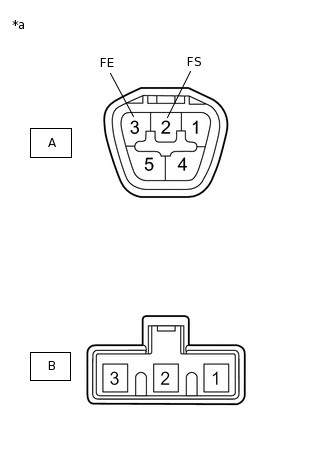
*a
Component without harness connected
(Fuel Suction Tube Assembly)
Measure the resistance according to the value(s) in the table below.
Standard Resistance
Tester Connection
Condition
Specified Condition
A-2 (FS) - B-2
Always
Below 1 Ω
A-3 (FE) - B-1
Always
Below 1 Ω
Result
Proceed to
OK
NG
-
INSPECT FUEL SENDER GAUGE ASSEMBLY
Remove the fuel sender gauge assembly.
for 1KR-FE:Click here
for 1PP:Click here
Inspect the fuel sender gauge assembly.
for 1KR-FE:Click hereClick here
for 1PP:Click hereClick here
OK
Fuel sender gauge assembly is normal.
Result
Proceed to
OK
NG
PERFORM ACTIVE TEST USING GTS (Fuel Meter Operation)
Connect the GTS to the DLC3.
Turn the ignition switch to ON.
Turn the GTS on.
Enter following menus: Body Electrical / Combination Meter / Active Test.
Perform the Active Test according to the display on the GTS.
Body Electrical > Combination Meter > Active Test
Tester Display
Measurement Item
Control Range
Diagnostic Note
Fuel Meter Operation
Fuel receiver gauge
OFF, Sender E, Empty, Warning, 1/4, 1/2, 3/4, Full, Sender F
-
Body Electrical > Combination Meter > Active Test
Tester Display
Fuel Meter Operation
OK
Fuel receiver gauge indication is normal.
Result
Proceed to
OK
NG
CHECK FOR DTC
Check if SFI system DTCs are output.
for 1KR-FE:Click here
for 1PP:Click here
Powertrain > Engine and ECT > Trouble Codes
Result
Result
Proceed to
SFI system DTCs are not output.
A
SFI system DTCs are output.
B
CHECK FOR DTC
Check if anti-lock brake system or vehicle stability control system DTCs are output.
for Anti-lock Brake System:Click here
for Vehicle Stability Control System:Click here
Chassis > ABS/VSC/TRC > Trouble Codes
Result
Result
Proceed to
DTCs are not output.
A
DTCs are output (for Anti-lock Brake System).
B
DTCs are output (for Vehicle Stability Control System).
C
CHECK FOR DTC
Check if meter / gauge system DTCs are output.
Body Electrical > Combination Meter > Trouble Codes
Result
Result
Proceed to
DTC B1500 is not output.
A
DTC B1500 is output.
B
INSPECT FUEL RECEIVER GAUGE
Disconnect the cable from the negative (-) battery terminal to reset the fuel receiver gauge.
Tip:Check that the ignition switch is turned off before disconnecting the cable from the negative (-) battery terminal.
Connect the cable to the negative (-) battery terminal and turn the ignition switch ON.
Check if the fuel receiver gauge reading corresponds with the amount of fuel remaining in the fuel tank sub-assembly.
Result
Result
Proceed to
Fuel receiver gauge reading corresponds with the amount of fuel remaining in the fuel tank sub-assembly.
A
Fuel receiver gauge reading does not correspond with the amount of fuel remaining in the fuel tank sub-assembly.
B
A END
B READ VALUE USING GTS (Fuel Input)Click here
CHECK FOR DTC
Check if SFI system DTCs are output.
for 1KR-FE:Click here
for 1PP:Click here
Powertrain > Engine and ECT > Trouble Codes
Result
Result
Proceed to
SFI system DTCs are not output.
A
SFI system DTCs are output.
B
CHECK FOR DTC
Check if anti-lock brake system or vehicle stability control system DTCs are output.
for Anti-lock Brake System:Click here
for Vehicle Stability Control System:Click here
Chassis > ABS/VSC/TRC > Trouble Codes
Result
Result
Proceed to
DTCs are not output.
A
DTCs are output (for Anti-lock Brake System).
B
DTCs are output (for Vehicle Stability Control System).
C
INSPECT FUEL TANK SUB-ASSEMBLY
Tip:Inspect the fuel tank sub-assembly for deformation, foreign matter or an improperly installed fuel receiver gauge, as this may be the cause of the fuel receiver gauge malfunction.
Visually check the fuel tank sub-assembly for any abnormalities.
Check if there is an excessive amount of foreign matter in the fuel tank sub-assembly.
Check the installation condition of the fuel tank sub-assembly and fuel sender gauge assembly.
Result
Result
Proceed to
Normal
A
Appearance of the fuel tank sub-assembly is abnormal.
B
There is an excessive amount of foreign matter in the fuel tank sub-assembly.
C
The fuel tank sub-assembly or fuel sender gauge assembly is not installed correctly.
D
C CLEAN INSIDE OF FUEL TANK SUB-ASSEMBLY
D INSTALL FUEL TANK SUB-ASSEMBLY OR FUEL SENDER GAUGE ASSEMBLY CORRECTLY