ENGINE UNIT INSPECTION

PROCEDURE
-
INSPECT CHAIN SUB-ASSEMBLY
-
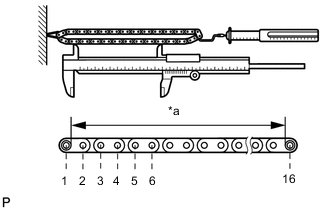
*a Measuring Area Using a spring scale, pull the chain sub-assembly with a force of 147 N (15 kgf, 33.0 lbf) as shown in the illustration.
-
Using a vernier caliper, measure the length of 16 links.
Maximum chain elongation 147.5 mm (5.81 in.) Tech Tips
Perform the measurement at 3 random places.
If the elongation is more than the maximum, replace the chain sub-assembly.
-
-
INSPECT NO. 2 CHAIN SUB-ASSEMBLY
-
Using a spring scale, pull the No. 2 chain sub-assembly with a force of 147 N (15 kgf, 33.0 lbf).
-
Using a vernier caliper, measure the length of 16 links.
Maximum chain elongation 123.6 mm (4.87 in.) Tech Tips
Perform the measurement at 3 random places.
If the elongation is more than the maximum, replace the No. 2 chain sub-assembly.
-
-
INSPECT NO. 1 CHAIN TENSIONER ASSEMBLY
-
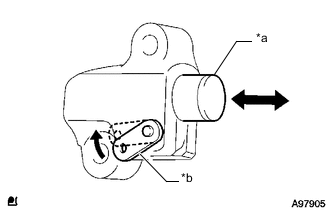
*a Plunger *b Stopper Plate Move the stopper plate upward to release the lock. Push the plunger and check that it moves smoothly.
If necessary, replace the No. 1 chain tensioner assembly.
-
-
INSPECT NO. 2 CHAIN TENSIONER ASSEMBLY
-
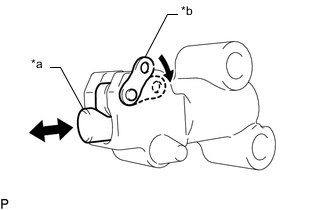
*a Plunger *b Stopper Plate Move the stopper plate downward to release the lock. Push the plunger and check that it moves smoothly.
If necessary, replace the No. 2 chain tensioner assembly.
-
-
INSPECT CAMSHAFT TIMING GEAR ASSEMBLY
-
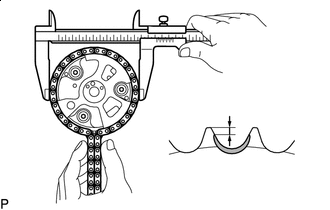

Worn Area Measure the distance between the most worn out timing gear tip and the beginning of the worn area below the tip.
Minimum distance 1.0 mm (0.0394 in.) If the distance is less than the minimum, replace the camshaft timing gear assembly.
If the worn area is too small or difficult to distinguish from a normal area, perform the following 2 steps.
-
Wrap the chain around the timing gear.
-
Using a vernier caliper, measure the sprocket diameter with the chain sub-assembly.
Minimum sprocket diameter (with chain) 113.8 mm (4.48 in.) Tech Tips
The vernier caliper must contact the chain rollers for the measurement.
If the diameter is less than the minimum, replace the chain and camshaft timing gear assembly.
-
-
INSPECT CAMSHAFT TIMING EXHAUST GEAR ASSEMBLY
-
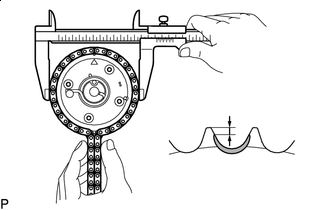
Worn Area Measure the distance between the most worn out timing gear tip and the beginning of the worn area below the tip.
Minimum distance 1.0 mm (0.0394 in.) If the distance is less than the minimum, replace the camshaft timing exhaust gear assembly.
If the worn area is too small or difficult to distinguish from a normal area, perform the following 2 steps.
-
Wrap the chain around the sprocket.
-
Using a vernier caliper, measure the sprocket diameter with the chain sub-assembly.
Minimum sprocket diameter (with chain) 113.8 mm (4.48 in.) Tech Tips
The vernier caliper must contact the chain rollers for the measurement.
If the diameter is less than the minimum, replace the chain and camshaft timing exhaust gear assembly.
-
-
INSPECT CRANKSHAFT TIMING GEAR OR SPROCKET
-
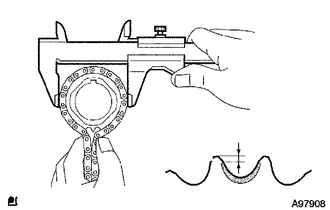
Worn Area Measure the distance between the most worn out sprocket tip and the beginning of the worn area below the tip.
Minimum distance 1.0 mm (0.0394 in.) If the distance is less than the minimum, replace the crankshaft timing gear or sprocket.
If the worn area is too small or difficult to distinguish from a normal area, perform the following 2 steps.
-
Wrap the chain around the drive sprocket.
-
Using a vernier caliper, measure the sprocket diameter with the chain sub-assembly.
Minimum sprocket diameter (with chain) 59.4 mm (2.34 in.) Tech Tips
The vernier caliper must contact the chain rollers for the measurement.
If the diameter is less than the minimum, replace the chain sub-assembly and crankshaft timing gear or sprocket.
-
-
INSPECT CHAIN TENSIONER SLIPPER
-
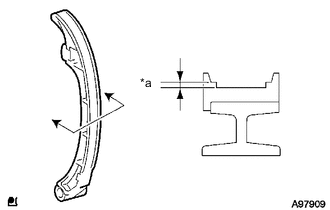
*a Depth Measure the depth of wear of the chain tensioner slipper.
Maximum depth 2.0 mm (0.0787 in.) If the depth is more than the maximum, replace the chain tensioner slipper.
-
-
INSPECT NO. 1 CHAIN VIBRATION DAMPER
-
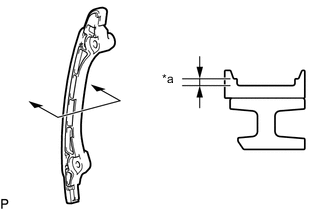
*a Depth Measure the depth of wear of the No. 1 chain vibration damper.
Maximum depth 2.0 mm (0.0787 in.) If the depth is more than the maximum, replace the No. 1 chain vibration damper.
-
-
INSPECT TIMING CHAIN GUIDE
-
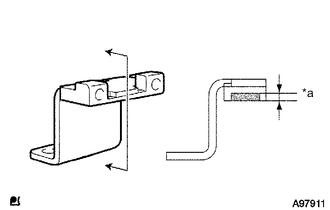
*a Depth Measure the depth of wear of the timing chain guide.
Maximum depth 0.5 mm (0.0197 in.) If the depth is more than the maximum, replace the timing chain guide.
-
-
INSPECT NO. 2 CRANKSHAFT TIMING SPROCKET
-
Wrap the chain around the No. 2 crankshaft timing sprocket.
-
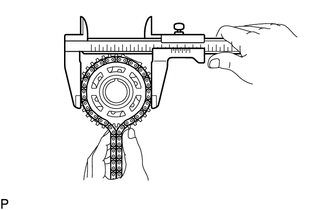
Using a vernier caliper, measure the No. 2 crankshaft timing sprocket diameter with the No. 2 chain sub-assembly.
Minimum sprocket diameter (with chain) 96.7 mm (3.81 in.) Tech Tips
The vernier caliper must contact the chain rollers for the measurement.
If the diameter is less than the minimum, replace the No. 2 chain sub-assembly and No. 2 crankshaft timing sprocket.
-
-
INSPECT BALANCESHAFT DRIVE GEAR SUB-ASSEMBLY
-
Wrap the chain around the balanceshaft drive gear sub-assembly.
-
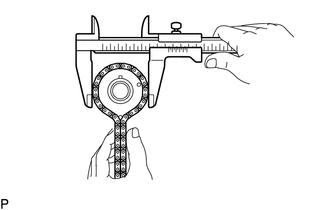
Using a vernier caliper, measure the balanceshaft drive gear sub-assembly diameter with the No. 2 chain sub-assembly.
Minimum sprocket diameter (with No. 2 chain sub-assembly) 75.9 mm (2.99 in.) Tech Tips
The vernier caliper must contact the chain rollers for the measurement.
If the diameter is less than the minimum, replace the No. 2 chain sub-assembly and balanceshaft drive gear sub-assembly.
-
-
INSPECT NO. 2 CHAIN VIBRATION DAMPER
-
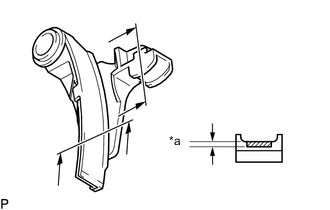
*a Depth Measure the depth of wear of the No. 2 chain vibration damper.
Maximum depth 1.0 mm (0.0394 in.) If the depth is more than the maximum, replace the No. 2 chain vibration damper.
-
-
INSPECT NO. 3 CHAIN VIBRATION DAMPER
-
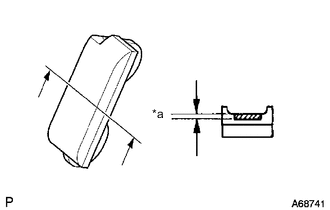
*a Depth Measure the depth of wear of the No. 3 chain vibration damper.
Maximum depth 1.0 mm (0.0394 in.) If the depth is more than the maximum, replace the No. 3 chain vibration damper.
-
-
INSPECT NO. 4 CHAIN VIBRATION DAMPER
-
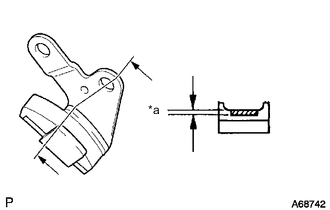
*a Depth Measure the depth of wear of the No. 4 chain vibration damper.
Maximum depth 1.0 mm (0.0394 in.) If the depth is more than the maximum, replace the No. 4 chain vibration damper.
-
-
INSPECT CYLINDER HEAD SET BOLT
-
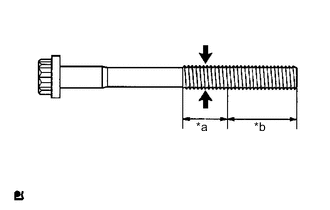
*a Measuring area *b Distance Using a vernier caliper, measure the diameter of the most elongated threads in the measuring area.
Standard outside diameter 10.76 to 10.97 mm (0.424 to 0.432 in.) Minimum outside diameter 10.40 mm (0.409 in.) Distance 30 mm (1.18 in.) If a visual check reveals no excessively thin areas, check the center of the measuring area (see illustration) and find the area that has the smallest diameter.
If the diameter is less than the minimum, replace the cylinder head set bolt.
-
-
INSPECT VALVE LASH ADJUSTER ASSEMBLY
Note
-
Keep the valve lash adjuster assembly free from dirt and foreign objects.
-
Only use clean engine oil.
-
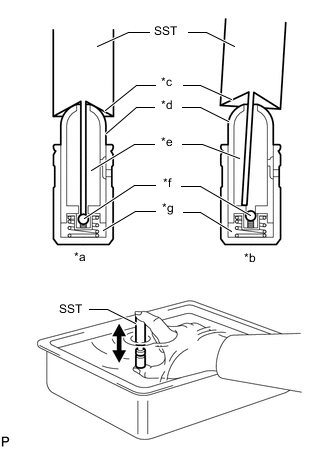
*a CORRECT *b INCORRECT *c Tapered Part *d Plunger *e Low Pressure Chamber *f Check Ball *g High Pressure Chamber Place the valve lash adjuster assembly into a container full of new engine oil.
-
Insert the tip of SST into the valve lash adjuster assembly plunger and use the tip to press down on the check ball inside the plunger.
- SST
- 09276-75010
-
Squeeze SST and the valve lash adjuster assembly together to move the plunger up and down 5 to 6 times.
-
Check the movement of the plunger and bleed air.
OK Plunger moves up and down. Note
When bleeding high-pressure air from the compression chamber, make sure that the tip of SST is actually pressing the check ball as shown in the illustration. If the check ball is not pressed, air will not bleed.
-
After bleeding the air, remove SST. Then try to quickly and firmly press the plunger with your fingers.
OK Plunger can be pressed 3 times. If the plunger can still be compressed after pressing it 3 times, replace the valve lash adjuster assembly with a new one.
-
-
INSPECT CAMSHAFT
-
Check the camshaft runout.
-
Place the camshaft on V-blocks.
-
Using a dial indicator, measure the circle runout at the center journal.
Maximum circle runout 0.03 mm (0.00118 in.) If the circle runout is more than the maximum, replace the camshaft.
-
-
Using a micrometer, measure the cam lobe height.
Standard cam lobe height 42.855 to 42.955 mm (1.687 to 1.691 in.) Minimum cam lobe height 42.855 mm (1.687 in.) If the cam lobe height is less than the minimum, replace the camshaft.
-
Using a micrometer, measure the journal diameter.
Standard Journal Diameter Item Specified Condition No. 1 journal 35.949 to 35.965 mm (1.415 to 1.416 in.) Other journal 26.959 to 26.975 mm (1.061 to 1.062 in.) If the journal diameter is not as specified, check the oil clearance.
-
-
INSPECT NO. 2 CAMSHAFT
-
Check the No. 2 camshaft runout.
-
Place the No. 2 camshaft on V-blocks.
-
Using a dial indicator, measure the circle runout at the center journal.
Maximum circle runout 0.03 mm (0.00118 in.) If the circle runout is more than the maximum, replace the No. 2 camshaft.
-
-
Using a micrometer, measure the cam lobe height.
Standard cam lobe height 42.854 to 42.954 mm (1.687 to 1.691 in.) Minimum cam lobe height 42.854 mm (1.687 in.) If the cam lobe height is less than the minimum, replace the No. 2 camshaft.
-
Using a micrometer, measure the journal diameter.
Standard Journal Diameter Item Specified Condition No. 1 journal 35.949 to 35.965 mm (1.415 to 1.416 in.) Other journal 26.959 to 26.975 mm (1.061 to 1.062 in.) If the journal diameter is not as specified, check the oil clearance.
-
-
INSPECT CAMSHAFT THRUST CLEARANCE
-
INSPECT CAMSHAFT OIL CLEARANCE
-
INSPECT EXHAUST MANIFOLD
-
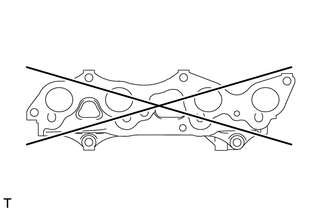
Using a precision straightedge and feeler gauge, measure the warpage of the surface that contacts the cylinder head sub-assembly.
Maximum warpage 0.7 mm (0.0276 in.) If the warpage is more than the maximum, replace the exhaust manifold.
-