AUTOMATIC TRANSMISSION FLUID HIGH TEMPERATURE ADJUSTMENT
CAUTION:
-
Use caution while the engine is idling and the radiator fan is operating.
-
Be careful not to burn yourself when the automatic transmission fluid temperature is high.
-
ADJUST FLUID LEVEL AT HIGH TEMPERATURE
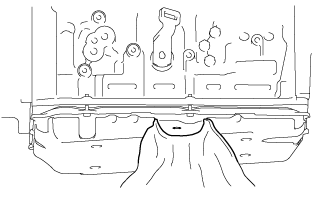
Note
When removing the overflow plug, automatic transmission fluid may enter through the gap in the automatic transmission oil pan sub-assembly. Therefore, insert cloth between the gap in the automatic transmission oil pan sub-assembly as shown in the illustration to prevent the entry of automatic transmission fluid.
-
Warm up and stop the engine. [*4]
-
Connect the GTS to the DLC3 with the ignition switch off.
-
Turn the ignition switch to ON and turn the GTS on.
Note
To reduce load, make sure that all electrical systems, such as the air conditioning, lighting system, electric fan and audio system are off.
-
Enter the following menus: Powertrain / Engine and ECT / Data List.
-
Select the Data List menu: A/T Oil Temperature 3
-
Select the Data List menu: Engine Speed
-
Check the ATF temperature.
Note
-
If the fluid temperature tends to decrease when the fluid temperature is between 85°C (185°F) and 90°C (194°F) with the engine idling, make sure that the fluid temperature is above 90°C (194°F) before starting work.
-
If the fluid temperature tends to increase when the fluid temperature is between 85°C (185°F) and 90°C (194°F) with the engine idling, make sure that the fluid temperature is below 85°C (185°F) before starting work.
-
If the fluid temperature tends to not change when the fluid temperature is between 85°C (185°F) and 90°C (194°F) with the engine idling, make sure that the fluid temperature is 87.5°C (189.5°F) before starting work.
-
-
Depress and hold the brake pedal.
-
Start the engine.
-
Slowly move the shift lever from P to S, then move the shift lever to P.
Tech Tips
Slowly move the shift lever to circulate the automatic transmission fluid through each part of the automatic transmission assembly.
-
Lift the vehicle.
Note
Set the vehicle on a lift so that the vehicle is kept level when it is lifted up (make sure the tilt angle from the front to rear and side to side of the vehicle is within +/-1°).
-
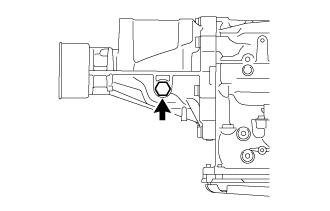
Loosen the refill plug.
CAUTION:
When loosening the refill plug, make sure not to touch the exhaust pipe.
-
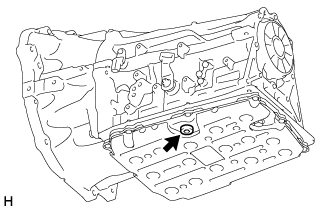
Using a 5 mm hexagon socket wrench, remove the overflow plug and gasket from the automatic transmission assembly. [*1]
CAUTION:
Be careful as the fluid coming out of the overflow plug hole is hot.
Note
-
Before removing the overflow plug, make sure that the fluid temperature and the engine idle speed is within the range specified in the tables provided in step *3.
-
When adding fluid (step *3), add the specified amount in accordance with the fluid temperature and the engine idle speed.
-
If fluid does not come out, add fluid to the refill hole until fluid comes out of the overflow hole, install the overflow plug, and perform the procedure from step *4 again.
-
-
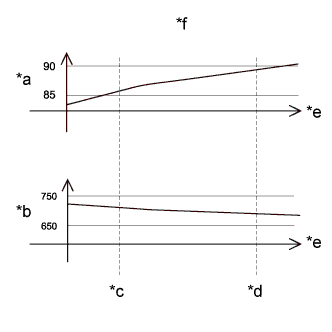
Text in Illustration *a Automatic Transmission Fluid Temperature [°C] *b Engine Idle Speed [rpm] *c Overflow Plug Removed *d Overflow Plug Installed *e Time *f Example: When adjusting with the engine idle speed between 650 and 750 rpm Make sure that the fluid temperature and engine speed remain within the appropriate range until the overflow plug is tightened in step *2.
-
Wait until the fluid flow changes from a steady flow to a drip. As soon as the fluid begins to drip, make a note of the fluid temperature displayed on the GTS.
Note
Be sure to install the overflow plug with a new gasket immediately after the fluid begins to drip. If the overflow plug is not installed immediately after the fluid begins to drip, the transmission will have to be refilled and the procedure will have to be repeated from step *4.
Tech Tips
Be sure to make a note of the fluid temperature at the exact moment the fluid begins to drip as this temperature will be used in step *3.
-
Using a 5 mm hexagon socket wrench, install a new gasket and overflow plug to the automatic transmission assembly. [*2]
- Torque:
- 20 N*m { 204 kgf*cm, 15 ft.*lbf }
-
Lower the vehicle.
-
Turn the ignition switch off.
-
Remove the refill plug and O-ring from the automatic transmission assembly.
CAUTION:
When removing the refill plug, make sure not to touch the exhaust pipe.
-
Install a hose and funnel to the refill hole as shown in the illustration.
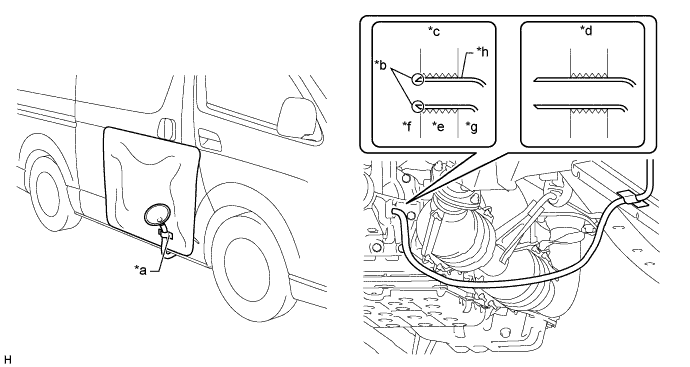
Text in Illustration *a Tape *b Cut *c Correct *d Incorrect *e Automatic Transmission Assembly *f Inside *g Outside *h Hose CAUTION:
When installing the hose to the refill hole, make sure not to touch the exhaust pipe with the hose or your hand.
Note
-
When the fluid level is correct and the fluid temperature is approximately 40°C (104°F), the transmission is designed so that the fluid level is at the same height as the end of the overflow tube. When adjusting the fluid level with a fluid temperature of 85 to 90°C (185 to 194°F), drain the amount of fluid that has expanded due to heat (step *1). After the fluid has been drained, make sure to add the amount of fluid specified in the table below.
-
Pay extra attention when adding fluid because adding an excessive or insufficient amount of fluid may cause a malfunction in the automatic transmission assembly.
-
Do not insert the hose into the refill hole excessively.
-
Be sure to use tape or equivalent to prevent the hose from sagging.
-
Do not damage the body when installing the funnel.
Tech Tips
-
Make sure to use a hose with a length of 1250 mm (4.1 ft.) and an outer diameter of 16 mm (0.63 in.).
-
Shave off a small amount from the end of the hose to make it easier to insert into the refill hole.
-
-
Add the specified amount of automatic transmission fluid to the refill hole. [*3]
-
If determining the specific amount of automatic transmission fluid to be added, refer to the table below.
Specified Amount to be Added (Automatic Transmission Fluid Weight) Specified Amount to be Added at Automatic Transmission Fluid Temperature of 85°C (185°F) to 90°C (194°F) Engine Idle Speed (rpm)
650 to 750
-
for 1TR-FE, 2TR-FE:
671 g (23.6 oz)(789 cc (48.1 cu in.))
-
for 1GD-FTV:
463 g (16.3 oz)(545 cc (33.3 cu in.))
Engine Idle Speed (rpm)
750 to 850
Note
-
The specified amount to be added includes the amount of fluid remaining inside the hose.
-
The acceptable margin of error when adding automatic transmission fluid is +/-8.5 g (0.3 oz.) or +/-10 cc (0.6 cu in.).
-
Use Toyota Genuine ATF WS.
Tech Tips
-
The values in the table are reference values for when the temperature of the fluid to be added is between 10°C (50°F) and 30°C (86°F).
-
If fluid comes out (the amount of fluid is not as specified), perform the procedure from step *4 again.
-
-
-
If determining the specified amount of automatic transmission fluid to be added by volume, calculate it based on weight and density at each temperature.
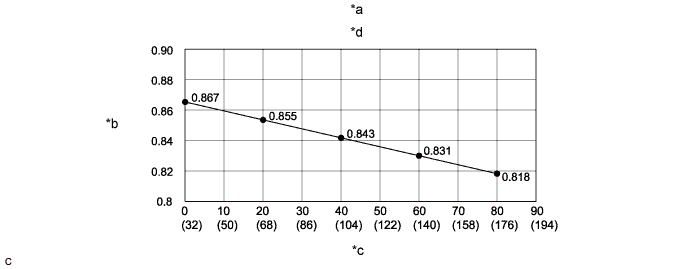
Text in Illustration *a This example shows the volume of automatic transmission fluid to be added when the temperature of the automatic transmission fluid to be added 10°C (50°F) to 30°C (86°F). *b Density [g / cc] *c Temperature of automatic transmission fluid to be measured [°C (°F)] *d Relation between temperature and density of Toyota genuine ATF WS -
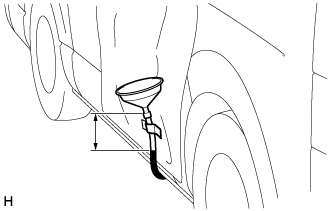
Check the distance from the hose end to the remaining fluid.
Distance to remaining fluid 121 to 191 mm (4.77 to 7.51 in.) Note
If the distance to the remaining fluid is not as specified, check the installation of the hose and perform the procedure from step *1 again.
Tech Tips
Some fluid will remain in the hose regardless of how the hose is installed.
-
Remove the hose and funnel.
-
Install a new O-ring and refill plug to the automatic transmission assembly.
- Torque:
- 39 N*m { 400 kgf*cm, 29 ft.*lbf }
-
Disconnect the GTS from the DLC3.
-
-
AFTER FILLING TRANSMISSION
-
Lift the vehicle.
-
Clean each part.
-
Check for automatic transmission fluid leaks.
-
Lower the vehicle.
-