AUTOMATIC TRANSAXLE SYSTEM HYDRAULIC TEST
PERFORM HYDRAULIC TEST
Measure the line pressure.
CAUTION:The line pressure test should always be carried out with at least 2 people. One person should observe the condition of wheels and wheel chocks while the other is performing the test.
Note:Perform a test at the normal operating Automatic Transaxle Fluid (ATF) temperature: 50 to 80°C (122 to 176°F)
Be careful to prevent the hose of SST from interfering with the exhaust pipe.
This check must be conducted after checking and confirming that the engine is normal.
Perform the test with the A/C off.
Do not perform the stall test for longer than 5 seconds.
Warm up the ATF.
Lift the vehicle up.
Remove the engine under cover.
-
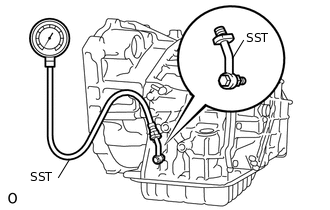
Remove the test plug on the transaxle case and install SST.
09992-00095
09992-00231
09992-00271
Lower the vehicle.
Fully apply the parking brake and chock the 4 wheels.
Connect the GTS to the DLC3.
Start the engine.
Enter the following menus: Powertrain / Engine and ECT / Active Test / Control the Shift Position.
Powertrain > Engine and ECT > Active Test
Tester Display
Control the Shift Position
Move the shift lever to D, and then use the GTS to hold 3rd gear using Active Test. Measure the line pressure while the engine is idling.
Table 1. Specified Line Pressure Condition
Shift Lever in D
Idling
360 to 430 kPa
(3.7 to 4.4 kgf/cm2, 52 to 62 psi)
Turn the ignition switch off.
-
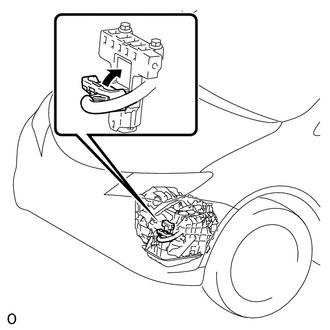
Disconnect the harness connector from the wiring harness connector.
Tip:Disconnect the connector only when performing the D position stall test.
Start the engine.
Firmly depress the brake pedal, move the shift lever to D, depress the accelerator pedal all the way down, and check the line pressure while the stall test is performed.
Table 2. Specified Line Pressure Condition
Shift Lever in D
Stall test
1160 to 1350 kPa
(11.8 to 13.8 kgf/cm2, 168 to 196 psi)
Turn the ignition switch off.
Connect the harness connector, depress the brake pedal firmly, move the shift lever to R, and check that the line pressure while the engine is idling and during the stall test.
Table 3. Specified Line Pressure Condition
Shift Lever in R
Idling
670 to 820 kPa
(6.8 to 8.4 kgf/cm2, 97 to 119 psi)
Stall test
1650 to 1910 kPa
(16.8 to 19.5 kgf/cm2, 239 to 277 psi)
Remove SST, install the test plug.
Clear the DTCs.
Powertrain > Engine and ECT > Clear DTCs
Table 4. Evaluation Test Result
Possible Cause
Measured values are higher than the specified value in all positions
Shift solenoid valve SLT defective
Regulator valve defective
Measured values are lower than the specified value in all positions
Shift solenoid valve SLT defective
Regulator valve defective
Oil pump defective
Pressure is low in D only
D position circuit fluid leak
Clutch No. 1 (C1) defective
Pressure is low in R only
R position circuit fluid leak
Brake No. 2 (B2) defective
Brake No. 3 (B3) defective