ENGINE ON-VEHICLE INSPECTION
PROCEDURE
INSPECT ENGINE COOLANT
INSPECT ENGINE OIL
INSPECT BATTERY
INSPECT AIR CLEANER FILTER ELEMENT SUB-ASSEMBLY
Remove the air cleaner case sub-assembly.
Remove the air cleaner filter element sub-assembly.
Visually check that the air cleaner filter element sub-assembly is not excessively damaged or oily.
If necessary, replace the air cleaner filter element sub-assembly.
Tip:If there is any foreign matter or clogs in the air cleaner filter element sub-assembly, clean it with compressed air.
If any foreign matter or clogs remain even after cleaning the air cleaner filter element sub-assembly with compressed air, replace it.
Install the air cleaner filter element sub-assembly.
Install the air cleaner case sub-assembly.
INSPECT SPARK PLUG
INSPECT FAN AND GENERATOR V BELT
INSPECT VALVE CLEARANCE
INSPECT COMPRESSION
Note:Keep the spark plug holes free of foreign matter when measuring the compression pressure.
Check for DTCs.
Warm up and stop the engine.
Remove the 3 spark plugs.
Disconnect the 3 fuel injector connectors.
Note:Disable fuel injection in order to prevent catalyst damage due to unburned gasoline.
-
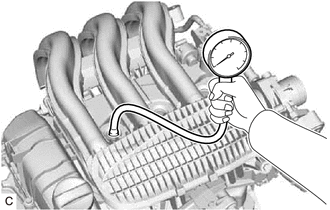
Inspect the cylinder compression pressure.
Insert a compression gauge into the spark plug hole.
Fully open the throttle.
While cranking the engine, measure the compression pressure.
Pressure Difference between each Cylinder
500 kPa (5.1 kgf/cm2, 73 psi) or less
Note:Use a fully-charged battery to obtain an engine speed of 250 rpm or more.
Inspect the other cylinders in the same way.
Measure the compression pressure as quickly as possible.
If the cylinder compression pressure is low, pour a small amount of engine oil into the cylinder through the spark plug hole, then inspect it again.
Tip:If adding oil increases the compression pressure, the piston rings and/or cylinder bore may be worn or damaged.
If the compression pressure stays low, a valve may be stuck or seated improperly, or there may be leaks in the gasket.
Connect the 3 fuel injector connectors.
Install the 3 spark plugs.
Clear the DTCs.
Note:After the inspection, clear the DTCs, check for DTCs again and make sure the normal system code is output.