ENGINE UNIT
-
CONSTRUCTION
-
The pistons are made of aluminum alloy to allow them to be compact and lightweight.
-
A piston with a concave top surface is used to prevent air turbulence and to realize high speed combustion. This contributes to the prevention of engine knock which enables a high compression ratio, resulting in increased performance and reduced fuel consumption.
-
The casting process and the structure of the piston has been optimized, realizing thinner inner walls and resulting in a drastic weight reduction.
-
The skirt portion of the piston has a resin coating to ensure a smooth surface. By minimizing bore friction, protection against scuffing is enhanced.
-
A Diamond Like Carbon (DLC) coating has been applied to the surface of the No. 1 compression ring and oil ring, in order to reduce friction losses and improve wear resistance.
-
The groove of the No. 1 compression ring is coated with alumite to ensure abrasion resistance.
-
An oil ring expander which utilizes punched grooves to prevent deposits from accumulating is used. Oil flow between the expander and side rails is enhanced, realizing a structure that prevents deposits from accumulating.
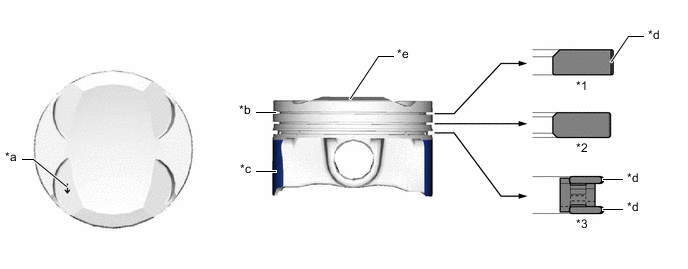
*1 No. 1 Compression Ring *2 No. 2 Compression Ring *3 Oil Ring - - *a Front Mark *b Alumite Coating *c Resin Coating *d DLC Coating *e Combustion Bowl - - -
By tilting the sidewalls of the piston towards the piston center, the combustion pressure is better distributed to the piston pin. This allows for higher power output capability.
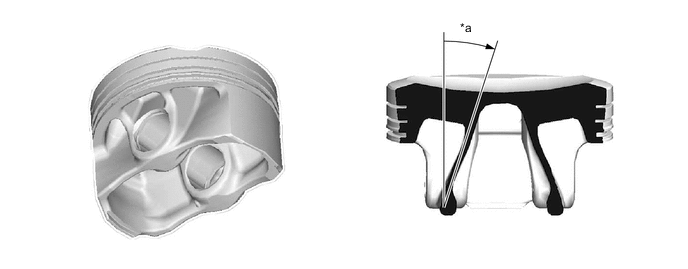
*a Tilted Sidewall - -
-