HYBRID BATTERY SYSTEM
-
SPECIFICATION
-
HV Battery
Item Specification Type Sealed Nickel Metal Hydride (Ni-MH) Battery Cell Quantity 192 Cells (6 Cells x 32 Modules) Nominal Voltage V 230.4 (1.2 V x 192 Cells) Battery Capacity (3HR) Ah 6.5 -
Cooling System (for HV Battery)
Item Specification Battery Cooling Blower Assembly Motor Type Brushless Fan Type Sirocco Fan Air Flow Volume m3/h
138
-
-
MAIN FEATURES
-
Cooling System
-
To ensure the proper performance of the HV battery while it generates heat during repetitive charge and discharge cycles, a dedicated cooling system is used for the HV battery.
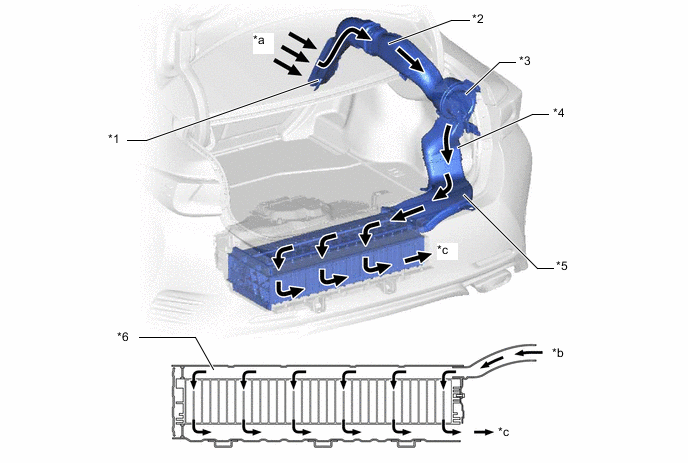
*1 No. 1 Hybrid Battery Intake Duct *2 No. 2 Hybrid Battery Intake Duct *3 Battery Cooling Blower Assembly *4 No. 3 Hybrid Battery Intake Duct *5 No. 4 Hybrid Battery Intake Duct *6 HV Battery Assembly *a from Cabin *b from Battery Cooling Blower Assembly *c Cooling Air Flow Exhaust - - 
Cooling Air Flow - -
-
-
Service Plug Grip
-
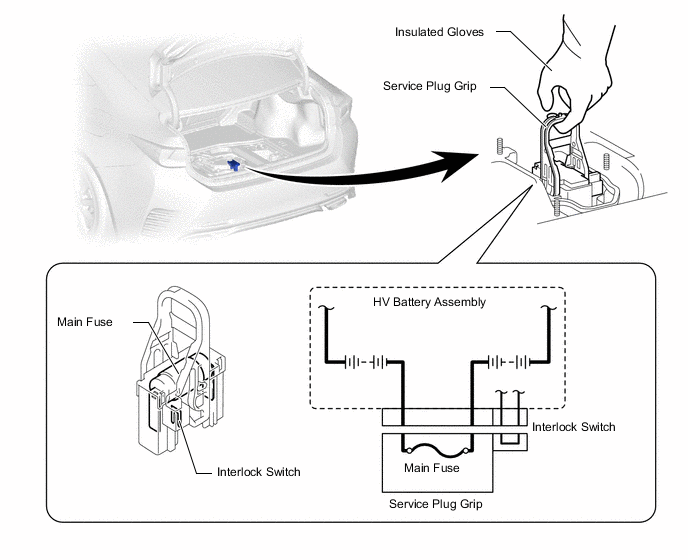
By removing the service plug grip before performing any inspection or service, the high-voltage circuit is shut off at an intermediate position of the HV battery, thus ensuring safety during service.
CAUTION:
-
A charge remains in the high-voltage capacitor in the inverter with converter assembly after the high-voltage circuits are shut down. When servicing a hybrid vehicle, after the service plug grip is removed, wait at least 10 minutes to allow the capacitor to discharge before beginning work.
-
For further details on how to handle the service plug grip and other safety cautions, refer to the Repair Manual.
Note
-
The service plug grip should never be removed when the system is in the on (READY) state.
-
After removing the service plug grip, turning the power switch on (READY) may cause a malfunction. Do not turn the power switch on (READY) unless instructed by the Repair Manual.
-
-
The service plug grip is connected in the middle of the battery module circuit and is used for manually shutting off the high-voltage circuit. This ensures safety during service.
-
The main fuse for the high-voltage circuit is provided inside of the service plug grip.
-
An interlock switch is provided on the service plug grip. When the grip section is unlocked, the interlock switch is turned off and the hybrid vehicle control ECU assembly shuts off the system main relays. However, to ensure safety, make sure to turn the power switch off before removing the service plug grip.
-
-
-
PRECAUTION
-
HV Battery Handling Precautions
-
HV battery electrolyte is a highly alkaline potassium hydroxide solution (odorless, transparent, and colorless). Careless handling of the HV battery is very dangerous. Handle the HV battery properly according to the procedure below.
Item Procedure When there is liquid leakage present in the area of the HV battery
-
Neutralize it with a saturated mixture of boric acid and water.
-
After litmus paper has been used to determine that the mixture is neutral, wipe it up with rags or waste cloth.
When battery electrolyte gets on skin, eyes etc.*
-
Flush it with a diluted solution of boric acid and water, or with a large amount of water.
-
Remove contaminated clothes at once.
When a vehicle is scrapped Remove the HV battery from the vehicle for collection via the specified route. When the HV battery is stored The HV battery should not be left in a damp or humid location. Prevention of HV battery discharge or damage when a vehicle is stored for a long time
-
Disconnect the auxiliary battery negative terminal.
-
When in storage, the HV battery should be charged every 2 months. Using the following procedure, charge the HV battery with the vehicle. Using the following procedure, charge the HV battery:
-
Connect the negative terminal of the auxiliary battery.
-
Turn the power switch on (IG) for 3 minutes, do not apply any electrical loads. (This operation is needed to allow the hybrid vehicle control ECU assembly to detect the correct SOC.)
-
Turn the power switch on (READY). After the engine starts, leave it running for 30 minutes to charge the HV battery. If the engine does not start or intermittently stops within 30 minutes, stop the operation at that time. (The HV battery does not need to be charged.)
CAUTION:
*: If you get electrolyte in your eyes, shout loudly for help, do not rub your eyes, rinse your eyes with large amount of water and seek medical attention immediately.
-
-
-