INTELLIGENT PARKING ASSIST SYSTEM
-
OUTLINE
-
The intelligent parking assist system shows a view of the area behind the vehicle on the multi-display of the radio and display receiver assembly*1 or navigation receiver assembly*2. In addition, it controls the steering to assist the driver with perpendicular parking and parallel parking.
*1: Models with multimedia system
*2: Models with navigation system
-
The system calculates the target parking position based on signals from the No. 1 ultrasonic sensors mounted on both sides of the front bumper, and reduces the driver's burden of adjusting the target parking position on the multi-display.
-
An easy set function is provided. If the system recognizes the lines of the parking space (white lines) in parking assist mode, manual setting of the target parking position is unnecessary, improving usability.
-
The intelligent parking assist system can be disabled or enabled using the assist mode button displayed on the multi-display of the radio and display receiver assembly*1 or navigation receiver assembly*2.
*1: Models with multimedia system
*2: Models with navigation system
-
-
MAJOR DIFFERENCE
-
The new models have been modified from the previous models as shown below:
-
The hybrid vehicle control ECU has been adopted.
-
-
-
MAIN FEATURES
-
The intelligent parking assist system can display either perpendicular parking assist or parallel parking assist modes.
-
Perpendicular parking assist is used when parking the vehicle in a space that is located perpendicular to the vehicle.
-
Parallel parking assist is used when parallel parking.
-
Using the assist mode button disables or enables the intelligent parking assist system. When the intelligent parking assist system is disabled, a view of the area behind the vehicle, on which the guide lines are superimposed, is displayed on the multi-display of the radio and display receiver assembly*1 or navigation receiver assembly*2.
*1: Models with multimedia system
*2: Models with navigation system
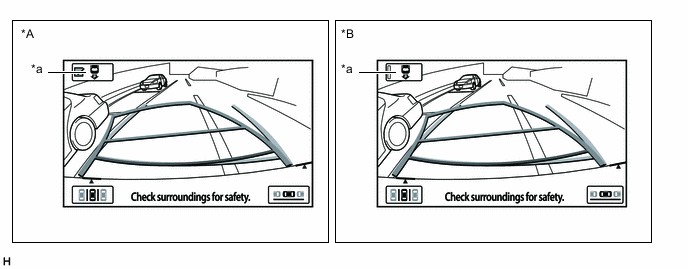
Text in Illustration *A Models for Europe *B Models for Australia *a Assist Mode Button - -
-
-
PRECAUTION
-
General Precautions
-
Do not rely entirely on the intelligent parking assist system. When backing up, drive the vehicle as carefully as you would drive one that is not equipped with the intelligent parking assist system.
-
Back up slowly by depressing the brake pedal to adjust the speed.
-
If it appears that the vehicle is about to come into contact with an adjacent vehicle or pedestrian, depress the brake pedal to bring the vehicle to a stop. Then, cancel the intelligent parking assist system by pressing the stop switch on the screen.
-
When the system is operating in parking assist mode, the steering wheel will turn automatically. Maintain a proper driving posture without allowing a necktie, pendant, or your arms to get caught, or long finger nails to come in contact with the steering wheel. Do not allow children to come close to the steering wheel.
-
Never attempt to back up the vehicle only by observing the screen. If you do so, you could unexpectedly crash the vehicle or cause an accident because the image on the screen could differ from the actual situation. While backing up, also make sure to use the inside and outside rear view mirrors in order to directly verify the safety of the rear and surrounding areas.
-
Do not operate the system on a slippery surface such as a frozen or snowy road, or when using tire chains. Doing so could unexpectedly cause the vehicle to crash or become involved in an accident.
-
If the back door is open, only the image from the rear television camera assembly and a warning message are displayed on the screen. Operate the system only with the back door completely closed.
-
-
Television Camera Precautions
-
The area covered by the rear television camera assembly is limited. The rear television camera assembly does not show objects close to either corner of the bumper or show items under the bumper. The clearance distance that appears on the screen is different from the actual distance because the rear television camera assembly uses a wide-angle lens.
-
The camera is unable to capture a clear image if the glass in front of the lens is dirty. If the glass has water drops, snow, or dirt on it, flush it with a large quantity of water. After that, rinse the camera lens with water and wipe it clean with a soft and wet cloth.
-
In the following cases, it may become difficult to see the images on the screen, but this is not a malfunction:
-
In the dark (for example, at night).
-
When the temperature near the lens is very high or low.
-
When water droplets are adhering to the camera, or when humidity is high (for example, when it rains).
-
When the camera lens has scratches or dirt on it.
-
When foreign matter (for example, mud) is adhering to the camera lens.
-
When the sun or the beam of headlights is shining directly into the camera lens.
-
-
When the camera is used under fluorescent lights, sodium lights, or mercury lights etc., the lights and the illuminated area may appear to flicker.
-
When washing the vehicle with a high-pressure washer, do not spray water on the rear television camera assembly or surrounding area. High-pressure water can damage the camera.
-
-
Road Condition Precautions
-
Depending on the number of occupants, the load conditions, the slope of the road, and bumps in the road, a disparity may occur between the display indication and the actual distance on the road surface. Operate the vehicle carefully.
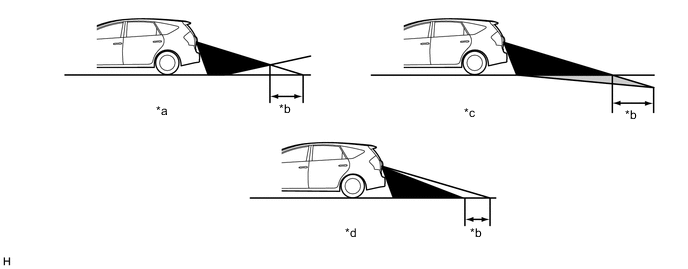
Text in Illustration *a Steep Uphill Incline behind Vehicle *b Disparity *c Steep Downhill Incline behind Vehicle *d Vehicle Posture Changed by Passengers and Load -
If a steep uphill incline is behind the vehicle, an obstacle will appear to be further away than it actually is, as shown in the illustration below.
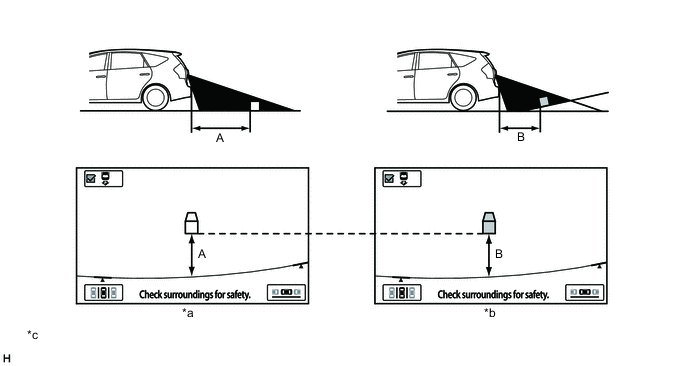
Text in Illustration *a Screen Image in Case A *b Screen Image in Case B *c The illustrations shown are examples only. The illustrations may differ from the actual vehicle screens. - - -
On slippery roads, such as snowy roads, the estimated vehicle path and actual vehicle path may not match.
-
When only one parking line is provided, the vehicle may seem to be parallel to the line on the screen even if it is not actually parallel.
-
-
Precautions for 3-Dimensional Obstacles
-
Drive carefully when any 3-dimensional objects, such as walls or vehicles, are behind the vehicle as the distance and estimated guide lines are provided based on the road surface.
-
When passing close to a 3-dimensional object, the vehicle may come into contact with the object even if the estimated vehicle path seems not to be in contact with it on the screen.
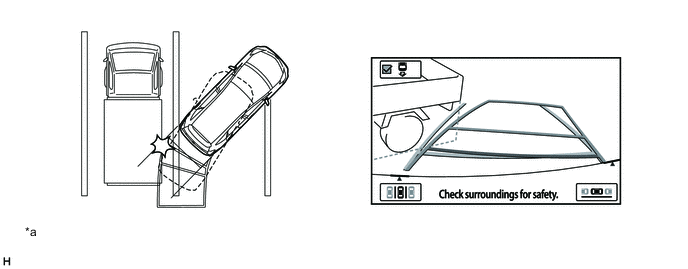
Text in Illustration *a The illustration shown is an example only. The illustration may differ from the actual vehicle screen. - -
-
The distance indication as shown on the screen varies between 3-dimensional objects such as a vehicle and a flat plane such as the road surface. As shown in the following illustrations, points A and B are actually vertically aligned and point C is farther away from them, however, the points are displayed in order of distance from the vehicle, B, C and A. Therefore, the vehicle will come into contact with the 3-dimensional object if it is backed to point B on the screen.
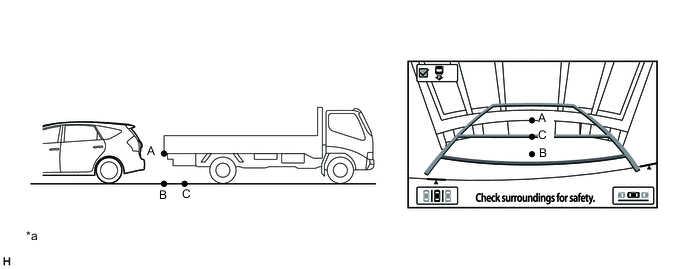
Text in Illustration *a The illustration shown is an example only. The illustration may differ from the actual vehicle screen. - -
-
-
-
Ultrasonic Sensor Precautions
-
The No. 1 ultrasonic sensor may not operate properly in the following conditions:
-
When foreign matter such as ice, snow or mud is attached to the No. 1 ultrasonic sensors. If the sensor is cleaned, the system will return to normal.
-
When a No. 1 ultrasonic sensor is frozen. If the No. 1 ultrasonic sensor temperature rises, the system will return to normal.
-
When a No. 1 ultrasonic sensor is covered with something. If the object is removed, the system will return to normal.
-
-
Especially in cold weather, a malfunction warning may occur (the buzzer may sound) due to a frozen ultrasonic sensor. If the malfunction warning occurs, be sure to check the No. 1 ultrasonic sensors. If there is no mud, ice or snow on the No. 1 ultrasonic sensors, a No. 1 ultrasonic sensor may be malfunctioning.
-
In the following conditions, the detection range may be affected:
-
When foreign matter such as snow or mud is attached to a No. 1 ultrasonic sensor.
-
When the vehicle is operated under the hot sun or in a freezing climate.
-
-
In the following conditions, a detection error may occur:
-
When the vehicle is being driven on bumpy road, gravel road, or on grass.
-
When ultrasonic waves are received from the horn or parking sonar system of another vehicle, a motorcycle engine, or the air brakes of a large vehicle.
-
When there is a downpour, or water is splashing on the vehicle.
-
When the vehicle posture tilts significantly.
-
When an antenna for a wireless transmitter is mounted on the vehicle.
-
When the No. 1 ultrasonic sensors are covered with foreign matter such as ice, snow or mud.
-
When the vehicle travels alongside a tall curb or a square curb.
-
When other vehicles with sonar are near.
-
When the bumper is damaged.
-
-
There are cases in which the objects listed below cannot be detected:
-
Thin objects such as wire or rope.
-
Objects with surfaces that are too small to reflect ultrasonic waves such as wire gauze or a fence.
-
Objects that absorb ultrasonic waves such as cotton or snow.
-
Objects that have sharp edges.
-
Objects that are short.
-
Objects that are tall and protrude toward the vehicle above the detection range of the sensors.
-
-
Other notices
-
Objects directly underneath the bumpers cannot be detected. Some objects located lower than the No. 1 ultrasonic sensors, or thin objects, may not be detected as the vehicle approaches the objects.
-
An object might not be detected if the vehicle is too close.
-
The No. 1 ultrasonic sensors might not detect obstacles properly if they are exposed to strong shocks such as when being struck or dropped.
-
-
-
Other Precautions
-
Do not use tires of a different size from those that came new with the vehicle, otherwise the system may not operate properly or may display improper estimated guide lines. Therefore, confirm tire fitment before replacing the tires.
-
Directly verify the rear and the surroundings of the vehicle with your eyes for safety before backing up the vehicle. Never attempt to back up the vehicle only by observing the screen.
-
-