BRAKE CONTROL SYSTEM
-
SYSTEM CONTROL
-
If the driver presses the accelerator pedal aggressively when starting off or when accelerating on a slippery surface, the drive wheels could slip due to the excessive amount of torque that is generated. By applying hydraulic brake control to the drive wheels and regulating the throttle to control the engine output, TRC helps minimize the slippage of the drive wheels, thus generating the drive force that is appropriate for the road surface conditions.
-
For example, a comparison may be made between two vehicles, one with the TRC function and the other without. If the driver of each vehicle operates the accelerator pedal in a rough manner while driving over a surface with different surface friction characteristics, the drive wheels on the slippery surface could slip as illustrated. As a result, the vehicle could become unstable.
-
However, when the vehicle is equipped with the TRC function, the skid control ECU assembly determines the state of the vehicle and operates the brake actuator assembly in order to apply the brake of the slipping drive wheel. Furthermore, the hybrid vehicle control ECU assembly receives signals from the skid control ECU assembly and regulates the throttle in order to control the engine output. Thus, this function can constantly maintain a stable vehicle posture.
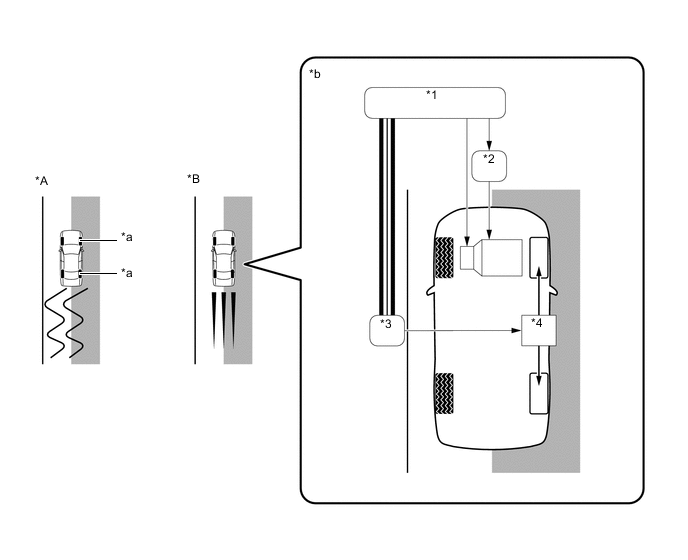
*A Models without Traction Control (TRC) *B Models with Traction Control (TRC) *1 Hybrid Vehicle Control ECU Assembly *2 ECM Assembly *3 Skid Control ECU Assembly *4 Brake Actuator Assembly *a Excessive drive force causes the drive wheels to slip *b Regulates the motive force of Engine and MG2 
Slippery Surface 
CAN Communication Line
-