REPAIR INSTRUCTION VEHICLE LIFT AND SUPPORT LOCATIONS
-
NOTICE ABOUT VEHICLE CONDITION WHEN RAISING VEHICLE
-
The vehicle must be unloaded before jacking up or raising the vehicle. Never jack up or raise a heavily loaded vehicle.
-
Set the jack and safety stands exactly under the specified locations on the vehicle.
-
Never try to jack up or raise a vehicle that exceeds the weight specifications of the equipment being used.
-
When raising the vehicle, first raise the vehicle only a little, and then shake the vehicle slightly to make sure it is stable before raising it to the specified position.
-
Before removing the jack, tap the safety stands with a hammer or equivalent to make sure that the vehicle is properly supported.
-
When using a lift, always lower the vehicle when work is not being performed.
-
When removing any heavy components like the engine or transmission, the vehicle's center of gravity will shift. To stabilize the vehicle, place a balance weight in a location that will prevent the vehicle from rolling or shifting, or place a transmission jack under the appropriate jack position at the opposite end of the vehicle.
-
-
NOTICE FOR USING 4 POST LIFT
-
Follow the safety procedures outlined in the lift's instruction manual.
-
Use precautionary measures to prevent the free wheel beam from damaging tires or wheels.
-
Use wheel chocks to secure the vehicle.
-
-
NOTICE FOR USING JACK AND SAFETY STAND
-
Work on a level surface. Use wheel chocks at all times.
-
Set the jack and safety stands to the specified locations on the vehicle accurately.
-
When jacking up the vehicle, first release the parking brake and move the shift lever to N.
-
When jacking up the entire vehicle:
-
When jacking up the front wheels first, make sure wheel chocks are behind the rear wheels.
-
When jacking up the rear wheels first, make sure wheel chocks are in front of the front wheels.
-
-
When jacking up only the front or rear wheels of the vehicle:
-
Before jacking up the front wheels, place wheel chocks on both sides of the rear wheels.
-
Before jacking up the rear wheels, place wheel chocks on both sides of the front wheels.
-
-
When lowering a vehicle that only has its front or rear wheels jacked up:
-
Before lowering the front wheels, make sure wheel chocks are in front of the rear wheels.
-
Before lowering the rear wheels, make sure wheel chocks are behind the front wheels.
-
-
It is extremely dangerous to perform any work on a vehicle raised on a jack alone, even for work that can be finished quickly. Safety stands must be used to support the vehicle.
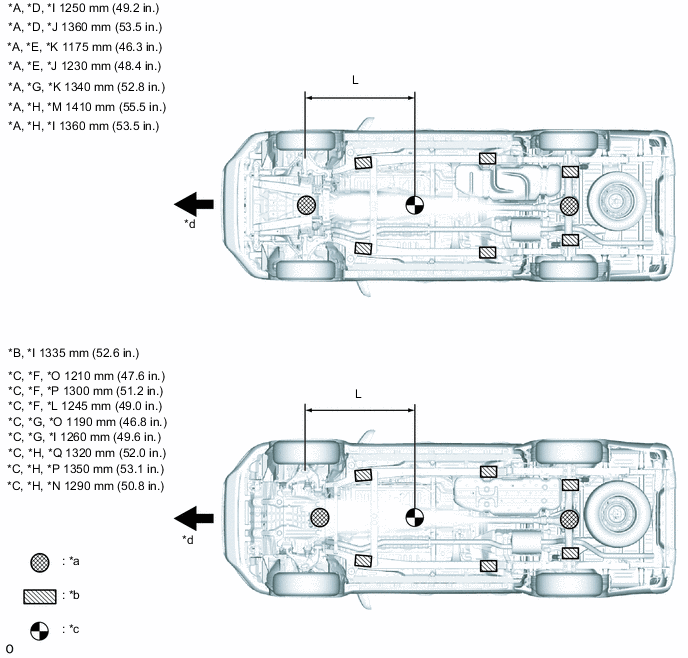
*A for 2WD (except Pre-Runner) *B for Pre-Runner *C for 4WD *D for Single Cab, Wheel Base Long *E for Single Cab, Wheel Base Short *F for Single Cab *G for Smart Cab *H for Double Cab *I for 1GD-FTV, 2GD-FTV, 2KD-FTV *J for 1TR-FE, 2TR-FE *K for 2GD-FTV, 2KD-FTV *L for 2KD-FTV *M for 1GR-FE, 1TR-FE, 2TR-FE *N for 1GD-FTV, 2GD-FTV, 1KD-FTV, 2KD-FTV *O for 1GD-FTV, 2GD-FTV *P for 2TR-FE *Q for 1GR-FE - - *a JACK POSITION
Front: Center of crossmember
Rear: Center of rear differential
CAUTION:
When jacking up the vehicle, make sure the vehicle is not carrying any extra weight.
*b SUPPORT POSITION
- Safety stand
*c VEHICLE CENTER OF GRAVITY (Unloaded Condition) *d Front
-
-
NOTICE FOR USING A SWING ARM TYPE LIFT
-
Follow the safety procedures outlined in the lift's instruction manual.
-
Use swing arms equipped with rubber attachments as shown in the illustration.
-
Position the vehicle so that its center of gravity is centered on the lift (length of "L" in the illustration should be as short as possible).
-
Ensure that the rubber cushions or swing arms do not contact the body cladding or lower mouldings.
-
Be sure to lock the swing arms before raising the vehicle (if equipped with arm locks).
-
Use the lift to raise the vehicle until the tires are off the ground, then stop the lift and shake the front and rear of the vehicle to make sure that it is stable.
-
for Single Cab:
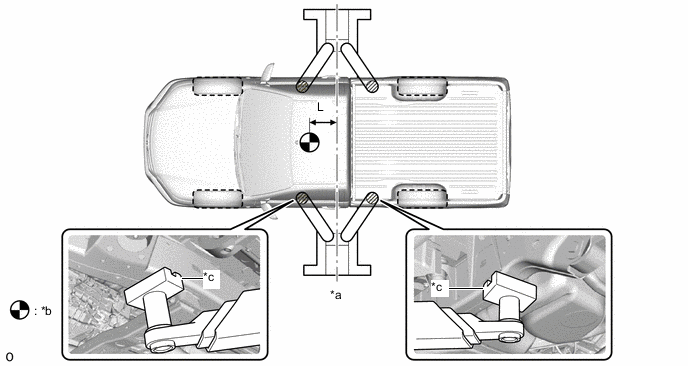
*a Center of lift *b VEHICLE CENTER OF GRAVITY (Unloaded Condition) *c Attachment - - -
for Smart Cab:
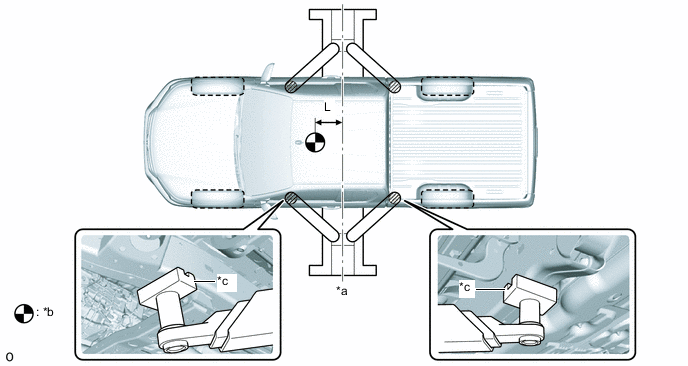
*a Center of lift *b VEHICLE CENTER OF GRAVITY (Unloaded Condition) *c Attachment - - -
for Double Cab:
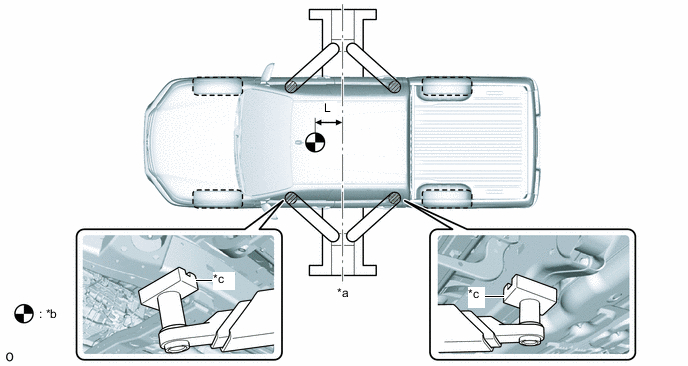
*a Center of lift *b VEHICLE CENTER OF GRAVITY (Unloaded Condition) *c Attachment - -
-
-