LUBRICATION SYSTEM ON-VEHICLE INSPECTION
PROCEDURE
-
CHECK ENGINE OIL LEVEL
-
Warm up and stop the engine, then wait for 5 minutes.
-
Check that the engine oil level is between the low level and full level marks on the engine oil level dipstick.
If the level is low, check for engine oil leaks and add engine oil to the full level mark.
Note
Do not fill to above the full level mark.
Tech Tips
A certain amount of engine oil will be consumed while driving. In the following situations, engine oil consumption may increase, and engine oil may need to be refilled in between oil maintenance intervals.
-
When the engine is new, for example directly after purchasing the vehicle or after replacing the engine.
-
If low quality engine oil or oil of an inappropriate viscosity is used.
-
When driving at high engine speeds or with a heavy load (when towing, etc.), or when accelerating or decelerating frequently while driving.
-
When idling for a long time, or when driving frequently through heavy traffic.
When judging the amount of oil consumption, keep in mind that the oil may have become diluted, making it difficult to judge the true level accurately.
-
-
-
CHECK ENGINE OIL QUALITY
-
Check the engine oil for deterioration, water intrusion, discoloration or thinning.
If the quality is visibly poor, replace the engine oil and oil filter element.
-
-
INSPECT OIL PRESSURE
CAUTION:
-
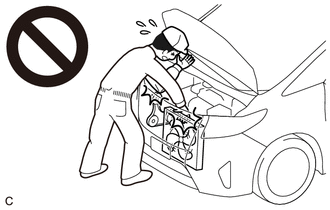
To prevent injury due to contact with an operating V-ribbed belt or cooling fan, keep your hands and clothing away from the V-ribbed belt and cooling fan when working in the engine compartment with the engine running or the ignition switch ON.
-
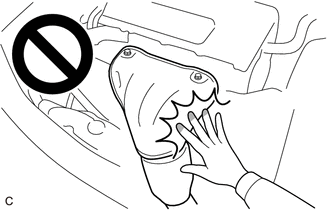
To prevent burns, do not touch the engine, exhaust manifold or other high temperature components while the engine is hot.
-
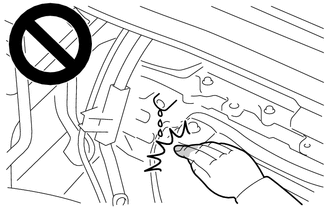
To prevent burns, do not remove the oil pressure sender gauge assembly while the engine is hot.
-
Connect the GTS to the DLC3.
-
Turn the ignition switch to ON.
-
Turn the GTS on.
-
Enter the following menus: Powertrain / Engine / Trouble Codes.
Powertrain > Engine > Trouble CodesNote
If any DTCs are present, perform troubleshooting in accordance with the procedure for each DTC.
-
Remove the oil pressure sender gauge assembly.
-

Install an oil pressure gauge with an adapter.
-
Warm up the engine.
Tech Tips
After warming up the engine, the engine coolant temperature is 75 to 100°C (167 to 212°F).
-
Check the oil pressure.
Standard Oil Pressure Condition Specified Condition Idling 60 kPa (0.6 kgf/cm2, 8.7 psi) or higher
2000 rpm 190 kPa (1.9 kgf/cm2, 28 psi) or higher
4000 rpm 300 kPa (3.1 kgf/cm2, 44 psi) or higher
If the result is not as specified, check the quality of the engine oil and check the oil paths for clogging. Repair or replace if necessary. If the engine oil pressure is still not as specified, check the oil pump assembly.
-
Remove the oil pressure gauge with the adapter.
CAUTION:
Make sure the engine is cold when removing the oil pressure gauge to prevent burns caused by hot engine oil.
-
Install the oil pressure sender gauge assembly.
-
Turn the ignition switch to ON.
-
Turn the GTS on.
-
Enter the following menus: Powertrain / Engine / Trouble Codes.
-
Clear the DTCs.
Powertrain > Engine > Clear DTCs -
Inspect for engine oil leaks.
-