ECD SYSTEM, Diagnostic DTC:P200C and P200E
| DTC Code | DTC Name |
|---|---|
| P200C | Diesel Particulate Filter Over Temperature Bank 1 |
| P200E | Catalyst System Temperature Too High Bank 1 |
DESCRIPTION
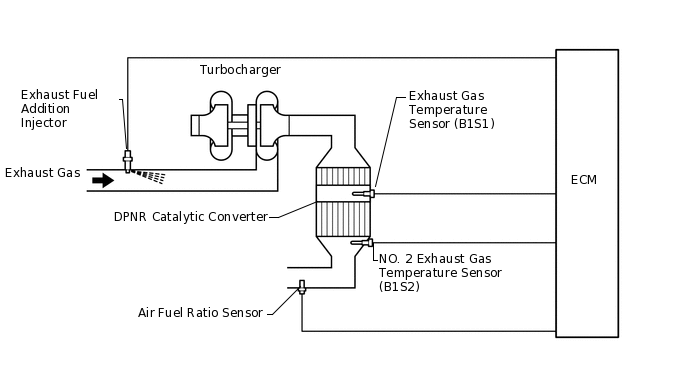
The exhaust fuel addition injector is mounted on the exhaust port of the cylinder head, and low pressure fuel is supplied to the injector by the feed pump in the supply pump. This injector adds fuel in response to a control signal from the ECM, in order to perform PM forced regeneration.
During PM forced regeneration, the exhaust fuel addition injector adds fuel to raise the DPNR*1 catalyst temperature.
For more information on the exhaust fuel addition injector assembly and TOYOTA D-CAT*2, refer to the following procedures (Click here).
If P200C and P200E are present, refer to the diagnostic trouble code (DTC) chart for TOYOTA D-CAT (Click here).
-
*1: Diesel Particulate-NOx Reduction system
*2: Diesel Clean Advanced Technology
DTC No. |
Detection Item |
DTC Detection Condition |
Trouble Area |
MIL |
Memory |
|---|---|---|---|---|---|
P200C |
Diesel Particulate Filter Over Temperature Bank 1 |
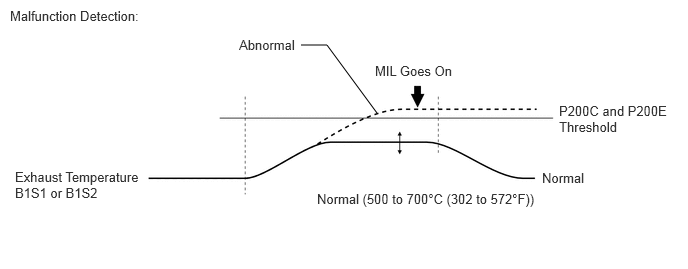
The value of "Exhaust Temperature B1S2" is higher than 1000°C (1832°F) for 5 seconds (1 trip detection logic). |
|
Comes on |
DTC stored |
P200E |
Catalyst System Temperature Too High Bank 1 |
The value of "Exhaust Temperature B1S1" is higher than 1000°C (1832°F) for 5 seconds (1 trip detection logic). |
|
Comes on |
DTC stored |
Due to fail-safe operation when other DTCs (that involve the engine power limit) are stored, PM forced regeneration may be prohibited.
This DTC or P20CF, P244B, P244C and P2463 may be stored due to the fact that PM forced regeneration is prohibited due to the fail-safe operation of other DTCs.
The air fuel ratio and the exhaust gas temperature can be checked by entering the following menus on the GTS: Powertrain / Engine / Data List / AF Lambda B1S1, Exhaust Temperature B1S1 and Exhaust Temperature B1S2.
Malfunctions in the engine itself may affect the DPNR system control and cause storage of this DTC. For example, malfunctions in the injector assemblies that cause a large amount of smoke emission: These affect the exhaust fuel addition injector assembly operation.
Malfunctions in the engine itself may affect the DPNR system control and cause storage of this DTC. For example, malfunctions in the injector assemblies that cause a large amount of smoke emission: These affect the exhaust fuel addition injector assembly operation. Blockages or leaks in the air intake system, or an EGR system malfunction such as EGR passage blockages: These malfunctions affect the DPNR catalyst temperature control. Therefore, the engine condition itself should also be checked, in addition to the exhaust fuel addition injector assembly.
DTC No. |
Data List |
|---|---|
P200C |
|
P200E |
MONITOR DESCRIPTION
The ECM monitors DPNR catalyst temperature. When the temperature becomes high due to uncombusted fuel, engine oil or thermal degradation to the DPNR catalyst, the ECM illuminates the MIL.
CONFIRMATION DRIVING PATTERN
DTC No. |
DTC Detection Drive Pattern |
|---|---|
P200C |
PM forced regeneration* *: When P200C is detected due to a DPNR catalyst problem such as thermal degradation, because the malfunction cannot be duplicated even if the vehicle is driven after PM forced regeneration is performed, perform troubleshooting by following the diagnosis procedure and checking the freeze frame data. |
P200E |
PM forced regeneration* *: When P200E is detected due to a DPNR catalyst problem such as thermal degradation, because the malfunction cannot be duplicated even if the vehicle is driven after PM forced regeneration is performed, perform troubleshooting by following the diagnosis procedure and checking the freeze frame data. |
CAUTION / NOTICE / HINT
Inspect the fuses of circuits related to this system before performing the following inspection procedure.
After replacing the ECM, the new ECM needs registration (Click here) and initialization (Click here).
After replacing the fuel supply pump assembly, the ECM needs initialization (Click here).
After replacing an injector assembly, the ECM needs registration (Click here).
Read freeze frame data using the GTS. Freeze frame data records the engine condition when malfunctions are detected. When troubleshooting, freeze frame data can help determine if the vehicle was moving or stationary, if the engine was warmed up or not, and other data from the time the malfunction occurred.
PROCEDURE
READ DTC OUTPUT (RECORD STORED DTC AND FREEZE FRAME DATA (PROCEDURE 1))
Connect the GTS to the DLC3.
Turn the ignition switch to ON and turn the GTS on.
Enter the following menus: Powertrain / Engine / Trouble Codes.
Powertrain > Engine > Trouble Codes
Record the stored DTC and freeze frame data.
Result
Proceed to
NEXT
REPLACE EXHAUST GAS TEMPERATURE SENSOR
Check the values of "Exhaust Temperature B1S1" and "Exhaust Temperature B1S2" that were saved in Procedure 1.
Table 2. Result Result
Items to be Replaced
DTC P200E is output and the value of "Exhaust Temperature B1S1" is 850°C (1562°F) or higher
Exhaust gas temperature sensor (B1S1)
DTC P200C is output and the value of "Exhaust Temperature B1S2" is 850°C (1562°F) or higher
No. 2 exhaust gas temperature sensor (B1S2)
If DTC P200C and/or P200E is output, the exhaust gas temperature sensors need to be replaced. However, make sure to perform all diagnostic procedures for P200C and/or P200E before replacing the exhaust gas temperature sensors.
Tip:If the exhaust gas temperature sensors are subjected to an abnormally high temperature, the internal resistance of the sensor increases. This causes incorrect temperature measurement.
Result
Proceed to
NEXT
CHECK FOR BLACK SMOKE
Start the engine and drive the vehicle until the engine coolant temperature reaches 60°C (140°F) or higher.
Stop the vehicle and allow the engine to idle.
Fully depress the accelerator pedal for 5 seconds, and then release it [A].
Repeat the above procedure [A] 10 times [B].
Check for black smoke emission during procedure [A] and [B].
OK
Black smoke is emitted less than 5 times.
Tip:Even if the black smoke is very thin, count the number of black smoke emissions if there is any visible smoke.
Result
Proceed to
OK
NG
OK CHECK FUEL INJECTION SYSTEMClick here
REPLACE EXHAUST MANIFOLD CONVERTER SUB-ASSEMBLY
Even though it has been determined that the DPNR catalytic converter (Exhaust manifold converter sub-assembly) needs to be replaced, make sure to perform all diagnostic procedures for DTC P200C, P200E and/or P2428 before replacing it.
Tip:This DTC is stored because an excessive amount of PM has accumulated and resulted in abnormal combustion. It is necessary to diagnose the cause of abnormal PM accumulation and repair the problem. Therefore, do not perform replacement at this time.
Result
Proceed to
NEXT
CHECK FUEL INJECTION SYSTEM
Check the fuel injection system.
Result
Proceed to
NEXT
CHECK INTAKE / EXHAUST SYSTEM
Check the intake/exhaust system.
Result
Proceed to
NEXT
CHECK AFTER TREATMENT CONTROL SYSTEM
Check the after treatment control system.
Result
Proceed to
NEXT
REPLACE MALFUNCTIONING PARTS
Tip:Replace the following items only when it has been determined necessary based on diagnosis for DTC P200C and/or P200E.
Replace the DPNR catalytic converter (Exhaust manifold converter sub-assembly).
Replace the exhaust gas temperature sensor (B1S1).
Replace the No. 2 exhaust gas temperature sensor (B1S2).
Result
Proceed to
NEXT
CONFIRM WHETHER MALFUNCTION HAS BEEN SUCCESSFULLY REPAIRED
Clear the DTC and Exhaust Fuel Addition FB value by disconnecting the cable from the negative (-) battery terminal or removing the EFI-MAIN NO. 1 fuse for 1 minute or more.
Tip:The accumulated PM volume stored in the ECM cannot be initialized using the GTS.
To perform PM forced regeneration, it is necessary to perform initialization of the accumulated PM volume stored in the ECM.
Connect the GTS to the DLC3.
Start the engine and drive the vehicle until the engine coolant temperature reaches 60°C (140°F) or higher.
Move the shift lever to neutral and set the parking brake.
Turn the GTS on.
Enter the following menus: Powertrain / Engine / Active Test / Activate the DPF Rejuvenate (PM) / Data List / PM Accumulation Ratio.
Powertrain > Engine > Active Test
Active Test Display
Activate the DPF Rejuvenate (PM)
Data List Display
PM Accumulation Ratio
Perform the Active Test while the vehicle is driven at a constant vehicle speed within 50 to 100 km/h (31 to 62 mph) (transaxle in 3rd gear) for more than 15 minutes.
Tip:While the "Activate the DPF Rejuvenate (PM)" Active Test is being performed, the accelerator opening angle should be kept as constant as possible.
When you start driving, "DPNR/DPF Status Reju (PM)" on the Data List displays "Compl". However, continue to drive the vehicle until "PM Accumulation Ratio" drops to 0%.
Once "PM Accumulation Ratio" drops to 0%, regeneration is complete.
Continue to drive the vehicle until "PM Accumulation Ratio" drops to 0%.
CAUTION:Be aware of excessive heat on and around the exhaust pipes during PM forced regeneration.
Note:If PM forced regeneration stops, repair the malfunction that caused it to stop, and perform it again to complete the operation.
Tip:PM forced regeneration completes in 15 to 40 minutes.
PM forced regeneration time changes depending on PM Accumulation Ratio and driving conditions.
A fail-safe stops PM forced regeneration if Catalyst Differential Press increases too much during regeneration
Exhaust Temperature B1S2 becomes 500°C (932°F) or higher within 20 minutes of PM forced regeneration start.
PM forced regeneration will be stopped if the accelerator pedal is depressed during regeneration. In this case, PM forced regeneration needs to be performed again.
Even if PM forced regeneration stops while it is occurring, the GTS displays Compl (complete) for DPNR/DPF Status Reju (PM).
Result
Proceed to
NEXT
NEXT END