SFI SYSTEM, Diagnostic DTC:P0420
| DTC Code | DTC Name |
|---|---|
| P0420 | Catalyst System Efficiency Below Threshold (Bank 1) |
DESCRIPTION
This vehicle has two heated oxygen sensors. One is located in front of the Three-Way Catalytic Converter (TWC), and the other is mounted behind the TWC. The output signals of the sensors are converted into waveforms inside the ECM. The heated oxygen sensors are used by the ECM to monitor the air fuel ratio, and its signal prompts the ECM to perform air fuel ratio feedback control. As a result, the air fuel ratio is balanced, and the waveform of the heated oxygen sensors regularly oscillates between rich and lean. To determine whether or not the TWC performance has deteriorated, the ECM compares the waveforms of the heated oxygen sensor (sensor 1) and heated oxygen sensor (sensor 2). While the TWC is functioning normally, the waveform of the heated oxygen sensor (sensor 2) fluctuates between rich and lean more slowly than the heated oxygen sensor (sensor 1) waveform. When the heated oxygen sensor (sensor 2) waveform frequently fluctuates, it indicates that the TWC performance has deteriorated.
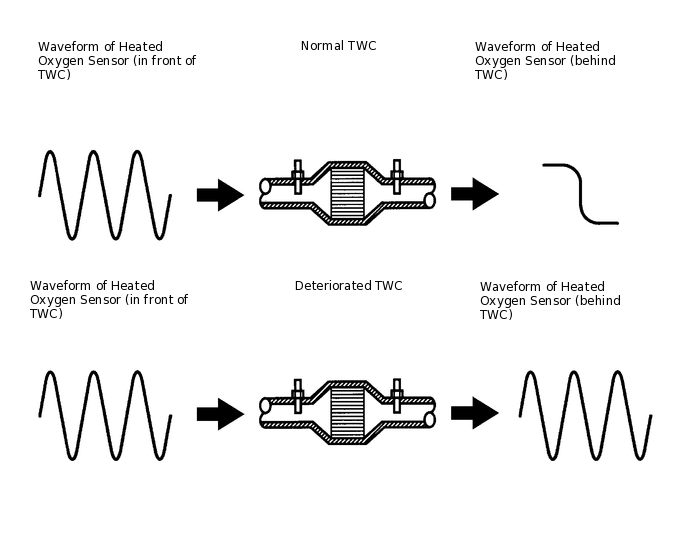
DTC No. |
Detection Item |
DTC Detection Condition |
Trouble Area |
MIL |
Memory |
|---|---|---|---|---|---|
P0420 |
Catalyst System Efficiency Below Threshold (Bank 1) |
After engine and TWC are warmed up, and while vehicle is driven within predetermined engine speed (3 trip detection logic). |
|
Come on |
DTC stored (Euro-OBD) - (except Euro-OBD) |
CATALYST LOCATION
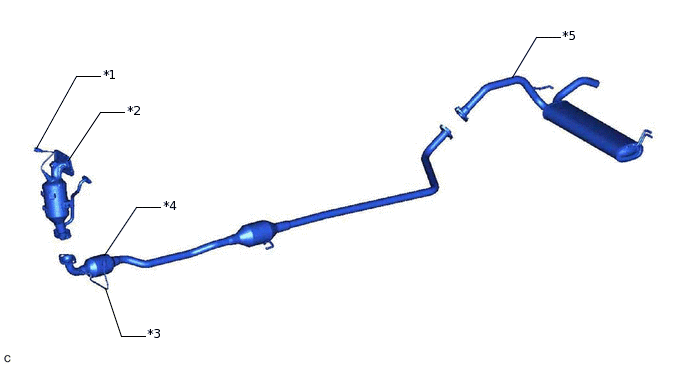
*1 |
Heated Oxygen Sensor (Sensor 1) |
*2 |
Exhaust Manifold (TWC: Front Catalyst) |
*3 |
Heated Oxygen Sensor (Sensor 2) |
*4 |
Front Exhaust Pipe Assembly (TWC: Rear Catalyst) |
*5 |
Tail Exhaust Pipe Assembly |
- |
- |
CONFIRMATION DRIVING PATTERN
When performing the confirmation driving pattern, obey all speed limits and traffic laws.
DTC P0420 is detected when the vehicle is driven at an average vehicle speed of approximately 50 km/h (31 mph) with a city driving pattern for approximately 30 minutes, and then driven for approximately 15 minutes at a constant vehicle speed of between 70 and 90 km/h (43 and 56 mph).
CAUTION / NOTICE / HINT
Read freeze frame data using the GTS. Freeze frame data records the engine condition when malfunctions are detected. When troubleshooting, freeze frame data can help determine if the vehicle was moving or stationary, if the engine was warmed up or not, if the air fuel ratio was lean or rich, and other data from the time the malfunction occurred.
PROCEDURE
CHECK ANY OTHER DTCS OUTPUT (IN ADDITION TO DTC P0420)
Connect the GTS to the DLC3.
Turn the ignition switch to ON.
Turn the GTS on.
Enter the following menus: Powertrain / Engine and ECT / Trouble Codes.
Read the DTCs.
Powertrain > Engine and ECT > Trouble Codes
Result
Result
Proceed to
DTC P0420 is output
A
DTC P0420 and other DTCs are output
B
Tip:If any DTCs other than P0420 are output, troubleshoot those DTCs first.
PERFORM ACTIVE TEST USING GTS (CONTROL THE INJECTION VOLUME FOR A/F SENSOR)
Connect the GTS to the DLC3.
Start the engine.
Turn the GTS on.
Warm up the engine at an engine speed of 2500 rpm for approximately 3 minutes.
Enter the following menus: Powertrain / Engine and ECT / Active Test / Control the Injection Volume for A/F Sensor / All Data / O2S B1S1 and O2S B1S2.
Powertrain > Engine and ECT > Active Test
Active Test Display
Control the Injection Volume for A/F Sensor
Data List Display
O2S B1S1
O2S B1S2
Perform the Active Test operation with the engine idling (press the RIGHT or LEFT button to change the fuel injection volume).
Monitor the voltage output of the heated oxygen sensor (sensor 1) and heated oxygen sensor (sensor 2) (O2S B1S1 and O2S B1S2) displayed on the GTS.
Tip:The Control the Injection Volume for A/F Sensor operation lowers the fuel injection volume by 12.5% or increases the injection volume by 12.5%.
If the sensor output voltage does not change (almost no reaction) while performing the Active Test, the sensor may be malfunctioning.
Result
The heated oxygen sensors reacts in accordance with increases and decreases of the fuel injection volume
+12.5% = Rich output
Higher than 0.55 V
-12.5% = Lean output
Below 0.4 V
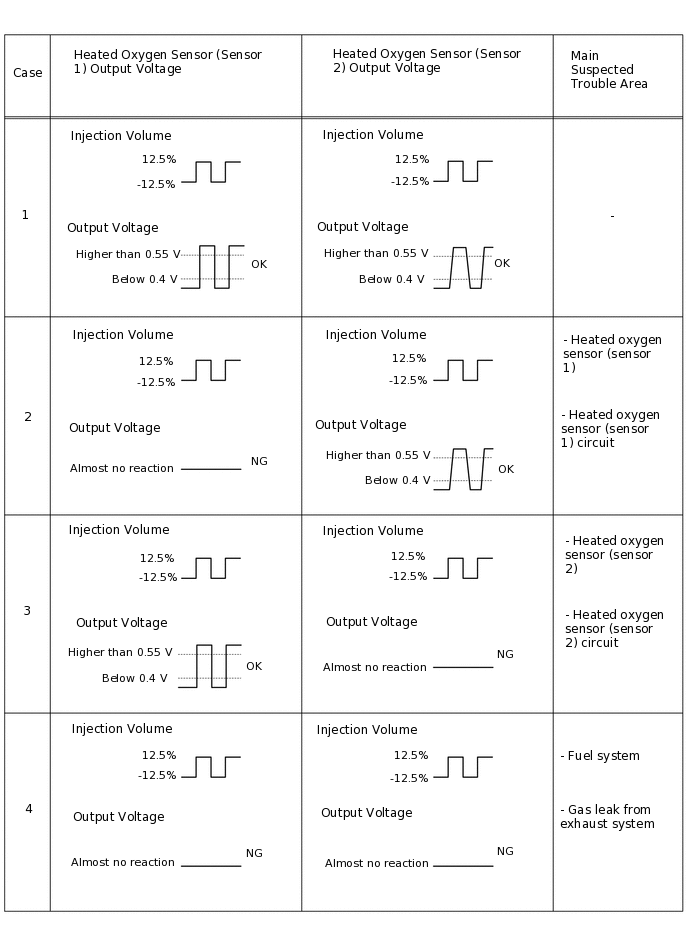
The following procedure enables the technician to check and graph the voltage output of both the heated oxygen sensors.
To display the graph, enter the following menus:
Powertrain / Engine and ECT / Active Test / Control the Injection Volume for A/F Sensor / All Data / O2S B1S1 and O2S B1S2; then press the view button.
Result
Result
Proceed to
Case 1
A
Case 2
B
Case 3
C
Case 4
D
C CHECK FOR EXHAUST GAS LEAKClick here
D CHECK EXTREMELY RICH OR LEAN ACTUAL AIR FUEL RATIO, AND GO TO STEP 3
CHECK FOR EXHAUST GAS LEAK
Check for exhaust gas leak.
OK
No gas leak.
Result
Proceed to
OK
NG
NG REPAIR FOR EXHAUST GAS LEAK POINT
CHECK FOR EXHAUST GAS LEAK
Check for exhaust gas leak.
OK
No gas leak.
Result
Proceed to
OK
NG
NG REPAIR FOR EXHAUST GAS LEAK POINT