SFI SYSTEM, Diagnostic DTC:P0137, P0138, P013A, P013B, P013E, P013F, P0140
| DTC Code | DTC Name |
|---|---|
| P0137 | Oxygen Sensor Circuit Low Voltage (Bank 1 Sensor 2) |
| P0138 | Oxygen Sensor Circuit High Voltage (Bank 1 Sensor 2) |
| P013A | Oxygen Sensor Slow Response - Rich to Lean Bank 1 Sensor 2 |
| P013B | O2 Sensor Slow Response - Lean to Rich (Bank 1 Sensor 2) |
| P013E | O2 Sensor Delayed Response - Rich to Lean (Bank 1 Sensor 2) |
| P013F | O2 Sensor Delayed Response - Lean to Rich (Bank 1 Sensor 2) |
| P0140 | Oxygen Sensor Circuit No Activity Detected (Bank 1 Sensor 2) |
DESCRIPTION
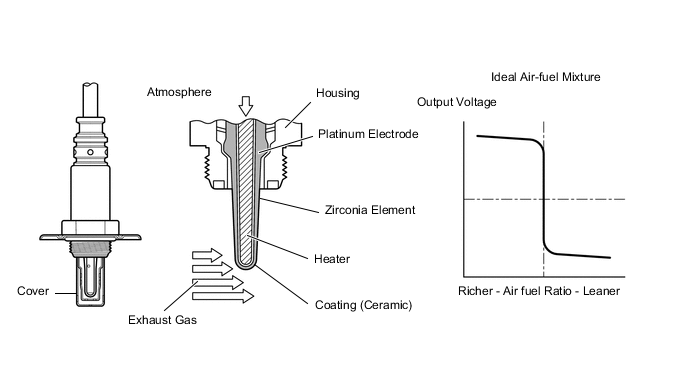
In order to obtain a high purification rate of the carbon monoxide (CO), hydrocarbon (HC) and nitrogen oxide (NOx) components in the exhaust gas, a TWC (Three-Way Catalytic Converter) is used. For the most efficient use of the TWC, the air fuel ratio must be precisely controlled so that it is always close to the stoichiometric air fuel level. For the purpose of helping the ECM to deliver accurate air fuel ratio control, a Heated Oxygen (HO2) sensor is used.
The HO2 sensor is located behind the TWC, and detects the oxygen concentration in the exhaust gas. Since the sensor is integrated with the heater that heats the sensing portion, it is possible to detect the oxygen concentration even when the intake air volume is low (the exhaust gas temperature is low).
When the air fuel ratio becomes lean, the oxygen concentration in the exhaust gas is rich. The HO2 sensor informs the ECM that the post-TWC air fuel ratio is lean (low voltage, i.e. less than 0.45 V).
Conversely, when the air fuel ratio is richer than the stoichiometric air fuel level, the oxygen concentration in the exhaust gas becomes lean. The HO2 sensor informs the ECM that the post-TWC air fuel ratio is rich (high voltage, i.e. more than 0.45 V). The HO2 sensor has the property of changing its output voltage drastically when the air fuel ratio is close to the stoichiometric level.
The ECM uses the supplementary information from the HO2 sensor to determine whether the air fuel ratio after the TWC is rich or lean, and adjusts the fuel injection time accordingly. Thus, if the HO2 sensor is working improperly due to internal malfunctions, the ECM is unable to compensate for deviations in the primary air fuel ratio control.
| DTC No. | DTC Detection Condition | Trouble Area |
|---|---|---|
| P0137 | Heated Oxygen (HO2) sensor voltage is less than 0.03 V. (2 trip detection logic) |
|
| P0138 | Heated Oxygen (HO2) sensor voltage is 1.2 V or more for 2.5 seconds or more. (2 trip detection logic) |
|
| P013A | The response rate for heated oxygen sensor voltage to change from 0.5 V (rich) to 0.2 V (lean) is slow for 2 seconds or more. (2 trip detection logic) |
|
| P013B | The response rate for heated oxygen sensor voltage to change from 0.3 V (lean) to 0.5 V (rich) is slow for 4 seconds or more. (2 trip detection logic) |
|
| P013E | Heated oxygen sensor voltage is slow in dropping to 0.5 V or less for 4 seconds or more. (2 trip detection logic) |
|
| P013F | Heated oxygen sensor voltage is slow in increasing to 0.3V or more for 120 seconds. (2 trip detection logic) |
|
| P0140 | One of the following conditions is met for 180 seconds or more (2 trip detection logic):
|
MONITOR DESCRIPTION
-
Abnormal Voltage Output of Heated Oxygen (HO2) Sensor (DTC P013B, P013F or P0140)
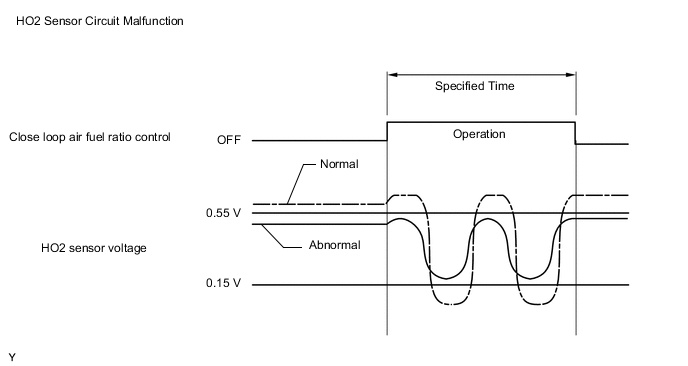
If the sensor is not functioning properly, the voltage output variation is small. For example, when the HO2 sensor voltage does not decrease to less than 0.15 V and does not increase to more than 0.55 V, the ECM determines that the sensor voltage output is abnormal and stores DTC P013B, P013F or P0140.
-
Open in Heated Oxygen (HO2) Sensor Circuit (DTC P0137)
The ECM calculates the Oxygen Storage Capacity (OSC)* of the Three-Way Catalytic Converter (TWC) by forcibly regulating the air fuel ratio to become rich or lean.
If the HO2 sensor has an open or short, or the voltage output of the sensor noticeably decreases, OSC indicates an extraordinarily high value. Even if the ECM attempts to continue regulating the air fuel ratio to become rich or lean, the HO2 sensor output does not change.
When the target air fuel ratio is rich and the HO2 sensor voltage output is 0.03 V or less (lean), the ECM interprets this as an abnormally low sensor output voltage and stores DTC P0137.
Tech Tips
*: The TWC has the capability to store oxygen. The OSC and the emission purification capacity of the TWC are mutually related. The ECM determines whether the catalyst has deteriorated, based on the calculated OSC value Click here.
-
Extremely High Output Voltage of Heated Oxygen (HO2) Sensor (DTC P0138)
The ECM continuously monitors the HO2 sensor output voltage while the engine is running.
DTC P0138 is stored if the HO2 sensor voltage output is more than 1.2 V.
-
Abnormal Voltage Output of Heated Oxygen (HO2) Sensor During Fuel-cut (DTC P013A or P013E)
The sensor output voltage drops to below 0.2 V (extremely lean status) immediately when the vehicle decelerates and fuel cut is operating. If the voltage does not drop to below 0.5 V for 4 seconds or more, or voltage does not drop from 0.5 V to 0.2 V, the ECM determines that the sensor response has deteriorated, illuminates the MIL and stores a DTC.
CONFIRMATION DRIVING PATTERN
-
Connect the GTS to the DLC3.
-
Turn the ignition switch to ON and turn the GTS on.
-
Clear DTCs (even if no DTCs are stored, perform the clear DTC operation) Click here.
-
Turn the ignition switch off and wait for at least 30 seconds.
-
Turn the ignition switch to ON and turn the GTS on.
-
Start the engine and warm it up until the engine coolant temperature reaches 75°C (167°F) or higher.
-
Perform the following the confirmation driving pattern.
CAUTION:
When performing the confirmation driving pattern, obey all speed limits and traffic laws.
-
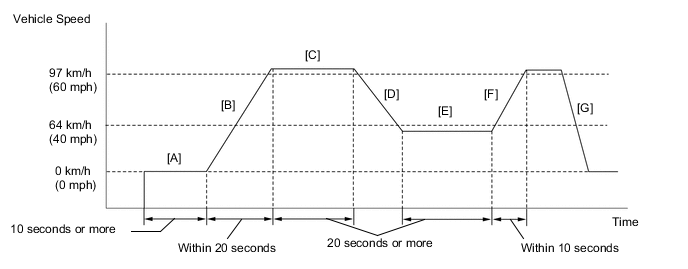
Idle the engine for 10 seconds or more [A].
-
Accelerate the vehicle to 97 km/h (60 mph) or more within 20 seconds [B].
-
Drive the vehicle at 97 km/h (60 mph) or more for 20 seconds or more [C].
-
Release the accelerator pedal to Decelerate until the vehicle speed decreases to less than 64 km/h (40 mph) [D].
Tech Tips
Release the accelerator pedal fully to perform the fuel-cut.
-
Drive the vehicle at 60 km/h (40 mph) or less for 20 seconds or more [E].
-
Accelerate the vehicle to 97 km/h (60 mph) or more within 10 seconds [F].
-
Release the accelerator pedal and stop the vehicle [G].
-
Enter the following menus: Powertrain / Engine / Trouble Codes.
-
Read pending DTCs.
Tech Tips
-
If a pending DTC is output, the system is malfunctioning.
-
If a pending DTC is not output, perform the following procedure.
-
-
Enter the following menus: Powertrain / Engine / Utility / All Readiness.
-
Input the DTC: P0137, P0138 P13A, P013B, P013E, P013F or P0140.
-
Check the DTC judgment result.
GTS Display Description NORMAL
-
DTC judgment completed
-
System normal
ABNORMAL
-
DTC judgment completed
-
System abnormal
INCOMPLETE
-
DTC judgment not completed
-
Perform driving pattern after confirming DTC enabling conditions
N/A
-
Unable to perform DTC judgment
-
Number of DTCs which do not fulfill DTC preconditions has reached ECU memory limit
Tech Tips
-
If the judgment result shows NORMAL, the system is normal.
-
If the judgment result shows ABNORMAL, the system has a malfunction.
-
-
If the test result is INCOMPLETE or N/A and no DTC is output, perform a universal trip and check for permanent DTCs Click here.
Tech Tips
-
If a permanent DTC is output, the system is malfunctioning.
-
If no permanent DTC is output, the system is normal.
-
WIRING DIAGRAM
Refer to DTC P0037 Click here.
CAUTION / NOTICE / HINT
Tech Tips
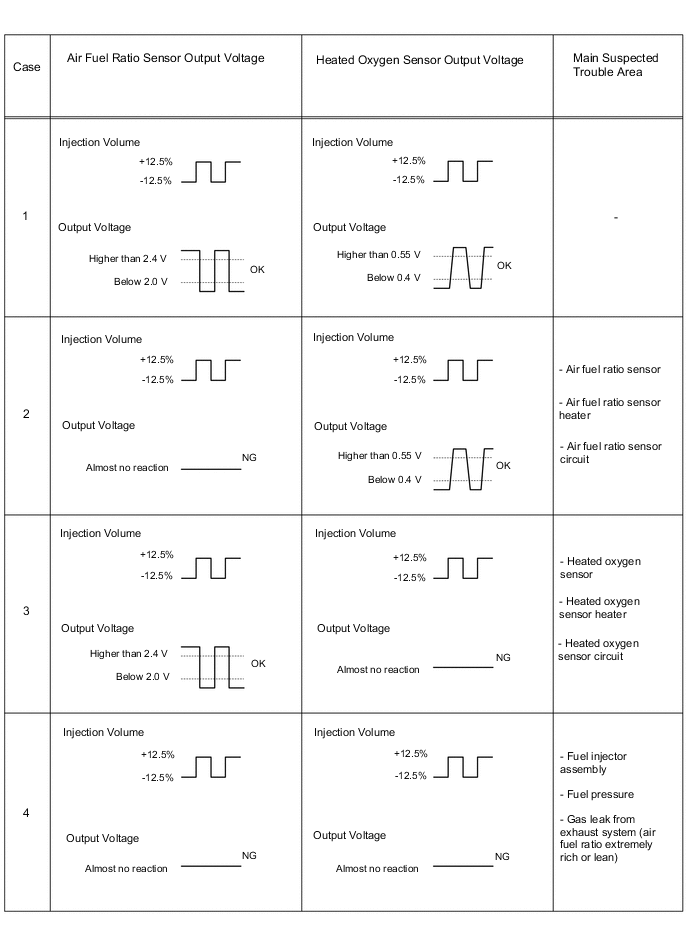
Malfunctioning areas can be identified by performing the Control the Injection Volume function provided in the Active Test. The Control the Injection Volume function can help to determine whether the air fuel ratio sensor, heated oxygen sensor and other potential trouble areas are malfunctioning.
The following instructions describe how to conduct the Control the Injection Volume operation using the GTS.
-
Connect the GTS to the DLC3.
-
Start the engine.
-
Turn the GTS on.
-
Warm up the engine at an engine speed of 2500 rpm for approximately 90 seconds.
-
Enter the following menus: Powertrain / Engine / Active Test / Control the Injection Volume.
-
Perform the Active Test operation with the engine idling (press the RIGHT or LEFT button to change the fuel injection volume).
-
Monitor the output voltages of the air fuel ratio and heated oxygen sensors (AFS Voltage B1S1 and O2S B1S2) displayed on the GTS.
Tech Tips
-
Change the fuel injection volume within the range of -12.5% to +12.5%. The injection volume can be changed in fine gradations.
-
Each sensor reacts in accordance with increases and decreases in the fuel injection volume.
| GTS Display (Sensor) | Injection Volume | Status | Voltage |
|---|---|---|---|
| AFS Voltage B1S1 (Air fuel ratio) |
+12.5% | Rich | Below 2.0 V |
| -12.5% | Lean | Higher than 2.4 V | |
| O2S B1S2 (Heated oxygen) |
+12.5% | Rich | Higher than 0.55 V |
| -12.5% | Lean | Below 0.4 V |
Note
The air fuel ratio sensor has an output delay of a few seconds and the heated oxygen sensor has a maximum output delay of approximately 20 seconds.
-
Following the Control the Injection Volume procedure enables technicians to check and graph the voltage outputs of both the air fuel ratio and heated oxygen sensors.
-
To display the graph, enter the following menus: Powertrain / Engine / Active Test / Control the Injection Volume / AFS Voltage B1S1 and O2S B1S2; and then press the graph button on the Data List view.
Note
Inspect the fuses for circuits related to this system before performing the following inspection procedure.
Tech Tips
-
Sensor 1 refers to the sensor closest to the engine assembly.
-
Sensor 2 refers to the sensor farthest away from the engine assembly.
-
Read freeze frame data using the GTS. The ECM records vehicle and driving condition information as freeze frame data the moment a DTC is stored. When troubleshooting, freeze frame data can help determine if the vehicle was moving or stationary, if the engine was warmed up or not, if the air fuel ratio was lean or rich, and other data from the time the malfunction occurred.
PROCEDURE
-
READ OUTPUT DTC (DTC P0137, P0138, P013A, P013B, P013E, P013F OR P0140)
-
Connect the GTS to the DLC3.
-
Turn the ignition switch to ON.
-
Turn the GTS on.
-
Enter the following menus: Powertrain / Engine / Trouble Codes.
-
Read DTCs.
Result Result Proceed to P0137, P0138, P013A, P013B, P013E, P013F or P0140 is output A P0137, P0138, P013A, P013B, P013E, P013F or P0140 and other DTCs are output B Tech Tips
If any DTCs other than P0136, P0137, P0138 or P0139 are output, troubleshoot those DTCs first.
B 
GO TO DTC CHART Click here
A 
-
-
PERFORM ACTIVE TEST USING GTS (CONTROL THE INJECTION VOLUME)
-
Connect the GTS to the DLC3.
-
Turn the ignition switch to ON.
-
Turn the GTS on.
-
Warm up the engine.
-
Enter the following menus: Powertrain / Engine / Active Test / Control the Injection Volume.
-
Change the fuel injection volume using the GTS, and monitoring the voltage output of heated oxygen sensors displayed on the GTS.
-
Read the heated oxygen (HO2) sensor output voltage while idling.
Tech Tips
-
Change the fuel injection volume within the range of - 12.5% and +12.5%.
-
The heated oxygen sensor is displayed as O2S B1S2, on the GTS.
-
The heated oxygen sensor has a maximum output delay of approximately 20 seconds.
-
If the sensor output voltage does not change (almost no reaction) while performing the Active Test, the sensor may be malfunctioning.
Standard The heated oxygen (HO2) sensor output voltage alternates between more than 0.55 V and less than 0.4 V. -
NG 
CHECK FOR EXHAUST GAS LEAK Click here
OK
-
-
PERFORM ACTIVE TEST USING GTS (CONTROL THE INJECTION VOLUME)
-
Connect the GTS to the DLC3.
-
Start the engine.
-
Turn the GTS on.
-
Warm up the engine.
-
Enter the following menus: Powertrain / Engine / Active Test / Control the Injection Volume.
-
Change the fuel injection volume using the GTS and monitor the voltage output of the air fuel ratio and heated oxygen sensors displayed on the GTS.
Tech Tips
-
Change the fuel injection volume within the range of -12% and +12%. The injection volume can be changed in fine gradations within the range.
-
The air fuel ratio sensor is displayed as AFS Voltage B1S1, and the heated oxygen sensor is displayed as O2S B1S2, on the GTS.
-
The air fuel ratio sensor has an output delay of a few seconds and the heated oxygen sensor has a maximum output delay of approximately 20 seconds.
-
If the sensor output voltage does not change (almost no reaction) while performing the Active Test, the sensor may be malfunctioning.
Result GTS Display (Sensor) Voltage Variation Proceed to AFS Voltage B1S1 (A/F) Alternates between more and less than 2.2 V OK Remains at more than 2.2 V NG Remains at less than 2.2 V NG Tech Tips
A normal heated oxygen sensor voltage (O2S B1S2) reacts in accordance with increases and decreases in fuel injection volumes. When the air fuel ratio sensor voltage remains at either less or more than 2.2 V despite the heated oxygen sensor indicating a normal reaction, the air fuel ratio sensor is malfunctioning.
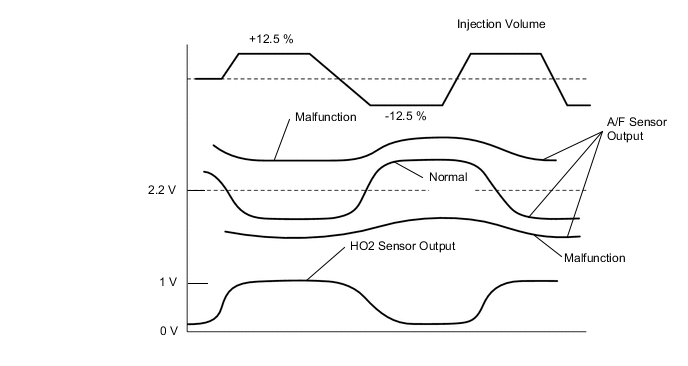
-
OK
CHECK ENGINE TO DETERMINE CAUSE OF EXTREMELY RICH OR LEAN ACTUAL AIR FUEL RATIO (FUEL INJECTOR, FUEL SYSTEM, INTAKE SYSTEM, ETC.) Click here
NG
REPLACE HEATED OXYGEN SENSOR Click here
-
-
CHECK FOR EXHAUST GAS LEAK
-
Inspect for exhaust gas leaks from the exhaust manifold sub-assembly and exhaust pipes.
OK No gas leakage.
NG
REPAIR OR REPLACE EXHAUST GAS LEAK POINT
OK
-
-
INSPECT HEATED OXYGEN SENSOR (HEATER RESISTANCE)
-
Inspect the heated oxygen sensor Click here.
NG
REPLACE HEATED OXYGEN SENSOR Click here
OK
-
-
CHECK HARNESS AND CONNECTOR (HEATED OXYGEN SENSOR - ECM)
-
Disconnect the heated oxygen sensor connector.
-
Disconnect the ECM connector.
-
Measure the resistance according to the value(s) in the table below.
Standard Resistance (Check for open) Tester Connection Condition Specified Condition A36-6 (HT1B) - C13-1 (HT1B) Always Below 1 Ω A34-21 (OX1B) - C13-3 (OX1B) Always Below 1 Ω A36-29 (E1) - C13-4 (E2) Always Below 1 Ω Standard Resistance (Check for short) Tester Connection Condition Specified Condition A36-6 (HT1B) or C13-1 (HT1B) - Body ground Always 10 kΩ or higher A34-21 (OX1B) or C13-3 (OX1B) - Body ground Always 10 kΩ or higher A36-29 (E1) or C13-4 (E2) - Body ground Always 10 kΩ or higher
NG
REPAIR OR REPLACE HARNESS OR CONNECTOR
OK
-
-
REPLACE HEATED OXYGEN SENSOR
-
Replace the heated oxygen sensor Click here.
NEXT
-
-
CHECK WHETHER DTC OUTPUT RECURS (P0137, P0138, P013A, P013B, P013E, P013F OR P0140)
-
Connect the GTS to the DLC3.
-
Turn the ignition switch to ON.
-
Turn the GTS on.
-
Clear the DTCs Click here.
-
Turn the ignition switch off and wait for at least 30 seconds.
-
Turn the ignition switch to ON.
-
Turn the GTS on.
-
Start the engine and warm it up.
-
Drive the vehicle in accordance with the driving pattern described in Confirmation Driving Pattern.
-
Enter the following menus: Powertrain / Engine / Utility / All Readiness.
-
Input the DTC: P0137, P0138, P013A, P013B, P013E, P013F or P0140.
-
Check the DTC judgment result.
Result Result Proceed to NORMAL (DTC is not output) A ABNORMAL (DTC P0137, P0138, P013A, P013B, P013E, P013F or P0140 is output) B
A
END
B
REPLACE AIR FUEL RATIO SENSOR Click here
-
-
REPLACE HEATED OXYGEN SENSOR
-
Replace the heated oxygen sensor Click here.
NEXT
-
-
CHECK WHETHER DTC OUTPUT RECURS (P0137, P0138, P013A, P013B, P013E, P013F OR P0140)
-
Connect the GTS to the DLC3.
-
Turn the ignition switch to ON.
-
Turn the GTS on.
-
Clear the DTCs Click here.
-
Turn the ignition switch off and wait for at least 30 seconds.
-
Turn the ignition switch to ON.
-
Turn the GTS on.
-
Start the engine and warm it up.
-
Drive the vehicle in accordance with the driving pattern described in Confirmation Driving Pattern.
-
Enter the following menus: Powertrain / Engine / Utility / All Readiness.
-
Input the DTC: P0137, P0138, P013A, P013B, P013E, P013F or P0140.
-
Check the DTC judgment result.
Result Result Proceed to NORMAL (DTC is not output) A ABNORMAL (DTC P0137, P0138, P013A, P013B, P013E, P013F or P0140 is output) B
A
END
B
REPLACE HEATED OXYGEN SENSOR Click here
-