NAVIGATION SYSTEM(for Radio and Display Type) Vehicle Speed Signal Circuit between Radio Receiver and Combination Meter
DESCRIPTION
-
The radio and display receiver assembly receives a vehicle speed signal from the combination meter sub-assembly and sends the signal to the navigation ECU.
for Navigation System:
-
This circuit is necessary for the Automatic Sound Levelizer (ASL) built into the radio and display receiver assembly.
The Automatic Sound Levelizer (ASL) function automatically adjusts the audio system volume level in order to compensate for increased vehicle noise (vehicle noise tends to increase as vehicle speed increases). The ASL adjusts the volume level based upon vehicle speed signals sent from the combination meter sub-assembly.
for Automatic Sound Levelizer (ASL) (for 6 Speakers):
-
Vehicle speed signals are received from the combination meter sub-assembly and used to cancel "Bluetooth" function operation.
The radio and display receiver assembly recognizes that the vehicle is being driven and makes it impossible to connect or register a "Bluetooth" device while driving.
for "Bluetooth":
Tech Tips
-
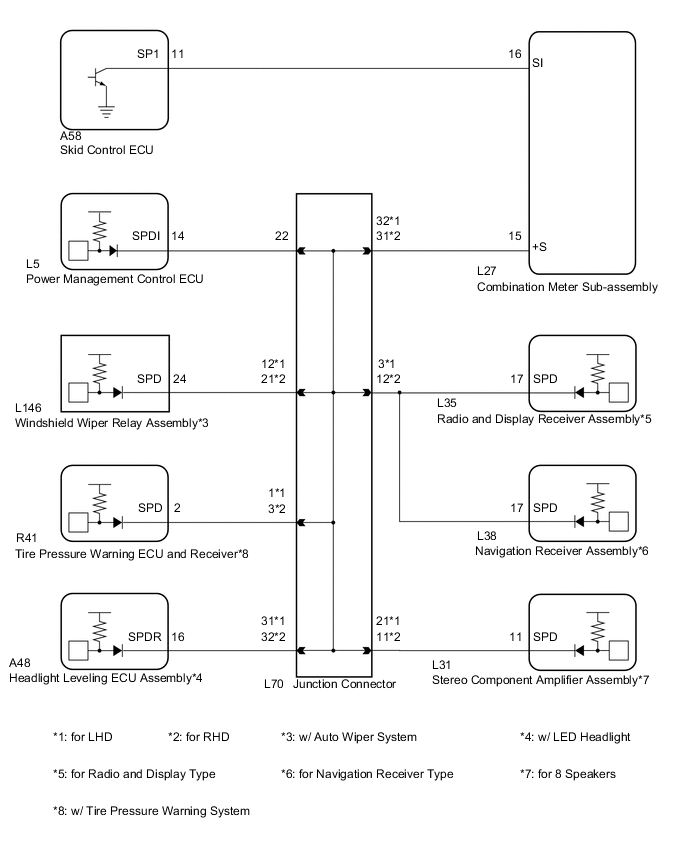
A voltage of 12 V or 5 V is output from each ECU and then input to the combination meter sub-assembly. The signal is changed to a pulse signal at the transistor in the combination meter sub-assembly. Each ECU controls the respective system based on the pulse signal.
-
If a short occurs in any of the ECUs or in the wire harness connected to an ECU, all systems in the following diagram will not operate normally.
WIRING DIAGRAM
PROCEDURE
-
CHECK VEHICLE SIGNAL (OPERATION CHECK)
-
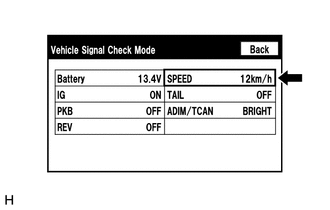
Enter the "Vehicle Signal Check Mode" screen. Refer to Check Vehicle Signal Check Mode in Operation Check Click here.
-
While driving the vehicle, compare the value of "SPEED" to the reading on the speedometer. Check if these readings are almost equal.
Tech Tips
The combination meter sub-assembly receives the vehicle speed signal from the skid control ECU via CAN communication. Therefore, perform the following inspection referring to values on the Data List of the skid control ECU because it is the source of the vehicle speed signal.
OK Vehicle speed displayed on the "Vehicle Signal Check Mode" screen is almost the same as the actual vehicle speed measured using the intelligent tester (See page Click here).
OK 
PROCEED TO NEXT SUSPECTED AREA SHOWN IN PROBLEM SYMPTOMS TABLE Click here
NG 
-
-
INSPECT COMBINATION METER SUB-ASSEMBLY (OUTPUT WAVEFORM)
-
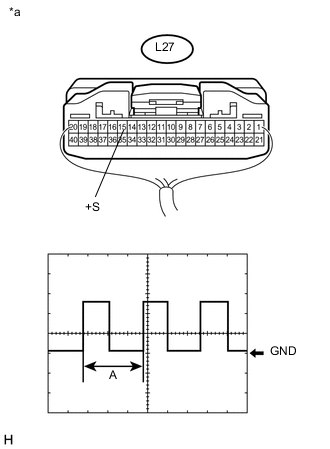
Text in Illustration *a Component with harness connected
(Combination Meter Sub-assembly)
Check the output waveform.
-
Remove the combination meter sub-assembly with the connector still connected.
-
Connect an oscilloscope to terminal L27-15 (+S) and body ground.
-
Turn the power switch on (IG).
-
Turn a wheel slowly.
-
Check the signal waveform according to the condition(s) in the table below.
Item Condition Measurement terminal L27-15 (+S) - Body ground Tool setting 5 V/DIV., 20 ms./DIV. Vehicle condition Wheel being rotated OK The waveform is similar to that shown in the illustration. Tech Tips
When the system is functioning normally, one wheel revolution generates 4 pulses. As the vehicle speed increases, the width indicated by (A) in the illustration narrows.
-
NG
GO TO METER / GAUGE SYSTEM Click here
OK
-
-
CHECK HARNESS AND CONNECTOR (RADIO AND DISPLAY RECEIVER ASSEMBLY - COMBINATION METER SUB-ASSEMBLY)
-
Disconnect the L35 radio and display receiver assembly connector.
-
Disconnect the L27 combination meter sub-assembly connector.
-
Measure the resistance according to the value(s) in the table below.
Standard Resistance Tester Connection Condition Specified Condition L35-17 (SPD) - L27-15 (+S) Always Below 1 Ω
OK
REPLACE RADIO AND DISPLAY RECEIVER ASSEMBLY Click here
NG
-
-
CHECK HARNESS AND CONNECTOR (RADIO AND DISPLAY RECEIVER ASSEMBLY - JUNCTION CONNECTOR)
-
Disconnect the L35 radio and display receiver assembly connector.
-
Disconnect the L70 junction connector.
-
Measure the resistance according to the value(s) in the table below.
Standard Resistance Tester Connection Condition Specified Condition L35-17 (SPD) - L70-3*1 Always Below 1 Ω L35-17 (SPD) - L70-12*2 Always Below 1 Ω
-
*1: for LHD
-
*2: for RHD
-
NG
REPAIR OR REPLACE HARNESS OR CONNECTOR
OK
-
-
CHECK HARNESS AND CONNECTOR (COMBINATION METER SUB-ASSEMBLY - JUNCTION CONNECTOR)
-
Disconnect the L27 combination meter sub-assembly connector.
-
Disconnect the L70 junction connector.
-
Measure the resistance according to the value(s) in the table below.
Standard Resistance Tester Connection Condition Specified Condition L27-15 (+S) - L70-32*1 Always Below 1 Ω L27-15 (+S) - L70-31*2 Always Below 1 Ω
-
*1: for LHD
-
*2: for RHD
-
OK
REPLACE JUNCTION CONNECTOR
NG
REPAIR OR REPLACE HARNESS OR CONNECTOR
-