PANORAMIC VIEW MONITOR SYSTEM
-
OUTLINE
-
A panoramic view monitor system is provided which can assist with confirming the conditions around the vehicle, driving at low speeds, and driving during parking by displaying a panoramic view image on radio and display receiver assembly. The panoramic view image is created by seamlessly combining images from each television camera assembly installed on the front, rear, left and right sides of the vehicle.
-
The panoramic view system provides a variety of image display modes to make confirming the area around the vehicle possible according to driving conditions. These display modes include the simultaneous display of the panoramic view and a front (wide front view) or rear (rear view and wide rear view) image, and a side simultaneous view displaying images of the left and right sides of the vehicle.
-
A wide rear view, which displays a wide view of the rear of the vehicle, is used to make confirming the safety of your surroundings possible when driving in reverse.
-
The shape of the wide front view mask was optimized in consideration of creating a feeling of openness and an easily viewable area by using a wide field of view. Also, the mask was made partially transparent to improve the sense of security created by allowing drivers to see in front of the vehicle.
-
The see through view is provided to enable the driver to confirm that the vehicle surroundings are safe before starting to drive the vehicle.
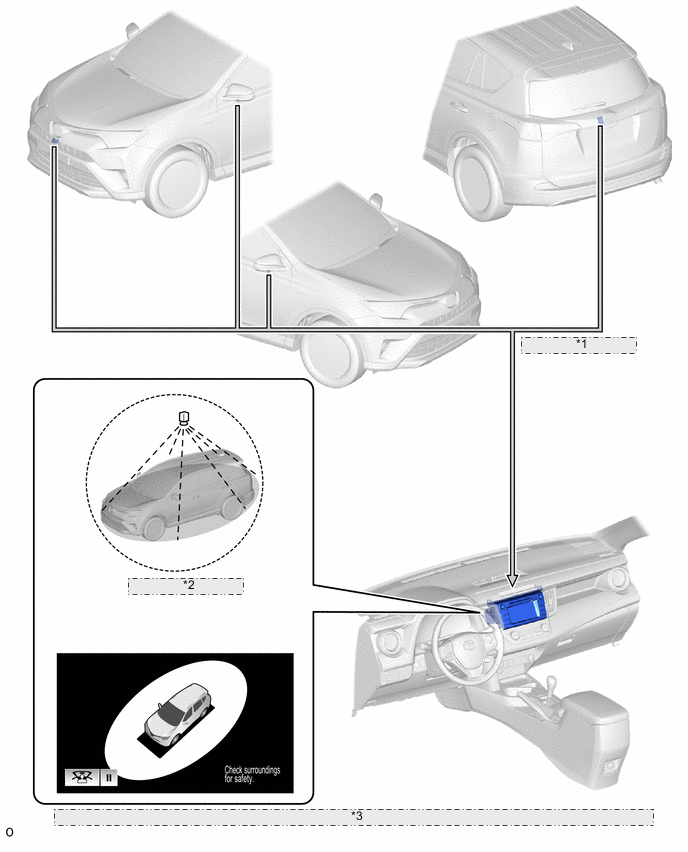
*1 Combines Video Signals from Each Television Camera Assembly *2 Displays Overhead View of Vehicle *3 The illustrations shown are examples only. The illustrations may differ from the actual vehicle screens. Note
The panoramic view monitor system is an auxiliary device used to confirm the are around the vehicle. Always check the rear of the vehicle and drive while directly confirming the safety of your surroundings.
-
-
MAIN FEATURES
-
The panoramic view monitor system seamlessly combines images from the front, rear, left and right television camera assemblies and displays the combined images as the panoramic view image. Also, the system assists with confirming the area around the vehicle, driving at low speeds, and driving during parking by simultaneously displaying the panoramic view and front (wide front view) or rear (rear view and wide rear view) images, or side images (side simultaneous view), etc., on the multi-display assembly.
-
The front image of the vehicle (wide front view) assists with confirming the safety of the areas to the left and right of the vehicle at locations with poor visibility, such as intersections and T-junctions, and the area in front of the vehicle when starting off. The rear images (rear view and wide rear view) assist with driving in reverse. Finally, the side images (side simultaneous view) assist with confirming the safety of the area to the sides of the vehicle, and evading obstacles and driving close to the shoulders on narrow roads.
-
-
PRECAUTION
-
General Precautions
-
Do not rely solely upon the panoramic view monitor system. As with unequipped models, drive carefully while directly confirming the safety of your surroundings.
-
When driving, directly confirm the safety of your surroundings. Do not drive while only viewing the monitor screen.
-
The image displayed on the monitor screen may differ from actual conditions. Also, since the area captured by each television camera is limited, do not drive straight, make left and right turns or operate the vehicle in reverse while only viewing the monitor screen. Doing so can lead to unforeseen accidents, such as collisions with other vehicles, etc. Always drive carefully while directly confirming the safety of your surroundings with the inner rear view mirror assembly, outer rear view mirror assembly, etc.
-
The position of the guidelines displayed on the monitor screen may differ according to the number of passengers and load capacity. Always check the rear and drive while directly confirming the safety of your surroundings.
-
Use the panoramic view monitor system with all the doors closed.
-
When the road surface is slick (frozen or covered with snow), do not use the panoramic view monitor system while using snow chains and driving on slopes. Doing so can lead to unforeseen accidents such as collisions with other vehicles, etc.
-
These are just some of the operation procedures for each mode of the panoramic view monitor system. The steering wheel timing and amount the steering wheel should be turned differ depending on the road condition, road surface and vehicle condition when parking. Use the panoramic view monitor system with full understanding of the above conditions. Always confirm that there is appropriate space before attempting to park the vehicle and operate the system.
-
-
Precautions for Panoramic View Monitor Screen Display
-
The panoramic view display is an image created by combining images from the front, rear, left and right side television camera assemblies. Since the possible display area and display contents are limited, use the panoramic view monitor with full understanding of the panoramic view display characteristics.
-
Since the vehicle icon displayed in the panoramic view display is displayed using computer graphics, the vehicle color, shape and size may differ from the actual vehicle.
-
The clearness of the image at the four corners may be reduced, but this is not a malfunction.
-
The panoramic view display may appear lighter or darker according to the lighting intensity near each television camera assembly.
-
The panoramic view display does not display anything above each television camera assembly installation position and imaging range.
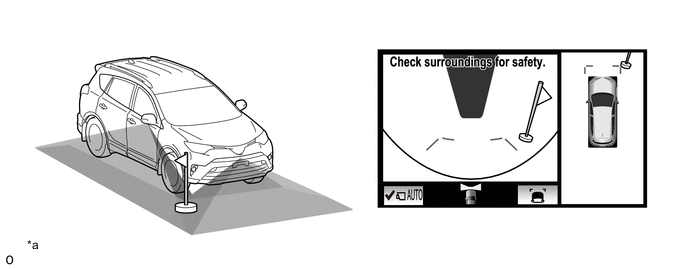
*a The illustrations shown are examples only. The illustrations may differ from the actual vehicle screens. - - -
There are blind spots near the vehicle that cannot be displayed on the panoramic view display.
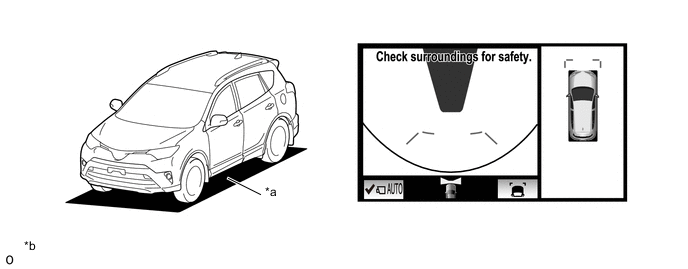
*a Blind Spot Area not Displayed on Screen *b The illustrations shown are examples only. The illustrations may differ from the actual vehicle screens. -
Objects displayed on the wide front view and rear view may not be displayed on the panoramic view display.
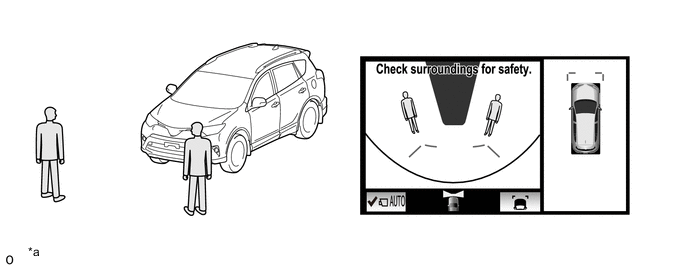
*a The illustrations shown are examples only. The illustrations may differ from the actual vehicle screens. - - -
The panoramic view display may display objects such as people and obstacles in a way that may differ from actual conditions.
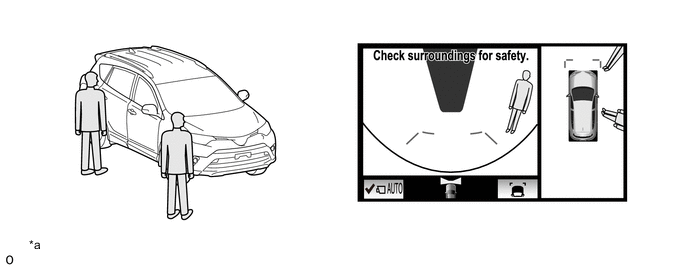
*a The illustrations shown are examples only. The illustrations may differ from the actual vehicle screens. - - -
If the back door with installed rear television camera assembly and front door with installed side television camera assembly (built into the outer rear view mirror assembly) are open, the panoramic view may not correctly display.
-
-
Precautions for Television Camera Assembly Image
-
Do not subject the television camera assemblies to impacts. The panoramic view monitor system may stop operating normally.
-
Since each television camera assembly is equipped with a special lens, the distance displayed on the monitor differs from actual conditions.
-
Since the lens of the front television camera assembly is made of glass, the lens can be damaged by flying rocks and other debris in the same way as windshield glass.
-
The area covered by the front television camera assembly is limited. The front television camera assembly does not show objects close to either corner of the bumper or under the bumper.
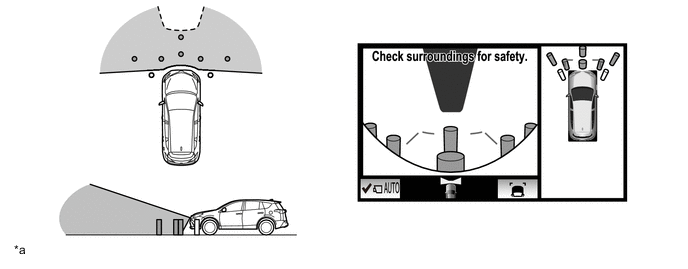
*a The illustrations shown are examples only. The illustrations may differ from the actual vehicle screens. - - -
The area covered by the rear television camera assembly is limited. The rear television camera assembly does not show objects close to either corner of the bumper or under the bumper.
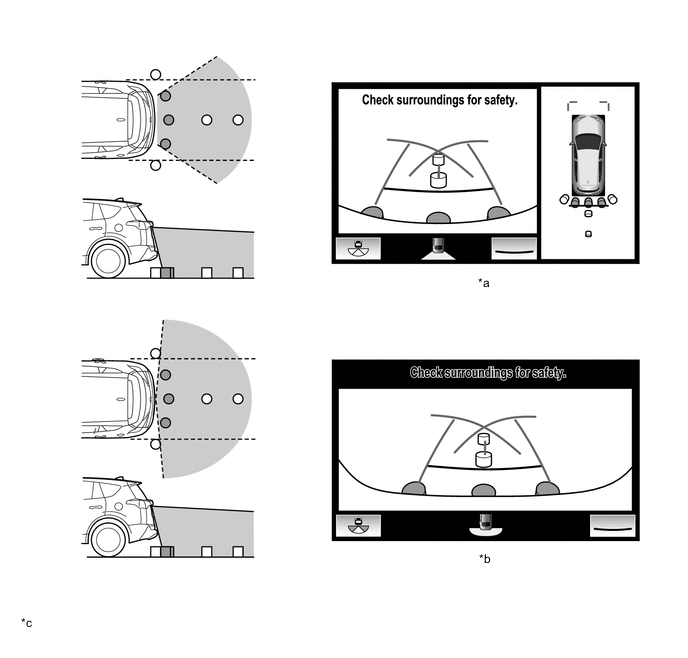
*a Panoramic View and Rear View Display *b Wide Rear View Display *c The illustrations shown are examples only. The illustrations may differ from the actual vehicle screens. - - -
There are limits to the imaging range of the side television camera assemblies.
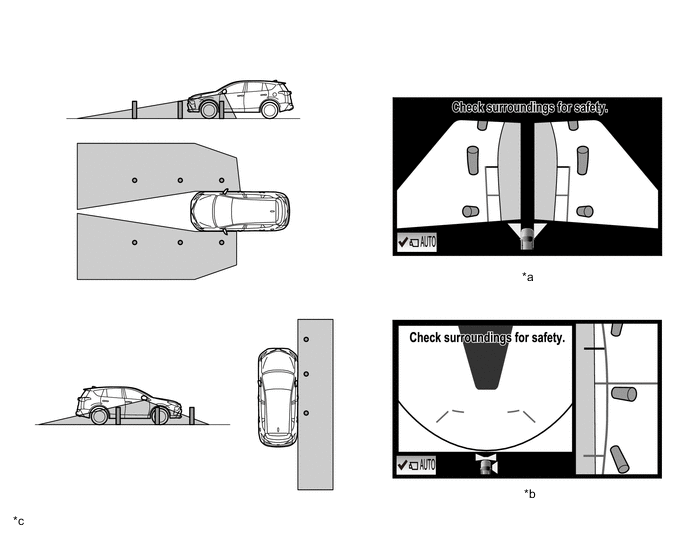
*a Side Simultaneous View Display *b Side View and Wide Front View Display *c The illustrations shown are examples only. The illustrations may differ from the actual vehicle screens. - - -
When the outside air temperature is low, the screen may become darker or appear faint. Since moving objects in particular may become distorted or disappear, always drive carefully while directly confirming the safety of your surroundings.
-
When light from the sun or headlights directly strikes the lens, the vehicle is in a dark location (at night, etc.), or the temperature near the lens is high or low, the screen may become difficult to see, but this is not a malfunction.
-
When washing the vehicle, do not aim a high pressure washer nozzle directly at or around the television camera assemblies. The television camera assembly may malfunction due to the high water pressure.
-
Do not disassemble or modify the television camera assemblies as they use a waterproof construction. Water leakage may occur or the assemblies may operate incorrectly.
-
If the television camera assemblies are subject to sudden temperature changes, the system may stop operating normally.
-
If an organic solvent, wax, oil film remover, glass coating, etc., is present on a television camera assembly lens, immediately wipe off with a soft cloth and wash with water.
-
If water, snow, mud, etc. is stuck to the television camera assembly lens, the camera cannot capture clear images. In this case, wash the camera with a large amount of water and wipe the lens with a wet soft cloth.
-
Do not strongly rub the television camera assembly lenses. The lens may become damaged and unable to capture clear images.
-
When under halogen, sodium and mercury lights, etc., the lights themselves and areas illuminated by the lights may appear to fade in and out, resulting in a "flicker effect".
-
-
Road Condition Precautions
-
Depending on the number of occupants, the load conditions, the slope of the road, and bumps in the road, a disparity may occur between the display indication and the actual distance on the road surface. Operate the vehicle carefully.
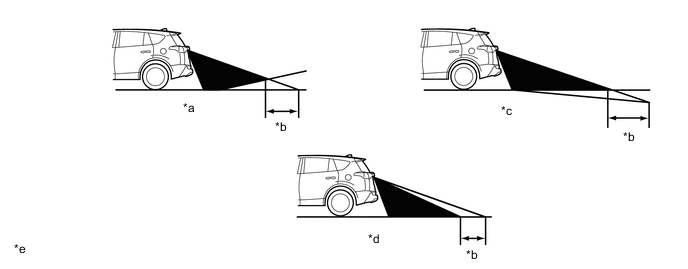
*a Steep Uphill Incline behind Vehicle *b Disparity *c Steep Downhill Incline behind Vehicle *d Vehicle Posture Changed by Passengersand Load *e The illustrations shown are examples only. - - -
If a steep uphill incline is behind the vehicle, an obstacle appears to be further away than it actually is, as shown in the illustration below.
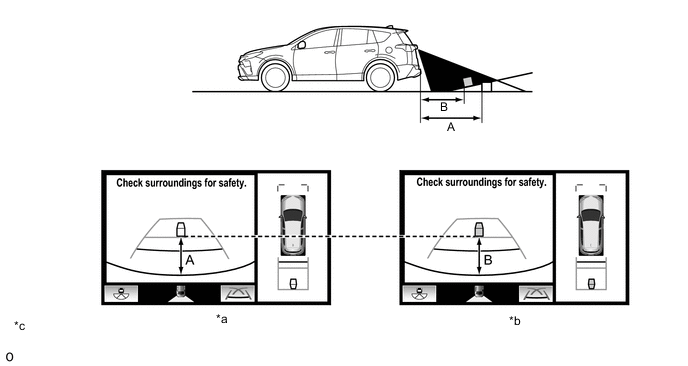
*a Screen Image in Case A *b Screen Image in Case B *c The illustrations shown are examples only. The illustrations may differ from the actual vehicle screens. - -
-
-
Precautions for 3-Dimensional Obstacles
-
Drive carefully when any 3-dimensional objects such as walls or vehicles are behind the vehicle as the distance and estimated guide lines are provided based on the road surface.
-
When passing close to a 3-dimensional object, the vehicle may come into contact with the object even if the estimated vehicle path seems not to be in contact with it on the screen.
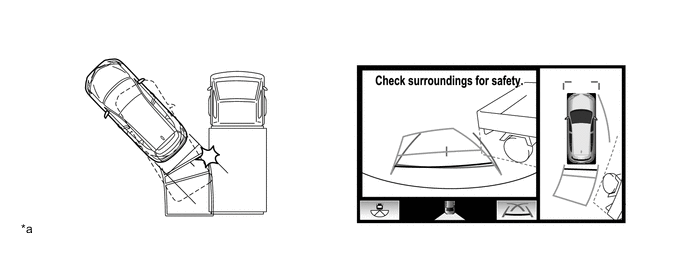
*a The illustrations shown are examples only. The illustrations may differ from the actual vehicle screens. - - -
The distance indication as shown on the screen varies between 3-dimensional objects such as a vehicle and objects on a flat plane such as the road surface. As shown in the following illustration, points A and B are actually vertically in the same position and point C is a short distance away from them: however, the points are displayed in order of distance from the vehicle, B, C and A. Therefore, the vehicle will come into contact with the 3-dimensional object if it is backed up to point B on the screen.
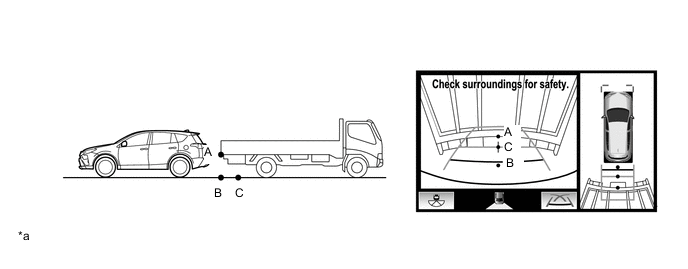
*a The illustrations shown are examples only. The illustrations may differ from the actual vehicle screens. - - -
On slippery roads such as snowy roads, the estimated vehicle path and actual vehicle path may not match.
-
When only one parking line is provided, the vehicle may seem to be parallel to the line on the screen even if it is not actually parallel.
-
-
-