BODY STRUCTURE
-
CONSTRUCTION
-
Impact Absorbing Structure for Frontal Collision
-
A structure that ensures collision energy absorption efficiency, dissipates impact and minimizes cabin deformation during a frontal collision has been achieved.
-
The front crash box and front side member sub-assembly absorb and disperse collision energy received from the front bumper reinforcement.
-
Collision energy applied to the front side member sub-assembly is transmitted to the front apron to cowl side member sub-assembly and cowl under section.
-
The front lower side member and lower side members absorb and disperse collision energy received from the radiator support lower cross member.
-
Collision energy applied to the lower side members is transmitted to the front suspension cross member and floor panel.
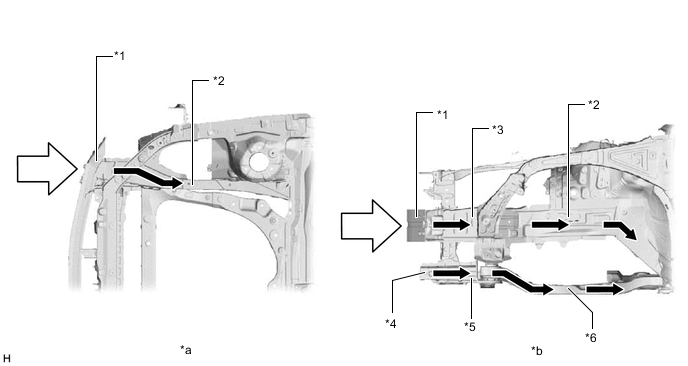
*1 Front Bumper Reinforcement *2 Front Side Member Sub-assembly *3 Front Crash Box *4 Radiator Support Lower Cross Member *5 Front Lower Side Member *6 Front Suspension Cross Member *a Upper View *b Side View 
Front Impact Energy 
Dissipate -
Front body pillars have been strengthened to optimize dispersal of collision energy to the rail panel, rocker panel and floor panel.
-
Collision energy applied to the front body pillar transmitted to the suspension tower brace, cowl panel and instrument panel reinforcement circular structure via the instrument panel reinforcement cowl side bracket.
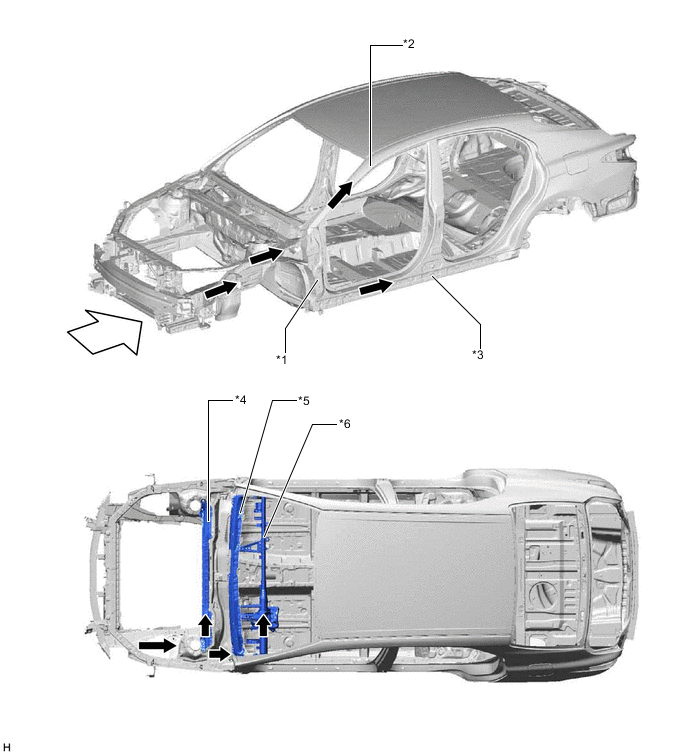
*1 Front Body Pillar *2 Rail Panel *3 Rocker Panel *4 Suspension Tower Brace *5 Cowl Panel *6 Instrument Panel Reinforcement Front Impact Energy Dissipate -
Hot-stamped sheet steel is used for the dash panel cross member.
-
Ultra high-tensile strength sheet steel are used for the rocker panel reinforcement and floor member. high-tensile strength sheet steel is used for floor tunnel panel.
-
Collision energy applied to the dash panel cross member transmitted to the rocker panel, floor member and floor tunnel.
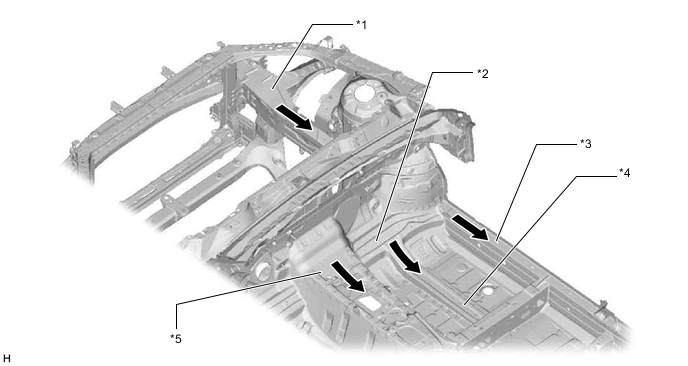
*1 Front Side Member Sub-assembly *2 Dash Panel Cross Member *3 Rocker Panel *4 Floor Member *5 Floor Tunnel - - Dissipate - -
-
-
-
Impact Absorbing Structure for Side Collision
-
A structure that ensures collision energy absorption efficiency, dissipates impact and minimizes cabin deformation during a side collision has been achieved.
-
Hot-stamped sheet steel are used for the rail outer reinforcement, center pillar outer reinforcement, center pillar hinge reinforcement and roof gusset.
-
High-tensile strength sheet steel is used for the roof cross reinforcement CTR and front body pillar outer reinforcement.
-
A structure which uses the floor side member reinforcement and rocker inner side panel to efficiently transmit impact load during a side collision to the floor is used.
-
A structure which optimizes the placement of the rear door protection beam and rocker panel reinforcement to efficiently transmit impact load is used.
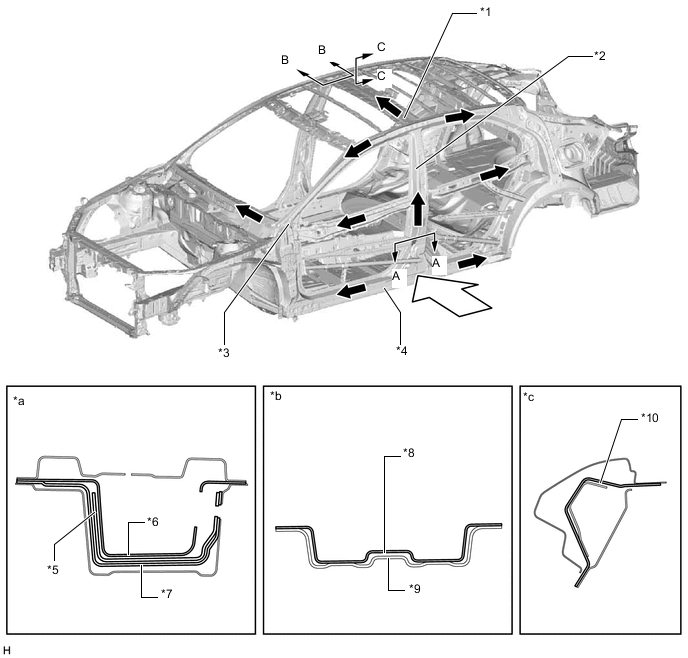
*1 Roof Cross Reinforcement CTR *2 Center Pillar *3 Front Body Pillar *4 Rocker Panel *5 Center Pillar Hinge Reinforcement *6 Center Pillar Outer Reinforcement Lower *7 Center Pillar Outer Reinforcement *8 Roof Cross Reinforcement Lower *9 Roof Gusset *10 Rail Outer Reinforcement *a A - A Cross Section *b B - B Cross Section *c C - C Cross Section - - Side Impact Energy Dissipate -
Ultra high-tensile strength sheet steel are used for front door protection beam and rear door protection beam.
-
High-tensile strength sheet steel are used for the front door beltline reinforcement and rear door reinforcement.
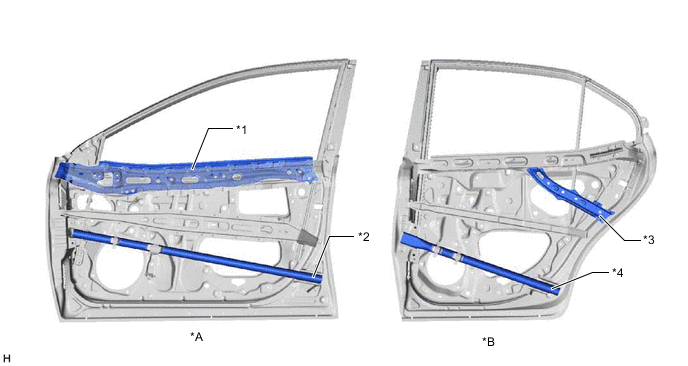
*A Front Door *B Rear Door *1 Front Door Beltline Reinforcement
(High-tensile Strength Sheet Steel)
*2 Front Door Protection Beam
(Ultra High-tensile Strength Sheet Steel)
*3 Rear Door Reinforcement
(High-tensile Strength Sheet Steel)
*4 Rear Door Protection Beam
(Ultra High-tensile Strength Sheet Steel)
-
High-tensile strength sheet steel are used for the seat cross member No. 1, seat cross member No. 2 and floor cross member CTR.
-
A bulk is provided on the tunnel of floor panel. In the event of a side collision, the center body pillar strikes the seat side, absorbing the impact by transmitting it to the floor tunnel.
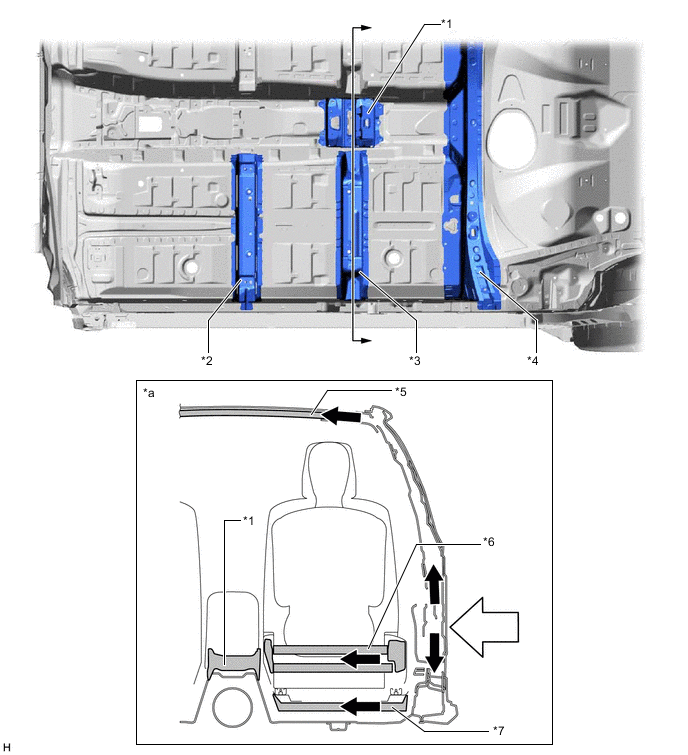
*1 Bulk *2 Seat Cross Member No. 1 *3 Seat Cross Member No. 2 *4 Floor Cross Reinforcement CTR *5 Roof Cross Reinforcement CTR *6 Seat Pipe *7 Floor Cross Members - - *a A - A Cross Section - - Side Impact Energy Dissipate
-
-
-
Impact Absorbing Structure for Rear Collision
-
A protector is provided around the fuel inlet pipe hole. This suppresses deformation of the fuel inlet during a rear collision.
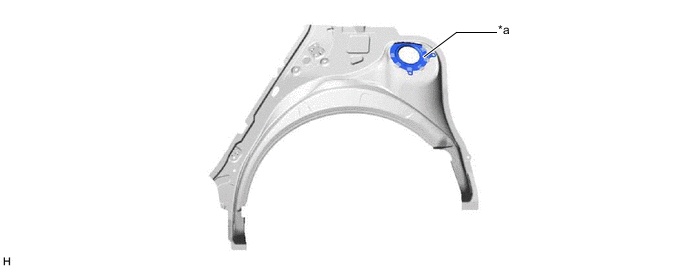
*a Protector - -
-
-
Roof Crush Resistance
-
When the roof is subjected to an impact, the impact is dispersed to the roof reinforcements, front pillars and center pillars, there by minimizing deformation of the cabin.
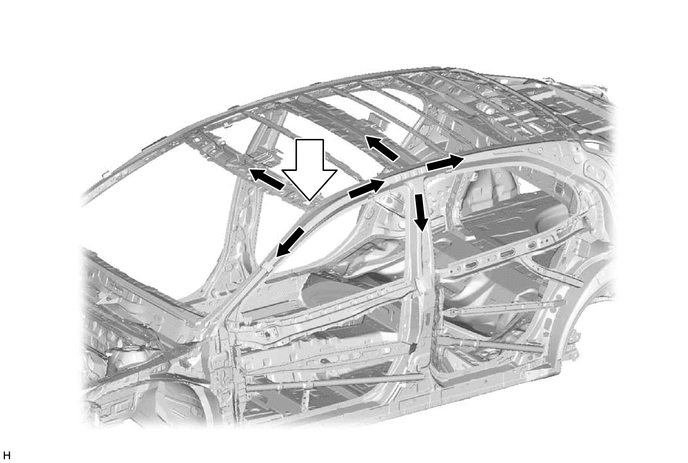
Impact Energy Dissipate
-
-
Reduction Pedestrian Head Injury
-
The following shape is used for around the front body, thus maintaining necessary rigidity and aiming for a reduction of impact against a pedestrian in a collision with a pedestrian.
-
Impact absorbing structure has been adopted hood inner panel.
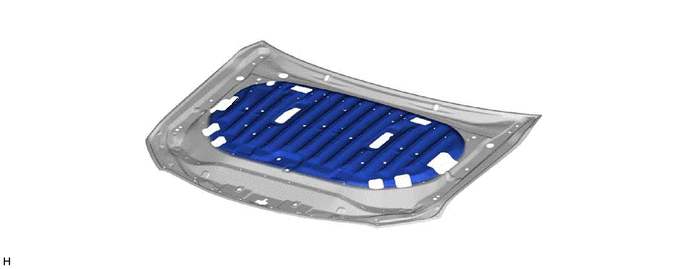

Floating Island Structure - - -
The parts surrounding the cowl top ventilator louver sub-assembly use a crushable structure to improve the rate of energy absorption from the estimated collision direction to reduce the impact to the pedestrian whose head, etc., struck the area. The structure of the cowl top ventilator louver sub-assembly maintains the necessary rigidity while having a lowered deformation strength in order to absorb impact load.
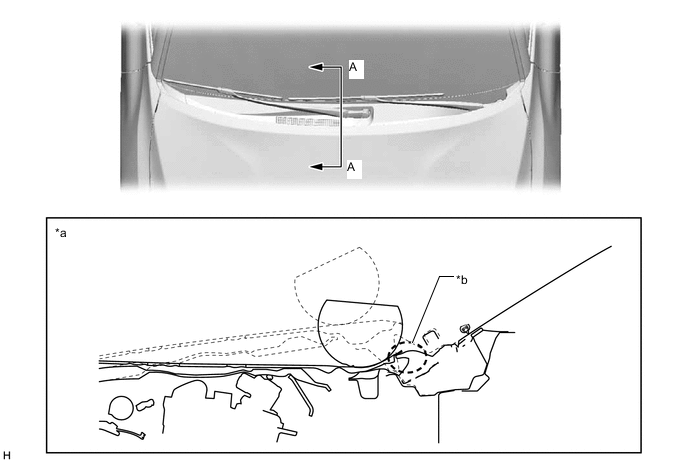
*a A - A Cross Section *b Impact Absorption Stroke
-
-
-