SFI SYSTEM Lack of Power (Turbocharger System)
| DTC Code | DTC Name |
|---|---|
| Lack of Power (Turbocharger System) |
CAUTION / NOTICE / HINT
The diagnosis flowchart is for lack of power due to turbocharger factors.
If symptom-specific diagnosis indicates a turbocharger related problem, check using this flowchart.
PROCEDURE
CHECK TURBOCHARGER SUB-ASSEMBLY
Check for oil leaks and large carbon deposits around the connecting surfaces of the turbocharger sub-assembly.
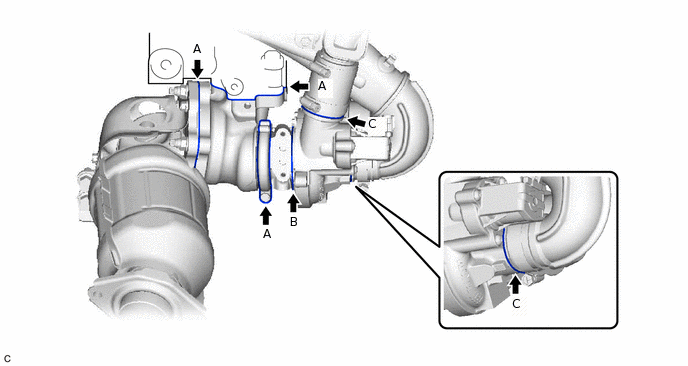 Tip:
Tip:If oil leaks or a large amount of carbon deposits exist, air leaks from the respective sealing surfaces may be causing the lack of boost pressure.
Result
Result
Proceed to
An oil leak or large amount of carbon deposits does not exist.
A
A large amount of carbon deposits exist around the turbine housing, flange or gaskets in any of the areas (A) shown in the illustration.
B
A large amount of carbon deposits exist around the waste gate valve link.
C
Oil is leaking from between the sealing surfaces of the seal plate and compressor housing or bearing housing in the area (B) shown in the illustration.
D
Oil is leaking from the compressor housing in any of the areas (C) shown in the illustration.
E
B CHECK EXHAUST MANIFOLD CONVERTER SUB-ASSEMBLYClick here
C CHECK TURBOCHARGER SUB-ASSEMBLY (INSPECT TURBINE HOUSING)Click here
E CHECK AND REPAIR AIR TUBE OR HOSE CLAMP
CHECK TURBOCHARGER SUB-ASSEMBLY (INSPECT TURBINE SHAFT)
Check for loose turbine mounting nuts and for axial play in the turbine shaft.
Tip:If the turbine shaft catches or there is no play, seal failure due to seizure or improper operation due to accumulation of deposits is suspected.
Result
Result
Proceed to
No turbine shaft malfunction
A
Turbine shaft malfunction
B
CHECK TURBOCHARGER SUB-ASSEMBLY (INSPECT WASTE GATE VALVE)
Use a vacuum pump to apply -35 +/-4.0 kPa (-263 +/-35 mmHg) negative pressure to the diaphragm chamber and check that the waste gate valve seats.
Note:Do not apply a negative pressure of -65 kPa (-488 mmHg) or more to the waste gate valve actuator with bracket assembly, as doing so may damage the diaphragm.
Standard
Waste gate valve seats without a gap
Result
Result
Proceed to
Seats at less than -35 kPa (-263 mmHg) negative pressure
A
Seats at -35 kPa (-263 mmHg) or greater negative pressure
B
Waste gate valve does not move
C
CHECK TURBOCHARGER SUB-ASSEMBLY (INSPECT WASTE GATE VALVE)
Check for play in the waste gate valve and waste gate valve link.
Standard
Play exists
Tip:Some play is required as the waste gate valve link slides. If no play exists, the valve is determined to be stuck.
Check for gaps at the waste gate valve contact surface due to scratches, deformation or wear.
Standard
0.15 mm (0.0059 in.) or less
Result
Proceed to
OK
NG
CHECK TURBOCHARGER SUB-ASSEMBLY (INSPECT AIR BY-PASS VALVE)
Inspect the air by-pass valve.
Result
Proceed to
OK
NG
CHECK EXHAUST MANIFOLD CONVERTER SUB-ASSEMBLY
Check for deformation or cracks in the mounting surfaces on the exhaust manifold converter sub-assembly and the turbocharger sub-assembly.
Tip:Deformation or cracks on a mounting surface may allow exhaust gas to leak from the damaged position.
Standard
No deformation or cracks on a mounting surface
Result
Result
Proceed to
No problem with the mounting surface
A
Deformation or cracks on the exhaust manifold converter sub-assembly mounting surface
B
Deformation or cracks on the turbocharger sub-assembly mounting surface
C
REPLACE GASKET
Replace the gasket between the exhaust manifold converter sub-assembly and turbocharger sub-assembly.
Result
Proceed to
NEXT
PERFORM SIMULATION TEST
Check that the abnormal state has disappeared.
Result
Proceed to
NEXT
NEXT END
CHECK TURBOCHARGER SUB-ASSEMBLY (INSPECT TURBINE HOUSING)
Check that the bushing of the turbine housing waste gate valve link is free of cracks and the play does not exceed 0.15 mm (0.0059 in.).
Standard
No cracks and play does not exceed 0.15 mm (0.0059 in.)
Result
Proceed to
OK
NG