BRAKE MASTER CYLINDER(for RHD) INSTALLATION
PROCEDURE
INSTALL BRAKE MASTER CYLINDER SUB-ASSEMBLY
Note:When installing a new brake master cylinder sub-assembly, remove the protectors from the master cylinder piston and outlet ports.
Install a new brake master cylinder O-ring to the brake master cylinder sub-assembly.
Install the brake master cylinder sub-assembly to the brake booster assembly with 2 new nuts.
20 N*m
204 kgf*cm
15 ft.*lbf
Note:The brake master cylinder sub-assembly requires careful handling. Do not allow the brake master cylinder sub-assembly to receive any impact, such as from being dropped. Do not reuse a brake master cylinder sub-assembly that has been dropped.
Do not hold the brake master cylinder sub-assembly by the master cylinder piston. Hold the brake master cylinder sub-assembly by its body or its reservoir when carrying it.
Do not pull out the master cylinder piston.
Do not strike or pinch the master cylinder piston, or cause any damage to the master cylinder piston by any other means.
When installing the brake master cylinder sub-assembly to the brake booster assembly, or when removing the brake master cylinder sub-assembly from the brake booster assembly, make sure that the brake master cylinder sub-assembly is kept horizontal or with its tip facing downward (the master cylinder piston is facing upward) to prevent the master cylinder piston from falling out.
Do not allow any foreign matter to contaminate the master cylinder piston. If any foreign matter gets on the master cylinder piston, remove it by using a piece of cloth and then apply an even layer of lithium soap base glycol grease around the circumference (sliding part) of the master cylinder piston.
Do not kink or damage the brake lines.
Do not allow the brake lines to twist or interfere with other parts or the vehicle body during tightening.
Do not allow any foreign matter such as dirt or dust to enter the brake lines from the connecting parts.
Do not use any other type of grease or fluid.
-
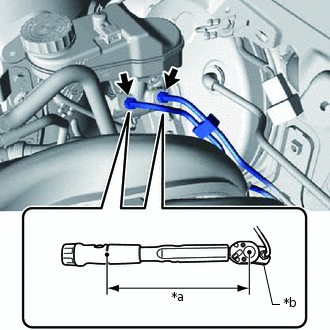
*a
Torque Wrench Fulcrum Length
*b
Union Nut Wrench
Using a union nut wrench, connect the 2 brake lines to the brake master cylinder sub-assembly.
Specified tightening torque
19.5 N*m
199 kgf*cm
14 ft.*lbf
Note:Do not kink or damage the brake lines.
Do not allow the brake lines to twist or interfere with other parts or the vehicle body during tightening.
Do not allow any foreign matter such as dirt or dust to enter the brake lines from the connecting parts.
Tip:Calculate the torque wrench reading when changing the fulcrum length of the torque wrench.
When using a union nut wrench (fulcrum length of 20 mm (0.787 in.)) + torque wrench (fulcrum length of 162 mm (6.38 in.)):
17.4 N*m (177 kgf*cm, 13 ft.*lbf)
Engage the clamp to secure the 2 brake lines to the No. 3 brake tube clamp.
Connect the reservoir level switch connector.
BLEED BRAKE SYSTEM
INSTALL AIR CLEANER ASSEMBLY WITH DUCT
INSTALL OUTER COWL TOP PANEL
Install the outer cowl top panel with the 9 bolts.
9.2 N*m
94 kgf*cm
81 in.*lbf
Engage the 2 clamps to install the wire harness.
INSTALL FRONT AIR SHUTTER SEAL RH
Install the front air shutter seal RH with the 2 clips.
INSTALL FRONT NO. 1 VENTILATOR SEAL
Engage the clamp to install the front No. 1 ventilator seal.
INSTALL FRONT WIPER MOTOR AND LINK ASSEMBLY