SFI SYSTEM(w/o Canister Pump Module) VEHICLE CONTROL HISTORY
-
DESCRIPTION (SFI SYSTEM)
-
Vehicle Control History is a function that captures and stores ECU data when triggered by specific vehicle behavior.
-
If the customer states that the engine stalls or will not start, it may be possible to diagnose the cause of the malfunction by checking the vehicle history information and freeze frame data.
-
The number of possible stored Freeze Frame Data sets, whether multi Freeze Frame Data is available, the number of freeze frame points, Freeze Frame Data items, the ECU internal range, etc., is different depending on the stored group.
-
The stored data items for Vehicle Control History Freeze Frame Data are different depending on the stored group. When the value of a data item does not change across all points, only the value of the detection point will be displayed. The contents of the Freeze Frame Data is almost the same as that of the Data List.
-
-
PRECAUTIONS (SFI SYSTEM)
-
As Vehicle Control History may be overwritten whenever the trigger conditions are met, make sure to save Vehicle Control History before performing any inspections.
-
As Vehicle Control History may be stored when performing an Active Test, learning, etc., make sure to clear the Vehicle Control History before returning the vehicle to the customer.
-
-
CHECK VEHICLE CONTROL HISTORY (SFI SYSTEM)
-
Connect the GTS to the DLC3.
-
Turn the engine switch on (IG).
-
Turn the GTS on.
-
Enter the following menus: Powertrain / Engine / Utility / Vehicle Control History.
Powertrain > Engine > UtilityTester Display Vehicle Control History Tech Tips
It is also possible to display Vehicle Control History during the Health Check, if "Store All Data" is selected.
Vehicle Control History Item Code Item Trigger Description Stored Group Reference Inspection Procedure Link X0800 Engine Stall
-
Prerequisite Conditions: The engine is running (after engine is judged to be difficult to start)
-
Detection Conditions: The engine speed decreases to 200 rpm or less, or stops
-
Duration: 0.5 seconds or more
Detection Condition (Engine Stall)
08 Flowchart [Engine Stalls] step 3 The engine stalled due to factors other than the operation of the engine switch X0803 Engine Stall (Compression Leakage) It is judged that the engine is stalled due to compression leakage 08 Flowchart [Engine Stalls] step 3 X0810 Engine Difficult to Start (Engine Starting Time Long)
-
Prerequisite Conditions: STA signal is ON
-
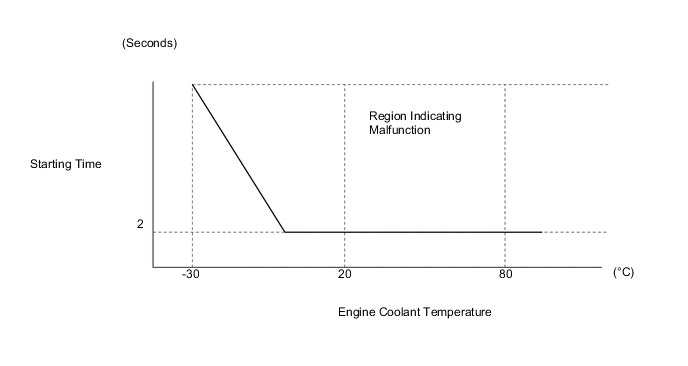
Detection Conditions: The engine speed is less than 500 rpm for a long period of time (the starting time is long or the engine does not start)
-
Duration: Refer to Engine Difficult to Start Duration Judgment Region illustration
Detection Condition (Engine Starting Time Long)
09 Flowchart [Engine Difficult to Start] step 3 The engine speed decreases or the engine stalls immediately after starting X0811 Engine Difficult to Start (Engine Stall Immediately After Starting)
-
Prerequisite Conditions: Within 2 seconds after the engine has started (engine speed is 500 rpm or more) and the engine coolant temperature is -15°C (5°F) or more
-
Detection Conditions: The engine speed decreases to 200 rpm or less (immediately after starting, the engine speed decreases or the engine stalls)
-
Duration: -
Detection Condition (Engine Stall Immediately After Starting)
09 Flowchart [Engine Difficult to Start] step 3 The engine speed decreases or the engine stalls immediately after starting X0812 Engine Difficult to Start (Immobiliser) Engine difficult to start due to immobiliser 09 Flowchart [Engine Difficult to Start] step 3 X0821 Rough Idle #1
-
Prerequisite Conditions: The engine is idling with the vehicle stopped and the accelerator pedal is fully released
-
Detection Conditions: It is judged that combustion is unstable due to the instantaneous change in engine speed for each cylinder
-
Duration: Depending on the combustion status, between 2 and 10 seconds
Detection Condition (Rough Idle)
03 Flowchart [Rough Idling] step 3 Idling is rough due to unstable combustion in the No. 1 cylinder X0822 Rough Idle #2 Idling is rough due to unstable combustion in the No. 2 cylinder 03 Flowchart [Rough Idling] step 3 X0823 Rough Idle #3 Idling is rough due to unstable combustion in the No. 3 cylinder 03 Flowchart [Rough Idling] step 3 X0824 Rough Idle #4 Idling is rough due to unstable combustion in the No. 4 cylinder 03 Flowchart [Rough Idling] step 3 X0825 Rough Idle #5 Idling is rough due to unstable combustion in the No. 5 cylinder 03 Flowchart [Rough Idling] step 3 X0826 Rough Idle #6 Idling is rough due to unstable combustion in the No. 6 cylinder 03 Flowchart [Rough Idling] step 3 X082A Rough Idle (Plural Cylinders) Idling is rough due to multiple cylinders
As more than one cylinder is affected, the fuel system, etc. is suspected
03 Flowchart [Rough Idling] step 3 X082D Rough Idle (Compression Leakage) Idling is judged to be rough due to compression leakage 03 Flowchart [Rough Idling] step 3 X082E Rough Idle (Low Frequency) Slight rough idle symptoms are detected 3 times in 10 trips
Tech Tips
As the rough idle symptoms are slight, if rough idle codes other than rough idle (low frequency) code X082E are stored, this code will not be stored.
03 Flowchart [Rough Idling] step 3 X0844 Engine Lack of Power
-
Prerequisite Conditions: All of the following conditions are met
-
The accelerator opening angle 80% or more.
-
The engine speed is 1800 rpm or more.
-
The engine coolant temperature is 70°C (158°F) or higher
-
The intake air temperature is 60°C (140°F) or less.
-
The atmospheric pressure is 95 kPa(abs) [13.78 psi(abs)] or higher.
-
The STP signal is off.
-
The STA signal is off.
-
Shift state is not in P or N.
-
Detects a condition where the output torque is insufficient approximately 40% or more relative to the requested torque (divided value of the output torque is approximately 0.6 less than the requested torque)
-
Duration: 3 seconds or more
Detection Condition (Engine Lack of Power)
04 Flowchart [Lack of Power] step 3 X0850 Engine Oil Pressure Low The engine oil pressure is low 05 - - X0851 Engine Coolant Temperature High The engine coolant temperature is high (overheating) 05 - - X0852 Engine RPM High The engine speed is high (over revving) 05 - - X0854 Engine Coolant Temperature High (Low Voltage) The engine coolant temperature is high (overheating) due to a low engine water pump assembly voltage causing the engine water pump assembly to stop
Tech Tips
Only for vehicles equipped with an electric water pump (for engine).
05 - - X0856 GPF Rejuvenate Interruption When normal PM (Particulate Matter) regeneration stops 0A - - X0857 GPF Rejuvenate Run Insufficiency The air-fuel ratio conditions are met at 60 km/h (37 mph) or more, but the temperature required for PM regeneration has not been reached 0A - - X0858 Particulate Filter Differential Pressure High Bank1 When the GPF upstream exhaust pressure measured by the differential pressure sensor (GPF differential pressure calibration value) exceeds the threshold value due to the accumulation of PM or ash (metal oxide)
Tech Tips
When this code is detected, output is limited and the "Reduced Engine Power" warning message is displayed on the multi-information display.
0A Refer to the P244B00 inspection procedure X0859 Particulate Filter Differential Pressure Too High Bank1 When the GPF upstream exhaust pressure measured by the differential pressure sensor (GPF differential pressure calibration value) exceeds the threshold value due to further PM and ash being accumulated in the GPF after the GPF differential sensor determines the pressure is high (X0858)
Tech Tips
When this code is detected, output is limited and the "Reduced Engine Power" warning message is displayed on the multi-information display.
0A Refer to the P244B00 inspection procedure X085A Particulate Filter Differential Pressure High Bank2 When the GPF upstream exhaust pressure measured by the differential pressure sensor (GPF differential pressure calibration value) exceeds the threshold value due to the accumulation of PM or ash
Tech Tips
When this code is detected, output is limited and the "Reduced Engine Power" warning message is displayed on the multi-information display.
0A Refer to the P244B00 inspection procedure X085B Particulate Filter Differential Pressure Too High Bank2 When the GPF upstream exhaust pressure measured by the differential pressure sensor (GPF differential pressure calibration value) exceeds the threshold value due to further PM and ash being accumulated in the GPF after the GPF differential sensor determines the pressure is high (X085A)
Tech Tips
When this code is detected, output is limited and the "Reduced Engine Power" warning message is displayed on the multi-information display.
0A Refer to the P244B00 inspection procedure X085C Over Temperature Prevention when Particulate Filter Over Accumulation When the PM deposition ratio is at or above the specified value
Tech Tips
When this code is detected, output is limited and the "Reduced Engine Power" warning message is displayed on the multi-information display.
0A Refer to the P246300 inspection procedure Figure 1. Engine Difficult to Start Duration Judgment Region (Engine Starting Time Long) (X0810)
Stored Data Stored Group Number of Records Number of Freeze Frame Points Multi Freeze Frame Data Sampling Period Note 03 1 code
Tech Tips
-
If the detection conditions for a code that is not currently stored are met, the code will be stored.
-
If the detection conditions for a code that is currently stored are met again in the same trip, the code will not be overwritten.
-
If the detection conditions for a code that is currently stored are met again in a different trip, the code will be overwritten.
-
If rough idle codes other than Rough Idle (Low Frequency) code X082E are stored, data for code X082E will not be overwritten.
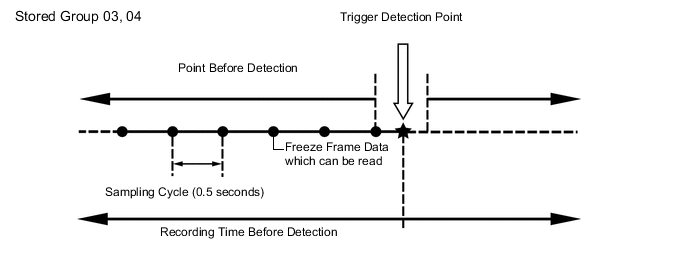
7 points (1 point at detection + 6 points before detection)
Tech Tips
When the value of a data item does not change across all points, only the value at the detection point will be displayed.
0.5 seconds The data can be cleared by using the GTS or by disconnecting the cable from the negative (-) battery terminal. 04 1 code
Tech Tips
-
If the detection conditions for a code that is not currently stored are met, the code will be stored.
-
If the detection conditions for a code that is currently stored are met again in the same trip, the code will not be overwritten.
-
If the detection conditions for a code that is currently stored are met again in a different trip, the code will be overwritten.
7 points (1 point at detection + 6 points before detection)
Tech Tips
When the value of a data item does not change across all points, only the value at the detection point will be displayed.
0.5 seconds The data can be cleared by using the GTS or by disconnecting the cable from the negative (-) battery terminal. 05 2 codes
Tech Tips
-
If the detection conditions for a code that is not currently stored are met, the code will be stored.
-
If the detection conditions for a code that is currently stored are met again in the same trip, the code will not be overwritten.
-
If the detection conditions for a code that is currently stored are met again in a different trip, the code will be overwritten.
1 point (multi freeze frame data not available) -
-
The data can be cleared by using the GTS.
-
The data cannot be cleared by disconnecting the cable from the negative (-) battery terminal.
08 1 codes
Tech Tips
-
If the detection conditions for a code that is not currently stored are met, the code will be stored.
-
If the detection conditions for a code that is currently stored are met again in the same trip, the code will not be overwritten.
-
If the detection conditions for a code that is currently stored are met again in a different trip, the code will be overwritten.
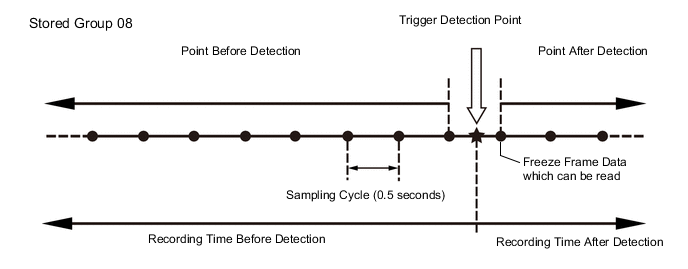
12 points (1 point at detection + 8 points before detection + 3 points after detection)
Tech Tips
When the value of a data item does not change across all points, only the value at the detection point will be displayed.
0.5 seconds
-
The data can be cleared by using the GTS.
-
The data cannot be cleared by disconnecting the cable from the negative (-) battery terminal.
09 1 code
Tech Tips
-
If the detection conditions for a code that is not currently stored are met, the code will be stored.
-
If the detection conditions for a code that is currently stored are met again in the same trip, the code will not be overwritten.
-
If the detection conditions for a code that is currently stored are met again in a different trip, the code will be overwritten.
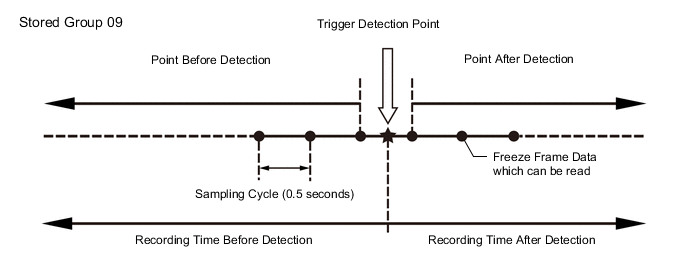
7 points (1 point at detection + 3 points before detection + 3 points after detection)
Tech Tips
When the value of a data item does not change across all points, only the value at the detection point will be displayed.
0.5 seconds The data can be cleared by using the GTS or by disconnecting the cable from the negative (-) battery terminal. 0A 4 code
Tech Tips
-
If the detection conditions for a code that is not currently stored are met, the code will be stored.
-
If the detection conditions for a code that is currently stored are met again in the same trip, the code will not be overwritten.
-
If the detection conditions for a code that is currently stored are met again in a different trip, the code will be overwritten.
1 point (multi freeze frame data not available) - The data can be cleared by using the GTS or by disconnecting the cable from the negative (-) battery terminal. Tech Tips
-
Multi Freeze Frame Data makes it possible to display the engine condition (ECU data) both before and after the trigger detection point.
-
The number of available points differs depending on the stored group.
-
When the value of a data item does not change across all points, only the value at the detection point will be displayed.
Only 1 measurement point can be displayed for stored group 05 and 0A Freeze Frame Data.
-
-
-
CLEAR VEHICLE CONTROL HISTORY (SFI SYSTEM)
-
Connect the GTS to the DLC3.
-
Turn the engine switch on (IG).
-
Turn the GTS on.
-
Enter the following menus: Powertrain / Engine / Utility / Vehicle Control History (Clear).
Note
By performing this procedure, all stored Vehicle Control History items will be cleared.
-
-
VEHICLE CONTROL HISTORY FREEZE FRAME DATA (SFI SYSTEM)
-
Connect the GTS to the DLC3.
-
Turn the engine switch on (IG).
-
Turn the GTS on.
-
Enter the following menus: Powertrain / Engine / Utility / Vehicle Control History.
Powertrain > Engine > UtilityTester Display Vehicle Control History -
Select a vehicle control history item to access the applicable freeze frame data.
-
Check the freeze frame Data recorded with the Vehicle Control History.
Figure 2. Vehicle Control History Data
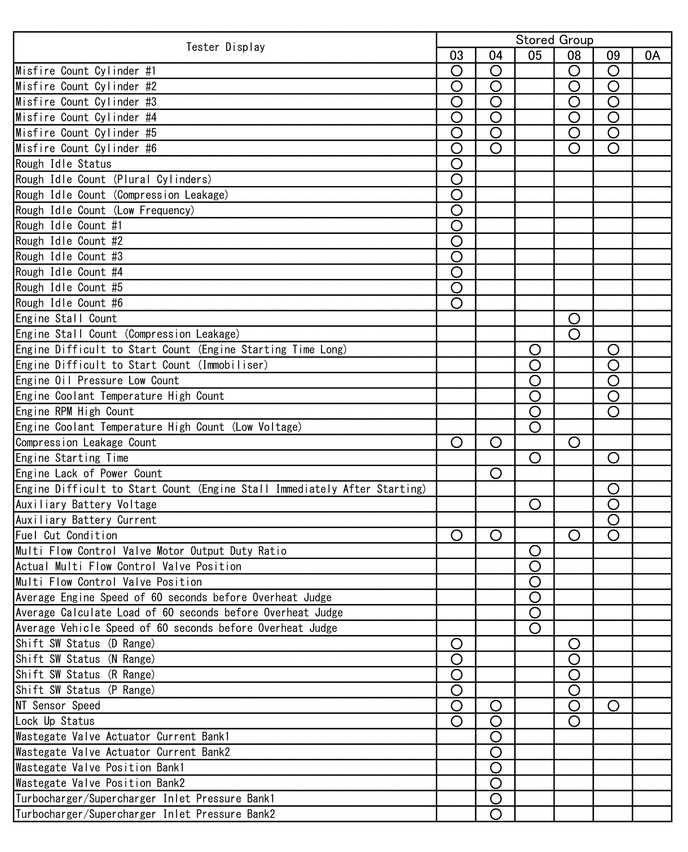
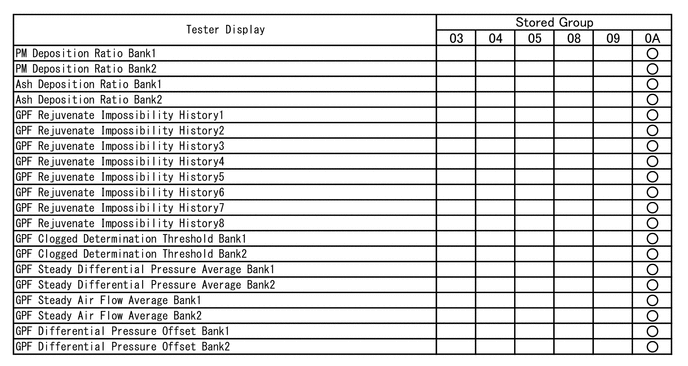
-
-
Tech Tips
-
The vehicle control history (automatic transmission system) stores the history of system protection operations.
-
The number of occurrences is stored for each item.
CHECK VEHICLE CONTROL HISTORY (AUTOMATIC TRANSMISSION SYSTEM)
-
Connect the GTS to the DLC3.
-
Turn the engine switch on (IG).
-
Turn the GTS on.
-
Enter the following menus: Powertrain / Engine / Utility / Vehicle Control History.
Powertrain > Engine > UtilityTester Display Vehicle Control History Vehicle Control History Item Code Tester Display Measurement Item Diagnostic Note X090A Limited Slip Differential Speed Higher than Expected History of high differential control operation while driving
-
Shift operation is prohibited to protect the differential when driving on a road with different friction between the left and right drive wheels and it is predicted that a large rotational difference will occur due to slip at one of the wheels.
-
It can be understood that one of the wheels slipped.
X090B Lock Up On (High A/T Oil Temperature) History of lock-up control operation due to the A/T fluid rising to a high temperature Switches to a shift line that restricts the engine speed until the A/T fluid temperature drops, in order to protect the A/T. -
-
-
CLEAR VEHICLE CONTROL HISTORY (AUTOMATIC TRANSMISSION SYSTEM)
-
Connect the GTS to the DLC3.
-
Turn the engine switch on (IG).
-
Turn the GTS on.
-
Enter the following menus: Powertrain / Engine / Utility / Vehicle Control History (Clear).
Note
By performing this procedure, all stored Vehicle Control History items will be cleared.
-
-
VEHICLE CONTROL HISTORY FREEZE FRAME DATA (AUTOMATIC TRANSMISSION SYSTEM)
-
Connect the GTS to the DLC3.
-
Turn the engine switch on (IG).
-
Turn the GTS on.
-
Enter the following menus: Powertrain / Engine / Utility / Vehicle Control History.
Powertrain > Engine > UtilityTester Display Vehicle Control History -
Select a vehicle control history item to access the applicable freeze frame data.
-
Check the freeze frame Data recorded with the Vehicle Control History.
Vehicle Control History Data Tester Display Description Acceleration Sensor Correct Value Acceleration sensor calibration value Throttle Position for Shift Point Control Throttle position for shift point control Stop Light SW Brake pedal operation availability Shift Range Signal Shift range Turbine Rotation Speed Input shaft speed Speed (SP2) ECT vehicle speed A/T Oil Temperature No.1 ATF temperature sensor value Output Axis Speed Output shaft speed Limited Slip Differential Speed Higher than Expected Count Occurrence count of Limited Slip Differential Speed Higher than Expected Lock Up On Count (High A/T Oil Temperature) Occurrence count of Lock Up On (High A/T Oil Temperature)
-
-
CHECK VEHICLE CONTROL HISTORY (CHARGING SYSTEM)
-
Connect the GTS to the DLC3.
-
Turn the engine switch on (IG).
-
Turn the GTS on.
-
Enter the following menus: Powertrain / Engine / Utility / Vehicle Control History.
Powertrain > Engine > UtilityTester Display Vehicle Control History Vehicle Control History Item Code Tester Display Measurement Item Diagnostic Note X0600 Auxiliary Battery Voltage Low at Start History of low battery voltage at engine control system start - X0601 Auxiliary Battery Voltage Low at IG OFF History of low battery voltage when engine switch off - X0602 Auxiliary Battery Discharge at IG OFF History of battery becoming discharged when engine switch off - X0603 Auxiliary Battery Discharge at Running History of battery becoming discharged while vehicle being driven -
-
-
CLEAR VEHICLE CONTROL HISTORY (CHARGING SYSTEM)
-
Connect the GTS to the DLC3.
-
Turn the engine switch on (IG).
-
Turn the GTS on.
-
Enter the following menus: Powertrain / Engine / Utility / Vehicle Control History (Clear).
Note
By performing this procedure, all stored Vehicle Control History items will be cleared.
-
-
VEHICLE CONTROL HISTORY FREEZE FRAME DATA (CHARGING SYSTEM)
-
Connect the GTS to the DLC3.
-
Turn the engine switch on (IG).
-
Turn the GTS on.
-
Enter the following menus: Powertrain / Engine / Utility / Vehicle Control History.
Powertrain > Engine > UtilityTester Display Vehicle Control History -
Select a vehicle control history item to access the applicable freeze frame data.
-
Check the freeze frame Data recorded with the Vehicle Control History.
Vehicle Control History Data GTS Display Description Total Distance Traveled Driving distance Total Distance Traveled - Unit Unit of driving distance Initial Engine Battery Minimum Voltage Minimum voltage at engine start Alternator Voltage - Non Active Test Requested voltage when the regulator forced operation is not executed Alternator Output Duty Ratio LIN terminal output (power generation rate) Auxiliary Battery Voltage Battery voltage
(+B, +B2, +B3, +B4 terminal)
Auxiliary Battery Integrated Current Battery capacity taking into account battery deterioration. Smoothed Value of Auxiliary Battery Temperature Calculated battery fluid temperature by battery fluid temperature sensor Auxiliary Battery Charge Rate Battery charge percentage calculated by battery sensor Auxiliary Battery Charging Rate Accuracy Accuracy of battery charge percentage calculated by battery sensor Auxiliary Battery Charging Capacity Battery charging capacity calculated by battery sensor Charging Control Mode Status of charging control Charging Control Working Factor Rate of charging control operation Average Vehicle Speed during Trip Average vehicle speed after engine starts during the current trip Auxiliary Battery Integrated Current during Trip Integrated current value detected by the battery state sensor during the current trip Auxiliary Battery Charging Integrated Current when Trip before Last Integrated current charged during the previous trip Auxiliary Battery Discharging Integrated Current when Trip before Last Integrated current discharged during the previous trip Auxiliary Battery Capacity after IG ON Battery capacity immediately after engine switch on (IG) Auxiliary Battery Capacity after IG OFF Battery capacity immediately after engine switch off Estimated Open Ended Auxiliary Battery Voltage when IG OFF Estimated battery release voltage calculated when engine switch is off by the battery sensor Auxiliary Battery Average Current during IG OFF Average current while parked (average value of current consumed from when the engine switch is off until lit is on (IG)) IG OFF Time just before IG ON Parking duration (duration from when the engine switch is off until it is on (IG)) Auxiliary Battery Average Current when Auxiliary Battery Voltage Low (during IG OFF) Average current when system judges that voltage is low while parked (average current value when the engine switch is off until the system judges the voltage is low while parked) IG OFF Time when Auxiliary Battery Voltage Low (during IG OFF) Parking duration when system judges that voltage is low while parked (duration from when the engine switch is off until the system judges the voltage is low while parked) Elapsed Time during Auxiliary Battery Voltage Low Duration that the voltage detected by the battery state sensor while the vehicle is in motion is below the threshold (example: 11 V) Average Engine Speed Average engine speed after engine starts during the current trip
-
-
VEHICLE CONTROL HISTORY (AIRBAG SYSTEM)
Tech Tips
A part of the control history can be confirmed using the vehicle control history.