СИСТЕМА ЗАПУСКА И ОСТАНОВА (для моделей с 2AR-FE), Diagnostic DTC:P0C2B11
| DTC Code | DTC Name |
|---|---|
| P0C2B11 | Auxiliary Transmission Fluid Pump Control Module Feedback Signal Circuit Short to Ground |
DESCRIPTION
The oil pump of the continuously variable transaxle assembly stops operating when the engine is stopped by stop and start control. While the engine is stopped by stop and start control, the oil pump with motor assembly is operated continuously ensuring optimal CVT oil pressure and smooth start-off when the engine is restarted.
The engine stop and start ECU supplies power to the oil pump with motor assembly via terminal OP21 and operates the oil pump with motor assembly in accordance with signals sent from terminal OPM1. The oil pump with motor assembly sends operating speed signals to the engine stop and start ECU via the NOPM signal line.
| DTC No. | Detection Item | DTC Detection Condition | Trouble Area | Warning Indicate | Memory | Note |
|---|---|---|---|---|---|---|
| P0C2B11 | Auxiliary Transmission Fluid Pump Control Module Feedback Signal Circuit Short to Ground | Both of the following conditions are met for 2 seconds or more (1 trip detection logic):
|
|
Blinks | DTC stored | SAE Code: P0C2D |
CONFIRMATION DRIVING PATTERN
-
Tech Tips
-
If the cable is disconnected from the battery terminal, stop and start control is prohibited until refresh charge is completed.
In this case, let the vehicle idle to complete the refresh charge. The refresh charge is complete when the Data List item [Status of Battery Charge Control] changes from "Refresh Charge Mode". (Usually, idling the engine for 5 to 60 minutes with the battery fluid temperature at 11°C (52°F) or higher, the refresh charge will be completed.)
-
If the GTS is not available and the Data List item [Status of Battery Charge Control] cannot be checked, charge the battery by idling the engine for approximately 5 to 60 minutes or driving the vehicle, and then drive the vehicle and check that stop and start control operates.
If the engine is started with the hood open, the system determines that a jump start has occurred. Therefore, make sure that the hood is closed before starting the engine and driving the vehicle.
-
After the refresh charge completes, turn the engine switch off, wait for at least 30 seconds, and then start the engine again. If the vehicle enters refresh charge mode again while the engine is idling, the initial refresh charge did not properly complete, so wait for the refresh charge to complete.
-
Allow the engine to idle for 3 minutes after it is warmed up and check that the engine idle speed is within 50 rpm of the target idle speed.
CONFIRMATION AFTER TROUBLESHOOTING
-
Connect the GTS to the DLC3.
-
Turn the engine switch on (IG).
-
Turn the GTS on.
-
Clear the DTCs.
Powertrain > Stop and Start > Clear DTCs -
Start the engine and warm it up.
-
Drive the vehicle at 7 km/h (4.3 mph) or more.
CAUTION:
When performing Confirmation Driving Pattern, obey all speed limits and traffic laws.
-
Depress the brake pedal and stop the vehicle.
-
Keep the engine stopped by stop and start control. (Keep the shift lever in D.)
-
Release the brake pedal with the shift lever in D to start the engine.
-
Check that no DTCs are output.
Powertrain > Stop and Start > Trouble Codes
-
-
Tech Tips
-
If the cable is disconnected from the battery terminal, stop and start control is prohibited until refresh charge is completed.
In this case, let the vehicle idle to complete the refresh charge. The refresh charge is complete when the Data List item [Status of Battery Charge Control] changes from "Refresh Charge Mode". (Usually, idling the engine for 5 to 60 minutes with the battery fluid temperature at 11°C (52°F) or higher, the refresh charge will be completed.)
-
If the GTS is not available and the Data List item [Status of Battery Charge Control] cannot be checked, charge the battery by idling the engine for approximately 5 to 60 minutes or driving the vehicle, and then drive the vehicle and check that stop and start control operates.
If the engine is started with the hood open, the system determines that a jump start has occurred. Therefore, make sure that the hood is closed before starting the engine and driving the vehicle.
-
After the refresh charge completes, turn the engine switch off, wait for at least 30 seconds, and then start the engine again. If the vehicle enters refresh charge mode again while the engine is idling, the initial refresh charge did not properly complete, so wait for the refresh charge to complete.
STOP AND START SYSTEM OPERATION CHECK
-
Start the engine and warm it up.
-
Turn the air conditioning system off.
-
Drive the vehicle at 7 km/h (4.3 mph) or more.
CAUTION:
When performing Confirmation Driving Pattern, obey all speed limits and traffic laws.
-
Depress the brake pedal and stop the vehicle.
-
Allow the engine to stop by stop and start control. (Keep the shift lever in D.)
-
Release the brake pedal with the shift lever in D to start the engine.
-
WIRING DIAGRAM
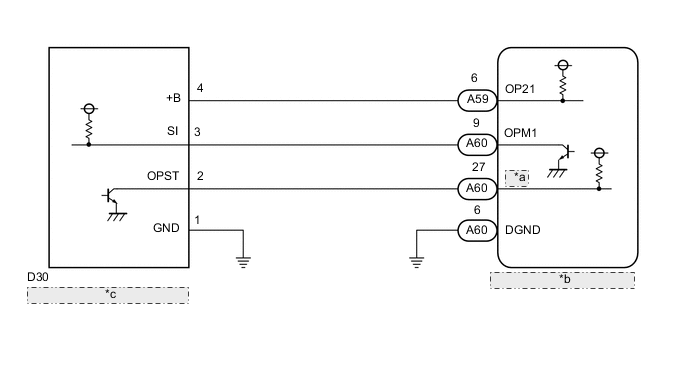
| *a | NOPM |
| *b | Engine Stop and Start ECU |
| *c | Oil pump with motor assembly |
CAUTION / NOTICE / HINT
Note
-
When replacing the engine stop and start ECU with a new one, make sure to download the previous status (number of starter operations) of the old engine stop and start ECU. After replacing the engine stop and start ECU, turn the engine switch on (IG) and wait 20 seconds, then confirm that "OK" is displayed for the Data List item [Stop&Start Operating Permission (Discharged Oil Pump Air)]. Then upload the previous status (number of starter operations) to the engine stop and start ECU.
-
After replacing the engine stop and start ECU or air conditioning amplifier assembly, reset and perform learning of the air conditioning information in the engine stop and start ECU.
-
After replacing the engine stop and start ECU or airbag ECU assembly, clear and calibrate the deceleration sensor zero point in the engine stop and start ECU.
-
After replacing the engine stop and start ECU, perform learning of the external backup boost converter (eco run vehicle converter assembly).
Tech Tips
-
Using the GTS, read the freeze frame data before troubleshooting. System condition information is recorded as freeze frame data the moment a DTC is stored. This information can be useful when troubleshooting.
-
DTCs for the stop and start system are not cleared even if the malfunction has been repaired. After repairing the malfunction, be sure to clear the DTCs.
PROCEDURE
-
CHECK HARNESS AND CONNECTOR (ENGINE STOP AND START ECU - OIL PUMP WITH MOTOR ASSEMBLY)
-
Disconnect the engine stop and start ECU connector.
-
Disconnect the oil pump with motor assembly connector.
-
Measure the resistance according to the value(s) in the table below.
Standard Resistance Tester Connection Condition Specified Condition A60-27 (NOPM) - D30-2 (OPST) Always Below 1 Ω A59-6 (OP21) - D30-4 (+B) Always Below 1 Ω A60-27 (NOPM) or D30-2 (OPST) - Body ground and other terminals Always 10 kΩ or higher A59-6 (OP21) or D30-4 (+B) - Body ground and other terminals Always 10 kΩ or higher Result Proceed to OK NG
NG 
REPAIR OR REPLACE HARNESS OR CONNECTOR
OK 
-
-
CHECK ENGINE STOP AND START ECU (NOPM TERMINAL VOLTAGE)
-
Disconnect the oil pump with motor assembly connector.
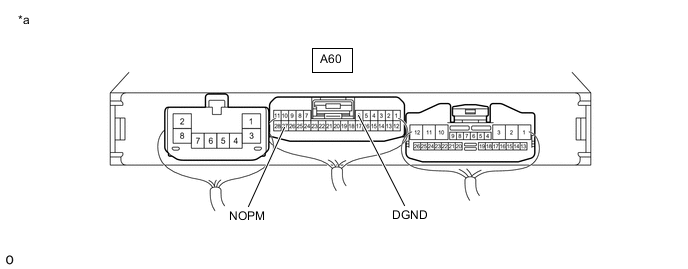
*a Component with harness connected
(Engine Stop and Start ECU)
- - -
Turn the engine switch to on (IG).
-
Measure the voltage according to the value(s) in the table below.
Standard Voltage Tester Connection Condition Specified Condition A60-27 (NOPM) - A60-6 (DGND) Engine switch on (IG) 10 to 14 V Result Proceed to OK NG
OK
REPLACE OIL PUMP WITH MOTOR ASSEMBLY (CONTINUOUSLY VARIABLE TRANSAXLE ASSEMBLY) Click here
NG
REPLACE ENGINE STOP AND START ECU Click here
-