EMISSION CONTROL SYSTEM ON-VEHICLE INSPECTION
CAUTION / NOTICE / HINT
CAUTION:
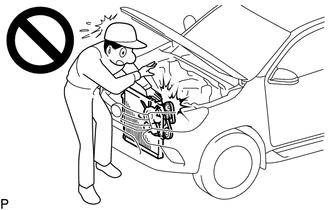
To prevent injury due to contact with an operating fan and generator V-belt or cooling fan, keep your hands and clothing away from the fan and generator V-belt and cooling fans when working in the engine compartment with the engine running.
PROCEDURE
-
CHECK FUEL CUT RPM
CAUTION:
To prevent injury due to contact with an operating fan and generator V-belt or cooling fan, keep your hands and clothing away from the fan and generator V-belt and cooling fans when working in the engine compartment with the engine running.
-
Start and warm up the engine.
-
Maintain the engine speed at 3000 rpm.
-
Use a sound scope to check for injector operating sounds.
-
Check that when the accelerator pedal is released, fuel injector operation noise stops momentarily and then resumes.
If the result is not as specified, check the fuel injector assembly, wire harness and ECM.
-
-
VISUALLY INSPECT HOSES, CONNECTORS AND GASKETS
-
Visually check that the hoses, connections and gaskets have no cracks, leaks or damage.
Note
-
Detachment or other problems with the engine oil level dipstick, oil filler cap sub-assembly, PCV hose and other components may cause the engine to run improperly.
-
Air suction caused by disconnections, looseness or cracks in the parts of the air induction system between the throttle body with motor assembly and the cylinder head will cause engine failure or engine malfunctions.
If the result is not as specified, replace parts as necessary.
-
-
-
CHECK FUEL TANK ASSEMBLY
-
Visually check for deformation, cracks or fuel leakage.
-
-
CHECK PURGE VSV
CAUTION:
To prevent injury due to contact with an operating fan and generator V-belt or cooling fan, keep your hands and clothing away from the fan and generator V-belt and cooling fans when working in the engine compartment with the engine running.
-
Check that the vacuum hose is connected correctly.
-

*a Vacuum Gauge Disconnect the vacuum hose from the canister and connect a vacuum gauge.
-
Using the procedure below, perform a purge VSV operation inspection when the engine coolant temperature is 74°C (165°F) or higher (while the engine is hot (purge VSV is opened)).
Tech Tips
The ECM turns the purge VSV on so that a vacuum is created in the intake manifold and the canister's fuel vapors are purged to the intake manifold.
-
Purge VSV operation inspection procedure.
-
When the engine is idling, the vacuum gauge indicates 40 kPa (300 mmHg, 11.8 in.Hg) or higher.
Result Result Procedure Yes Purge VSV operation normal No Go to next step -
Inspect the purge VSV.
Result Result Procedure OK Check wire harness and ECM NG Replace purge VSV
-
-
-
-
INSPECT SECONDARY AIR INJECTION SYSTEM OPERATION
-
Start the engine and warm it up.
-
Turn the ignition switch off.
-
Connect the GTS to the DLC3.
-
Turn the ignition switch to ON and turn the GTS on.
-
Enter the following menus: Powertrain / Engine / Utility / Secondary Air Injection Check / Manual Mode / AIR PUMP: ON, ASV: OPEN, and AIR PUMP: OFF, ASV: CLOSE.
Tech Tips
When Manual Mode is selected, the GTS initialization (atmospheric pressure measurement) is performed automatically. The initialization takes 10 seconds. After the initialization, air pump and air switching valve operation can be selected.
Powertrain > Engine > UtilityTester Display Secondary Air Injection Check -
Start the engine.
-
Perform the Secondary Air Injection System intrusive operation while the engine is idling.
-
Check that the air pump (AIR PUMP), air switching valve (ASV) and pressure in the secondary air injection system passage (PRESSURE) status displayed on the GTS, indicate the conditions shown in the table below.
Standard GTS Operation AIR PUMP ASV PRESSURE* AIR PUMP: ON, ASV: OPEN ON ON 1 kPa or more AIR PUMP: OFF, ASV: CLOSE OFF OFF Less than 3.3 kPa *:
Average pumping pressure. The pressure should be 1 kPa or more when the secondary air injection system operates.
-
Turn the ignition switch off.
Note
-
This Secondary Air Injection Check only allows technicians to operate the secondary air injection system for a maximum of 5 seconds.
Furthermore, the check can only be performed up to 4 times per trip. If the test is repeated, intervals of at least 30 seconds are required between checks.
While secondary air injection system operation using the GTS is prohibited, the GTS display indicates the prohibition (Wait or Error).
If an Error is displayed on the GTS during the test, stop the engine for 10 minutes, and then try again.
-
Performing the Secondary Air Injection Check repeatedly may cause damage to the secondary air injection system. If necessary, leave an interval of several minutes between System Check operations to prevent the system from overheating.
-
When performing the Secondary Air Injection Check operation after the battery cable has been reconnected, wait for 7 minutes with the ignition switch turned to ON or the engine running.
-
Turn the ignition switch off when the Secondary Air Injection Check operation finishes.
-
-