REAR SUSPENSION SYSTEM
-
CONSTRUCTION
-
Rear Shock Absorber Assembly
-
Graceful riding comfort and a high degree of handling stability with a feeling of oneness with the vehicle help enhancing by the adoption of wide-bore pistons for the rear suspension support assembly.
-
Linear, highly responsive damping characteristics have been produced from the very-low-speed range through the pressure-reducing effect of a large-bore piston and by layering several kinds of different-diameter leaf valves with clever piston shapes.
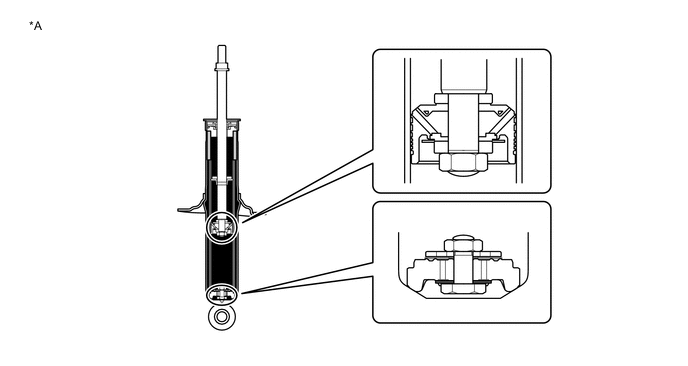
Text in Illustration *A For SHOWA Made - - -
Internal pressure fluctuations during the switch between pushing and pulling have been suppressed to the minimum and responsiveness has been further improved by layering different-diameter leaf valves on the piston's upper chamber side and sharing the damping force on the pushing side with the base valve side.
-
Linear, highly responsive damping from the very-low-speed range has produced linear handling and a sense of oneness with the vehicle.
-
High-dimensional handling stability can be achieved by combining the graceful ride achieved by a large piston bore and reducing internal pressure fluctuations.
-
A rear shock absorber assembly made by SACHS was employed in accordance with specifications. High-dimensional handling stability and ride quality were both established in pursuit of damping.
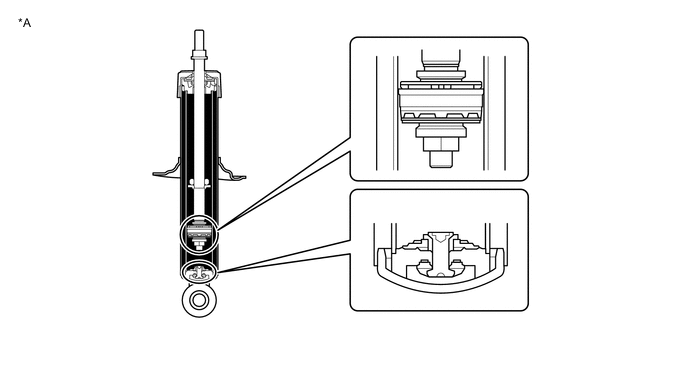
Text in Illustration *A For SACHS Made - -
-
-
Rear Upper Arm Assembly and Bush
-
Cast iron has been adopted for the rear upper control arm assembly, achieving higher rigidity.
-
A ball joint has been adopted for attachment to the rear axle carrier sub-assembly, enhancing support rigidity.
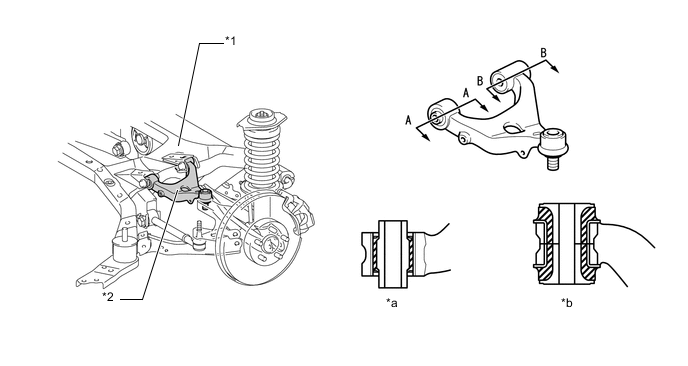
Text in Illustration *1 Suspension Member (Rear Suspension Member Sub-assembly) *2 Rear Upper Control Arm Assembly *a A-A Cross Section *b B-B Cross Section
-
-
Rear Lower Arm Assembly and Bush
-
Tubing has been used for the toe control link sub-assembly in order to further enhance high rigidity and reduce weight. A ball joint has also been adopted for attachment on the axle side.
-
Pressed steel sheet has been used for rear No.2 suspension arm assembly in order to further enhance high rigidity and reduce weight. A bush with external cylinder for attachment on the member side and a pillow-ball for attachment to the axle side have also been respectively adopted, enhancing a high level of support rigidity.
-
Front bush with external cylinder has been adopted on the rear trailing arm assembly, enhancing excellent riding comfort by enhancing front-rear compliance.
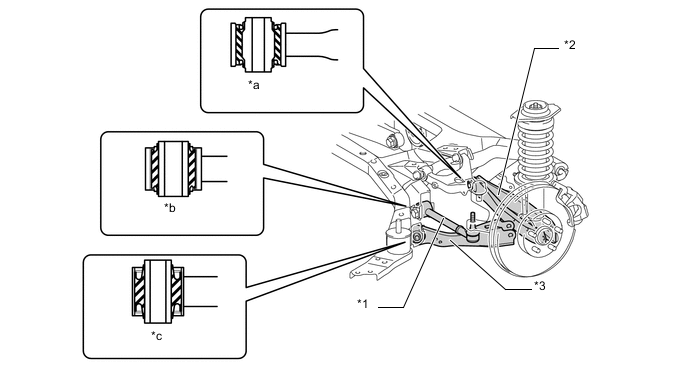
Text in Illustration *1 Toe Control Link Sub-assembly *2 Rear No.2 Suspension Arm Assembly *3 Rear No.1 Suspension Arm Assembly - - *a Rear Bush Cross Section *b Bush Cross Section *c Front Bush Cross Section - -
-
-
Rear Stabilizer Bar
-
A solid rear stabilizer bar with a diameter of 15.0 mm has been adopted to optimize roll rigidity.
-
A design for the stabilizer link sub-assembly has been adopted that uses a ball joint for the upper portion and a bush for the lower portion, and attaches to rear No.2 suspension arm assembly.
-
Self-lubricating rubber has been adopted for the rear stabilizer bar bush.
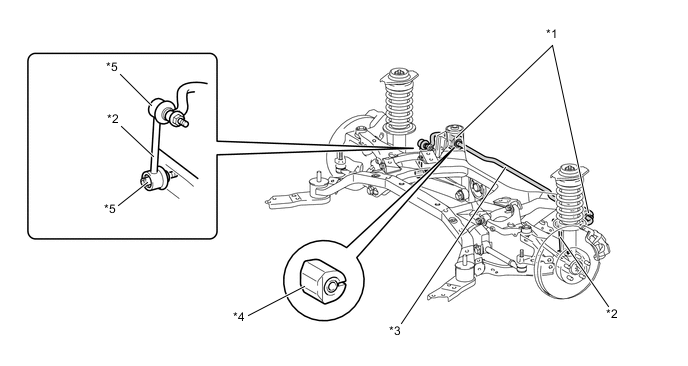
Text in Illustration *1 Rear Stabilizer Bar Bush *2 Stabilizer Link Sub-assembly *3 Rear Stabilizer Bar *4 Self Lubricating Rubber *5 Ball Joint - -
-
-
Suspension Member
-
A square-shaped rear suspension member sub-assembly with closed section construction has been adopted.
-
A high level of rigidity and excellent maneuvering stability have been ensured for the attachment parts of each suspension arm.
-
A cold-forged iron rear suspension member rear upper stopper has been adopted, increasing rigidity to improve the feel of direct control as a sports car.
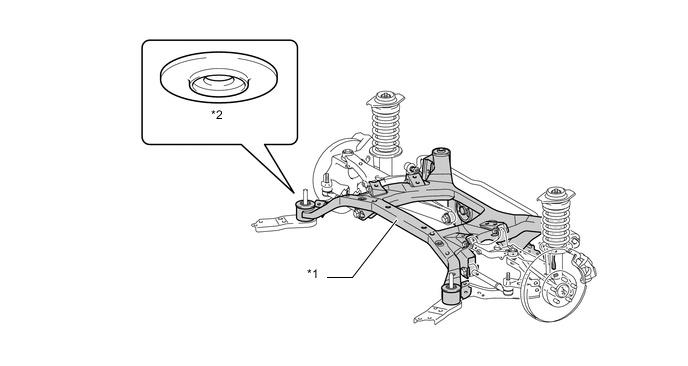
Text in Illustration *1 Suspension-Member
(Rear Suspension Member Sub-assembly)
*2 Rear Suspension Member Rear Upper Stopper
-
-