PARKING ASSIST MONITOR SYSTEM
-
OUTLINE
-
The parking assist monitor system consists of the rear monitor and parking guide lines to assist the driver in parking the vehicle.
-
The parking assist monitor system has a rear television camera assembly mounted on the back door to display a view of the area behind the vehicle on the radio and display receiver assembly.
-
This system consists of the rear television camera assembly and the radio and display receiver assembly.
-
The rear television camera assembly controls the parking assist monitor system.
-
The illustrations in these descriptions represent sample screens.
-
-
PRECAUTION
-
General Precautions
-
Do not rely entirely on the parking assist monitor system. Use caution, just as when driving any vehicle.
-
Never drive while looking only at the screen. The image on the screen may differ from actual conditions. Backing up while looking only at the screen may cause an accident or cause the vehicle to hit an object. Be sure to confirm the safety of the surroundings when driving the vehicle.
-
-
Television Camera Precautions
-
The area covered by the rear television camera assembly is limited. The rear television camera assembly does not show objects close to either corner of the bumper or show items under the bumper. The clearance distance that appears on the screen is different from the actual distance because the rear television camera assembly uses a wide-angle lens.
-
The camera is unable to capture a clear image if the glass in front of the lens is dirty. Therefore, clean the glass if it has water, snow or dirt on it.
-
In the following cases, it may become difficult to see the images on the screen, but this is not a malfunction:
-
In the dark (for example, at night).
-
When the temperature near the lens is very high or low.
-
When water droplets are adhering to the camera, or when humidity is high (for example, when it rains).
-
When the camera has scratches or dirt on it.
-
When foreign matter (for example, mud) is adhering to the camera lens.
-
When the sun or the beams of the headlights is shining directly into the camera lens.
-
-
When the camera is used under fluorescent lights, sodium lights or mercury lights, etc., the lights and the illuminated area may appear to flicker.
-
When washing the vehicle with a high-pressure washer, do not spray water on the rear television camera assembly or surrounding area. High-pressure water can damage the camera.
-
-
Road Condition Precautions
-
Depending on the number of occupants, the load conditions, the slope of the road, and bumps in the road, a disparity may occur between the display indication and the actual distance on the road surface. Operate the vehicle carefully.
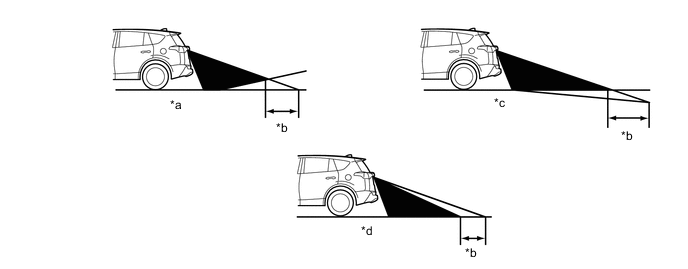
*a Steep Uphill Incline behind Vehicle *b Disparity *c Steep Downhill Incline behind Vehicle *d Vehicle Posture Changed by Passengers and Load -
If a steep uphill incline is behind the vehicle, an obstacle will appear to be further away than it actually is as shown in the illustration below:
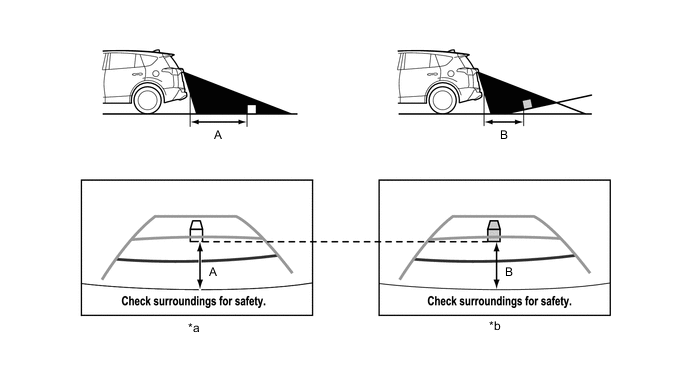
*a Screen Image in Case A *b Screen Image in Case B
-
-
Precautions for 3-dimensional Obstacles
-
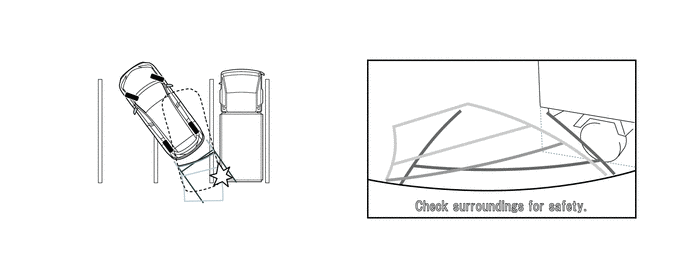
Drive carefully when any 3-dimensional objects such as walls or vehicles are behind the vehicle as the distance and estimated course lines are provided based on the road surface.
-
When passing close to a 3-dimensional object, the vehicle may come into contact with the object even if the estimated vehicle path seems not to be in contact with the object on the screen.
-
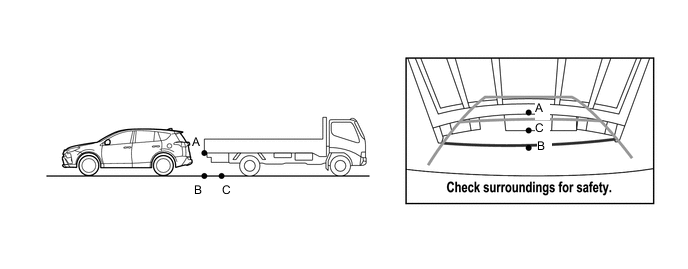
The distance indication as shown on the screen varies between 3-dimensional objects such as a vehicle and a flat plane such as the road surface. As shown in the following illustrations, points A and B are actually vertically in the same position and point C is a bit away from them, however, the points are displayed in order of distance from the vehicle, B, C and A. Therefore, the vehicle will come into contact with the 3-dimensional object if it is backed to point B on the screen.
-
On slippery roads such as snowy roads, the estimated vehicle path and actual vehicle path may not match.
-
When only one parking line is provided, the vehicle may seem to be parallel to the line on the screen even if it is not actually parallel.
-
-
-