ENGINE UNIT
-
CONSTRUCTION
-
The ventilation inside the stiffening crankcase assembly uses the same PCV valve (ventilation valve sub-assembly) as a Natural Aspiration (NA) engine. In addition, blow-by gas ventilation control, which forcibly performs ventilation when in the supercharging range by using an ejector, is used. As a result, blow-by gas with a large quantity of hydrocarbons is prevented from being discharged into the atmosphere by forcibly introducing the blow-by gas into the intake system and combusting the gas. Also, the same oil maintenance schedule as an NA engine is achieved by actively performing ventilation during all driving ranges.
-
A larger volume of blow-by gas is present in a turbocharged engine compared to an NA engine. Therefore, a No. 1 oil separate chamber is provided in the cylinder block sub-assembly, and No. 2 and No. 3 oil separate chambers are provided in the cylinder head cover sub-assembly. The No. 1 and No. 2 oil separate chambers use a labyrinth structure to improve the efficiency of separating engine oil from the blow-by gas.
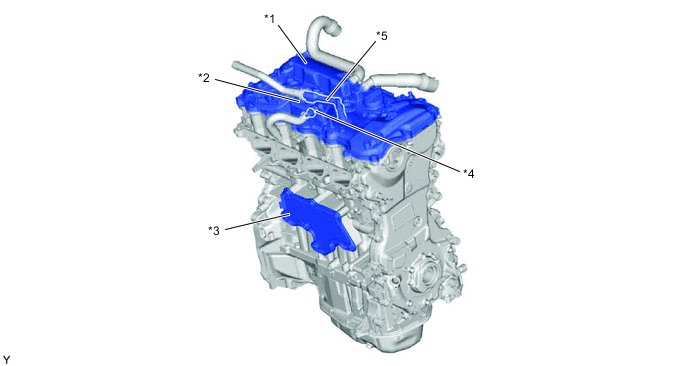
*1 No. 3 Oil Separate Chamber *2 No. 2 Oil Separate Chamber *3 No. 1 Oil Separate Chamber *4 PCV Valve (Ventilation Valve Sub-assembly) *5 Ejector - -
-
-
OPERATION
-
When the engine is in the turbocharged intake air range, blow-by gas is forcibly routed through the intake pipe by the ejector.
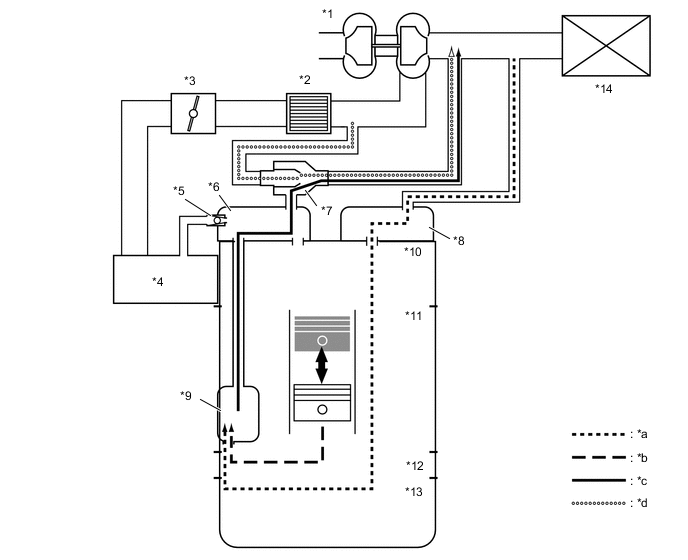
*1 Turbocharger Sub-assembly *2 Intercooler Assembly *3 Throttle Body Assembly *4 Intake Manifold *5 PCV Valve (Ventilation Valve Sub-assembly) *6 No. 2 Oil Separate Chamber *7 Ejector *8 No. 3 Oil Separate Chamber *9 No. 1 Oil Separate Chamber *10 Cylinder Head Sub-assembly *11 Cylinder Block Sub-assembly *12 Stiffening Crankcase Assembly *13 Oil Pan Sub-assembly *14 Air Cleaner Assembly *a Fresh Air *b Blowby Gas *c Fresh Air + Blowby Gas *d Ejector Drive Gas -
When the engine is in the natural intake air range, blow-by gas is suctioned via the PCV valve (ventilation valve sub-assembly) due to the vacuum in the intake air ducts.
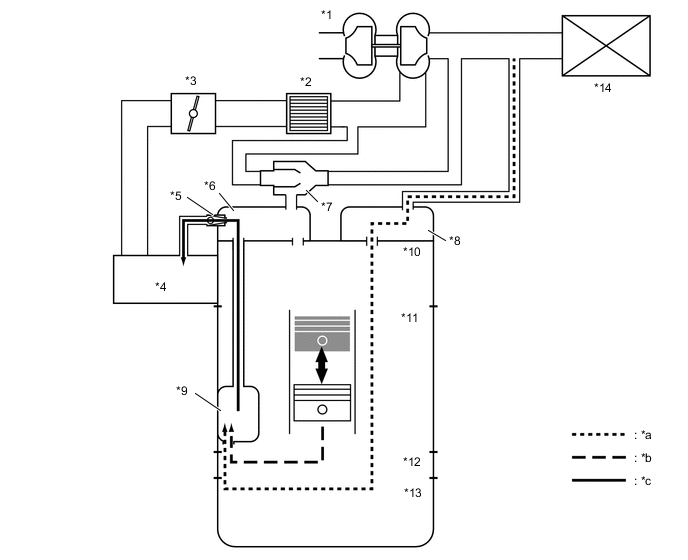
*1 Turbocharger Sub-assembly *2 Intercooler Assembly *3 Throttle Body Assembly *4 Intake Manifold *5 PCV Valve (Ventilation Valve Sub-assembly) *6 No. 2 Oil Separate Chamber *7 Ejector *8 No. 3 Oil Separate Chamber *9 No. 1 Oil Separate Chamber *10 Cylinder Head Sub-assembly *11 Cylinder Block Sub-assembly *12 Stiffening Crankcase Assembly *13 Oil Pan Sub-assembly *14 Air Cleaner Assembly *a Fresh Air *b Blowby Gas *c Fresh Air + Blowby Gas - - -
The ejector uses the Venturi effect as its operating principle. Blow-by gas is drawn in by the high-pressure air introduced by the ejector.
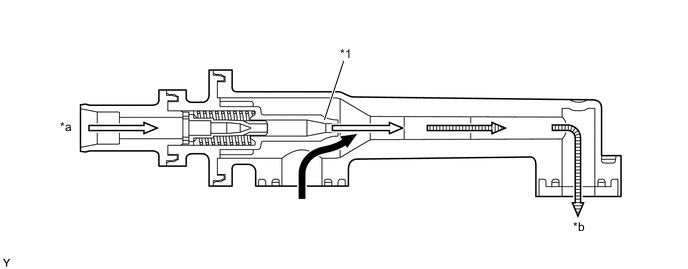
*1 Nozzle - - *a From Downstream of Turbocharger Sub-assembly *b Towards Upstream of Turbocharger Sub-assembly 
Blowby Gag 
Drive Gas 
Blowby Gag + Drive Gas - -
-