SFI SYSTEM, Diagnostic DTC:P2096, P2097
| DTC Code | DTC Name |
|---|---|
| P2096 | Post Catalyst Fuel Trim System Too Lean (Bank 1) |
| P2097 | Post Catalyst Fuel Trim System Too Rich (Bank 1) |
DESCRIPTION
The sub fuel trim is related to the feedback compensation value, not to the basic injection time. The sub fuel trim consists of both the short-term and the long-term fuel trim between the front catalyst and rear catalyst.
The short-term fuel trim is fuel compensation that is used to constantly maintain the air fuel ratio at stoichiometric levels. The signal from the air fuel ratio sensor indicates whether the air fuel ratio is rich or lean compared to the stoichiometric ratio. This triggers a reduction in the fuel injection volume if the air fuel ratio is rich and an increase in the fuel injection volume if it is lean.
Factors such as individual engine differences, wear over time and changes in operating environment cause short-term fuel trim to vary from the ideal theoretical value. The long-term fuel trim controls overall fuel compensation. The long-term fuel trim compensates for long term deviations of the fuel trim from the ideal theoretical value. These long term deviations result from the corrections made by the short-term fuel trim.
If both the short-term fuel and long-term fuel trim are lean or rich beyond predetermined values, it is interpreted as a malfunction, the ECM illuminates the MIL and sets a DTC.
| DTC No. | DTC Detection Condition | Trouble Area |
|---|---|---|
| P2096 | With warm engine and stable air fuel ratio feedback, sub fuel trim considerably in error to lean side (2 trip detection logic) |
|
| P2097 | With warm engine and stable air fuel ratio feedback, sub fuel trim considerably in error to rich side (2 trip detection logic) |
Tech Tips
-
When DTC P2096 is set, the actual air-fuel ratio is on the lean side. When DTC P2097 is set, the actual air-fuel ratio is on the rich side.
-
If the vehicle runs out of fuel, the air-fuel ratio is lean and DTC P2096 may be set. The MIL is then illuminated.
MONITOR DESCRIPTION
Under closed loop fuel control, fuel injection volumes that deviate from those estimated by the ECM cause changes in the long-term fuel trim compensation value. The long-term fuel trim is adjusted when there are persistent deviations in the short-term fuel trim values. Deviations from the ECM's estimated fuel injection volumes also affect the average fuel trim learning value, which is a combination of the average short-term fuel trim (fuel feedback compensation value) and the average long-term fuel trim (learning value of the air fuel ratio). If the average fuel trim learning value exceeds the malfunction threshold, the ECM interprets this as a malfunction in the fuel system and sets a DTC.
CONFIRMATION DRIVING PATTERN
-
Connect the GTS to the DLC3.
-
Turn the ignition switch to ON and turn the GTS on.
-
Clear DTCs (even if no DTCs are stored, perform the clear DTC operation) Click here.
-
Turn the ignition switch off and wait for at least 30 seconds.
-
Turn the ignition switch to ON and turn the GTS on.
-
Start the engine and warm it up until the engine coolant temperature reaches 75°C (167°F) or higher.
Tech Tips
Check the engine coolant temperature is 20°C (68°F) or less at engine started.
-
Perform the following the confirmation driving pattern.
CAUTION:
When performing the confirmation driving pattern, obey all speed limits and traffic laws.
-
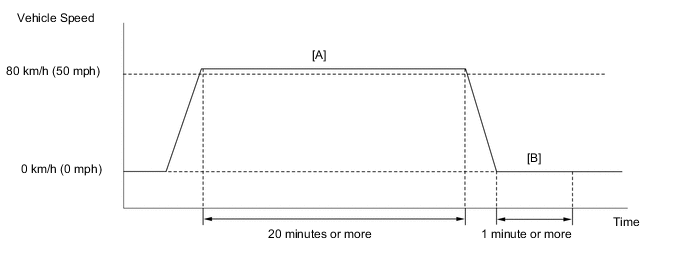
Drive the vehicle at 80 km/h (50 mph) or more for 20 minutes or more [A].
-
Stop the vehicle.
-
Idle the engine for 1 minute or more [B].
-
Enter the following menus: Powertrain / Engine / Trouble Codes.
-
Read pending DTCs.
Tech Tips
-
If a pending DTC is output, the system is malfunctioning.
-
If a pending DTC is not output, perform the following procedure.
-
-
Enter the following menus: Powertrain / Engine / Utility / All Readiness.
-
Input the DTC: P2096 or P2097.
-
Check the DTC judgment result.
GTS Display Description NORMAL
-
DTC judgment completed
-
System normal
ABNORMAL
-
DTC judgment completed
-
System abnormal
INCOMPLETE
-
DTC judgment not completed
-
Perform driving pattern after confirming DTC enabling conditions
N/A
-
Unable to perform DTC judgment
-
Number of DTCs which do not fulfill DTC preconditions has reached ECU memory limit
Tech Tips
-
If the judgment result shows NORMAL, the system is normal.
-
If the judgment result shows ABNORMAL, the system has a malfunction.
-
-
If the test result is INCOMPLETE or N/A and no DTC is output, perform a universal trip and check for permanent DTCs Click here.
Tech Tips
-
If a permanent DTC is output, the system is malfunctioning.
-
If no permanent DTC is output, the system is normal.
-
WIRING DIAGRAM
Refer to DTC P0030 Click here.
CAUTION / NOTICE / HINT
Tech Tips
Malfunctioning areas can be identified by performing the Control the Injection Volume for A/F Sensor function provided in the Active Test. The Control the Injection Volume for A/F Sensor function can help to determine whether the air fuel ratio sensor, heated oxygen sensor and other potential trouble areas are malfunctioning.
The following instructions describe how to conduct the Control the Injection Volume for A/F Sensor operation using the GTS.
-
Connect the GTS to the DLC3.
-
Start the engine.
-
Turn the GTS on.
-
Warm up the engine at an engine speed of 2500 rpm for approximately 90 seconds.
-
Enter the following menus: Powertrain / Engine / Active Test / Control the Injection Volume for A/F Sensor / Gas AF Control / AFS Voltage B1S1 and O2S B1S2.
-
Perform the Active Test operation with the engine idling (press the RIGHT or LEFT button to change the fuel injection volume).
-
Monitor the output voltages of the air fuel ratio and heated oxygen sensors (AFS Voltage B1S1 and O2S B1S2) displayed on the GTS.
Tech Tips
-
Change the fuel injection volume within the range of -12.5% to +12.5%.
-
Each sensor reacts in accordance with increases and decreases in the fuel injection volume.
| GTS Display (Sensor) | Injection Volume | Status | Voltage |
|---|---|---|---|
| AFS Voltage B1S1 (Air fuel ratio) |
+12.5% | Rich | Below 2.0 V |
| -12.5% | Lean | Higher than 2.4 V | |
| O2S B1S2 (Heated oxygen) |
+12.5% | Rich | Higher than 0.55 V |
| -12.5% | Lean | Below 0.4 V |
Note
The air fuel ratio sensor has an output delay of a few seconds and the heated oxygen sensor has a maximum output delay of approximately 20 seconds.
-
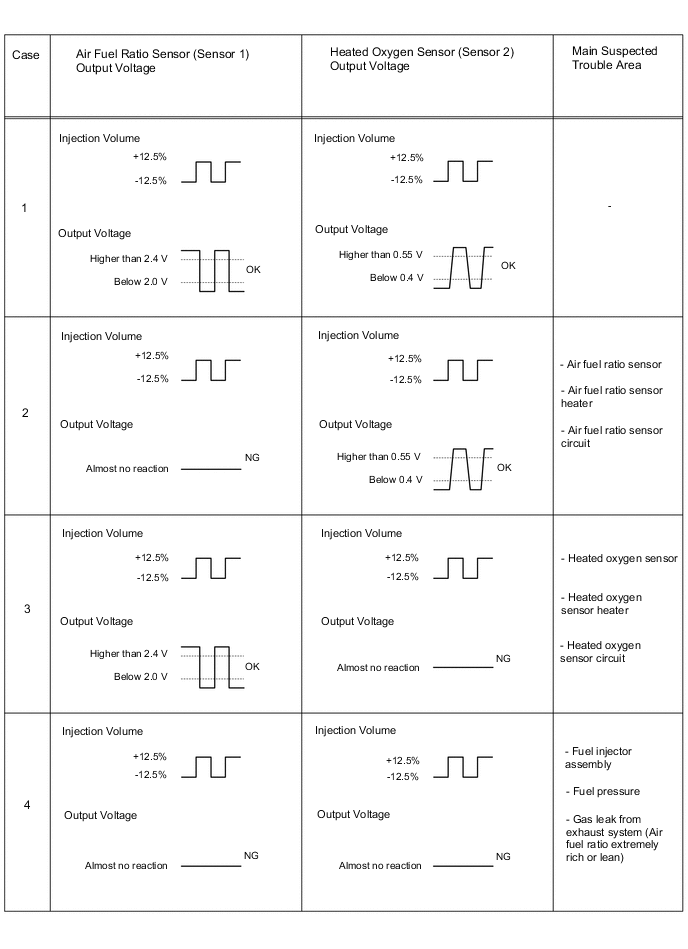
Following the Control the Injection Volume for A/F Sensor procedure enables technicians to check and graph the voltage outputs of both the air fuel ratio and heated oxygen sensors.
-
To display the graph, enter the following menus: Powertrain / Engine / Active Test / Control the Injection Volume for A/F Sensor / Gas AF Control / AFS Voltage B1S1 and O2S B1S2; and then press the graph button on the Data List view.
Tech Tips
-
Bank 1 refers to the bank that includes the No. 1 cylinder*.
*: The No. 1 cylinder is the cylinder which is farthest from transmission.
-
Bank 2 refers to the bank that does not include the No. 1 cylinder.
-
Sensor 1 refers to the sensor closest to the engine assembly.
-
Sensor 2 refers to the sensor farthest away from the engine assembly.
-
Read freeze frame data using the GTS. The ECM records vehicle and driving condition information as freeze frame data the moment a DTC is stored. When troubleshooting, freeze frame data can be helpful in determining whether the vehicle was moving or stationary, whether the engine was warmed up or not, whether the air fuel ratio was lean or rich, as well as other data recorded at the time of a malfunction.
-
A low air fuel ratio sensor voltage could be caused by a rich air fuel mixture. Check for conditions that would cause the engine to run rich.
-
A high air fuel ratio sensor voltage could be caused by a lean air fuel mixture. Check for conditions that would cause the engine to run lean.
PROCEDURE
-
CHECK ANY OTHER DTCS OUTPUT (IN ADDITION TO DTC P2096 AND/OR P2097)
-
Connect the GTS to the DLC3.
-
Turn the ignition switch to ON.
-
Turn the GTS on.
-
Enter the following menus: Powertrain / Engine / Trouble Codes.
-
Read the DTCs.
Result Result Proceed to P2096 or P2097 A P2096 and/or P2097 and other DTCs B Tech Tips
If any DTCs other than P2096 or P2097 are output, troubleshoot those DTCs first.
B 
GO TO DTC CHART Click here
A 
-
-
PERFORM SYSTEM CHECK (CONTROL THE INJECTION WAY)
-
Connect the GTS to the DLC3.
-
Turn the ignition switch to ON.
-
Turn the GTS on.
-
Start the engine.
-
Enter the following menus: Powertrain / Engine / Active Test / Control the Injection Way / Port.
-
Read the value Short #1 and Long FT #1.
OK Short FT #1 + Long FT #1 = Between -19% and +19% -
Enter the following menus: Powertrain / Engine / Active Test / Control the Injection Way / Direct.
-
Read the value Short FT #1 and Long FT #1.
OK Short FT #1 + Long FT #1 = Between -19% and +19% Result Item Proceed to Port Direct OK OK A OK NG B NG OK C NG NG D
B 
CHECK FUEL PRESSURE SENSOR Click here
C
CHECK FUEL INJECTOR ASSEMBLY (FOR PORT INJECTION) Click here
D
CHECK PCV HOSE CONNECTIONS Click here
A
-
-
CHECK IF VEHICLE HAS RUN OUT OF FUEL IN PAST
-
Has the vehicle run out of fuel in the past?
YES
DTC CAUSED BY RUNNING OUT OF FUEL
NO
CHECK FOR INTERMITTENT PROBLEMS Click here
-
-
CHECK PCV HOSE CONNECTIONS
-
Check the PCV hose connections Click here.
OK PCV valve and hose are connected correctly and are not damaged.
NG
REPAIR OR REPLACE PCV HOSE
OK
-
-
CHECK INTAKE SYSTEM
-
Check the intake system for vacuum leaks Click here.
OK No leaks in intake system.
NG
REPAIR OR REPLACE INTAKE SYSTEM
OK
-
-
PERFORM ACTIVE TEST USING GTS (CONTROL THE INJECTION VOLUME FOR A/F SENSOR)
-
Connect the GTS to the DLC3.
-
Turn the ignition switch to ON.
-
Turn GTS on.
-
Warm up the engine and run the engine at an engine speed of 2500 rpm for approximately 90 seconds.
-
Enter the following menus: Powertrain / Engine / Active Test / Control the Injection Volume for A/F Sensor / AFS Voltage B1S1 and O2S B1S2.
-
Perform the Control the Injection Volume for A/F Sensor operation with the engine in an idling.
-
Monitor the output voltages of the A/F and HO2 sensors (AFS Voltage B1S1 and O2S B1S2) displayed on the GTS.
Tech Tips
-
Change the fuel injection volume within the range of -12.5% to 12.5%.
-
The air fuel ratio sensor has an output delay of a few seconds and the heated oxygen sensor has a maximum output delay of approximately 20 seconds.
-
If the sensor output voltage does not change (almost no reaction) while performing the Active Test, the sensor may be malfunctioning.
GTS Display (Sensor) Injection Volume Status Voltage AFS Voltage B1S1
(A/F)
12.5% Rich Less than 2.0 V -12.5% Lean More than 2.4 V O2S B1S2
(HO2)
12.5% Rich More than 0.55 V -12.5% Lean Less than 0.4 V Result Status
AFS Voltage B1S1
Status
O2S B1S2
A/F Condition and
A/F Sensor Condition
Suspected Trouble Area Proceed to Lean/Rich Lean/Rich Normal - A Lean Lean Actual air-fuel ratio lean
-
Ventilation valve and hose
-
Ventilation hose connections
-
Injector for port injection
-
Gas leakage from exhaust system
-
Air induction system
-
Fuel pressure
-
Mass Air Flow (MAF) meter
-
Engine Coolant Temperature (ECT) sensor
A Rich Rich Actual air-fuel ratio rich
-
Gas leakage from exhaust system
-
Ignition system
-
Fuel pressure
-
Mass air flow meter
-
ECT sensor
A Lean Lean/Rich A/F sensor malfunction
-
Air fuel ratio sensor
B Rich Lean/Rich A/F sensor malfunction
-
Air fuel ratio sensor
B Lean: During the Control the Injection Volume for A/F Sensor Active Test, the air fuel ratio sensor output voltage (AFS Voltage) is consistently higher than 2.4 V, and the heated oxygen sensor output voltage (O2S) is consistently below 0.4 V.
Rich: During the Control the Injection Volume for A/F Sensor Active Test, the AFS Voltage is consistently below 2.0 V, and the O2S is consistently higher than 0.55 V.
Lean/Rich: During the Control the Injection Volume for A/F Sensor Active Test, the output voltage of the heated oxygen sensor alternates correctly.
Tech Tips
Refer to "Data List / Active Test" [AFS Voltage B1S1 and O2S B1S2] Click here.
-
B
INSPECT AIR FUEL RATIO SENSOR (HEATER RESISTANCE) Click here
A
-
-
READ VALUE USING GTS (COOLANT TEMP)
-
Connect the GTS to the DLC3.
-
Turn the ignition switch to ON.
-
Turn the GTS on.
-
Enter the following menus: Powertrain / Engine / Data List / Coolant Temp.
-
Read the Coolant Temp twice, when the engine is both cold and warmed up.
Standard With cold engine Same as ambient air temperature. With warm engine Between 75 and 100°C (167 and 212°F)
NG
REPLACE ENGINE COOLANT TEMPERATURE SENSOR Click here
OK
-
-
READ VALUE USING GTS (MAF)
-
Connect the GTS to the DLC3.
-
Turn the ignition switch to ON.
-
Turn the GTS on.
-
Start the engine.
-
Enter the following menus: Powertrain / Engine / Data List / MAF, Coolant Temp and Engine Speed.
-
Allow the engine to idle until Coolant Temp reaches 75°C (167°F) or higher.
-
Read MAF with the engine speed at 3000 rpm.
Standard Between 13.0 gm/sec and 14.0 gm/sec (shift lever: N, A/C: Off).
NG
CHECK HARNESS AND CONNECTOR (MASS AIR FLOW METER CONNECTOR CONNECTION) Click here
OK
-
-
CHECK FOR EXHAUST GAS LEAK
-
Check for exhaust gas leaks.
OK No gas leaks.
OK
PERFORM CONFIRMATION DRIVING PATTERN Click here
NG
REPAIR OR REPLACE EXHAUST SYSTEM
-
-
INSPECT AIR FUEL RATIO SENSOR (HEATER RESISTANCE)
-
Inspect the air fuel ratio sensor Click here.
NG
REPLACE AIR FUEL RATIO SENSOR Click here
OK
-
-
CHECK HARNESS AND CONNECTOR (AIR FUEL RATIO SENSOR - ECM)
-
Disconnect the air fuel ratio sensor connector.
-
Disconnect the ECM connector.
-
Measure the resistance according to the value(s) in the table below.
Standard Resistance (Check for open) Tester Connection Condition Specified Condition A34-19 (A1A+) - C14-3 (A1A+) Always Below 1 Ω A34-18 (A1A-) - C14-4 (A1A-) Always Below 1 Ω A34-5 (HA1A) - C14-1 (HA1A) Always Below 1 Ω Standard Resistance (Check for short) Tester Connection Condition Specified Condition A34-19 (A1A+) or C14-3 (A1A+) - Body ground Always 10 kΩ or higher A34-18 (A1A-) or C14-4 (A1A-) - Body ground Always 10 kΩ or higher A34-5 (HA1A) or C14-1 (HA1A) - Body ground Always 10 kΩ or higher
NG
REPAIR OR REPLACE HARNESS OR CONNECTOR
OK
-
-
REPLACE AIR FUEL RATIO SENSOR
-
Replace the air fuel ratio sensor Click here.
NEXT
-
-
PERFORM CONFIRMATION DRIVING PATTERN
-
Connect the GTS to the DLC3.
-
Turn the ignition switch to ON and turn the GTS on.
-
Clear the DTCs Click here.
-
Turn the ignition switch off and wait for at least 30 seconds.
-
Turn the ignition switch to ON and turn the GTS on.
-
Drive the vehicle in accordance with the driving pattern described in Confirmation Driving Pattern.
NEXT
-
-
CHECK WHETHER DTC OUTPUT RECURS (DTC P2096 AND/OR P2097)
-
Enter the following menus: Powertrain / Engine / Trouble Codes.
-
Read the pending DTCs.
Result Result Proceed to P2096 and/or P2097 A DTC is not output B
B
END
A
-
-
CHECK FUEL PRESSURE (LOW PRESSURE SIDE)
-
Check the fuel pressure (low pressure side) Click here.
Result Result Proceed to NG A OK B
B
CHECK HARNESS AND CONNECTOR (MASS AIR FLOW METER CONNECTOR CONNECTION) Click here
A
-
-
CHECK FUEL PUMP OPERATION (LOW PRESSURE SIDE)
-
Check the fuel pump operation Click here.
NG
REPLACE FUEL PUMP ASSEMBLY Click here
OK
-
-
CHECK FUEL LEAK (LOW PRESSURE SIDE)
-
Check for fuel leaks (low pressure side).
OK No leaks.
OK
CHECK AND REPLACE FUEL PUMP, PRESSURE REGULATOR, FUEL LINE AND FILTER
NG
REPAIR OR REPLACE FUEL SYSTEM (LOW PRESSURE SIDE)
-
-
CHECK FUEL PRESSURE SENSOR
-
Connect the GTS to the DLC3.
-
Turn the ignition switch to ON.
-
Turn the GTS on.
-
Start the engine.
-
Enter the following menus: Powertrain / Engine / Data List / Fuel Press.
-
While revving the engine, check that the fuel pressure fluctuates.
Standard Idling 3000 to 5000 kPa (30.6 to 50.9 kgf/cm2, 436 to 725 psi). Tech Tips
The A/C switch and all accessory switches should be off, and the shift lever should be in the N, P or neutral, and the engine should be fully warmed up.
NG
CHECK MISFIRE COUNT Click here
OK
-
-
READ VALUE USING GTS
-
Connect the GTS to the DLC3.
-
Start the engine.
-
Turn the GTS on.
-
Enter the following menus: Powertrain / Engine / Active Test / Control the Injection Way / Direct.
Tech Tips
The A/C switch and all accessory switches should be off, and the Injection Switching Status is OK in the Data List, and the engine should be fully warmed up.
-
Read the value Short FT #1, Long FT #1 and Fuel Pump Duty.
Result Item Proceed to Fuel Pump Duty Short FT #1 + Long FT #1 10% to 40% - A 40% or more -20% or less B 10% or less +20% or more B 40% or more +20% or more C 10% or less -20% or less D
B
REPLACE FUEL PRESSURE SENSOR Click here
C
INSPECT INJECTOR DRIVER (EDU) Click here
D
REPLACE ECM Click here
A
-
-
READ VALUE USING GTS
-
Connect the GTS to the DLC3.
-
Start the engine.
-
Turn the GTS on.
-
Enter the following menus: Powertrain / Engine / Active Test / Control the Injection Way / Direct.
Tech Tips
The A/C switch and all accessory switches should be off, and the Injection Switching Status is OK in the Data List, and the engine should be fully warmed up.
-
Read the value Short FT #1, Long FT #1 and Fuel Pump Duty.
Result Item Proceed to Fuel Pump Duty Short FT #1 + Long FT #1 10% to 40% -25% or less A 10% to 40% -25% to +25% B 10% to 40% +25% or more A
A
REPLACE FUEL INJECTOR ASSEMBLY (FOR DIRECT INJECTION) Click here
B
CHECK FOR INTERMITTENT PROBLEMS Click here
-
-
CHECK MISFIRE COUNT
-
Connect the GTS to the DLC3.
-
Turn the ignition switch to ON.
-
Turn the GTS on.
-
Start the engine.
-
Enter the following menus: Powertrain / Engine / Active Test / Control the Injection Way / Direct.
-
Allow the engine to idle.
-
Monitor all of the misfire count values that are displayed on the GTS: Powertrain / Engine / Data List / Cylinder #1 Misfire Count to Cylinder #4 Misfire Count.
If no misfire counts occur for any of the cylinders, perform the following procedure:
-
Move the shift lever to D.
-
Monitor all of the misfire rate values that are displayed on the GTS.
Result Misfire Count Proceed to No misfire counts, or misfire counts occur randomly in all cylinders A Misfire counts occur in particular cylinder B
-
B
REPLACE FUEL INJECTOR ASSEMBLY (FOR DIRECT INJECTION) Click here
A
-
-
INSPECT INJECTOR DRIVER (EDU)
-
Replace the injector driver (EDU) with known good ones from another vehicle.
Note
Do not disconnect and reconnect the connectors with the ignition switch to ON, as the injector driver (EDU) may be damaged.
-
Connect the GTS to the DLC3.
-
Turn the ignition switch to ON.
-
Turn the GTS on.
-
Clear the DTCs Click here.
-
Turn the ignition switch off and wait for at least 30 seconds.
-
Turn the ignition switch to ON and turn the GTS on.
-
Start the engine and warm it up.
-
Drive the vehicle in accordance with the driving pattern described in Confirmation Driving Pattern.
-
Enter the following menus: Powertrain / Engine / Trouble Codes.
-
Read the pending DTCs.
Result Result Proceed to P2096 and/or P2097 A DTC is not output B
A
REPLACE FUEL PUMP ASSEMBLY (FOR HIGH PRESSURE) Click here
B
END (INJECTOR DRIVER (EDU) IS DEFECTIVE)
-
-
CHECK FUEL INJECTOR ASSEMBLY (FOR PORT INJECTION)
-
Check the injection volume (whether fuel volume is high or low, and whether injection pattern is poor).
OK
REPLACE ECM Click here
NG
REPLACE FUEL INJECTOR ASSEMBLY (FOR PORT INJECTION) Click here
-
-
CHECK HARNESS AND CONNECTOR (MASS AIR FLOW METER CONNECTOR CONNECTION)
-
Check the connection and terminal contact pressure of connectors and wire harness between the mass air flow meter and ECM Click here.
Tech Tips
Repair any problems.
NEXT
-
-
PERFORM CONFIRMATION DRIVING PATTERN
-
Connect the GTS to the DLC3.
-
Turn the ignition switch to ON and turn the GTS on.
-
Clear the DTCs Click here.
-
Turn the ignition switch off and wait for at least 30 seconds.
-
Turn the ignition switch to ON and turn the GTS on.
-
Start the engine and warm it up.
-
Drive the vehicle in accordance with the driving pattern described in Confirmation Driving Pattern.
NEXT
-
-
CHECK WHETHER DTC OUTPUT RECURS (DTC P2096 AND/OR P2097)
-
Enter the following menus: Powertrain / Engine / Trouble Codes.
-
Read the pending DTCs.
Result Result Proceed to P2096 and/or P2097 A DTC is not output B
B
END
A
-
-
CHECK HARNESS AND CONNECTOR (MASS AIR FLOW METER - ECM)
-
Disconnect the mass air flow meter connector.
-
Disconnect the ECM connector.
-
Measure the resistance according to the value(s) in the table below.
Standard Resistance (Check for open) Tester Connection Condition Specified Condition C33-22 (VG) - C16-5 (VG) Always Below 1 Ω C33-29 (E2G) - C16-4 (E2G) Always Below 1 Ω Standard Resistance (Check for short) Tester Connection Condition Specified Condition C33-22 (VG) or C16-5 (VG) - Body ground Always 10 kΩ or higher
NG
REPAIR OR REPLACE HARNESS OR CONNECTOR
OK
-
-
REPLACE MASS AIR FLOW METER
-
Replace the mass air flow meter Click here.
Tech Tips
If the result of the inspection performed in step 8 indicated no problem, proceed to the next step without replacing the mass air flow meter.
NEXT
-
-
PERFORM CONFIRMATION DRIVING PATTERN
-
Connect the GTS to the DLC3.
-
Turn the ignition switch to ON and turn the GTS on.
-
Clear the DTCs Click here.
-
Turn the ignition switch off and wait for at least 30 seconds.
-
Turn the ignition switch to ON and turn the GTS on.
-
Start the engine and warm it up.
-
Drive the vehicle in accordance with the driving pattern described in Confirmation Driving Pattern.
NEXT
-
-
CHECK WHETHER DTC OUTPUT RECURS (DTC P2096 AND/OR P2097)
-
Enter the following menus: Powertrain / Engine / Trouble Codes.
-
Read the pending DTCs.
Result Result Proceed to P2096 and/or P2097 A DTC is not output B
A
REPLACE ECM Click here
B
END
-