HYBRID CONTROL SYSTEM, Diagnostic DTC:P3004-131
| DTC Code | DTC Name |
|---|---|
| P3004-131 | High Voltage Power Resource |
DTC SUMMARY
MALFUNCTION DESCRIPTION
The hybrid vehicle control ECU monitors the high-voltage wiring between the HV battery and inverter with converter assembly and detects an open circuit malfunction.
The cause of this malfunction may be one of the following:
Inside of inverter voltage sensor (VH) circuit malfunction
Voltage sensor (VH) malfunction
Motor generator control ECU (MG ECU) malfunction
Communication (wire harness) malfunction
High voltage system malfunction
HV battery malfunction
HV battery junction block assembly malfunction
Inverter with converter assembly malfunction
High-voltage wire harness malfunction
High-voltage connector or connection malfunction
Low-voltage circuit (12 V) malfunction
Hybrid vehicle control ECU malfunction
HV battery junction block assembly malfunction
Low voltage wire harness malfunction
Low voltage connector malfunction
INSPECTION DESCRIPTION
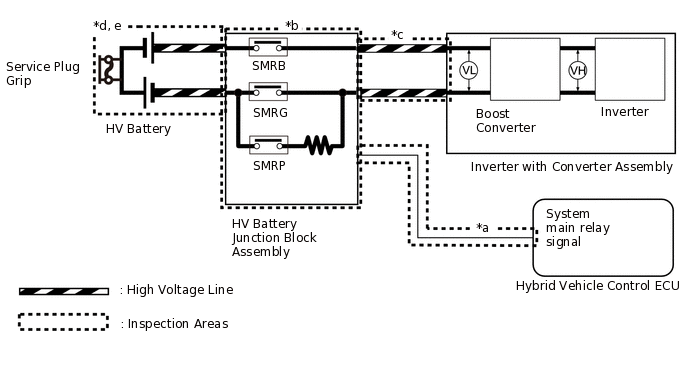
System Diagram Range
Inspection Content
Reason
Inspection Step
*a
Check connection condition and wire harness continuity between hybrid vehicle control ECU and HV battery junction block assembly
In order to check whether connectors are connected properly and to check for an open circuit in the SMRP and SMRB primary lines
3 to 6
*b
Check system main relay
Check whether SMRB and SMRP stuck OFF
7, 8
*c
Check connection condition and high-voltage cable continuity between HV battery junction block assembly and inverter with converter assembly
Check for open circuit and defective connection (arc marks) due to looseness
9, 10, 11
*d
Check high-voltage cable and connection condition between HV battery and HV battery junction block assembly
Check for open circuit and defective connection (arc marks) due to looseness
12
*e
Check HV battery
Check whether HV battery voltage has drastically dropped below normal range
13
DESCRIPTION
Refer to the description for DTC P0AE6-225.
The hybrid vehicle control ECU monitors the high-voltage wiring between the HV battery and the inverter with converter assembly and detects the following malfunction.
DTC No. |
Detection Item |
DTC Detection Condition |
Trouble Area |
MIL |
Warning Indicate |
|---|---|---|---|---|---|
P3004-131 |
High Voltage Power Resource |
Although an SMR on request was sent when the power switch is operated, the voltage after boosting did not increase. High-voltage circuit malfunctions between the HV battery and inverter with converter assembly. The EV electric battery fuse is blown, the service plug grip is removed, the system main resistor is blown, SMRG is turned off, SMRP or SMRB remains open, or the high-voltage cable has an open circuit. (2 trip detection logic) |
|
Does not come on |
Master Warning Light: Comes on |
DTC No. |
Data List |
|---|---|
P3004-131 |
|
The following items can be helpful when performing repairs:
Data List
Ready Signal
VL-Voltage before Boosting
Inter Lock Switch
SMRP Status
SMRB Status
SMRG Status
WIRING DIAGRAM
Refer to the wiring diagram for DTC P0AA6-526.
Refer to the wiring diagram for the HV battery high-voltage line circuit.
CAUTION / NOTICE / HINT
Before inspecting the high-voltage system or disconnecting the low voltage connector of the inverter with converter assembly, take safety precautions such as wearing insulated gloves and removing the service plug grip to prevent electrical shocks. After removing the service plug grip, put it in your pocket to prevent other technicians from accidentally reconnecting it while you are working on the high-voltage system.
After removing the service plug grip, wait for at least 10 minutes before touching any of the high-voltage connectors or terminals. After waiting for 10 minutes, check the voltage at the terminals in the inspection point in the inverter with converter assembly. The voltage should be 0 V before beginning work.
Tip:Waiting for at least 10 minutes is required to discharge the high-voltage capacitor inside the inverter with converter assembly.
When disposing of an HV battery, make sure to return it through an authorized collection agent who is capable of handling it safely. If the HV battery is returned via the manufacturer specified route, it will be returned properly and in a safe manner by an authorized collection agent.
After turning the power switch off, waiting time may be required before disconnecting the cable from the negative (-) auxiliary battery terminal. Therefore, make sure to read the disconnecting the cable from the negative (-) auxiliary battery terminal notices before proceeding with work.
After the repair, clear the DTCs, perform the following procedure and check that the same DTC (including pending DTC) is not output.
Turn the power switch off and wait for 30 seconds or more.
Turn the power switch on (READY) and wait for 30 seconds or more.
PROCEDURE
CHECK DTC OUTPUT (HYBRID CONTROL)
Connect the GTS to the DLC3.
Turn the power switch on (IG).
Enter the following menus: Powertrain / Hybrid Control / Trouble Codes.
Check for DTCs.
Powertrain > Hybrid Control > Trouble Codes
Result
Result
Proceed to
P3004-131 (including pending DTC) only is output, or DTCs except the ones in the tables below are also output.
A
Any of the following DTCs including pending DTCs in table 1 below are also output.
B
Any of the DTCs in table 2 below are also output.
C
Table 1
Malfunction Content
Relevant DTC
Microcomputer malfunction
P0A1A-151, 658
Generator Control Module
P0A1B-786
Drive Motor "A" Control Module
P0A1D-148
Hybrid Powertrain Control Module
P1C2A-155
Generator A/D Converter Circuit
P1CA6-156
Generator Control Module Malfunction
P1CA7-193
Drive Motor Control Module Malfunction
P2511-149
HV CPU Power Relay Sense Circuit Intermittent No Continuity
P3133-659
Communication Error from Generator to Drive Motor "A"
P3134-661
Communication Error from Drive Motor "A" to Generator
P324E-788
MG-ECU Power Relay Intermittent Circuit
Power source circuit malfunction
P06E6-164
Sensor Power Supply "C" Circuit / Open
P1C73-512
Sensor Standard Voltage "F" Circuit / Open
Communication system malfunction
U0110 (all INF codes)*1
Lost Communication with Drive Motor Control Module "A"
Sensor and actuator circuit malfunction
P0ADB-227
Hybrid Battery Positive Contactor Control Circuit Low
P0ADC-226
Hybrid Battery Positive Contactor Control Circuit High
P0ADF-229
Hybrid Battery Negative Contactor Control Circuit Low
P0AE0-228
Hybrid Battery Negative Contactor Control Circuit High
P0AE6-225
Hybrid Battery Precharge Contactor Control Circuit Low
P0AE7-224
Hybrid Battery Precharge Contactor Control Circuit High
P0C76-523
Hybrid Battery System Discharge Time Too Long
System malfunction
P0CA3-442
DC/DC Converter Step Up Voltage Performance
P0D2E-586
Drive Motor "A" Inverter Voltage Sensor Circuit Range / Performance
P0D2F-266
Drive Motor "A" Inverter Voltage Sensor Circuit Low
P0D30-267
Drive Motor "A" Inverter Voltage Sensor Circuit High
P3004-800, 801
High Voltage Power Resource
Table 2
Malfunction Content
Relevant DTC
Microcomputer malfunction
P0AFC-123
Hybrid Battery Pack Sensor Module
Power source circuit malfunction
P0ABF-123
Hybrid Battery Pack Current Sensor Circuit
Communication system malfunction
U029A-123
Lost Communication with Hybrid Battery Pack Sensor Module
Sensor and actuator circuit malfunction
P0A95-123
High Voltage Fuse
P0AC0-123
Hybrid Battery Pack Current Sensor Circuit Range / Performance
P0AC1-123
Hybrid Battery Pack Current Sensor "A" Circuit Low
P0AC2-123
Hybrid Battery Pack Current Sensor "A" Circuit High
P0B3D-123
Hybrid Battery Voltage Sensor "A" Circuit Low
P0B42-123
Hybrid Battery Voltage Sensor "B" Circuit Low
P0B47-123
Hybrid Battery Voltage Sensor "C" Circuit Low
P0B4C-123
Hybrid Battery Voltage Sensor "D" Circuit Low
P0B51-123
Hybrid Battery Voltage Sensor "E" Circuit Low
P0B56-123
Hybrid Battery Voltage Sensor "F" Circuit Low
P0B5B-123
Hybrid Battery Voltage Sensor "G" Circuit Low
P0B60-123
Hybrid Battery Voltage Sensor "H" Circuit Low
P0B65-123
Hybrid Battery Voltage Sensor "I" Circuit Low
P0B6A-123
Hybrid Battery Voltage Sensor "J" Circuit Low
P0B6F-123
Hybrid Battery Voltage Sensor "K" Circuit Low
P0B74-123
Hybrid Battery Voltage Sensor "L" Circuit Low
P0B79-123
Hybrid Battery Voltage Sensor "M" Circuit Low
P0B7E-123
Hybrid Battery Voltage Sensor "N" Circuit Low
P0B83-123
Hybrid Battery Voltage Sensor "O" Circuit Low
P0B88-123
Hybrid Battery Voltage Sensor "P" Circuit Low
P0B8D-123
Hybrid Battery Voltage Sensor "Q" Circuit Low
P0B92-123
Hybrid Battery Voltage Sensor "R" Circuit Low
P308A-123
Hybrid Battery Voltage Sensor All Circuits Low
Tip:*1: If any INF codes are stored for this DTC, refer to the corresponding diagnostic procedure.
P3004-131 may be output as a result of the malfunction indicated by the DTCs above.
-
The chart above is listed in inspection order of priority.
Check DTCs that are output at the same time by following the listed order. (The main cause of the malfunction can be determined without performing unnecessary inspections.)
Turn the power switch off.
CHECK FREEZE FRAME DATA (HYBRID CONTROL)
Connect the GTS to the DLC3.
Turn the power switch on (IG).
Enter the following menus: Powertrain / Hybrid Control / Trouble Codes.
Read the freeze frame data of DTC P3004-131.
Tip:In the freeze frame data, read the items "VH-Voltage after Boosting", "Power Resource VB" and "VL-Voltage before Boosting".
Result
Result
Proceed to
Both of the following conditions are met:
Post-boost voltage (VH-Voltage after Boosting) is below 50 V.
Difference between HV battery voltage (Power Resource VB) and pre-boost voltage (VL-Voltage before Boosting) is 40 V or less.
A
Except above
B
Turn the power switch off.
CHECK CONNECTOR CONNECTION CONDITION (HYBRID VEHICLE CONTROL ECU CONNECTOR)
Result
Proceed to
OK
NG
NG CONNECT SECURELY
CHECK CONNECTOR CONNECTION CONDITION (NO. 2 HV BATTERY PACK WIRE CONNECTOR)
Result
Result
Proceed to
OK
A
NG (The connector is not connected securely.)
B
NG (The terminals are not making secure contact or are deformed, or water or foreign matter exists in the connector.)
C
B CONNECT SECURELY
C REPAIR OR REPLACE HARNESS OR CONNECTOR
CHECK CONNECTOR CONNECTION CONDITION (HV BATTERY JUNCTION BLOCK ASSEMBLY CONNECTOR)
Result
Proceed to
OK
NG
NG CONNECT SECURELY
CHECK HARNESS AND CONNECTOR (HYBRID VEHICLE CONTROL ECU - HV BATTERY JUNCTION BLOCK ASSEMBLY)
CAUTION:Be sure to wear insulated gloves.
Check that the service plug grip is not installed.
Note:After removing the service plug grip, do not turn the power switch on (READY), unless instructed by the repair manual because this may cause a malfunction.
Disconnect the G193 hybrid vehicle control ECU connector.
Remove the No. 2 hybrid vehicle battery shield reinforcement.
-
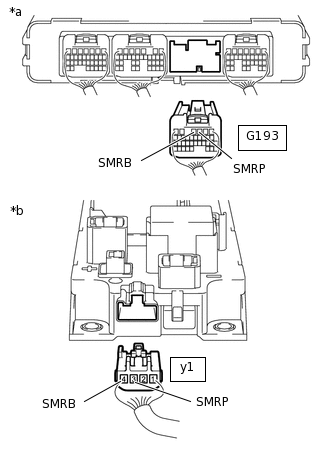
*a
Rear view of wire harness connector
(to Hybrid Vehicle Control ECU)
*b
Rear view of wire harness connector
(to HV Battery Junction Block Assembly)
Disconnect the y1 HV battery junction block assembly connector.
Measure the resistance according to the value(s) in the table below.
Standard Resistance
Tester Connection
Condition
Specified Condition
G193-4 (SMRB) - y1-4 (SMRB)
Power switch off
Below 1 Ω
G193-3 (SMRP) - y1-3 (SMRP)
Power switch off
Below 1 Ω
Reconnect the y1 HV battery junction block assembly connector.
Install the No. 2 hybrid vehicle battery shield reinforcement.
Reconnect the G193 hybrid vehicle control ECU connector.
Result
Proceed to
OK
NG
NG REPAIR OR REPLACE HARNESS OR CONNECTOR
INSPECT HV BATTERY JUNCTION BLOCK ASSEMBLY (SMRB)
CAUTION:Be sure to wear insulated gloves.
Check that the service plug grip is not installed.
Note:After removing the service plug grip, do not turn the power switch on (READY), unless instructed by the repair manual because this may cause a malfunction.
Remove the HV battery junction block assembly.
-
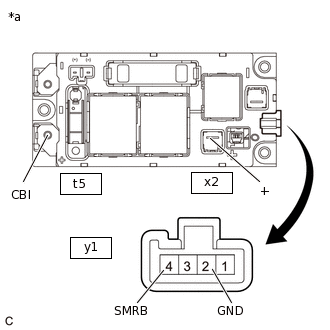
*a
Component without harness connected
(HV Battery Junction Block Assembly)
Measure the resistance according to the value(s) in the table below.
Standard Resistance
Tester Connection
Condition
Specified Condition
t5-1 (CBI) - x2-1 (+)
Auxiliary battery voltage is applied between terminals y1-4 (SMRB) and y1-2 (GND)
Below 1 Ω
Measure the resistance according to the value(s) in the table below.
Standard Resistance
Tester Connection
Condition
Specified Condition
y1-4 (SMRB) - y1-2 (GND)
-40 to 80°C (-40 to 176°F)
18.4 to 36.3 Ω
Install the HV battery junction block assembly.
Result
Proceed to
OK
NG
INSPECT HV BATTERY JUNCTION BLOCK ASSEMBLY (SMRP)
CAUTION:Be sure to wear insulated gloves.
Check that the service plug grip is not installed.
Note:After removing the service plug grip, do not turn the power switch on (READY), unless instructed by the repair manual because this may cause a malfunction.
Remove the HV battery junction block assembly.
-
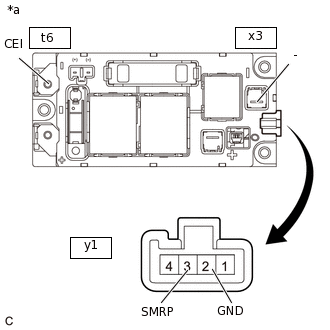
*a
Component without harness connected
(HV Battery Junction Block Assembly)
Measure the resistance according to the value(s) in the table below.
Standard Resistance
Tester Connection
Condition
Specified Condition
t6-1 (CEI) - x3-1 (-)
Auxiliary battery voltage is applied between terminals y1-3 (SMRP) and y1-2 (GND)
28.5 to 31.5 Ω
Measure the resistance according to the value(s) in the table below.
Standard Resistance
Tester Connection
Condition
Specified Condition
y1-3 (SMRP) - y1-2 (GND)
-40 to 80°C (-40 to 176°F)
112 to 274 Ω
Install the HV battery junction block assembly.
Result
Proceed to
OK
NG
CHECK INVERTER WITH CONVERTER ASSEMBLY (NO. 2 FRAME WIRE CONNECTION CONDITION)
CAUTION:Be sure to wear insulated gloves.
Check that the service plug grip is not installed.
Note:After removing the service plug grip, do not turn the power switch on (READY), unless instructed by the repair manual because this may cause a malfunction.
-
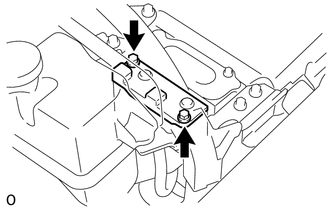
Remove the connector cover assembly from the inverter with converter assembly.
-

Check that the bolt for the No. 2 frame wire is tightened to the specified torque, the No. 2 frame wire is connected securely, and there are no contact problems.
Specified condition
T=8.0 N*m (82 kgf*cm, 71 in.*lbf)
Disconnect the No. 2 frame wire from the inverter with converter assembly.
Check for arc marks on the terminals of the No. 2 frame wire.
Result
Result
Proceed to
The terminals are connected securely and there are no contact problems.
There are no arc marks.
A
The terminals are not connected securely and there is a contact problem.
There are arc marks.
B
The terminals are not connected securely and there is a contact problem.
There are no arc marks.
C
The terminals are connected securely and there are no contact problems.
There are arc marks.
B
Reconnect the No. 2 frame wire.
Install the connector cover assembly.
B REPLACE MALFUNCTIONING PARTS
C CONNECT SECURELY
CHECK HV BATTERY JUNCTION BLOCK ASSEMBLY (NO. 2 FRAME WIRE CONNECTION CONDITION)
CAUTION:Be sure to wear insulated gloves.
Check that the service plug grip is not installed.
Note:After removing the service plug grip, do not turn the power switch on (READY), unless instructed by the repair manual because this may cause a malfunction.
Remove the No. 2 hybrid vehicle battery shield reinforcement.
-

Check that the nut for the No. 2 frame wire is tightened to the specified torque, the No. 2 frame wire is connected securely, and there are no contact problems.
Specified condition
T=9.0 N*m (92 kgf*cm, 80 in.*lbf)
Disconnect the No. 2 frame wire from the HV battery junction block assembly.
Check for arc marks on the terminals of the No. 2 frame wire.
Result
Result
Proceed to
The terminals are connected securely and there are no contact problems.
There are no arc marks.
A
The terminals are not connected securely and there is a contact problem.
There are arc marks.
B
The terminals are not connected securely and there is a contact problem.
There are no arc marks.
C
The terminals are connected securely and there are no contact problems.
There are arc marks.
B
Install the No. 2 hybrid vehicle battery shield reinforcement.
B REPLACE MALFUNCTIONING PARTS
C CONNECT SECURELY
CHECK NO. 2 FRAME WIRE (INVERTER WITH CONVERTER ASSEMBLY - HV BATTERY JUNCTION BLOCK ASSEMBLY)
CAUTION:Be sure to wear insulated gloves.
Check that the service plug grip is not installed.
Note:After removing the service plug grip, do not turn the power switch on (READY), unless instructed by the repair manual because this may cause a malfunction.
Remove the No. 2 hybrid vehicle battery shield reinforcement.
-
Disconnect the No. 2 frame wire from the HV battery junction block assembly.
-
Remove the connector cover assembly from the inverter with converter assembly.
-
Disconnect the No. 2 frame wire from the inverter with converter assembly.
-
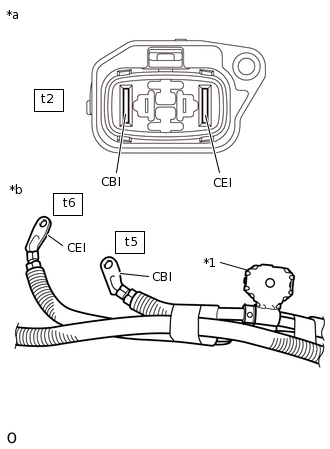
*1
Shield Ground
*a
No. 2 Frame Wire
(Inverter with Converter Assembly Side)
*b
No. 2 Frame Wire
(HV Battery Junction Block Assembly Side)
Measure the resistance according to the value(s) in the table below.
Standard Resistance
Tester Connection
Condition
Specified Condition
t2-1 (CBI) - t5-1 (CBI)
Power switch off
Below 1 Ω
t2-2 (CEI) - t6-1 (CEI)
Power switch off
Below 1 Ω
Reconnect the No. 2 frame wire.
Install the connector cover assembly.
Install the No. 2 hybrid vehicle battery shield reinforcement.
Result
Proceed to
OK
NG
CHECK HV BATTERY JUNCTION BLOCK ASSEMBLY (HV BATTERY HIGH VOLTAGE CONNECTOR CONNECTION CONDITION)
CAUTION:Be sure to wear insulated gloves.
Check that the service plug grip is not installed.
Note:After removing the service plug grip, do not turn the power switch on (READY), unless instructed by the repair manual because this may cause a malfunction.
Remove the No. 2 hybrid vehicle battery shield reinforcement.
-
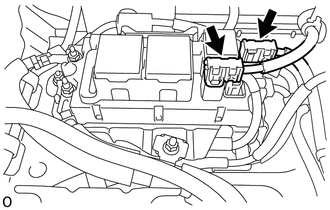
Check the connector connection condition between the 2 HV battery high voltage connectors and the HV battery junction block assembly.
Disconnect the 2 HV battery high voltage connectors from the HV battery junction block assembly.
Check for arc marks on the terminals of the HV battery high voltage terminals.
Result
Result
Proceed to
The terminals are connected securely and there are no contact problems.
There are no arc marks.
A
The terminals are not connected securely and there is a contact problem.
There are arc marks.
B
The terminals are not connected securely and there is a contact problem.
There are no arc marks.
C
The terminals are connected securely and there are no contact problems.
There are arc marks.
B
Reconnect the 2 HV battery high voltage connectors.
Install the No. 2 hybrid vehicle battery shield reinforcement.
B REPLACE MALFUNCTIONING PARTS
C CONNECT SECURELY
CHECK HV BATTERY
CAUTION:Be sure to wear insulated gloves.
Check that the service plug grip is not installed.
Note:After removing the service plug grip, do not turn the power switch on (READY), unless instructed by the repair manual because this may cause a malfunction.
Remove the No. 2 hybrid vehicle battery shield reinforcement.
Disconnect the 2 HV battery high voltage connectors from the HV battery junction block assembly.
-
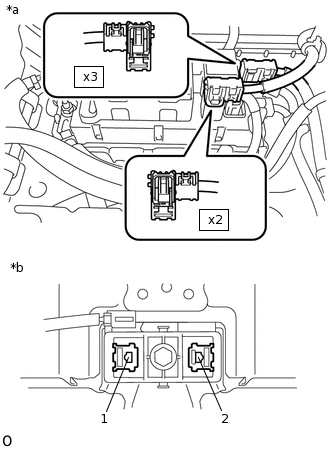
*a
Front view of wire harness connector
(to HV Battery Junction Block Assembly)
*b
Service Plug Grip Removed
(Service Plug Grip Connecting Terminals)
Measure the voltage according to the value(s) in the table below.
Standard Voltage
Tester Connection
Condition
Specified Condition
x2-1 (+) - Service plug terminal 1
Power switch off
96 V or higher
x3-1 (-) - Service plug terminal 2
Power switch off
108 V or higher
CAUTION:Do not allow the probes of the electrical tester to contact each other during this inspection.
Reconnect the 2 HV battery high voltage connectors.
Install the No. 2 hybrid vehicle battery shield reinforcement.
Result
Proceed to
OK
NG
CHECK FOR INTERMITTENT PROBLEMS
Check for intermittent problems.
Result
Proceed to
Problem symptom does not recur.
Problem symptom recurs.
Tip:Since 2 trip detection logic is used, the DTC detection condition must be met twice.
If DTC P3004-131 is output again after performing the inspection, replace the inverter with converter assembly. If DTC P3004-131 is not output again, replace the HV battery junction block assembly.