SFI SYSTEM(w/ Canister Pump Module), Diagnostic DTC:P2109
| DTC Code | DTC Name |
|---|---|
| P2109 | Throttle / Pedal Position Sensor "A" Minimum Stop Performance |
DESCRIPTION
The idle speed is controlled by the Electronic Throttle Control System (ETCS). The ETCS is comprised of a throttle actuator, which operates the throttle valve, and a throttle position sensor, which detects the opening amount of the throttle valve. The ECM controls the throttle actuator to adjust the throttle valve opening amount so that the idle speed is maintained at the target idle speed.
DTC No. |
Detection Item |
DTC Detection Condition |
Trouble Area |
MIL |
Memory |
|---|---|---|---|---|---|
P2109 |
Throttle / Pedal Position Sensor "A" Minimum Stop Performance |
The ISC learned value is approximately 3 times larger than normal even though the actual intake air amount during idling is within the normal range (up to 1.5 times the normal amount) (5 trip detection logic). |
Throttle with motor body assembly |
Comes on |
DTC stored |
The ISC learned value is the calculated intake air amount corresponding to the throttle opening amount necessary to maintain the idle speed.
This malfunction is only detected once per trip. After it has been detected once, the system will not monitor for the malfunction for the rest of the trip.
The system uses the throttle with motor body assembly and mass air flow meter sub-assembly to detect this malfunction.
MONITOR DESCRIPTION
If there are deposits in the throttle valve, a decrease in the ISC flow rate may cause engine stall or unstable idling. Therefore, the necessary ISC flow rate for idling is maintained using the ISC learned value and feedback. The ECM stores this DTC if the ISC learned value approaches its limit. The ECM begins monitoring for the DTC detection conditions when the following preconditions are met:
1) The mass air flow meter sub-assembly is normal.
2) Atmospheric pressure is 85 kPa(abs) [638 mmHg(abs)] or higher.
3) The vehicle has been driven at a speed of 30 km/h (18.6 mph) or more at least once.
4) The engine coolant temperature is 45°C (113°F) or less at engine start, the engine is warmed up and conditions for ISC learning are met, or the engine switch has been turned to on (IG) (include engine running) for 1 hour or more, the engine is warmed up and conditions for ISC learning are met.
CAUTION / NOTICE / HINT
Read freeze frame data using the GTS. Freeze frame data records engine conditions when a malfunction occurs. This information can be useful when troubleshooting.
Since a pending DTC is not stored for this DTC, it takes time to confirm whether the malfunction has been successfully repaired by checking for this DTC. When confirming whether the malfunction has been successfully repaired, compare "ISC Learning Value" recorded in the freeze frame data with "ISC Learning Value" in the Data List after repairs have been made to save time.
PROCEDURE
CHECK ANY OTHER DTCS OUTPUT (IN ADDITION TO DTC P2109)
Connect the GTS to the DLC3.
Turn the engine switch on (IG).
Turn the GTS on.
Enter the following menus: Powertrain / Engine and ECT / Trouble Codes.
Read the DTCs.
Powertrain > Engine and ECT > Trouble Codes
Result
Result
Proceed to
DTC P2109 is output
A
DTC P2109 and other DTCs are output
B
READ FREEZE FRAME DATA
Connect the GTS to the DLC3.
Turn the engine switch on (IG).
Using the GTS, check "ISC Learning Value" in the freeze frame data.
Tip:Be sure to confirm "ISC Learning Value" in the freeze frame data as it is used when confirming whether the malfunction has been successfully repaired.
Result
Proceed to
NEXT
REMOVE FOREIGN OBJECT (CLEAN THROTTLE WITH MOTOR BODY ASSEMBLY)
Clean off any deposits from the inside of the throttle with motor body assembly.
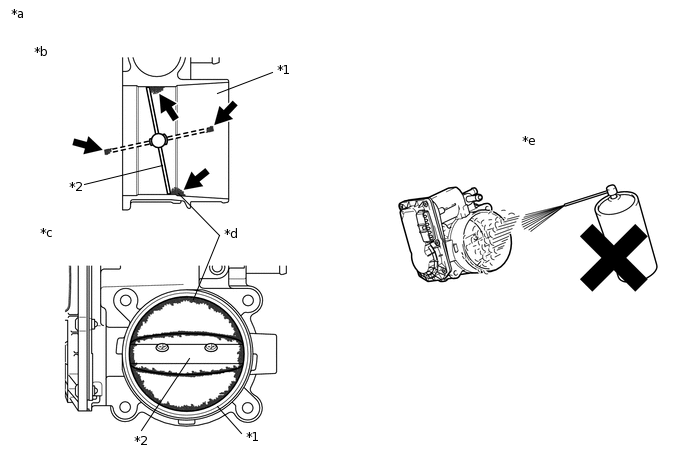
*1
Bore
*2
Valve
*a
Reference
*b
Throttle with Motor Body Assembly Cross-section Diagram
*c
When valve fully opened
*d
Deposits
*e
Do not directly apply cleaner
-
-
Push open the throttle valve and wipe off any carbon from the valve and bore using a cloth soaked in non-residue solvent.
Note:Make sure that the cloth or your fingers do not get caught in the valve.
Make sure that foreign matter does not enter the throttle valve.
Do not directly apply non-residue solvent to the throttle with motor body assembly or wash the throttle with motor body assembly. Cleaning solvent may leak into the motor from the shaft and cause problems such as rust or valve movement problems.
If there is coating material on the edge of the valve, be careful not to remove it.
Push the throttle valve open gently with your finger and check that the throttle valve moves smoothly.
Tip:If the throttle valve does not open smoothly, replace the throttle with motor body assembly.
Result
Proceed to
NEXT
READ VALUE USING GTS (ISC LEARNING VALUE)
Perform "Inspection After Repair" after cleaning the throttle with motor body assembly.
Connect the GTS to the DLC3.
Turn the GTS on.
Enter the following menus: Powertrain / Engine and ECT / Data List / Primary / ISC Learning Value.
Powertrain > Engine and ECT > Data List
Tester Display
ISC Learning Value
Read the value.
OK
The value is half of "ISC Learning Value" recorded in the freeze frame data or less.
Tip:Perform "Inspection After Repair" after replacing the throttle with motor body assembly.
Result
Proceed to
OK
NG
OK END