EXHAUST PIPE INSTALLATION

-
INSTALL FRONT EXHAUST PIPE ASSEMBLY
-
Using a vernier caliper, measure the free length of the compression spring.
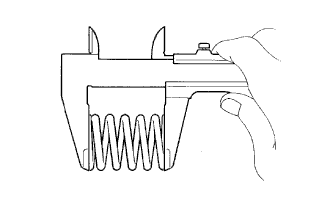
Standard 42.0 mm (1.65 in.) Minimum 40.5 mm (1.60 in.) Tech Tips
If the length is less than the minimum, replace the compression spring.
-
Fully insert a new gasket to the exhaust manifold converter sub-assembly.
-
Using a plastic hammer and wooden block, tap in the new gasket until its surface is flush with the exhaust manifold converter sub-assembly.
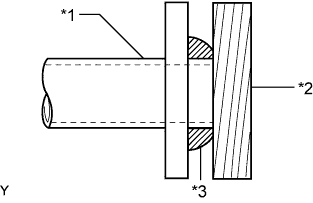
Text in Illustration *1 Exhaust Manifold Converter Sub-assembly *2 Wooden Block *3 Gasket Note
-
Be sure to install the gasket in the correct direction.
-
Do not reuse the gasket.
-
Do not damage the gasket.
-
Do not push in the gasket by using the exhaust pipe when connecting it.
-
-
Connect the front exhaust pipe assembly to the exhaust pipe support.
-
Install the front exhaust pipe assembly with the 2 compression springs and 2 bolts.
- Torque:
- 43 N*m { 438 kgf*cm, 32 ft.*lbf }
Tech Tips
After the installation, check that the gaps between the flanges of the exhaust manifold converter sub-assembly and front exhaust pipe assembly are consistent front-to-rear and left-to-right.
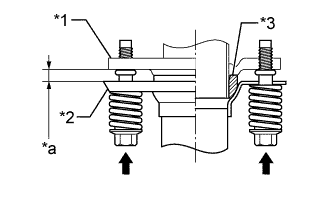
Text in Illustration *1 Exhaust Manifold Converter Sub-assembly *2 Front Exhaust Pipe Assembly *3 Gasket *a Space between flanges: 8.5 mm (0.335 in.)
-
-
INSTALL CENTER EXHAUST PIPE ASSEMBLY
-
Install a new gasket to the front exhaust pipe assembly.
-
Connect the center exhaust pipe assembly to the exhaust pipe support.
-
Install the center exhaust pipe assembly with the 2 nuts.
- Torque:
- 43 N*m { 438 kgf*cm, 32 ft.*lbf }
-
-
INSTALL TAIL EXHAUST PIPE ASSEMBLY
-
Using a vernier caliper, measure the free length of the compression spring.
Standard 40.0 mm (1.57 in.) Minimum 38.5 mm (1.52 in.) Tech Tips
If the length is less than the minimum, replace the compression spring.
-
Fully insert a new gasket to the center exhaust pipe assembly.
-
Using a plastic hammer and wooden block, tap in the new gasket until its surface is flush with the center exhaust pipe assembly.
Text in Illustration *1 Center Exhaust Pipe Assembly *2 Wooden Block *3 Gasket Note
-
Be sure to install the gasket in the correct direction.
-
Do not reuse the gasket.
-
Do not damage the gasket.
-
Do not push in the gasket by using the exhaust pipe when connecting it.
-
-
Connect the tail exhaust pipe assembly to the 3 exhaust pipe supports.
-
Install the tail exhaust pipe assembly with the 2 compression springs and 2 bolts.
- Torque:
- 43 N*m { 438 kgf*cm, 32 ft.*lbf }
Tech Tips
After the installation, check that the gaps between the flanges of the exhaust manifold converter sub-assembly and front exhaust pipe assembly are consistent front-to-rear and left-to-right.
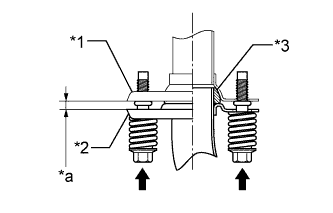
Text in Illustration *1 Tail Exhaust Pipe Assembly *2 Center Exhaust Pipe Assembly *3 Gasket *a Space between flanges: 6.5 mm (0.256 in.)
-
-
INSTALL HEATED OXYGEN SENSOR
-
Using SST, install the heated oxygen sensor to the front exhaust pipe.
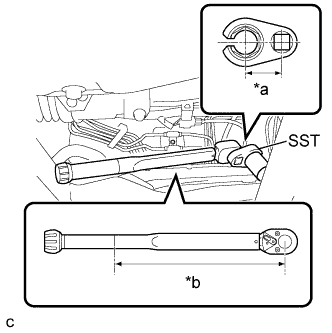
Text in Illustration *a Fulcrum Length
30 mm
*b Fulcrum Length
300 mm
- SST
- 09224-00010
- Torque:
- without SST
- 44 N*m { 449 kgf*cm, 32 ft.*lbf }
- with SST
- 40 N*m { 408 kgf*cm, 30 ft.*lbf }
Note
-
The "with SST" torque value is effective when using SST with a fulcrum length of 30 mm (1.18 in.) and a torque wrench with a fulcrum length of 300 mm (11.81 in.) Click here
-
The "with SST" torque value is effective when SST is parallel to the torque wrench.
-
Connect the heated oxygen sensor connector.
-
-
INSPECT FOR EXHAUST GAS LEAK