SEAT BELT ASSEMBLY
-
OUTLINE
-
Front Seat Belt
-
Three-way ELR seat belts are used. If the seat belt is pulled a certain amount or more, the seat belt winding mechanism immediately locks to secure the occupant. As a result, excellent occupant restraint performance is achieved.
-
Seat belts with a pretensioner and force limiter are used. These type of seat belts are immediately wound during collisions, achieving excellent occupant restraint performance. When further loads that meet or exceed a certain level are applied, the tension of the seat belt is automatically loosened to reduce the burden to the occupant's body.
-
Seat belts with a tension reducer are used. The seat belt winding force is reduced when the seat belt is fastened in consideration of a comfortable seat belt fit for the occupant.
-
Pre-collision seat belts (with comfort function*) are provided as an option. If it is determined that the possibility of a collision is very high, slack in the webbing is reduced by instantaneously winding it to support the occupant's posture. This allows safety devices such as the airbags, etc. to excel in performance.
Tech Tips
Comfort Function
-
Fitting assist: This function reduces the slack in the seat belt using the winding motor when the seat belt is fastened.
-
Retraction assist: This function assists winding using the motor when the seat belt is unfastened.
-
-
Silky webbings are used.
-
-
Rear Seat Belt
-
Three-way ELR seat belts are used. If the seat belt is pulled a certain amount or more, the seat belt winding mechanism immediately locks to secure the occupant. As a result, excellent occupant restraint performance is achieved.
-
Seat belts with a pretensioner and force limiter are used. These types of seat belts are immediately wound during collisions, achieving excellent occupant restraint performance. When further loads that meet or exceed a certain level are applied, the tension of the seat belt is automatically loosened to reduce the burden to the occupant's body.
-
Seat belts with a tension reducer are used. The seat belt winding force is reduced when the seat belt is fastened in consideration of a comfortable seat belt fit for the occupant.
-
A seat belt reminder is used. If there is an occupant with the seat belt unfastened, the seat belt reminder informs the driver to prevent the occupant from forgetting to fasten the seat belt.
-
Silky webbings are used.
Figure 1. Seat Belt (This illustration is an example only.)
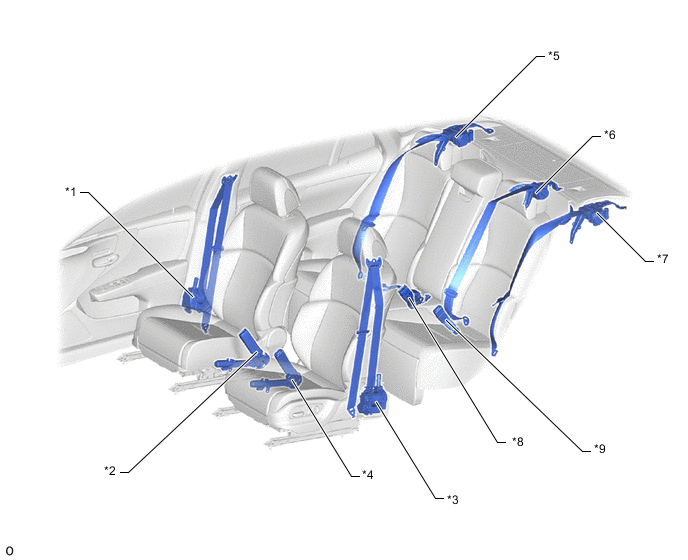
*1 Front Seat Outer Belt Assembly RH
-
3-point Type ELR Seat Belt
-
Pre-tensioner and Force Limiter
-
Tension Reducer
-
Motor-driven Seat Belt Retractor (Models with Pre-collision Seat Belt System)
*2 Front Seat Inner Belt Assembly RH *3 Front Seat Outer Belt Assembly LH
-
3-point Type ELR Seat Belt
-
Pre-tensioner and Force Limiter
-
Tension Reducer
-
Motor-driven Seat Belt Retractor (Models with Pre-collision Seat Belt System)
*4 Front Seat Inner Belt Assembly LH *5 Rear Seat Belt Assembly Outer RH
-
3-point Type ELR Seat Belt
-
Pre-tensioner and Force Limiter
-
Tension Reducer
*6 Rear Seat Belt Assembly Outer Center
-
3-point Type ELR Seat Belt
-
Pre-tensioner and Force Limiter
*7 Rear Seat Belt Assembly Outer LH
-
3-point Type ELR Seat Belt
-
Pre-tensioner and Force Limiter
-
Tension Reducer
*8 Rear Seat Inner Belt Assembly RH and Center *9 Rear Seat Inner Belt Assembly LH - - -
-
-
Front Seat Inner Belt Assembly (Easy Access Buckle System*)
Tech Tips
*: Models with easy access buckle system
-
An easy access buckle system, which automatically raises and lowers buckles to enable the occupant to easily secure or loosen the seat belt, is used.
-
When the driver door or front passenger door is opened before entering the vehicle, each front seat inner belt assembly light illuminates and the buckle moves upward by approximately 50 mm. When the tongue plate is inserted into the buckle, it lowers to its original position
-
When the tongue plate is not inserted into the buckle after a front door is opened, the user sits in the seat and the front seat inner belt assembly rises, the front seat inner belt assembly lowers to its original position approximately 8 minutes and 30 seconds after the door is opened. In addition, after the tongue plate is not inserted into the buckle for approximately 20 minutes after the door is opened, the illumination of the front seat inner belt assembly turns off.
-
When the engine switch is turned off with the driver seat belt fastened before exiting the vehicle, the front seat inner belt assembly RH light illuminates and the buckle moves upward by approximately 50 mm. When the seat belt is unfastened, the front seat inner belt assembly RH light turns off and the buckle moves downward to the original position.
-
When the occupant opens and closes the door before sitting, the front seat inner belt assembly light that was illuminated when the door is opened turns off after approximately 15 seconds.
-
When the occupant opens, closes and locks the door before sitting, the front seat inner belt assembly that moved upward when the door is opened lowers to its original position.
-
-
The easy access buckle system operates as follows.
-
The motor rotates.
-
The screw drive (male thread) rotates.
-
The slider (female thread) moves back and forth.
-
The wire connected to the slider (female thread) is pushed out along the guide.
-
The buckle moved upward.
Figure 2. Easy Access Buckle System
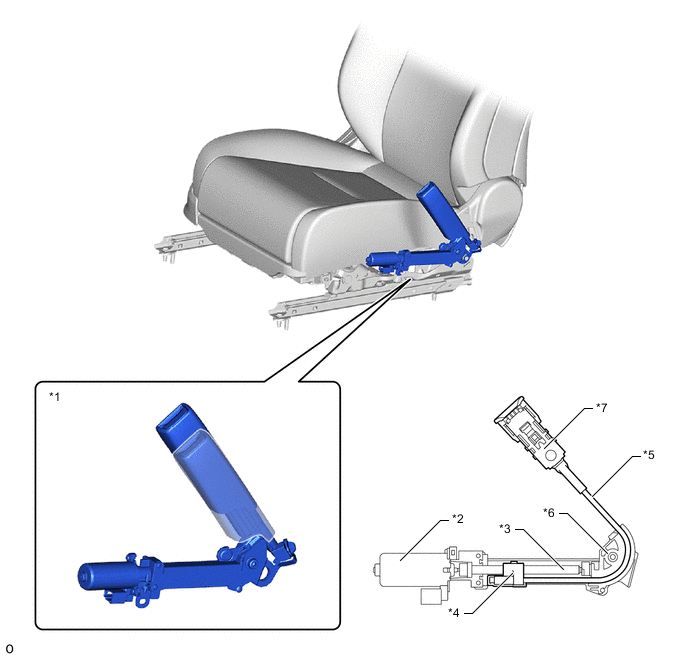
*1 Front Seat Inner Belt Assembly RH *2 Motor *3 Screw Drive (Male Screw) *4 Slider (Female Screw) *5 Wire *6 Guide *7 Buckle - -
-
-
-
Front Seat Inner Belt Assembly (Flexible Type*)
Tech Tips
*: Models without easy access buckle system
-
A flexible type front seat inner belt assembly (webbing + boot structure) is used. The front seat inner belt assembly can be bent towards the occupant to achieve easy insertion of the tongue plate.
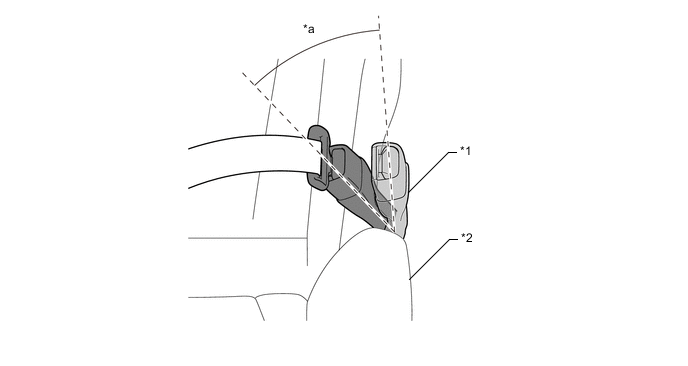
*1 Front Seat Inner Belt Assembly LH *2 Front Seat *a Possible Tongue Plate Insertion Range - -
-
-
Pullout Force Reduction when Seat Belt is Fastened
-
Silky webbings are used for all seat belts. A smooth texture that feels like silk and friction resistance reduction are achieved for webbing pullout force reduction.
-
The length of the shoulder anchor piece is extended more than the conventional structure and the groove pitch of the piece area is expanded to reduce friction resistance, achieving webbing pullout force reduction.
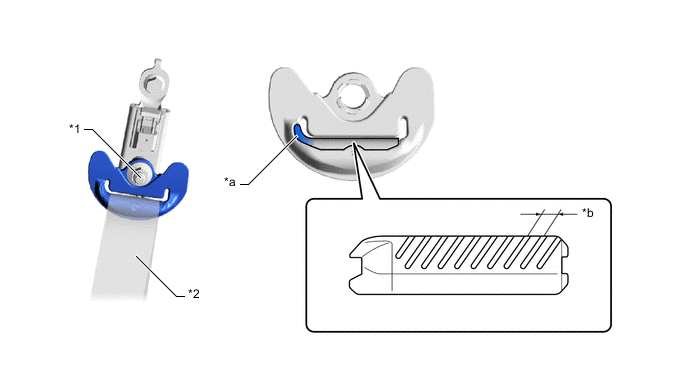
*1 Shoulder Anchor *2 Silky Webbing *a Piece Area Extended *b Piece Area Groove Pitch -
On models with pre-collision seat belts, the motor assists in winding the webbings to reduce the spring pressure for winding compared to the conventional structure. The spring pressure to wind the webbings is reduced for webbing pullout force reduction.
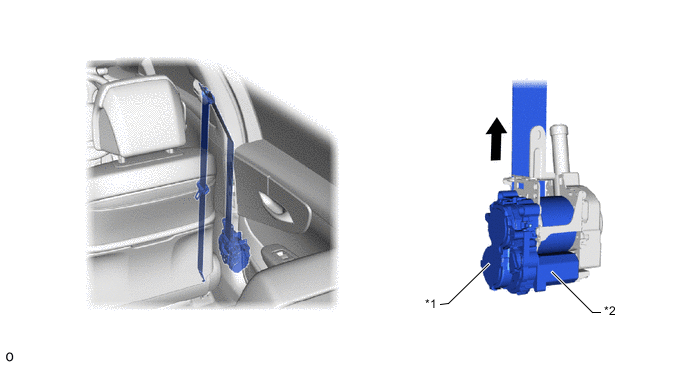
*1 Spring *2 Motor -
In general, if a certain level of acceleration or more is applied when the occupant pulls the webbing out quickly, the retractor locks. However, the acceleration setting of the front and rear retractor locks is changed to make it difficult for the occupant to feel any resistance when pulling out the webbing. As a result, the webbing can be pulled out smoothly.*
Tech Tips
Except models for China.
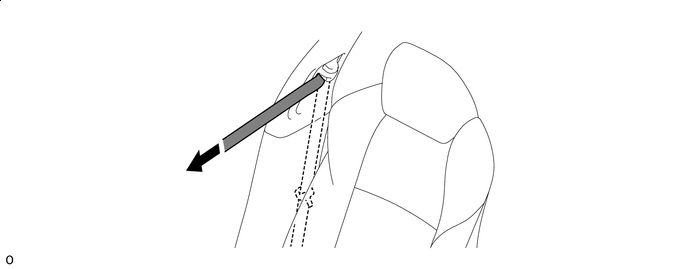
*a Webbing Pullout - -
-
-