PARKING SUPPORT ALERT SYSTEM
-
CONSTRUCTION
-
The No. 1 clearance warning buzzer is installed in the instrument panel. This sound pattern of the buzzer changes when an obstacle is detected in front of the vehicle to notify the driver of the approximate distance of the object from the vehicle.
-
The No. 2 clearance warning buzzer is installed on the rear inside the vehicle. This sound pattern of the buzzer changes when an obstacle is detected behind the vehicle to notify the driver of the approximate distance of the object from the vehicle.
-
Sounding of the No. 1 and No. 2 clearance warning buzzers is controlled by the clearance warning ECU assembly.
Clearance Warning Buzzer Specification Item Specification No. 1 Clearance Warning Buzzer Operation Frequency [kHz] 2.4 +/- 0.04 Sound Pressure Level [dB]* 80 +/- 6 No. 2 Clearance Warning Buzzer Operation Frequency [kHz] 2.0 +/- 0.04 Sound Pressure Level [dB]* 91 +/- 6 Tech Tips
*: This is the sound pressure level at a position 1 m (3.3 ft.) away from the buzzer itself, not the level where the driver would be sitting (where the sound would actually be heard).
-
-
OPERATION
-
Clearance Warning Buzzer Sounding
-
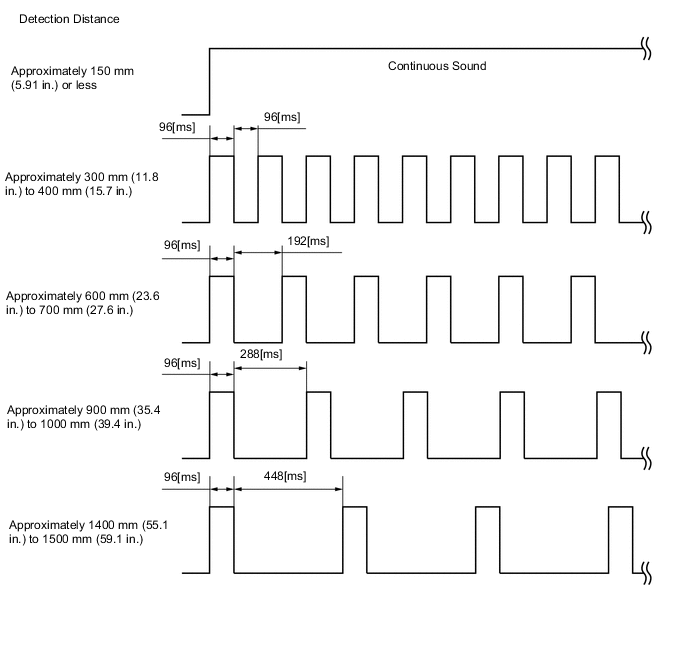
If an obstacle is detected at longest range, long-range or medium-range, the buzzer sounding interval changes approximately every 100 mm (3.94 in.) according to the distance from the object, and the clearance warning buzzer sounds.
-
If an obstacle is detected at short-range or shortest range, the clearance warning buzzer sounds continuously.
Figure 1. Example Buzzer Sounding Patterns
-
If both a front sensor and rear sensor detect an object at the same time, both the No. 1 and No. 2 clearance warning buzzers sound independently (based on the front detection distance for No. 1 and the rear detection distance for No. 2).
-
-