PARKING SUPPORT ALERT SYSTEM
-
OUTLINE
-
Various parking support systems that help the driver to drive more safely are provided together as the "Parking Support Alert (PKSA)" parking support package.
-
Stationary object detection: Lexus parking assist-sensor
-
Vehicle approaching from behind detection: Rear Crossing Traffic Alert (RCTA)*1
-
Pedestrian walking behind: Rear Camera Detection (RCD)*2
-
*1: Models with blind spot monitor system
-
*2: Models with panoramic view monitor system
-
-
The parking support alert system notifies the driver visually and audibly if the vehicle is moving forward or backward and could come into contact with a stationary object, vehicle approaching from the rear*1 or pedestrian walking behind*2.
-
*1: Models with blind spot monitor system
-
*2: Models with panoramic view monitor system
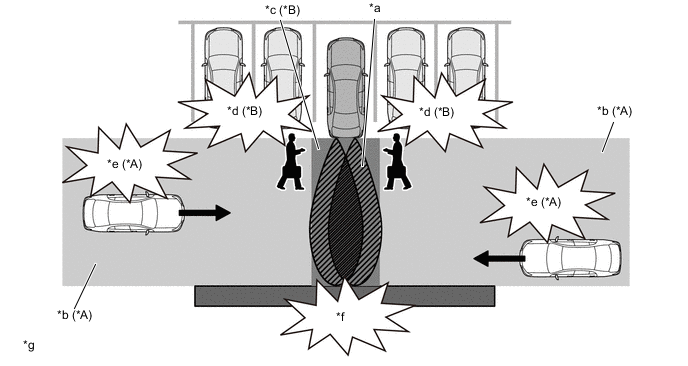
*A Models with Blind Spot Monitor System *B Models with Panoramic View Monitor System *a Lexus Parking Assist-sensor Detection Range *b RCTA Detection Range *c RCD Detection Range *d Pedestrian Detection *e Vehicle Approaching from Behind Detection *f Stationary Object Detection *g This illustration is only for explanatory purposes. - -
-
Lexus Parking Assist-sensor
-
The Lexus parking assist-sensor notifies the driver audibly by the clearance warning buzzer and visually on the multi-information display, multi-display or headup display of the distance until the stationary object and the degree of danger, when the vehicle is being driven at low speed and is approaching a wall or other stationary object.
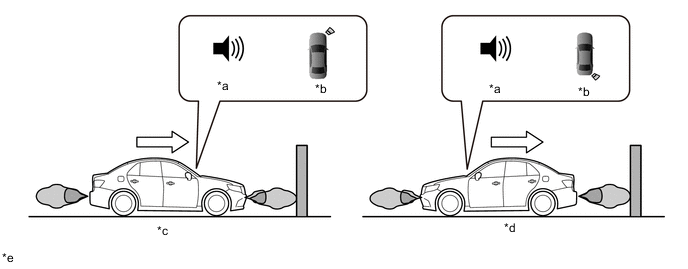
*a Warning *b Display *c While Driving Ahead *d While Reversing *e This illustration is only for explanatory purposes. - -
-
-
RCTA (Models with Blind Spot Monitor System)
-
If another vehicle approaches the vehicle from behind while reversing, the driver is notified audibly by the RCTA buzzer and visually by the indicator and multi-display.
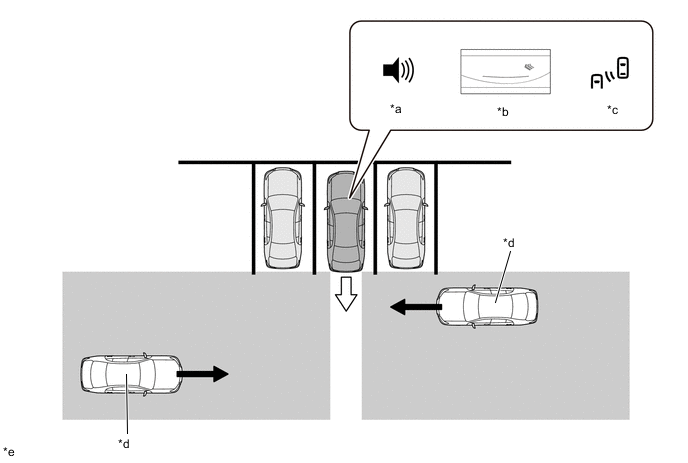
*a Warning *b Display *c Indicator *d Vehicle Approaching from Behind *e This illustration is only for explanatory purposes. - -
-
-
RCD (Models with Panoramic View Monitor System)
-
If a pedestrian is behind the vehicle when reversing, the driver is notified audibly by the RCTA buzzer and visually by the multi-display.
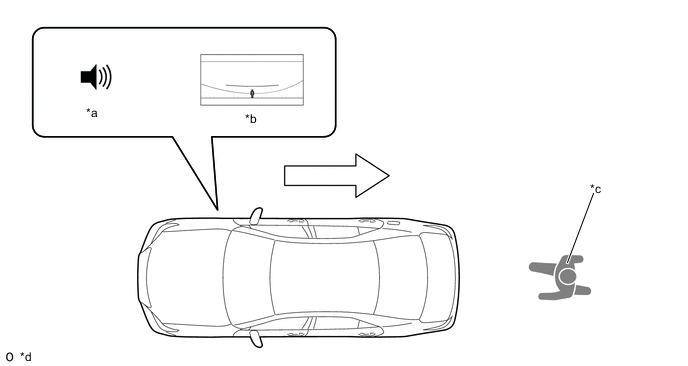
*a Warning *b Display *c Pedestrian *d This illustration is only for explanatory purposes.
-
-
-
-
PRECAUTION
-
Lexus Parking Assist-sensor
-
Lexus parking assist-sensor is supplemental equipment that notifies the driver by buzzer and display and distance of stationary objects during low-speed driving.
-
Precautions to observe during use
-
There are some restrictions to the detection range and operation speed of the sensor. When driving the vehicle in forward or reverse, be sure to confirm that the area around the vehicle is safe (especially on the sides of the vehicle), use the brakes to control the vehicle speed and drive slowly.
-
Do not install any accessories within the detection range of the sensor.
-
If an abnormality is displayed, first confirm the status of the sensor. If an abnormality is displayed even though there is no ice, snow or dirt, the sensor may be operating abnormally. Have it inspected by your Lexus dealer.
-
-
In the following situations, a sensor abnormality may prevent the equipment from operating properly. Have the vehicle inspected by your Lexus dealer.
-
The detection display is illuminated or blinks, or the buzzer sounds when no stationary object is detected.
-
The area around the sensor is struck by an object, hit or otherwise subject to a strong impact.
-
The bumper is struck.
-
-
Precautions to observe when washing the vehicle
-
When washing the vehicle in a high pressure car washer, do not allow water to make direct contact with the sensor area. The sensor may stop operating normally if subject to impact from high pressure water.
-
When washing the vehicle in a washer that uses steam, do not allow the steam to come too close to the sensor area. Steam may cause the sensor to stop operating normally.
-
-
Precautions during use
-
Do not allow the speed of the vehicle to exceed the operation vehicle speed.
-
The detection range of the sensor is limited to the vehicle corners and around the front/rear bumpers.
-
The detection range may decrease or the sensor may become unable to detect anything at all, depending on the shape of the stationary object or conditions.
-
The sensor may be unable to detect stationary objects that are too close.
-
After an stationary object is detected, it may take a short amount of time for the indicator to operate and the buzzer to sound. The stationary object may approach the non-detection range before the indicator operates and the buzzer sounds, even when driving at low speeds.
-
The sensor may not detect objects that are lower than the sensor, thin stakes and similar objects as they approach, even if they have been detected already.
-
When playing audio or using the air conditioning, sounds such as music or the fan noise may make it difficult to hear the buzzer sound.
-
-
The sensor may not be able to detect stationary objects in the following situations. Be sure to drive carefully.
-
The sensor is covered by ice, snow or dirt (returns to normal when the sensor is cleaned).
-
The sensor is frozen (returns to normal when not frozen).
-
The sensor is covered by an object such as a hand.
-
In blazing heat or freezing cold.
-
The vehicle is being driven on undulating roads, sloped roads, unpaved roads, in tall grass or similar conditions.
-
The vehicle is close to a source of ultrasonic waves, such as a vehicle horn or sensor system, motorcycle engine, large vehicle air brakes or Lexus parking assist-sensor equipment on another vehicle.
-
Heavy rain or water sprayed on the sensor.
-
The sensor is covered by water on a flooded road.
-
The vehicle is extremely tilted.
-
An after-market fender pole, wireless antenna or fog light is installed.
-
The vehicle is being driven toward a high curb or perpendicular curb.
-
An stationary object is near the bottom of the bumper.
-
An stationary object is too close to the sensor.
-
A towing hook is installed.
-
A suspension other than a genuine suspension is installed.
-
A backlit license plate is installed.
-
-
The sensor may not be able to detect the following objects. Be sure to drive carefully.
-
Thin objects such as wire, fences and rope.
-
Objects that absorb sound waves such as strings or snow.
-
Objects with sharp corners.
-
Short or low to the ground objects.
-
Tall objects where the top sticks out.
-
Some people may also not be detected due to their clothing.
-
-
-
RCTA (Models with Blind Spot Monitor System)
-
Safety precautions
-
The driver is responsible for safe operation of the vehicle. The driver must always be aware of the surroundings to ensure safe driving.
-
The RCTA is a supplemental system that notifies the driver of vehicles approaching from the rear left and rear right of the vehicle. The RCTA may not function effectively in certain conditions. The driver must therefore visually confirm safety. Relying solely upon the RCTA may result in unforeseen accidents, serious injury or even death.
-
-
Visibility of outer rear view mirror indicator light
-
Strong sunlight may make it difficult to see the outer rear view mirror indicator light.
-
-
Hearing RCTA buzzer sound
-
The RCTA buzzer may be difficult to hear if playing audio at a loud volume or if there are other loud noises.
-
-
The following types of vehicles and objects are not detected by the RCTA.
-
Vehicles approaching directly to the rear.
-
Vehicles reversing in a parking space next to the vehicle.
-
Vehicles that the sensor cannot detect due to the presence of an stationary object.
-
Stationary objects such as guardrails, walls, signs, parked vehicles, etc.*
-
Small two-wheeled vehicles, bicycles, pedestrians, etc.*
-
Vehicles that are moving away from the driver's own vehicle.
-
Vehicles approaching from a parking space next to the vehicle.*
Tech Tips
*: The sensor may detect the vehicles and objects described above depending on the situation.
-
-
Situations in which the RCTA may not operate effectively
-
The RCTA may not effectively detect vehicles in the following situations.
-
A blind spot monitor sensor position or direction is misaligned because the blind spot monitor sensor or the area around it was subject to a strong impact or the like.
-
Dirt, snow, ice, stickers or other objects are attached to the blind spot monitor sensor or to the rear bumper near the blind spot monitor sensor.
-
The vehicle is being driven through puddles or on wet roads during bad weather, such as heavy rain, snow or fog.
-
When multiple vehicles come close consecutively over a short period of time.
-
There are rapidly approaching vehicles.
-
A towing hook is attached to the rear of the vehicle.
-
The vehicle is reversing on slopes with extreme changes in gradient.
-
When parking at a small angle.
-
Immediately after the RCTA is turned on.
-
Immediately after starting the hybrid system when the RCTA is on.
-
The blind spot monitor sensor cannot detect vehicles due to the presence of an stationary object.
-
There may be unnecessary detections in the following situations.
-
Vehicles pass alongside the vehicle.
-
The vehicle is parked in a parking lot facing a road.
-
There is a metal object that easily reflects radio waves to the rear (such as a guardrail, wall, sign or parked vehicle).
-
A towing hook is attached to the rear of the vehicle.
-
-
Handling blind spot monitor sensors
-
A blind spot monitor sensor is installed on both the left and right sides on the rear of the vehicle. Observe the following to ensure that the system operates normally.
-
Always keep the area of the bumper near the blind spot monitor sensors clean.
-
Avoid strong impacts to the bumper around the blind spot sensors. If the position or orientation of the blind spot monitor sensor is even slightly misaligned, it may become unable to correctly detect vehicles, or the equipment may not operate normally. Have it inspected by your Lexus dealer.
-
The blind spot monitor sensor or the area nearby has been subject to a strong impact.
-
The rear bumper around the blind spot monitor sensor is scratched, dented or partially disconnected.
-
Do not disassemble the blind spot monitor sensor.
-
Do not install accessories in the blind spot monitor sensors and the rear bumper near the blind spot sensors and apply any sticker (including a transparent one) and aluminum tape.
-
Do not modify the blind spot monitor sensors or the rear bumper near the sensors.
-
When repairing the paint of the rear bumper, only use Lexus genuine colors.
-
This product conforms to electrical wave regulations in each country. The stamp on the surface of the product serves as proof of this. Do not remove it.
-
Do not modify this product. Modifying it will invalidate the certification number.
-
-
-
RCD (Models with Panoramic View Monitor System)
-
Situations in which pedestrians cannot be detected normally
-
Pedestrians who are crouching.
-
Pedestrians who are laying down.
-
Pedestrians who are running.
-
Pedestrians who suddenly appear from the shadow of the vehicle or a building.
-
Pedestrians who are riding moving objects such as a bicycle, skateboard or Segway.
-
Pedestrians wearing abnormal clothing (such as a party costume).
-
Pedestrians at night and pedestrians whose clothing resembles the color of their surroundings.
-
Pedestrians partially obscured by a cart, luggage, etc.
-
At night (after sunset).
-
During bad weather (rain, snow, fog, etc.).
-
Damaged or dirty lens (dirt, snow-melting agent, etc.).
-
Backlight (direct sunlight, sunlight reflected off the road surface, headlights of other vehicles, etc.).
-
Difference in brightness (near open shutters in a garage or underground parking area).
-
-
Objects and situations that may cause incorrect operation
-
Solid objects (pillars, pylons, fences, parked vehicles, etc.).
-
Moving objects (such as passing vehicles, motorcycles, etc.).
-
Moving objects (such as flags, exhaust gas, large drops of rain, large snowflakes, rainwater on roads, etc.).
-
Patterns on roads (white lines, pedestrian crossings, stones, streetcar rails, repaired areas, fallen leaves, gravel, etc.).
-
Grating, ditches and gutters.
-
Sides of roads and steps.
-
Surrounding objects reflected off puddles or wet road surfaces.
-
Shadows.
-
Driving onto an area with a difference in height.
-
The vehicle is extremely tilted (loaded, suddenly braking, etc.).
-
There are changes in gradient.
-
A lowered suspension or tire with a different diameter than a genuine tire, etc. is installed.
-
An extreme change in vehicle height (such as nose up, nose down, etc.).
-
An aftermarket accessory (backlit license plate, fog light, etc.) is installed near the camera.
-
An aftermarket protective part is installed to the rear bumper (bumper trim, etc.).
-
The axis of the camera is misaligned (due to reinstallation, collision, etc.).
-
A towing hook is installed.
-
The camera is dirty (dirty, snow-melting agents, etc.).
-
Rain drops are moving over the camera lens.
-
There are blinking lights (such as hazard warning lights).
-
-
-