EMISSION CONTROL SYSTEM(for Korea)
-
FUNCTION OF MAIN COMPONENTS
Component Function Fuel Tank Pressure Sensor (Vapor Pressure Sensor Assembly) Detects the internal pressure of the fuel tank assembly and sends a signal to the ECM. Fuel Vapor-containment Valve (Fuel Tank Solenoid Main Valve Assembly) This valve opens or closes in accordance with a signal provided by the ECM, in order to seal the fuel tank assembly or release its internal pressure. Fuel Lid Lock with Motor Assembly
-
The fuel lid lock with motor assembly consists of a built-in motor that opens the fuel lid via a linkage.
-
If the fuel lid lock with motor assembly malfunctions, the fuel lid can be opened manually by pulling on the emergency opener that is provided on the fuel lid lock with motor assembly.
Fuel Lid Lock with Motor Assembly Fuel Lid Courtesy Switch Whether the fuel lid is open or closed can be determined by the state (on or off) of this switch. Combination Meter Assembly Multi-information Display The multi-information display displays warnings in accordance with a signal from the ECM that has judged that the fuel lid is open. Canister Contains activated charcoal to absorb the vapors that are created in the fuel tank assembly as well as during refueling. Purge VSV Opens in accordance with the signals from the ECM when the system is purging in order to send the fuel vapors that were absorbed by the canister into the intake manifold. During the system monitoring mode, this valve controls the vacuum applied to the fuel tank assembly. Canister Pump Module Leak Detection Pump Sub-assembly Applies vacuum to the evaporative emission system in accordance with the signals from the ECM. Vent Valve Opens and closes the fresh air line in accordance with the signals from the ECM. Canister Pressure Sensor Detects the pressure in the evaporative emission system and sends a signal to the ECM. ECM
-
The ECM determines the results of the canister pump module's system leak check, performs purge control through the fuel vapor-containment valve (fuel tank solenoid main valve assembly) and the purge VSV, and controls the internal pressure of the fuel tank assembly.
-
The ECM monitors the system for any leaks and outputs a DTC if a malfunction is found.
-
-
SYSTEM CONTROL
-
Fuel Vapor-containment System
-
Parked (Power Switch Mode Off)
-
The ECM seals the fuel vapors in the fuel tank assembly by closing the fuel vapor-containment valve (fuel tank solenoid main valve assembly). At this time, if the internal pressure of the fuel tank assembly increases to a level above the specified pressure of the fuel outlet valve located in the fuel vapor-containment valve (fuel tank solenoid main valve assembly), the fuel outlet valve opens to release the internal pressure of the fuel tank assembly. This prevents the internal pressure in the fuel tank assembly from increasing abnormally.
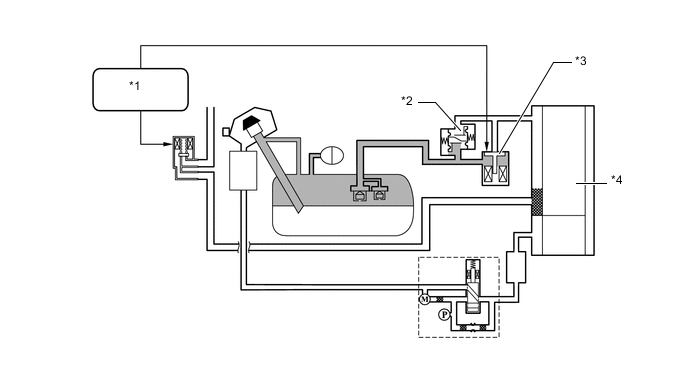
*1 ECM *2 Fuel Outlet Valve (Closed) *3 Fuel Vapor-containment Valve (Fuel Tank Solenoid Main Valve Assembly) (Closed) *4 Canister
-
-
Refueling Wait
-
When the fuel lid opening switch is operated, the ECM opens the fuel vapor-containment valve (fuel tank solenoid main valve assembly), allowing the fuel vapors to be absorbed by the canister and reducing the pressure in the fuel tank assembly. The fuel lid will not open unless the internal pressure of the fuel tank assembly decreases to a level close to the atmospheric pressure. In addition, the multi-information display will show the "PLEASE WAIT NOW OPENING".
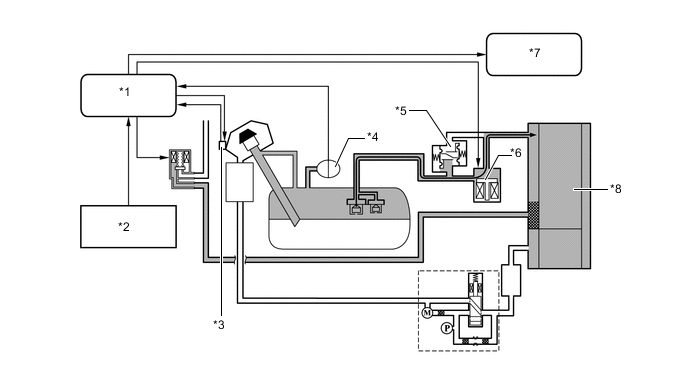
*1 ECM *2 Fuel Lid Opening Switch (On) *3 Fuel Lid Lock with Motor Assembly
-
Fuel Lid Courtesy Switch
*4 Fuel Tank Pressure Sensor (Vapor Pressure Sensor Assembly) *5 Fuel Outlet Valve (Closed) *6 Fuel Vapor-containment Valve (Fuel Tank Solenoid Main Valve Assembly) (Open) *7 Combination Meter Assembly
-
Multi-information Display
*8 Canister -
-
-
Refueling Ready
-
When the internal pressure of the fuel tank assembly decreases to a level close to the atmospheric pressure, the ECM opens the fuel lid. At this time, the multi-information display will show "REFUEL READY". Because the ECM keeps the fuel vapor-containment valve (fuel tank solenoid main valve assembly) open during refueling, the fuel vapors that are created during refueling pass through the fuel vapor-containment valve (fuel tank solenoid main valve assembly) and are absorbed by the canister. When the fuel lid is closed after refueling, the fuel vapor-containment valve (fuel tank solenoid main valve assembly) closes in order to seal the fuel tank assembly.
-
If 30 minutes elapse after the fuel lid is opened, the ECM closes the fuel vapor-containment valve (fuel tank solenoid main valve assembly) to seal the fuel tank assembly in order to prevent the fuel vapors from escaping, even if the fuel lid is not closed.
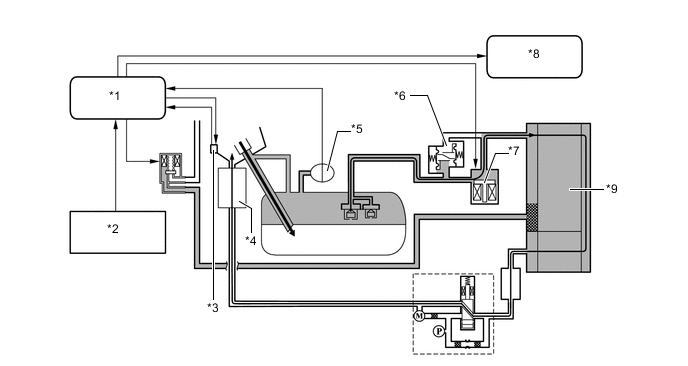
*1 ECM *2 Fuel Lid Opening Switch (On) *3 Fuel Lid Lock with Motor Assembly (Open)
-
Fuel Lid Courtesy Switch
*4 Canister Filter *5 Fuel Tank Pressure Sensor (Vapor Pressure Sensor Assembly) *6 Fuel Outlet Valve (Closed) *7 Fuel Vapor-containment Valve (Fuel Tank Solenoid Main Valve Assembly) (Open) *8 Combination Meter Assembly
-
Multi-information Display
*9 Canister - - -
-
-
Fuel Lid Open Warning
-
If one of the conditions listed below is met while the fuel lid is open, the ECM will show a "CLOSE FUEL LID" warning message on the multi-information display to warn the driver.
-
The vehicle speed is higher than 50 km/h (31 mph).
-
The vehicle has been driven more than 1 km (0.6 miles).
-
30 minutes have elapsed since the fuel vapor-containment valve (fuel tank solenoid main valve assembly) was opened.
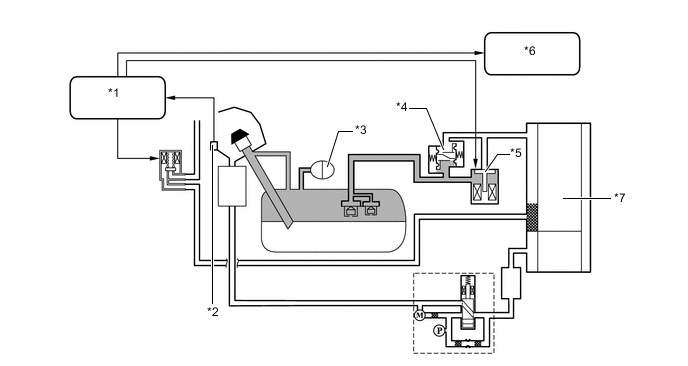
*1 ECM *2 Fuel Lid Lock with Motor Assembly (Open)
-
Fuel Lid Courtesy Switch
*3 Fuel Tank Pressure Sensor (Vapor Pressure Sensor Assembly) *4 Fuel Outlet Valve (Closed) *5 Fuel Vapor-containment Valve (Fuel Tank Solenoid Main Valve Assembly) (Closed) *6 Combination Meter Assembly
-
Multi-information Display
*7 Canister - - -
-
-
-
Purge flow Control
-
When the engine has reached predetermined parameters (closed loop, engine coolant temperature above 70°C (162°F), etc.), stored fuel vapors are purged from the canister whenever the purge VSV is opened by the ECM. The ECM changes the duty ratio cycle of the purge VSV, controlling the purge flow volume. The purge flow volume depends on the intake manifold pressure and the duty ratio cycle of the purge VSV. The atmospheric pressure is allowed into the canister to ensure that the purge flow is constantly maintained whenever purge vacuum is applied to the canister.
-
Due to the use of a fuel vapor-containment system, purge flow control occurs following 2 patterns, depending on the internal pressure of the fuel tank assembly.
-
If the internal pressure in the fuel tank assembly is near the atmospheric pressure, the ECM will not open the fuel vapor-containment valve (fuel tank solenoid main valve assembly) even if the purge VSV is open. At this time, the fuel vapors that are absorbed in the canister are drawn inside the engine and burned.
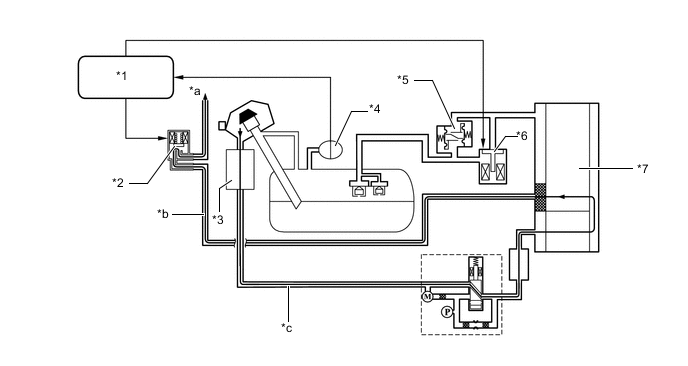
*1 ECM *2 Purge VSV (Open) *3 Canister Filter *4 Fuel Tank Pressure Sensor (Vapor Pressure Sensor Assembly) *5 Fuel Outlet Valve (Closed) *6 Fuel Vapor-containment Valve (Fuel Tank Solenoid Main Valve Assembly) (Closed) *7 Canister - - *a To Intake Manifold *b Purge Line *c Fresh Air Line - - -
If the internal pressure in the fuel tank assembly is high and the purge valve is open, the ECM opens the fuel vapor-containment valve (fuel tank solenoid main valve assembly) in order to release the pressure from the fuel tank assembly. At this time, the fuel vapors that are absorbed in the canister are drawn inside the engine by intake vacuum and burned.
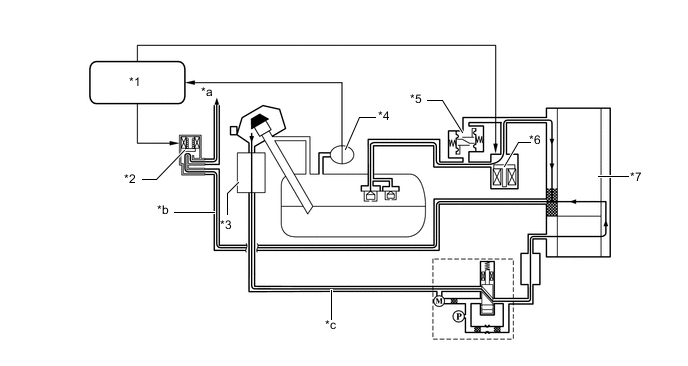
*1 ECM *2 Purge VSV (Open) *3 Canister Filter *4 Fuel Tank Pressure Sensor (Vapor Pressure Sensor Assembly) *5 Fuel Outlet Valve (Closed) *6 Fuel Vapor-containment Valve (Fuel Tank Solenoid Main Valve Assembly) (Open) *7 Canister - - *a To Intake Manifold *b Purge Line *c Fresh Air Line - -
-
-
EVAP Leak Check
-
The following are the typical conditions necessary to enable an evaporative emission leak check:
Typical Enabling Conditions
-
5 hours have elapsed after the engine has been turned off*.
-
Altitude: Below 2400 m (8000 ft.)
-
Auxiliary Battery Voltage: 10.5 V or higher
-
Power Switch: Off
-
Engine Coolant Temperature: Between 4.4 and 35°C (40 and 95°F)
-
Intake Air Temperature: Between 4.4 and 35°C (40 and 95°F)
*: If the engine coolant temperature does not drop below 35°C (95°F), this time is extended to 7 hours. After that, if the temperature is not less than 35°C (95°F), the time is extended to 9.5 hours.
Tech Tips
The canister pump module performs the fuel evaporative emission leak check. This check is done approximately 5 hours after the engine is turned off. A sound may be heard coming from underneath the luggage compartment for several minutes. This sound does not indicate a malfunction.
-
-
The ECM performs evaporative emission leak checks using 2 types of judgment methods.
-
When the internal pressure in the fuel tank assembly is equal to the atmospheric pressure:
-
The ECM actuates the leak detection pump sub-assembly to introduce a vacuum into the EVAP system pipes and the canister, in order to check for leaks and check the function of parts.
-
The ECM actuates the leak detection pump sub-assembly and opens the fuel vapor-containment valve (fuel tank solenoid main valve assembly) to introduce a vacuum into the fuel tank assembly, in order to check the fuel tank assembly for leaks and determine whether the fuel vapor-containment valve (fuel tank solenoid main valve assembly) is stuck closed.
Figure 1. When Fuel Tank Internal Pressure Equals Atmospheric Pressure
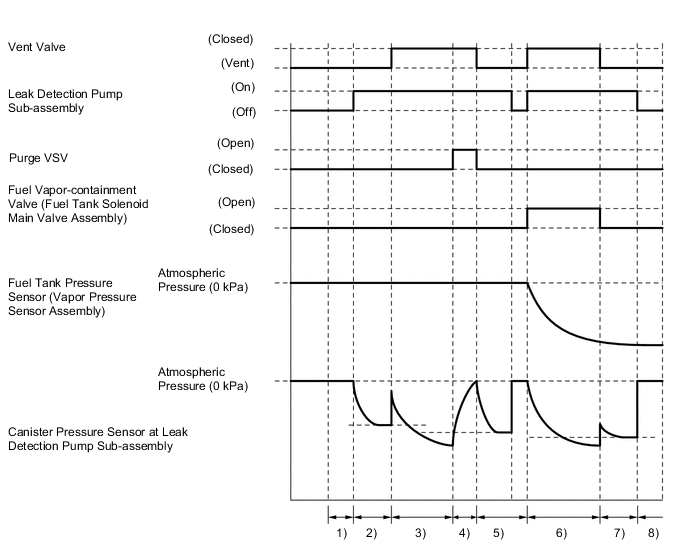
Order Operation Description Time 1) Atmospheric Pressure Measurement The ECM turns the vent valve off (vent) and measures the evaporative emission control system pressure to memorize the atmospheric pressure. 60 sec. 2) First Reference Pressure Measurement The leak detection pump sub-assembly creates negative pressure (vacuum) through the reference orifice. The ECM uses this as the first reference pressure. 360 sec. 3) EVAP Leak Check The leak detection pump sub-assembly creates negative pressure (vacuum) to check for leaks in the canister. If the stabilized pressure is larger than the first reference pressure, the ECM determines that the evaporative emission control system has a leak. If the pressure does not stabilize within 15 minutes, the ECM cancels evaporative emission control system monitoring. Within 15 min. 4) Purge VSV Monitor The ECM opens the purge VSV and monitors the vacuum created by the leak detection pump sub-assembly. If the pressure change is large (the pressure changes from vacuum to near atmospheric pressure), the ECM determines that the purge VSV is functioning normally. 10 sec. 5) Second Reference Pressure Measurement First, the leak detection pump sub-assembly creates negative pressure (vacuum) through the reference orifice. The ECM uses this as the second reference pressure. Then, the ECM turns the leak detection pump sub-assembly off and measures the pressure to memorize the atmospheric pressure. 60 sec. and 5 sec. 6) Fuel Vapor-containment Valve (Fuel Tank Solenoid Main Valve Assembly) Stuck Closed Judgment and Fuel Tank Leak Judgment When the fuel vapor-containment valve (fuel tank solenoid main valve assembly) is open, the leak detection pump sub-assembly creates a negative pressure (vacuum) in the fuel tank assembly and the ECM measures the pressure at this time. Within 15 min. 7) Third Reference Pressure Measurement The leak detection pump sub-assembly creates negative pressure (vacuum) through the reference orifice. The ECM uses this as the third reference pressure. 60 sec. 8) Final Check The ECM measures the atmospheric pressure and then records the monitor result. - -
When the internal pressure in the fuel tank assembly is higher or lower than the atmospheric pressure:
-
If the internal pressure of the fuel tank assembly is high or low, the ECM determines that there are no leaks in the fuel tank assembly, based on the holding state of the internal pressure in the fuel tank assembly.
-
The ECM actuates the leak detection pump sub-assembly to introduce a vacuum into EVAP system pipes and the canister in order to check for leaks and check the function of parts.
-
With the leak detection pump sub-assembly stopped, the ECM opens the fuel vapor-containment valve (fuel tank solenoid main valve assembly) to introduce the pressure from the fuel tank assembly into EVAP system pipes and the canister, in order to determine whether the fuel vapor-containment valve (fuel tank solenoid main valve assembly) is stuck closed.
Figure 2. When Fuel Tank Internal Pressure is High or Low
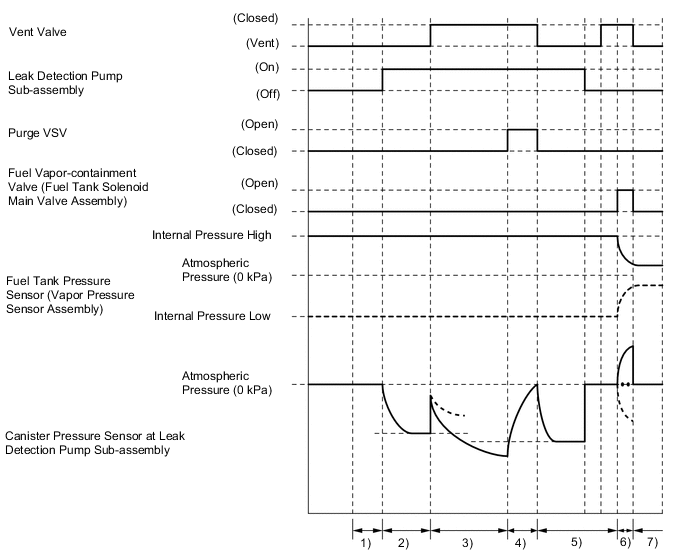
Order Operation Description Time 1) Atmospheric Pressure Measurement The ECM turns the vent valve off (vent) and measures evaporative emission control system pressure to memorize the atmospheric pressure. 60 sec. 2) First Reference Pressure Measurement The leak detection pump sub-assembly creates negative pressure (vacuum) through the reference orifice. The ECM uses this as the first reference pressure. 360 sec. 3) EVAP Leak Check The leak detection pump sub-assembly creates negative pressure (vacuum) to check for leaks in the canister. If the stabilized pressure is larger than the first reference pressure, the ECM determines that the evaporative emission control system has a leak. If the leak detection pump sub-assembly pressure does not stabilize within 15 minutes, the ECM cancels evaporative emission control system monitoring. Within 15 min. 4) Purge VSV Monitor The ECM opens the purge VSV and monitors the vacuum created by the leak detection pump sub-assembly. If the pressure change is large (the pressure changes from vacuum to near atmospheric pressure), the ECM determines that the purge VSV valve is functioning normally. 10 sec. 5) Second Reference Pressure Measurement First, the leak detection pump sub-assembly creates vacuum through the reference orifice. The ECM uses this as the second reference pressure. Then, the ECM turns the leak detection pump sub-assembly off and measures the pressure to memorize the atmospheric pressure. Following this, the vent valve is switched to the on position (vent). 60 sec. and 5 sec. 6) Fuel Vapor-containment Valve (Fuel Tank Solenoid Main Valve Assembly) Stuck Closed Judgment Using the pre-existing pressure or vacuum in the fuel tank assembly, the ECM monitors the pressure at the time the fuel vapor-containment valve (fuel tank solenoid main valve assembly) is opened. 0.1 sec. 7) Final Check The ECM measures the atmospheric pressure and then records the monitor result. -
-
-
Atmospheric Pressure Measurement
-
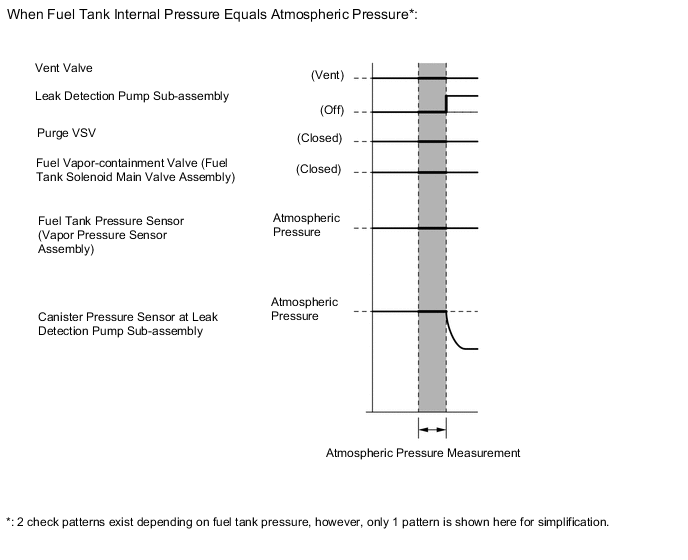
When the power switch is turned off, the purge VSV and the fuel vapor-containment valve (fuel tank solenoid main valve assembly) are off (closed). Therefore, the atmospheric pressure is introduced into the canister.
-
The ECM measures the atmospheric pressure through the signals provided by the canister pressure sensor.
-
If the measurement value is out of standard, the ECM actuates the leak detection pump sub-assembly in order to monitor the pressure changes.
-
If the ECM does not detect pressure changes, it stops the leak check and stores DTCs (Diagnostic Trouble Codes) in its memory.
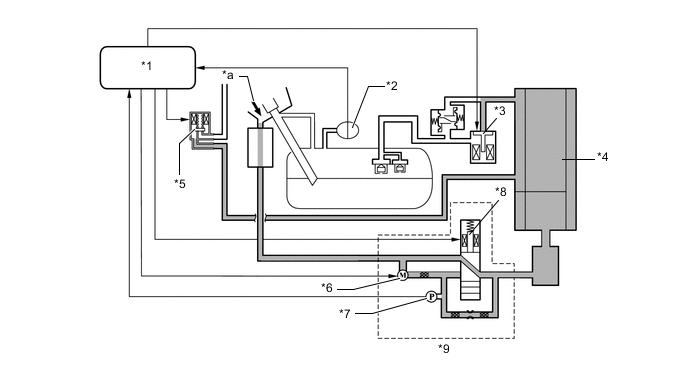
*1 ECM *2 Fuel Tank Pressure Sensor (Vapor Pressure Sensor Assembly) *3 Fuel Vapor-containment Valve (Fuel Tank Solenoid Main Valve Assembly) (Closed) *4 Canister *5 Purge VSV (Closed) *6 Leak Detection Pump Sub-assembly (Off) *7 Canister Pressure Sensor *8 Vent Valve (Vent Position) *9 Canister Pump Module - - *a Atmosphere - - -
The atmospheric pressure is measured at the following timing:
-
-
First Reference Pressure Measurement
-
The ECM turns the vent valve off (vent), introducing the atmospheric pressure into the canister, and actuates the leak detection pump sub-assembly, in order to create negative pressure.
-
At this time, the pressure will not decrease beyond a certain level due to the atmospheric pressure that enters through the reference orifice.
-
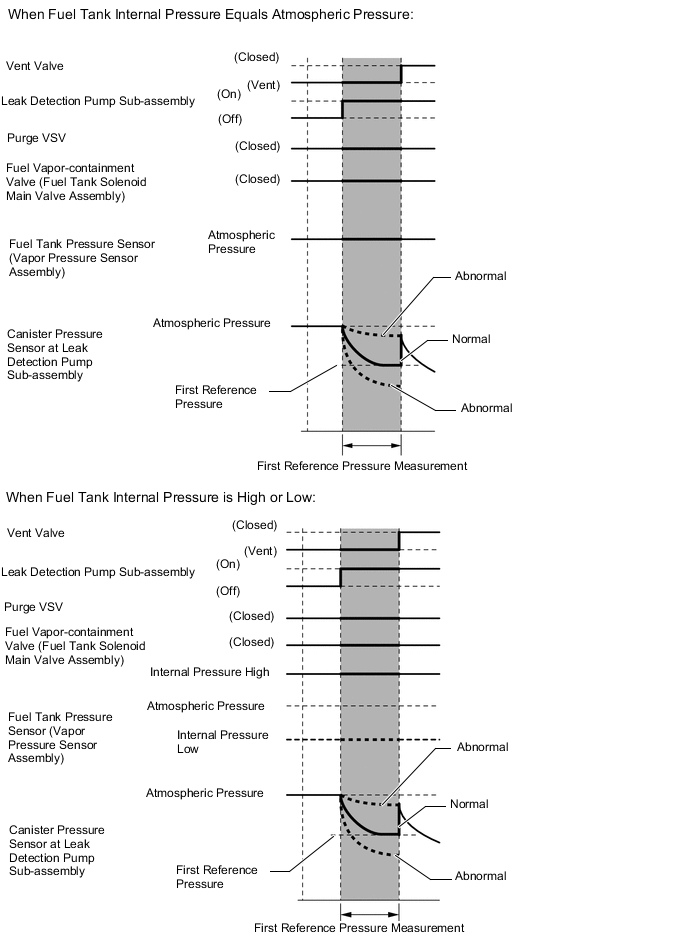
The ECM compares the logic value and this pressure and stores the measured pressure as the first reference pressure.
-
If the measurement value is below the standard (too much vacuum), the ECM determines that the reference orifice is clogged and stores a DTC in its memory.
-
If the measurement value is above the standard (pressure is too high, not enough vacuum), the ECM determines that a high flow rate pressure is passing through the reference orifice and stores a DTC in memory.
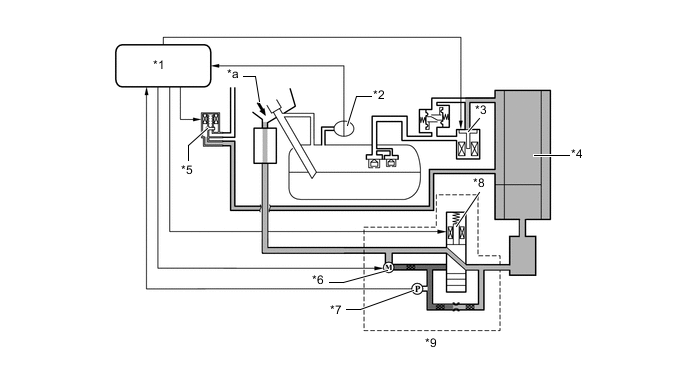
*1 ECM *2 Fuel Tank Pressure Sensor (Vapor Pressure Sensor Assembly) *3 Fuel Vapor-containment Valve (Fuel Tank Solenoid Main Valve Assembly) (Closed) *4 Canister *5 Purge VSV (Closed) *6 Leak Detection Pump Sub-assembly (On) *7 Canister Pressure Sensor *8 Vent Valve (Vent Position) *9 Canister Pump Module - - *a Atmosphere - - -
The timing of the first reference pressure measurement is as follows:
-
-
EVAP Leak Check
-
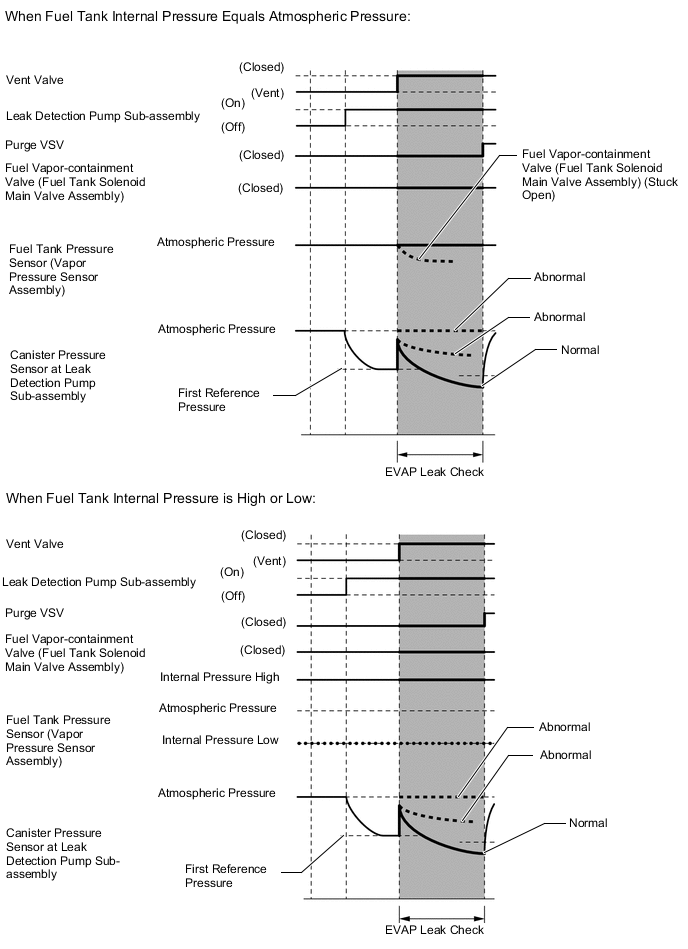
While actuating the leak detection pump sub-assembly, the ECM turns the vent valve on (closes the vent) in order to introduce a vacuum into the canister (the fuel vapor-containment valve (fuel tank solenoid main valve assembly) is closed as shown below).
-
When the pressure in the system stabilizes, the ECM compares this pressure and the first reference pressure in order to determine if a leak is occurring.
-
If the detection value is below the first reference pressure, the ECM determines that there is no leak.
-
If the detection value is above the first reference pressure and near the atmospheric pressure, the ECM determines that there is a large leak and stores a DTC in its memory.
-
If the detection value is above the first reference pressure and still below the atmospheric pressure, the ECM determines that there is a small leak and stores a DTC in its memory.
-
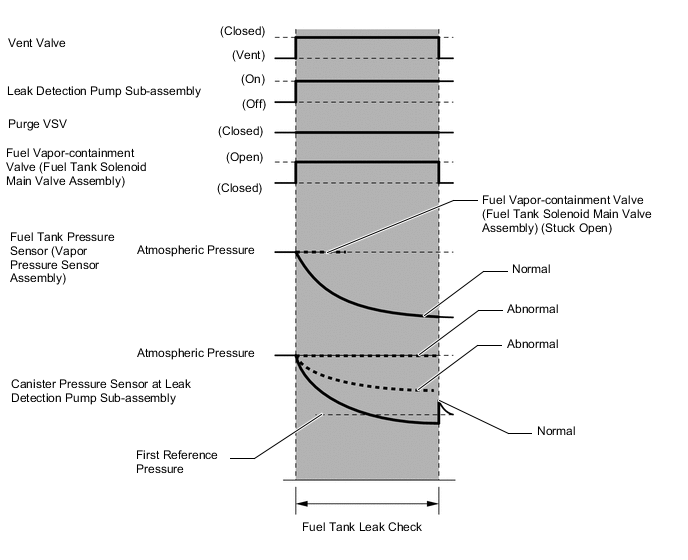
When the fuel tank internal pressure equals the atmospheric pressure, if there is a fluctuation in the fuel tank pressure sensor (vapor pressure sensor assembly) value, the ECM determines that the fuel vapor-containment valve (fuel tank solenoid main valve assembly) is stuck open and stores a DTC in memory.
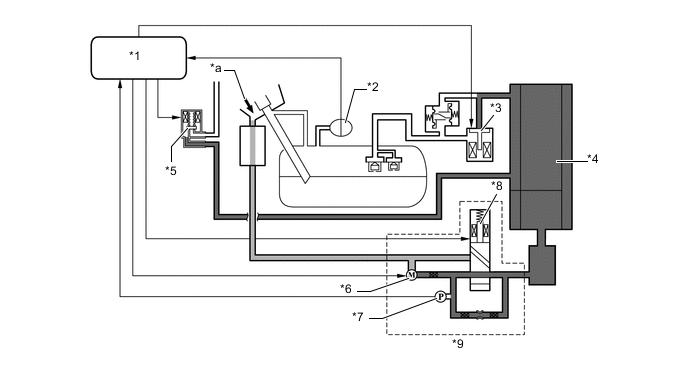
*1 ECM *2 Fuel Tank Pressure Sensor (Vapor Pressure Sensor Assembly) *3 Fuel Vapor-containment Valve (Fuel Tank Solenoid Main Valve Assembly) (Closed) *4 Canister *5 Purge VSV (Closed) *6 Leak Detection Pump Sub-assembly (On) *7 Canister Pressure Sensor *8 Vent Valve (Vent Closed) *9 Canister Pump Module - - *a Atmosphere - - -
The timing of the EVAP leak check is as follows:
-
-
Purge VSV Monitor
-
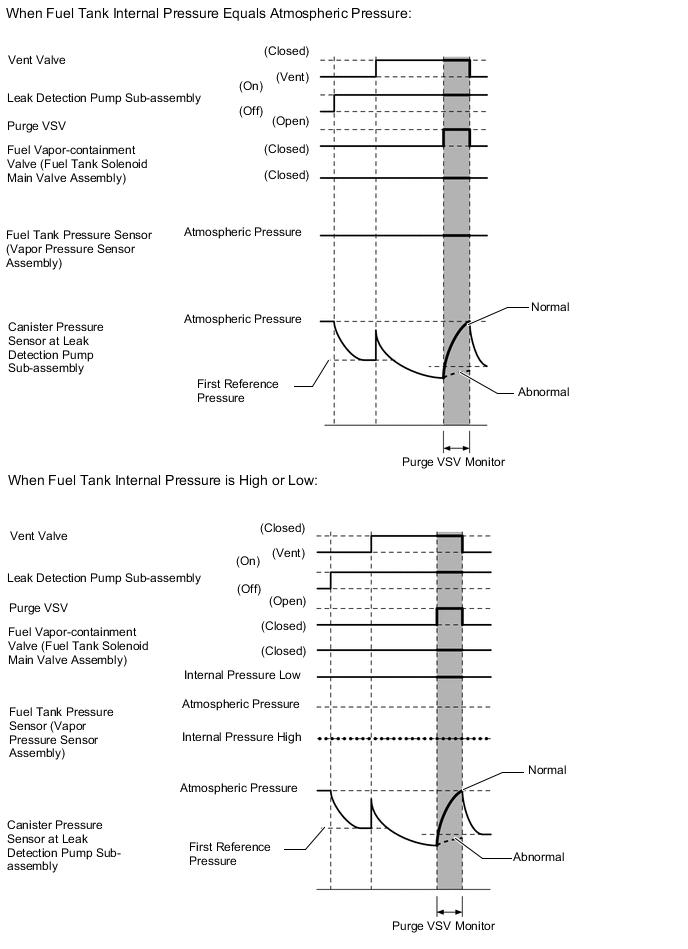
After completing an EVAP leak check, the ECM turns the purge VSV on (open) with the leak detection pump sub-assembly actuated, and introduces the atmospheric pressure into the canister from the intake manifold.
-
If the pressure change at this time is within the normal range, the ECM determines the condition to be normal.
-
If the pressure change is out of the normal range, the ECM will stop the purge VSV monitor and stores a DTC in memory.
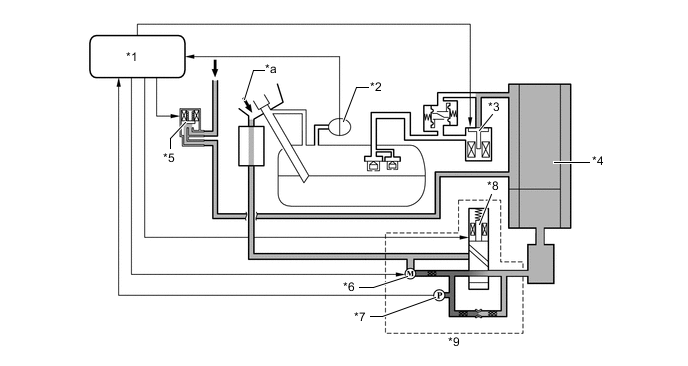
*1 ECM *2 Fuel Tank Pressure Sensor (Vapor Pressure Sensor Assembly) *3 Fuel Vapor-containment Valve (Fuel Tank Solenoid Main Valve Assembly) (Closed) *4 Canister *5 Purge VSV (Open) *6 Leak Detection Pump Sub-assembly (On) *7 Canister Pressure Sensor *8 Vent Valve (Vent Closed) *9 Canister Pump Module - - *a Atmosphere - - -
The timing of the purge VSV monitoring is as follows:
-
-
Fuel Vapor-containment Valve (Fuel Tank Solenoid Main Valve Assembly) Stuck Closed Judgment and Fuel Tank Leak Check
-
When Fuel Tank Internal Pressure Equals Atmospheric Pressure
-
The ECM actuates the leak detection pump sub-assembly, and turns on the vent valve (the vent is closed) and the fuel vapor-containment valve (fuel tank solenoid main valve assembly) (the valve opens), in order to introduce a vacuum into the fuel tank assembly, pipes, and canister.
-
When the pressure in the system stabilizes, the ECM compares this pressure and the first reference pressure in order to determine if a leak is occurring.
-
If the detection value is below the first reference pressure, the ECM determines that there is no leak.
-
If the detection value is above the first reference pressure and near the atmospheric pressure, the ECM determines that there is a large leak and stores a DTC in its memory.
-
If the detection value is above the first reference pressure and still below atmospheric pressure, the ECM determines that there is a small leak and stores a DTC in its memory.
-
At this time, if there is no fluctuation in the fuel tank pressure sensor (vapor pressure sensor assembly) value, the ECM determines that the fuel vapor-containment valve (fuel tank solenoid main valve assembly) is stuck closed and stores a DTC in memory.
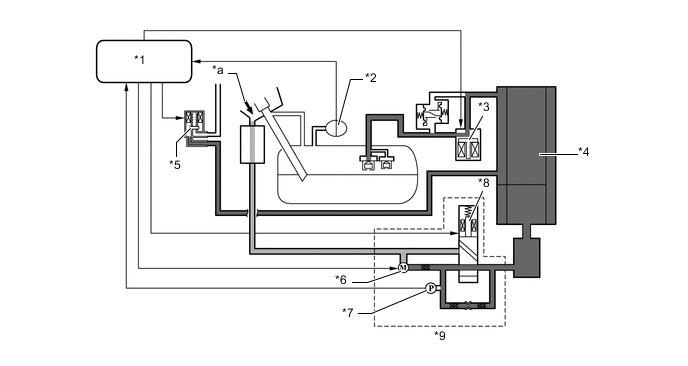
*1 ECM *2 Fuel Tank Pressure Sensor (Vapor Pressure Sensor Assembly) *3 Fuel Vapor-containment Valve (Fuel Tank Solenoid Main Valve Assembly) (Open) *4 Canister *5 Purge VSV (Closed) *6 Leak Detection Pump Sub-assembly (On) *7 Canister Pressure Sensor *8 Vent Valve (Vent Closed) *9 Canister Pump Module - - *a Atmosphere - - -
The timing of the fuel tank leak check is as follows:
-
When Fuel Tank Internal Pressure is Higher or Lower than Atmospheric Pressure
-
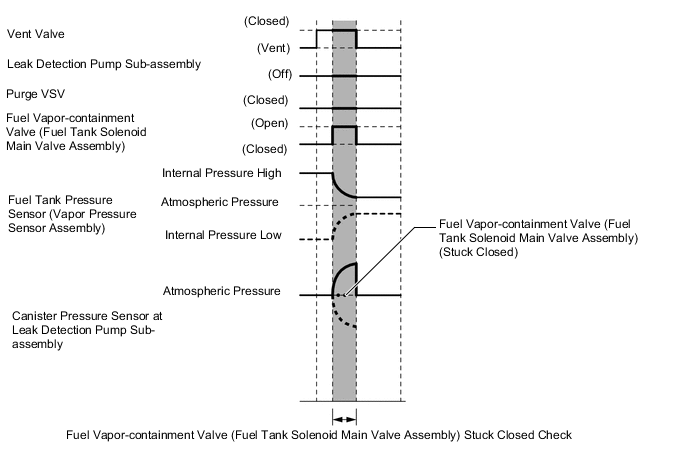
If the internal pressure in the fuel tank assembly is high or low, the ECM determines that there is no leak in the fuel tank assembly. Thus, it is only necessary to determine if the fuel vapor-containment valve (fuel tank solenoid main valve assembly) is stuck closed, without performing a fuel tank leak check.
-
With the leak detection pump sub-assembly stopped, the ECM turns the fuel vapor-containment valve (fuel tank solenoid main valve assembly) on (the valve opens) to introduce the internal pressure of the fuel tank assembly into the pipes and the canister.
-
The ECM measures the atmospheric pressure through the signals provided by the canister pressure sensor.
-
If the value detected by the canister pressure sensor stays within a specified range, the ECM determines that the fuel vapor-containment valve (fuel tank solenoid main valve assembly) is stuck closed and stores a DTC in memory.
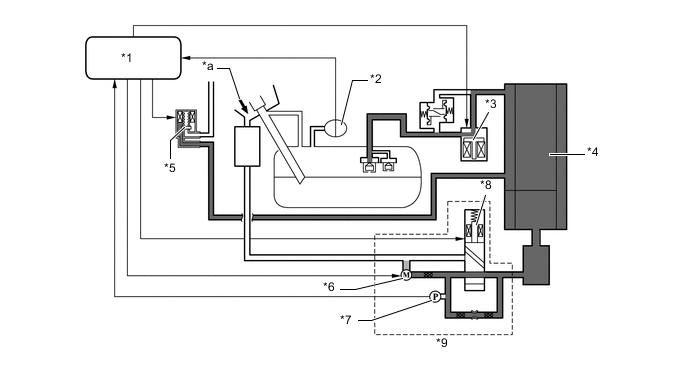
*1 ECM *2 Fuel Tank Pressure Sensor (Vapor Pressure Sensor Assembly) *3 Fuel Vapor-containment Valve (Fuel Tank Solenoid Main Valve Assembly) (Open) *4 Canister *5 Purge VSV (Closed) *6 Leak Detection Pump Sub-assembly (Off) *7 Canister Pressure Sensor *8 Vent Valve (Vent Closed) *9 Canister Pump Module - - *a Atmosphere - - -
The timing of the fuel vapor-containment valve (fuel tank solenoid main valve assembly) stuck closed check is as follows:
-
-
-