ACTIVE NOISE CONTROL SYSTEM
-
OUTLINE
-
An active noise control system is used. The active noise control system consists of the Active Noise Control (ANC) function and Engine Sound Enhancement (ESE) function.
-
ANC Function
-
An ANC function is used to reduce muffled sounds from the engine and propeller shaft, ensuring high levels of quietness in the cabin.
-
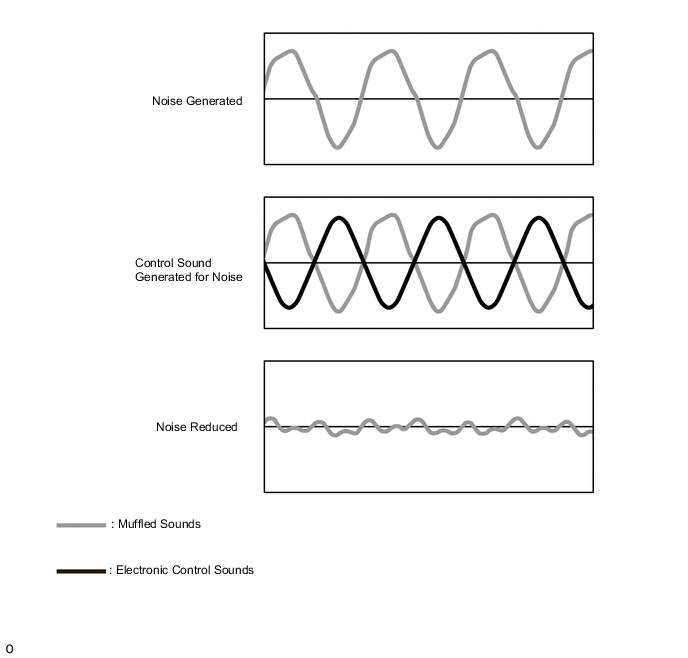
The ANC function uses a microphone to detect the muffled sounds emitted in synchronization with the speed of the engine and propeller shaft, and then outputs electronic control sounds with an inverted phase to the muffled sounds through the audio speakers, reducing the muffled sounds.
-
The ANC function is not linked with the audio system, so it operates even when the audio system is off or muted.
Figure 1. ANC Function Image
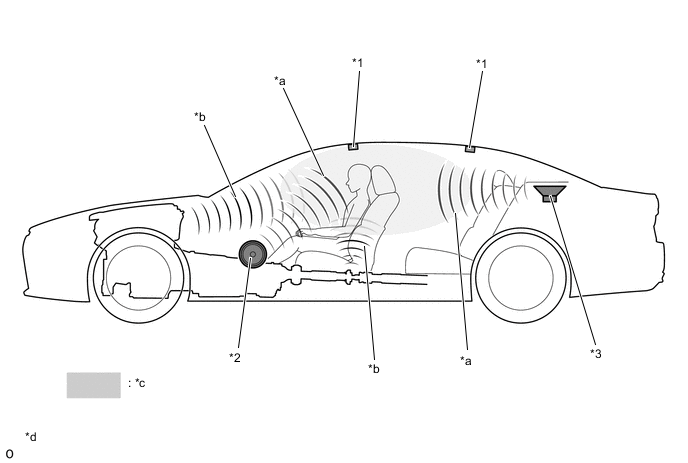
*1 Active Noise Control Microphone *2 Front No. 1 Speaker Assembly *3 Rear No. 3 Speaker Assembly - - *a Electronic Control Sounds *b Muffled Sounds *c Muffled Sounds Reduction Area *d This illustration is only for explanatory purposes. Figure 2. Principle of Muffled Sounds Reduction
-
-
ESE Function
-
The ESE function outputs an engine order component* sound from the audio speakers according to vehicle conditions, such as the acceleration opening angle and vehicle speed, creating more realistic engine sounds.
Tech Tips
*: The engine sound is composed of the sound of its rotational frequency and multiples of that frequency. For example, when the sound of the engine rotation period is 100 Hz, the actual engine sound that is heard is the combined sound of 100 Hz + 200 Hz + 300 Hz + ... + (n x 100) Hz. These multiples are called the 1st order component, 2nd order component, 3rd order component...n-th order component, and the ESE function outputs an artificial n-th order component sound.
-
The ESE function is not linked with the audio system, so it operates even when the audio system is off or muted.
-
-