TIRE PRESSURE WARNING SYSTEM
-
OUTLINE
-
A direct-sensing type tire pressure warning system is used. Also, a tire inflation pressure display function is provided.
Tech Tips
The tire inflation pressure display function does not show the tire pressure of the spare tire.
-
The direct-sensing type tire pressure warning system directly detects the tire pressure via tire pressure warning valve and transmitters installed in each disc wheel, and warns the driver about drops in the tire pressure by illuminating the tire pressure warning light when the tire pressure drops below the threshold to reduce CO2 emissions and improve safety. Since the tire pressure decreases over time, regular adjustments are necessary.
-
The 4 tire pressure warning valve and transmitters each send the tire inflation pressure, temperature, acceleration and ID code information to the tire pressure warning ECU and receiver.
Tech Tips
The spare tire is not included.
-
The tire pressure warning ECU and receiver, which consists of a receiver and an ECU, monitors the tire pressure warning valve and transmitters to detect low tire pressure in each of the 4 tires.
Tech Tips
The spare tire is not included.
-
The operation of the tire pressure warning system includes a tire inflation pressure display function, warning function, initial check function, initialization function and diagnosis function.
-
The tire inflation pressure display function is a function that displays the pressure of each tire together with the position of the identified tire on the multi-information display.
Tech Tips
The tire inflation pressure display function does not show the tire pressure of the spare tire.
-
The transmission cycle with which the information is sent from the tire pressure warning valve and transmitter to the pressure warning ECU and receiver is determined as follows based on the travel mode and the acceleration sensor built into each tire pressure warning valve and transmitter. Since the acceleration sensor is used only to determine if the vehicle is being driven, the value of rotational acceleration is not sent to the tire pressure warning ECU and receiver.
Travel Mode Transmission Cycle While stopping*1 1 time / 1.5 min While traveling*2 4 times / 1 min Tech Tips
*1: When G that is applied to the acceleration sensor is less than 8 G.
*2: When G that is applied to the acceleration sensor is 8 G or greater.
-
An automatic ID code registration function is provided. When an ID code registration operation is performed with a tire pressure warning valve and transmitter installed to each wheel, this function automatically registers the ID code of each tire pressure warning valve and transmitter after driving for 10 to 30 minutes. Refer to the Repair Manual for the details of the automatic ID code registration function.
-
The tire pressure warning ECU and receiver receives the transmitter ID, temperature and tire pressure information from the tire pressure warning valve and transmitters shown in the following illustration. This information is used to determine when the pressure in one of the tires has dropped.
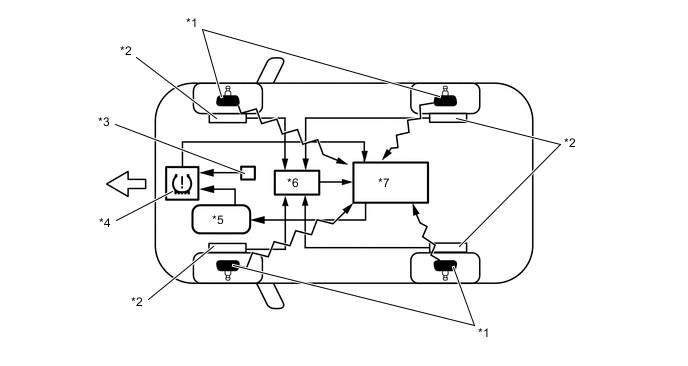
*1 Tire Pressure Warning Valve and Transmitter *2 Speed Sensor *3 Steering Pad Switch Assembly *4 Combination Meter Assembly
-
Tire Pressure Warning Light
*5 Main Body ECU (Multiplex Network Body ECU) *6 Skid control ECU *7 Tire Pressure Warning ECU and Receiver - - 
Forward - - -
-
-
PRECAUTION
-
The system is disabled in the following conditions (when the condition becomes normal, the system will works properly):
-
When all of the tires and wheels that have tire pressure warning valve and transmitters registered with the tire pressure warning ECU and receiver have not been installed.
-
When all of the transmitter ID codes are not registered with the tire pressure warning ECU and receiver.
-
When the tire pressure is extremely high [380 kPa (3.9 kgf/cm2, 3.8 bar) or more].
-
When the transmitter battery is depleted (battery life: approximately 10 years).
-
-
The system may become disabled in the following conditions (when the condition becomes normal, the system will works properly):
-
When electric devices or facilities using similar radio wave frequencies are nearby.
-
When a wireless device or other equipment operating at a similar frequency is in use in the vehicle.
-
When a window tint that affects the radio wave signals is installed.
-
When there is a lot of snow or ice on the vehicle, in particular around the wheels or wheel housings.
-
When non-genuine wheels are used.
-
When tire chains are used.
-
When an aftermarket tire repair sealant is used.
-
-
The tire pressure warning system may not function properly if a tire repair sealant has been used to repair a flat tire. If this type of sealant has been used, the tire pressure warning valve and transmitter should be replaced with a new one after repairing or replacing the tire.
-
The tire pressure warning light may illuminate due to natural pressure loss caused by air passing through the tires or by changes in tire pressure caused by temperature fluctuations. When adjusting the tire pressure, please be aware of the driving conditions and temperature conditions. The tire pressure warning light is prone to illuminate especially in late fall and during winter.
-
When tires and wheels are replaced, always ensure that each transmitter ID is correctly registered.
-
When one or more of the tire pressure warning valve and transmitters or the tire pressure warning ECU and receiver is replaced, the transmitter IDs for all of the tire pressure warning valve and transmitters must be re-registered. Before registering the transmitter ID of a new tire pressure warning valve and transmitter, check the Data List and record all of the transmitter IDs that are already registered.
-
When replacing the tire pressure warning valve and transmitter, all tire pressure warning valve and transmitter ID codes and the amount of tires*1 must be registered to the tire pressure warning ECU and receiver. Even when replacing only 1 of the tire pressure warning valve and transmitters, all tire pressure warning valve and transmitter ID codes and the amount of tires*1 must be re-registered.*2
Tech Tips
*1: The amount of tires must be registered when manually registering ID codes using the Global TechStream (GTS).
*2: The ID codes and the amount of tires need to be written down before manually re-registering them using the Global TechStream (GTS). If the ID codes are unknown, it is possible to perform registration by using the automatic ID code registration function.
-