ACTIVE STABILIZER SUSPENSION SYSTEM
-
OUTLINE
-
An active stabilizer suspension system is provided depending on the model.
-
The active stabilizer suspension system uses actuators installed in the front and rear stabilizer bars to suppress stabilizer bar twisting and vary the force transmitted to the suspension. As a result, stabilizer bar twisting is optimally controlled according to turns and movements in the roll direction of the vehicle due to input from the road surface, suppressing vehicle roll and achieving superior turning and a smooth ride.
-
Vehicle Dynamics Integrated Management (VDIM) of models with an active stabilizer suspension system optimally controls vehicle movement according to driving, turning and stopping inputs. As a result, vehicle response according to the driver's intensions and a pleasant driving comfort that cuts off input from the road surface are provided in manners appropriate for a flagship model. For details related to brake control, refer to the Brake Control System section. For details related to steering control, refer to the Lexus Dynamic Handling section.
-
A mode switching function is used, which makes it possible to select the control mode by performing drive mode select operations.
-
-
MAIN FEATURES
-
VDIM
-
VDIM of models with an active stabilizer suspension system does not individually control each vehicle movement (forward/rearward, up/down, lateral, yaw, roll and pitch), but it considers the movement of the entire vehicle as a single target and seamlessly controls each movement from the normal range to the limit range.
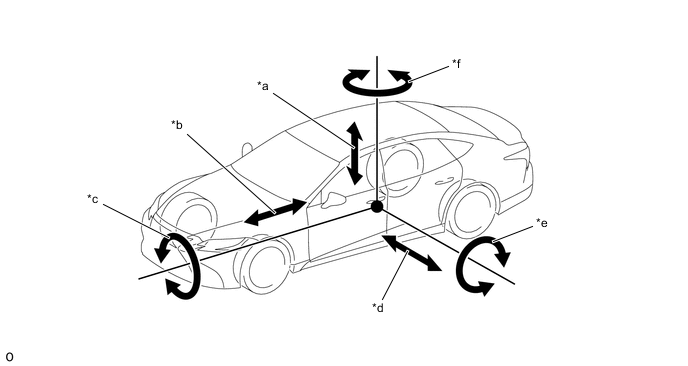
*a Up/Down
-
Adaptive Variable Suspension System (AVS)
-
Active Stabilizer Suspension System
*b Forward/Rearward
-
Brake Control System (ABS, TRC)
*c Roll
-
Adaptive Variable Suspension System (AVS)
-
Active Stabilizer Suspension System
-
Lexus Dynamic Handling (LDH) System (Variable Gear Ratio Steering (VGRS) System, Dynamic Rear Steering (DRS) System)
*d Lateral
-
Lexus Dynamic Handling (LDH) System (Variable Gear Ratio Steering (VGRS) System, Dynamic Rear Steering (DRS) System)
-
Brake Control System (VSC)
-
Power Steering System
*e Pitch
-
Adaptive Variable Suspension System (AVS)
*f Yaw
-
Lexus Dynamic Handling (LDH) System (Variable Gear Ratio Steering (VGRS) System, Dynamic Rear Steering (DRS) System)
-
Brake Control System (VSC)
-
Power Steering System
-
-
The main ECUs for VDIM are the front steering control ECU, which controls the vehicle's movement during normal driving (normal range), and the skid control ECU, which detects the tire slip condition based on information from various vehicle sensors and controls the vehicle's movement around its limits. The 2 ECUs handle all vehicle movement, comprehensively determine "which device to use to control which movement", and control each system.
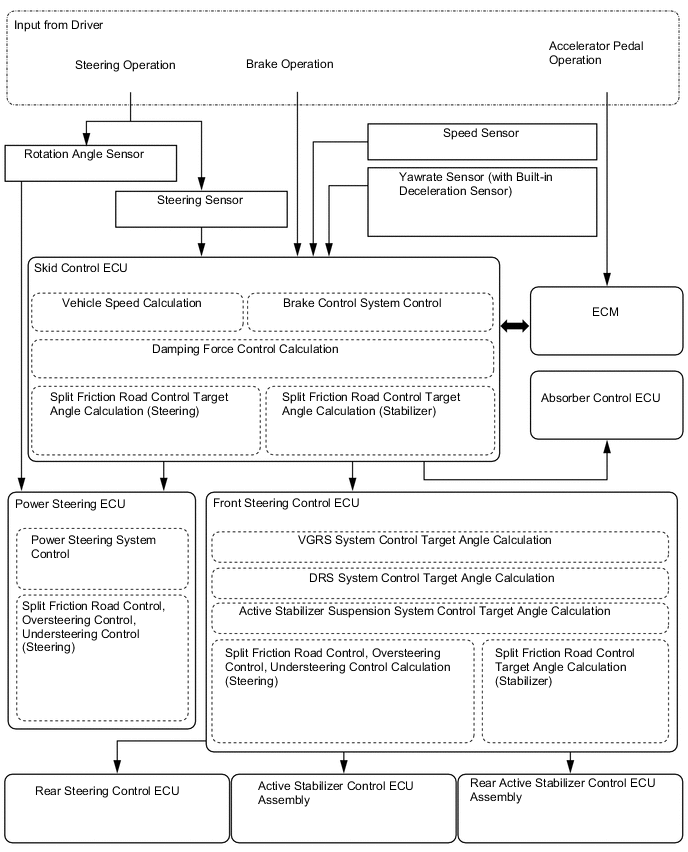
-
Effects in Normal Range
-
In the normal range, the active stabilizer suspension system and LDH system perform cooperative control performed by VDIM to control planar movement (yaw/lateral) and roll movement according to driver steering operations. As a result, in wide vehicle speed ranges, vehicle response according to the driver's intentions and a natural roll posture are achieved.
-
In addition, body movements in the roll direction according to road surface inputs are reduced by the active stabilizer suspension system and AVS mainly controls movements in the vertical direction to maintain a flat vehicle posture. As a result, line of sight and body movements are suppressed, achieving easy driveability and a pleasant vehicle posture.
-
-
Effects in Limit Range
-
At the vehicle's limits, the skid control ECU detects the tire slip condition based on information from vehicle sensors when driving on slippery surfaces with the tire grip force at its limits. The skid control ECU sends the brake control amount, front/rear wheel tire steering angle, steering assist torque, drive force and suspension control amount according to each movement in the front/rear, left/right, vertical, yaw and roll directions as commands to the ECUs. In addition, cooperative control is performed with each system as necessary to use the maximum tire grip force and support safer and more pleasant driving (driving, turning and stopping) in the limit range.
-
-
-