ELECTRONIC SHIFT LEVER SYSTEM
-
CONSTRUCTION
-
The shift control actuator assembly consists of a switched reluctance motor, rotation angle sensor, range sensor and cycloid reduction mechanism.
-
The shift control actuator assembly is mounted on the side of the transmission. Upon receiving an actuation signal from the shift control ECU, the motor rotates to engage or disengage the parking lock mechanism. As a result, the transmission is locked or unlocked mechanically.
-
A non-contact type range sensor is used to accurately detect whether the parking lock mechanism is locked or unlocked. Also, the non-contact type range sensor achieves friction reduction, improving the switching operations of the actuator.
-
A manual parking lock release mechanism is provided to manually release the parking lock when a malfunction occurs with the parking lock locked. For details and the operation method, refer to the Repair Manual.
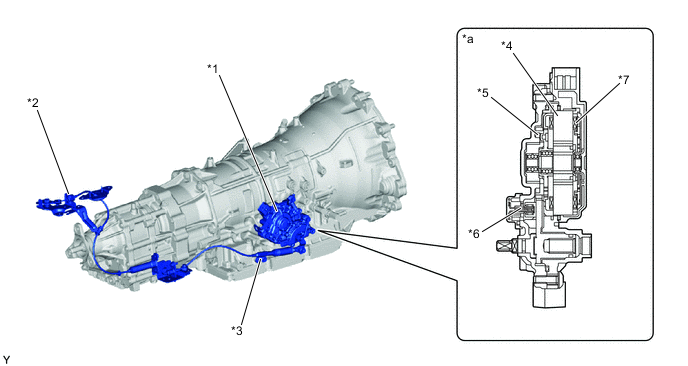
*1 Shift Control Actuator Assembly *2 Parking Lock Release Lever Assembly (Manual Parking Lock Release Mechanism) *3 No. 2 Parking Lock Release Cable Assembly (Manual Parking Lock Release Mechanism) *4 Switched Reluctance Motor *5 Cycloid Reduction Mechanism *6 Range Sensor *7 Rotation Angle Sensor - - *a Shift Control Actuator Assembly Cross Section - -
-
Switched Reluctance Motor
-
The stator and rotor of the switched reluctance motor use a salient pole structure, and the rotor is rotated by the intermittent magnetic attractive force generated by the current supplied based on rotor position information to the coils wrapped around the salient poles of the stator. This motor does not use brushes or magnets. As a result, it achieves superior reliability. Also, 2 Hall ICs are used in the rotation angle sensor to optimally control the current flowing to the coil by detecting the rotation angle of the rotor with a high degree of accuracy, making it possible to freely control the rotor rotation.
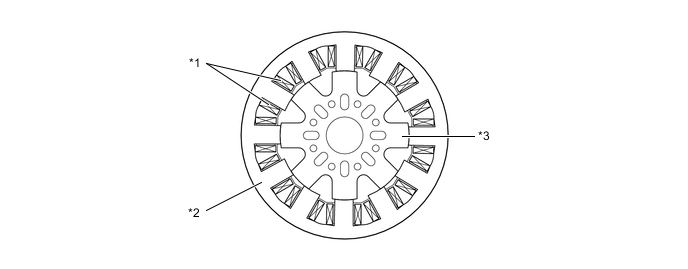
*1 Coil *2 Stator *3 Rotor - -
-
-
Cycloid Reduction Mechanism
-
The cycloid reduction mechanism is a reduction mechanism mainly composed of an eccentric plate, an outside gear and an inside gear. It amplifies the motor output so that it is possible to securely switch the shift position to P even when a high output is required, such as when switching to the P position while parking on a slope. When the eccentric plate linked with the motor shaft rotates once, the outside gear (60 teeth) rotates by one tooth engaging with the inside gear fixed to the housing (61 teeth), transmitting this rotation to the output shaft.
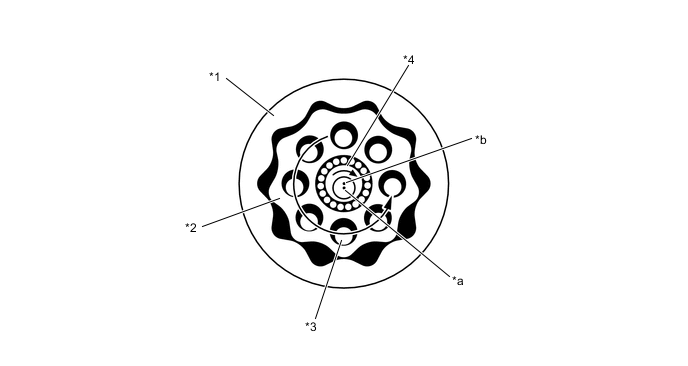
*1 Inside Gear *2 Outside Gear *3 Output Shaft *4 Eccentric Plate *a Motor Input Shaft Center *b Eccentric Plate Center
-
-
-