GASOLINE PARTICULATE FILTER (GPF)
-
FUNCTION OF MAIN COMPONENTS
-
The main components of the GPF system are as follows:
Component Function Differential Pressure Sensor Measures the pressure difference between atmosphere and upstream of the GPF catalyst. ECM Controls the GPF system based on signals from each sensor.
-
-
FUNCTION
-
Determines the GPF catalyst conditions based on various signals and controls the GPF catalyst conditions.
-
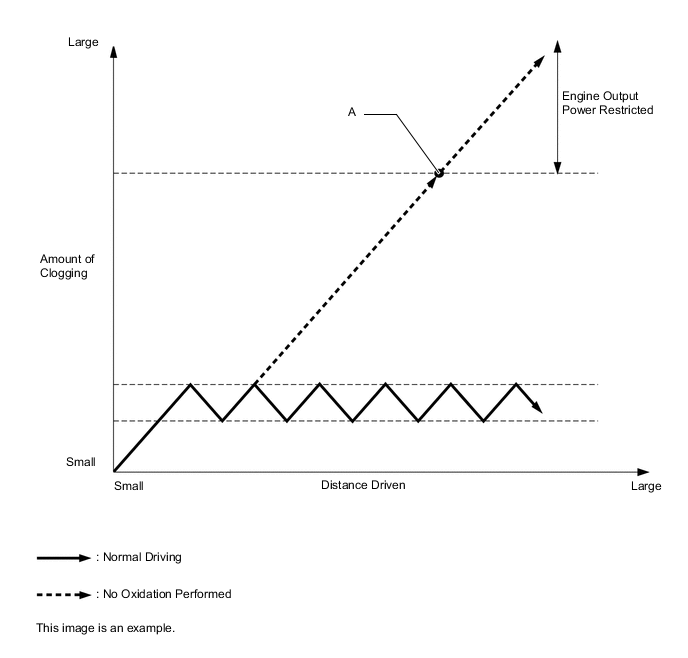
Accumulated particulate matter is oxidized within the GPF catalyst when it is combined with oxygen at high temperatures. When the GPF catalyst is hot such as when driving under high engine load and fuel cut occurs, oxygen introduced into the GPF catalyst oxidizes the particulate matter.
-
If the engine is only run at low engine loads, particulate matter gradually accumulates in the GPF catalyst and will eventually lead to clogging. The ECM monitors the differential pressure sensor to check the pressure difference in order to determine the amount of clogging by particulate matter, and when the threshold is exceeded, a message is displayed on the multi-information display in the combination meter assembly and the Malfunction Indicator Lamp (MIL) illuminates. When the Malfunction Indicator Lamp (MIL) is illuminated, engine output power restriction is performed. Since the engine output power restriction function only operates when there is a possibility that a malfunction may occur, even if the state of clogging remains the same, it may not operate depending on how the vehicle is used. Furthermore, the level of engine output power restriction changes in steps in accordance with the amount of clogging.
Tech Tips
When engine output power restriction is being performed, it will still be possible to drive the vehicle.
Combination Meter Assembly Display Content Condition
(Text in Illustration)
Multi-information Display Malfunction Indicator Lamp (MIL) A Exhaust Filter Full Visit Your Dealer Illuminates
-