BODY STRUCTURE
-
FUNCTION
-
Impact Absorbing Structure for Frontal Collision
-
The front end of the rocker protrudes forward (*c in illustration) to ensure an impact absorption area, receive impact energy from the front tires during frontal collisions and direct the front tires outwards (*d in illustration), suppressing cabin body deformation.*
Tech Tips
*: The deformation mode when the vehicle is in a frontal collision where the front end of the vehicle collides with a thin object (approximately 1/4 of the total width), such as a tree or utility pole.
-
The front body pillar outer reinforcement has a 2 part structure in the front and rear (*a in illustration), and bulkheads (*4 and *5 in illustration) are positioned inside it. As a result, cabin body deformation due to energy input from the tires during frontal collisions is suppressed.
-
Ultra high-tensile strength steel (tensile strength: 1180 MPa class) is used in the rocker outer reinforcement (fender panel inner (*8 in illustration)). As a result, cabin body deformation from vehicle pitching during frontal collisions is suppressed using a lightweight body structure.
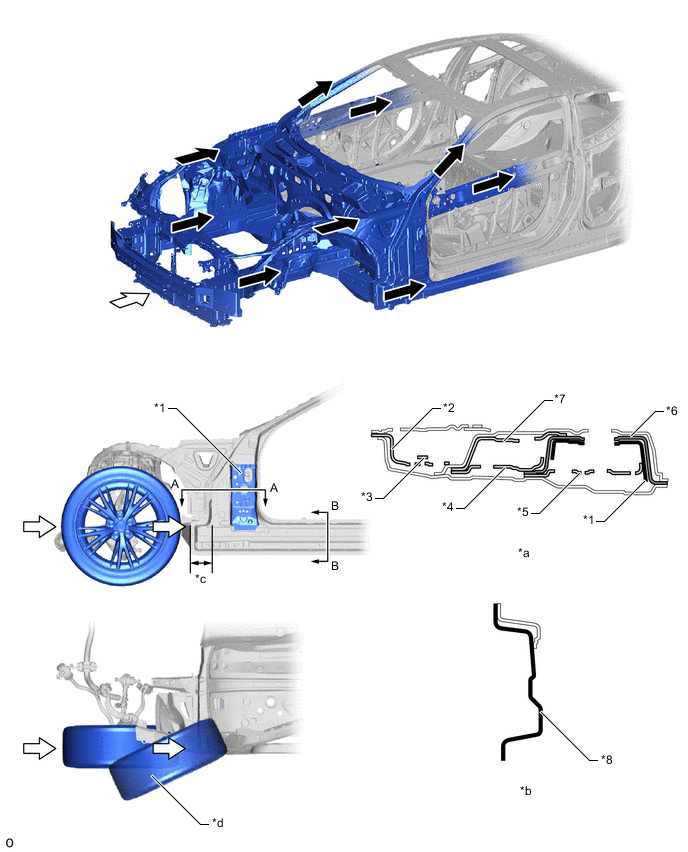
*1 Front Body Pillar Lower Hinge Retainer LH *2 Front Body Pillar Reinforcement Upper Out No. 2 LH *3 Front Body Pillar LWR Outer FR LH *4 Front Body Pillar Retainer LWR INNER LH *5 Front Pillar Extension LWR LH *6 Front Body Pillar Reinforcement LWR LH *7 Front Body Pillar Upper Hinge Retainer Holder LH *8 Fender Panel Inner LH *a A - A Cross Section *b B - B Cross Section *c Protruding Section at Front End of Rocker (Impact Absorption Area) *d Tires Directed Outwards during Frontal Collision 
Ultra High-tensile Strength Steel
(Tensile Strength: 1180 MPa Class)

Ultra High-tensile Strength Steel
(Tensile Strength: 980 MPa Class)

High-tensile Strength Steel
(Tensile Strength: 590 MPa Class)

Front Impact Energy 
Dissipate - - -
A front bumper reinforcement sub-assembly (*1 in illustration), which is highly resistant to warping, is used. It efficiently spreads impact energy received during a frontal collision to the opposite side of the vehicle and dissipates impact energy to body parts to increase the amount of impact energy that is absorbed in the engine compartment.
-
A wide crush box (front bumper mounting reinforce sub-assembly (*2 in illustration)) is used and a gusset (outrigger gusset No. 1 (*3 in illustration)) is provided to ensure superior initial collision energy absorption in various types of collisions.
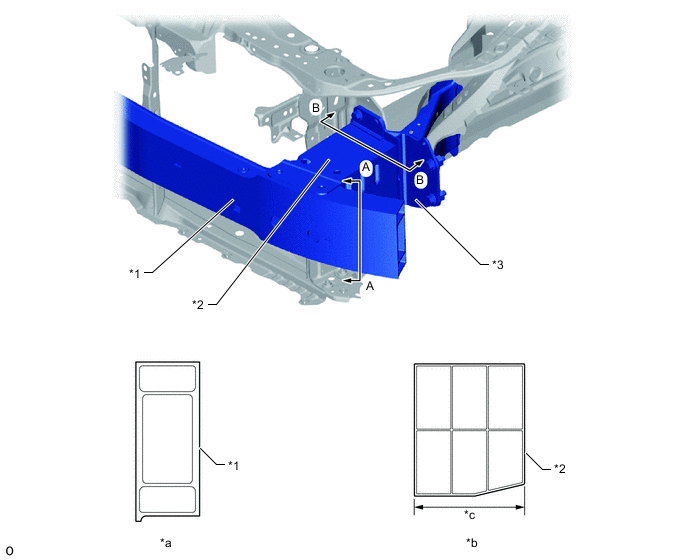
*1 Front Bumper Reinforcement Sub-assembly *2 Front Bumper Mounting Reinforce Sub-assembly LH *3 Outrigger Gusset No. 1 LH - - *a A - A Cross Section *b B - B Cross Section *c Wide Crush Box - - -
A multi-load path body structure, which dissipates input load along multiple paths, is used to absorb impact energy during frontal collisions, ensuring superior safety.
-
The load received by the front bumper reinforcement sub-assembly (*1 in illustration) during a collision dissipates to the front side member assembly (*3 in illustration) through the front bumper mounting reinforce sub-assembly (*2 in illustration).
-
The load received by the front bumper reinforcement sub-assembly (*1 in illustration) during a collision dissipates to the outrigger No. 2 (*4 in illustration) and outrigger No. 1 (*5 in illustration) through the front bumper mounting reinforce sub-assembly (*2 in illustration).
-
The load received by the front bumper reinforcement sub-assembly No. 2 (*6 in illustration) during a collision dissipates to the rear frame rail sub-assembly (*7 in illustration), frame crossmember sub-assembly front (*8 in illustration) and lower arm mounting reinforcement sub-assembly rear (*9 in illustration).
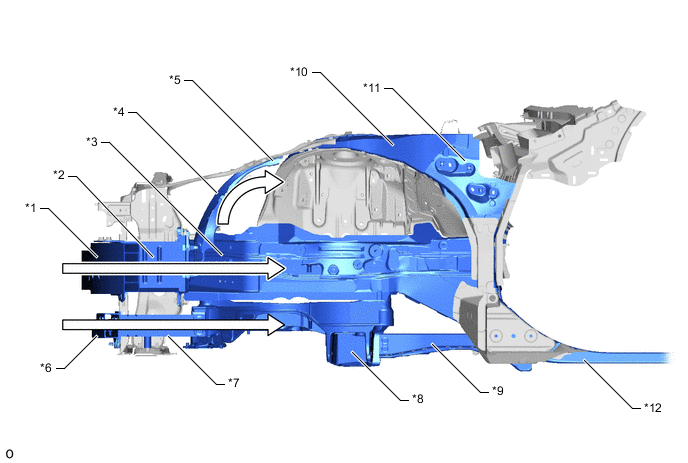
*1 Front Bumper Reinforcement Sub-assembly *2 Front Bumper Mounting Reinforce Sub-assembly LH *3 Front Side Member Assembly LH *4 Outrigger No. 2 LH *5 Outrigger No. 1 LH *6 Front Bumper Reinforcement Sub-assembly No. 2 *7 Rear Frame Rail Sub-assembly LH *8 Frame Crossmember Sub-assembly Front *9 Lower Arm Mounting Reinforcement Sub-assembly Rear LH *10 Cowl Top Side Panel LH *11 Front Apron to Cowl Side Member Plate LH *12 Front Side Member Reinforcement No. 5 LH Front Impact Energy - -
-
-
A torque box with a large cross section (C in illustration), a strengthened connection between the torque box and dash cross member (D in illustration), and a member rear with a large cross section (E in illustration) are provided to increase cabin strength and ensure superior safety during collisions. These structures also improve body rigidity.
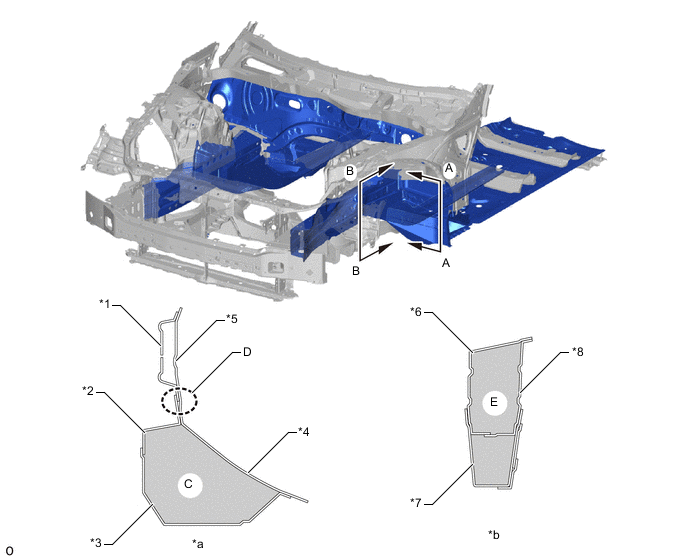
*1 Dash Panel No. 2 *2 Torque Box FR LH *3 Torque Box FR No. 2 LH *4 Front Floor Pan LH *5 Dash Panel Sub-assembly *6 Front Side Member Inner LH *7 Front Side Member Plate Outer LH *8 Front Side Member Plate Outer LH *a A - A Cross Section *b B - B Cross Section
-
-
Impact Absorbing Structure for Side Collision
-
Ultra high-tensile strength steel (tensile strength: 980 MPa class) and high-tensile strength steel (tensile strength: 590 MPa class) are used in the body frame, achieving weight reduction and structure simplification while ensuring strength.
-
High-tensile strength steel (tensile strength: 590 MPa class) is used in the center body pillar reinforcement UPR (*14 in illustration), center body pillar inner (*11 in illustration) and belt anchor to center pillar reinforcement (*12 in illustration). Furthermore, ultra high-tensile strength steel (tensile strength: 980 MPa class) is used in the center pillar upper hinge reinforcement No. 2 (*13 in illustration), which is positioned on the inner side of the center body pillar reinforcement UPR.
-
High-tensile strength steel (tensile strength: 590 MPa class) is used in the roof side rail UPR (*1 in illustration) and roof side rail inner (*3 in illustration). High-tensile strength steel (tensile strength: 590 MPa class) is also used in the roof side rail gusset RR (*2 in illustration), which is positioned on the inner side of the roof side rail UPR (*1 in illustration).
-
Ultra high-tensile strength steel (tensile strength: 1180 MPa class) is used in the fender panel inner (*8 in illustration).
-
Ultra high-tensile strength steel (tensile strength: 1180 MPa class) is used in the roof panel reinforcement (*16 in illustration).
-
-
The bulkhead (floor side member reinforcement No. 1 (*5 in illustration), floor side member reinforcement No. 2 (*6 in illustration) and rocker panel reinforcement No. 6 (*7 in illustration)) is positioned inside the fender panel inner (*8 in illustration) to suppress rocker cross sectional collapse. As a result, center body pillar intrusion during collisions is suppressed.
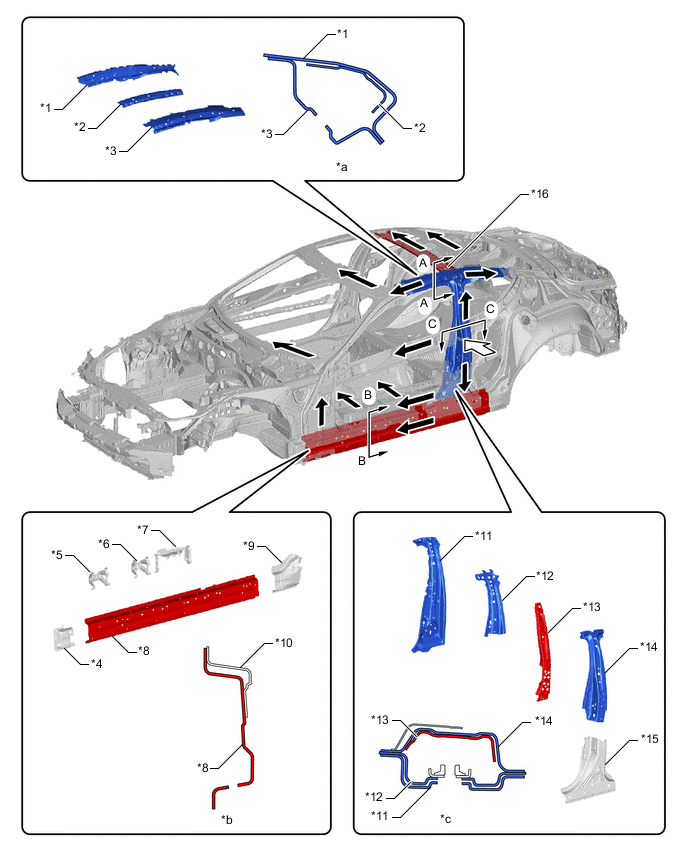
*1 Roof Side Rail UPR LH *2 Roof Side Rail Gusset RR LH *3 Roof Side Rail Inner LH *4 Rocker Panel Reinforcement No. 1 LH *5 Floor Side Member Reinforcement No. 1 *6 Floor Side Member Reinforcement No. 2 *7 Rocker Panel Reinforcement No. 6 LH *8 Fender Panel Inner LH *9 Rocker Panel Reinforcement No. 5 LH *10 Side Panel Outer No. 2 LH *11 Center Body Pillar Inner LH *12 Belt Anchor to Center Pillar Reinforcement LH *13 Center Pillar Upper Hinge Reinforcement No. 2 *14 Center Body Pillar Reinforcement UPR LH *15 Center Pillar Lower Hinge Reinforce No. 2 *16 Roof Panel Reinforcement *a A - A Cross Section *b B - B Cross Section *c C - C Cross Section - - Side Impact Energy Dissipate
-
-
Roof Crush Resistance
-
High-tensile strength steel (tensile strength: 440 MPa class) is used in the front header (windshield header panel outer (*1 in illustration)) and high-tensile strength steel (tensile strength: 590 MPa class) is used in the front body pillar reinforcement UPR INNER RH (*2 in illustration), front body pillar reinforcement UPR INNER LH (*4 in illustration) and windshield header panel inner (*3 in illustration) to ensure superior roof strength.
-
High-tensile strength steel (tensile strength: 590 MPa class) is used in the roof center reinforcement (roof panel reinforcement RR (*5 in illustration)) and ultra high-tensile strength steel (tensile strength: 1180 MPa class) is used in the roof panel reinforcement (*6 in illustration) to ensure superior roof strength.
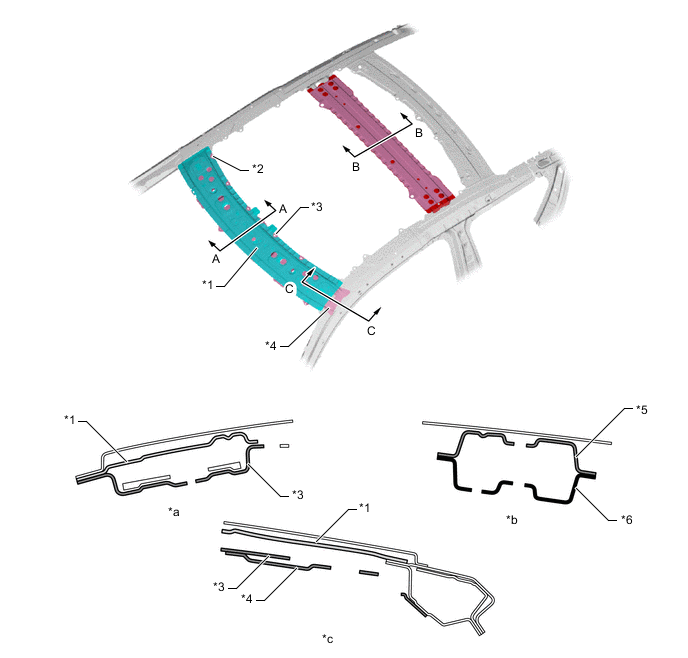
*1 Windshield Header Panel Outer *2 Front Body Pillar Reinforcement UPR INNER RH *3 Windshield Header Panel Inner *4 Front Body Pillar Reinforcement UPR INNER LH *5 Roof Panel Reinforcement RR *6 Roof Panel Reinforcement *a A - A Cross Section *b B - B Cross Section *c C - C Cross Section - -
-
-