CHARGING SYSTEM
-
FUNCTION OF MAIN COMPONENTS
Component Function Hybrid Vehicle Control ECU Assembly
-
Detects the electrical load condition, such as the operation of the battery cooling blower assembly, inverter water pump with motor assembly, oil pump assembly with motor, wiper motor, etc.
-
Receives signals about the state of the auxiliary battery detected by the battery state sensor (such as the voltage, current, temperature, State Of Charge (SOC), etc.) and calculates the auxiliary battery capacity condition.
-
Calculates the request voltage based on the electrical load and the state of the sub-battery and auxiliary battery and sends request voltage command signals to the hybrid vehicle converter assembly (DC-DC converter).
-
Controls the output voltage of the hybrid vehicle converter assembly (DC-DC converter).
Inverter with Converter Assembly Hybrid Vehicle Converter Assembly (DC-DC Converter)
-
Receives request voltage command signals from the hybrid vehicle control ECU assembly and charges the auxiliary battery.
Battery State Sensor Assembly
-
Detects the voltage, current, temperature, State Of Charge (SOC), etc., of the auxiliary battery and sends the information to the hybrid vehicle control ECU assembly.
Auxiliary Battery
-
Supplies power to ECUs and auxiliary devices such as the battery cooling blower assembly, inverter water pump with motor assembly, oil pump assembly with motor, wiper motor, etc.
Sub-battery Module Assembly Sub-battery ECU
-
Detects the voltage and State Of Charge (SOC) of the sub-battery.
-
Sends voltage generation request signals to the hybrid vehicle control ECU assembly when the voltage or capacity of the sub-battery is low.
-
-
SYSTEM CONTROL
-
Charging control is performed by the hybrid vehicle control ECU assembly.
-
The hybrid vehicle control ECU assembly calculates the requested voltage according to the electrical load status and auxiliary battery status, and sends request voltage command signals to the hybrid vehicle converter assembly (DC-DC converter). The hybrid vehicle converter assembly (DC-DC converter) receives the request voltage command signals from the hybrid vehicle control ECU assembly and charges the auxiliary battery.
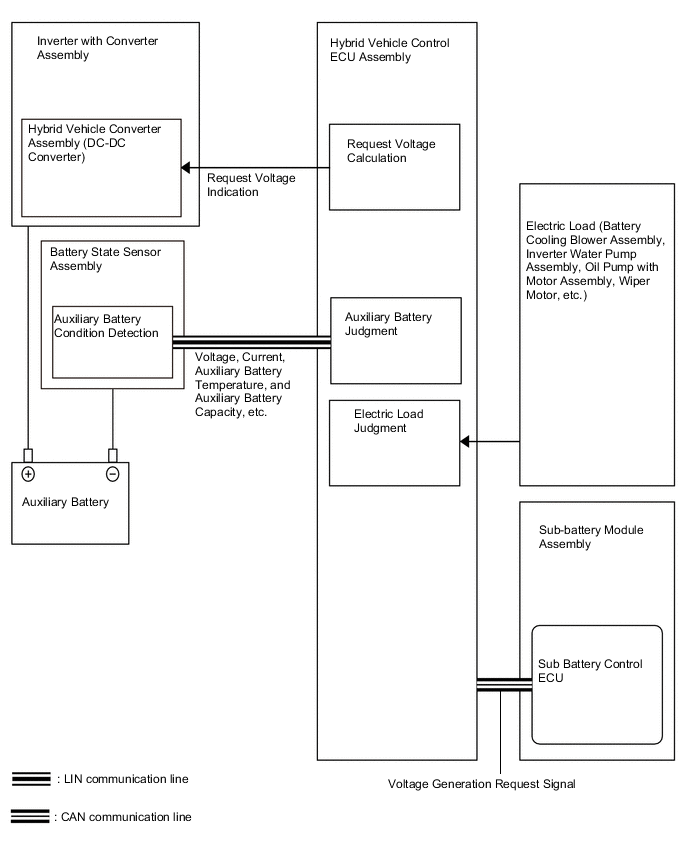
-
Charging control selects an optimal control mode according to the auxiliary battery status and vehicle conditions. The provided control modes are basic control mode, supplementary charging mode and refresh charging mode.
-
Basic Control Mode
-
This mode controls the output voltage of the hybrid vehicle converter assembly (DC-DC converter) to prevent the auxiliary battery from charging when the auxiliary battery capacity is high. As a result, vehicle power consumption is reduced.
-
-
Supplementary Charging Mode
-
This mode charges the auxiliary battery using constant voltage control if the auxiliary battery capacity is low when the hybrid system is started.
Tech Tips
Basic control mode is used when the auxiliary battery capacity is a specified amount or more.
-
-
Refresh Charging Mode
-
This mode suppresses decreases in the auxiliary battery lifespan by regularly* performing constant voltage control to charge the auxiliary battery. Also, the operation time of constant voltage control is longer in this mode compared to supplementary charging mode.
*: When a total of approximately 20 hours has elapsed with the power switch turned on (READY).
Tech Tips
Constant voltage control is also performed for a long time when the auxiliary battery capacity is low after the auxiliary battery is replaced or the vehicle is left for a long period of time.
-
-
-
The sub-battery control ECU detects the voltage of the sub-battery and calculates the State Of Charge (SOC) of the sub-battery. The sub-battery control ECU sends voltage generation request signals to the hybrid vehicle control ECU assembly when it is determined that charging is necessary according to the sub-battery condition.
-
-
Protection Control
-
When the following judgment conditions are met according to the auxiliary battery state and electrical load operation situation, charging control is canceled and constant voltage control starts.
Constant Voltage Control Operation Conditions Judgment Condition Purpose
-
Auxiliary battery capacity is low
If the auxiliary battery condition is poor, basic control mode is canceled to prevent the auxiliary battery capacity from dropping. In addition, if the auxiliary battery fluid temperature is too low or too high, the auxiliary battery may deteriorate faster than usual or become depleted.
-
Auxiliary battery fluid temperature is too low or too high
-
Vehicle cooling system is under a high load
-
Engine is under a high load
The voltage changes according to charging control. Therefore, to prevent uneasiness due to voltage changes when electrical components are operated, basic control mode is temporarily canceled.
-
Voltage or capacity of the sub-battery is low
When the voltage or capacity of the sub-battery is low, basic control mode is canceled to suppress reduction of the auxiliary battery capacity and sub-battery capacity. -
-