BLIND SPOT MONITOR SYSTEM
-
FUNCTION OF MAIN COMPONENTS
Component Function Blind Spot Monitor Sensor LH and RH
-
Outputs millimeter waves from the blind spot monitor sensor to the blind spot sensor detection area, uses the reflected millimeter waves for detecting the presence of a vehicle, the vehicle-to-vehicle distance, and the relative speed, and then sends this information to the built-in signal processing circuit.
-
The signal processing circuit determines if a vehicle is present, and illuminates or blinks the outer rear view mirror indicator light accordingly.
-
Receives display dimmer signals from the main body ECU and dims the outer rear view mirror indicator light.
Outer Rear View Mirror Assembly LH and RH Outer Rear View Mirror Indicator Light
-
Illuminates to inform the driver that a vehicle has been detected in the blind spot monitor sensor detection area.
-
Flashes to inform the driver when the turn signal lever is operated if a vehicle has been detected in the blind spot monitor sensor detection area.
-
Both indicator lights flash to inform the driver that a vehicle has been detected in the blind spot detection area while the driver is reversing.
RCTA Buzzer (Blind Spot Monitor Buzzer) Sounds when a vehicle is detected in the blind spot monitor sensor detection area while the driver is reversing. Combination Meter Assembly
-
BSM Indicator Light
-
RCTA Indicator Light
-
Multi-information Display
-
Master Warning Light
-
Meter Buzzer
-
Sends the on/off signal of the BSM function or RCTA function to the blind spot monitor sensor RH.
-
Sends the customization information signal of the BSM function or RCTA function to the blind spot monitor sensor RH.
-
Illuminates the BSM indicator light to inform the driver when the BSM function is on.
-
Illuminates the RCTA indicator light to inform the driver when the RCTA function is on.
-
When a malfunction is detected in the blind spot monitor sensors or the blind spot monitor sensors determine that control is not possible, the master warning light illuminates and a message is displayed on the multi-information display to warn the driver.
-
Sounds to warn the driver of a malfunction in the blind spot monitor system.
Steering Pad Switch Assembly Sends operation signals to the combination meter assembly. Multi-display Receives visual signals from the television camera assembly, and displays them. Television Camera Assembly
-
Captures images of the area behind the vehicle.
-
The RCTA icon is superimposed on the captured image. Then, the image is sent to the multi-display.
Steering Sensor
-
Sends the steering angle signal to the blind spot monitor sensor RH.
-
Sends the turn light signal to the blind spot monitor sensor RH.
Turn Signal Switch Sends the turn light signal to the steering sensor. Yawrate Sensor Sends yawrate information to the blind spot monitor sensor RH. Hybrid Vehicle Control ECU Assembly Sends the shift position signal to the blind spot monitor sensor RH. Skid Control ECU Assembly Sends the vehicle speed signal to the blind spot monitor sensor RH. Main Body ECU (Multiplex Network Body ECU) Sends display dimmer signals to the blind spot monitor sensor RH. Central Gateway ECU (Network Gateway ECU) Relays the signal between the CAN communication buses. DLC3
-
The Global TechStream (GTS) can be connected to read the Diagnostic Trouble Codes (DTCs) of malfunctions.
-
The Global TechStream (GTS) can be connected to change settings as desired by the user.
-
-
SYSTEM CONTROL
-
The BSM function operates when all of the following conditions are met:
-
The BSM function is on.
-
The shift position is other than R.
-
The vehicle speed is greater than approximately 16 km/h (10 mph).
-
-
The BSM function can detect vehicles in its detection areas.
-
The detection areas formed by the blind spot monitor sensor LH and RH are as shown below.
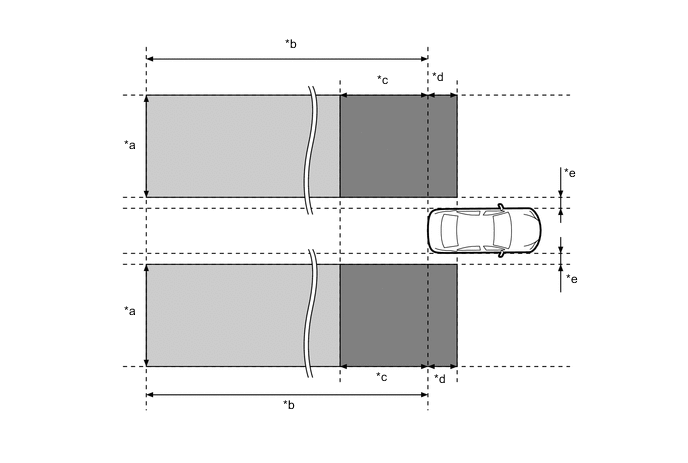
*a Approximately 3.0 m (9.8 ft.) *b Approximately 60 m (197 ft.) *c Approximately 3.0 m (9.8 ft.) *d Approximately 1.0 m (3.3 ft.) *e Approximately 0.5 m (1.6 ft.) - - 
Detection Area (for Vehicle in Blind Spot) 
Detection Area (for Rapidly Approaching Vehicle from Behind) Tech Tips
If another vehicle that is rapidly approaching the vehicle's blind spot is detected, the notification timing is determined by the relative speed of the approaching vehicle. The notification timing for vehicles rapidly approaching the vehicle's blind spot can be customized. For details, refer to the Repair Manual.
-
Detection Area (for Vehicle in Blind Spot)
-
When this vehicle is overtaken by another vehicle in an adjacent lane.
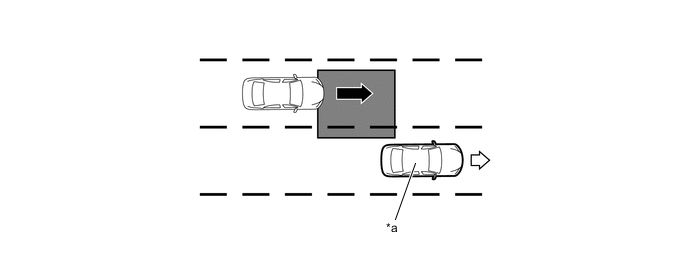
*a This Vehicle - - 
Vehicle Speed (Fast) 
Vehicle Speed (Slow) Detection Area - - -
When another vehicle enters the detection area of this vehicle due to a lane change.
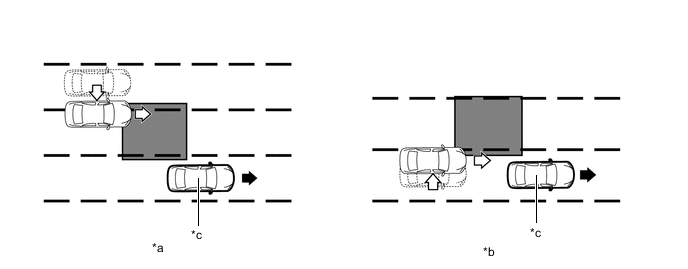
*a Another vehicle enters the detection area during lane change (merge in) (Type 1). *b Another vehicle enters the detection area during lane change (merge in) (Type 2). *c This Vehicle - - Motion Direction of This Vehicle Motion Direction of Another Vehicle Detection Area - -
-
-
Detection Area (for Rapidly Approaching Vehicle from Behind)
-
When another vehicle is rapidly approaching from behind.
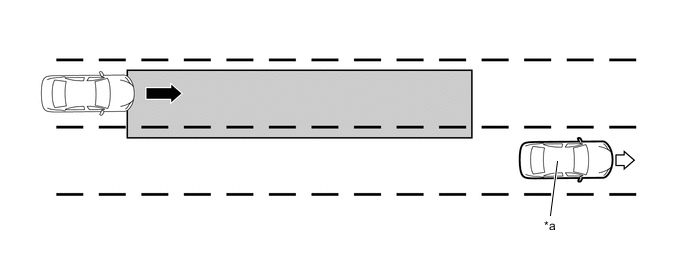
*a This Vehicle - - Vehicle Speed (Fast) Vehicle Speed (Slow) Detection Area - - -
When another vehicle enters the detection area of this vehicle due to a lane change and approaches this vehicle.
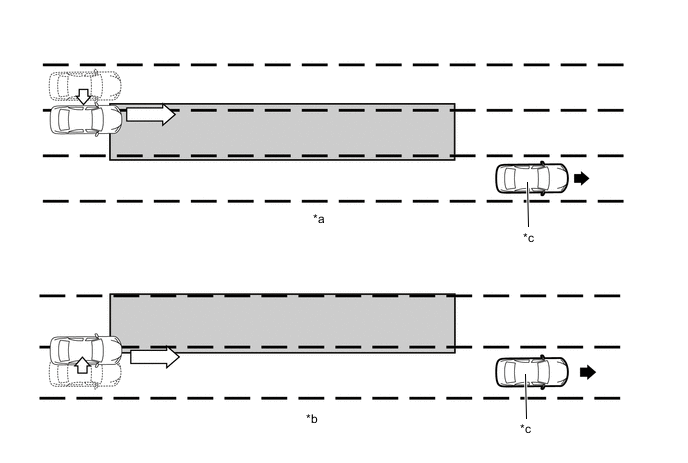
*a Another vehicle enters the detection area during lane change (merge in) (Type 1). *b Another vehicle enters the detection area during lane change (merge in) (Type 2). *c This Vehicle - - Motion Direction of This Vehicle Motion Direction of Another Vehicle Detection Area - -
-
-
-
According to operation conditions, the BSM function promotes safety confirmation by using the outer rear view mirror indicator light to inform the driver that the system detects vehicles that are in or rapidly approaching the vehicle's blind spot.
-
The outer rear view mirror indicator light illuminates when a vehicle is in or rapidly approaching the vehicle's blind spot and the turn light switch is not operated. The indicator light flashes when a vehicle is in or rapidly approaching the vehicle's blind spot and the turn light switch is operated.
-
The RCTA function operates when all of the following conditions are met:
-
The RCTA function is on.
-
The shift position is R.
-
The speed of this vehicle is less than approximately 8 km/h (5 mph).
-
The speed of the target vehicle is between approximately 8 km/h (5 mph) and 28 km/h (18 mph).
-
-
The RCTA function can detect vehicles in its detection areas.
-
The system continuously measures the relative speed of an approaching vehicle and its distance. If it is determined that the approaching vehicle will cross the path of this vehicle, the Estimated Crossing Time (ECT) is calculated. When the ECT is 2.5 seconds or less, the system alerts the driver by flashing the outer rear view mirror indicator lights and sounding the RCTA buzzer.
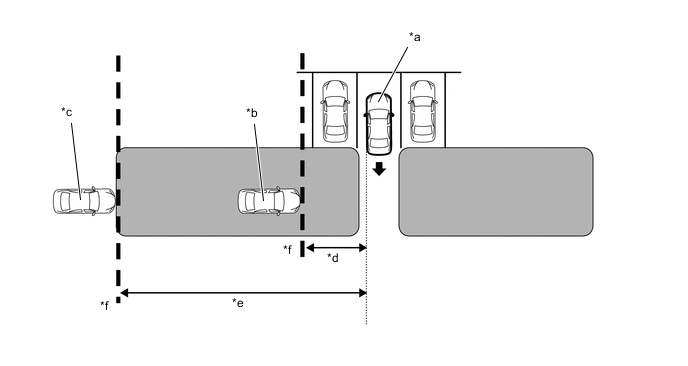
*a This Vehicle *b Target Vehicle (Approximately 8 km/h (5 mph)) *c Target Vehicle (Approximately 28 km/h (18 mph)) *d Approximately 5.5 m (18.0 ft.) *e Approximately 20 m (66 ft.) *f Target Detection Line Detection Area - - -
Normal Parking
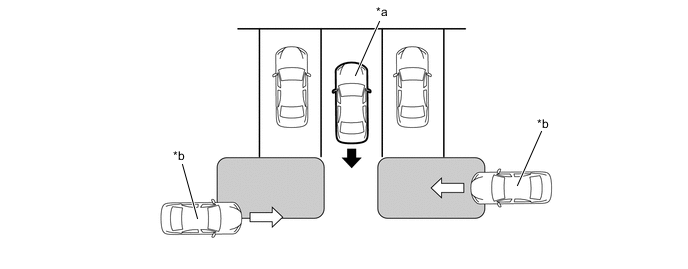
*a This Vehicle *b Target Vehicle Detection Area - -
-
-
According to operation conditions, the RCTA function promotes safety confirmation by using the outer rear view mirror indicator lights and RCTA buzzer to inform the driver that another vehicle has entered the blind spot monitor sensor alert area of this vehicle.
-
-
FUNCTION
-
Blind Spot Monitor System Operation
-
The BSM function and RCTA function can be switched on and off by operating the multi-information display with the steering pad switch assembly.
Tech Tips
It is not possible to enable the RCTA function only.
-
An indicator light that can be used to check whether the BSM function and RCTA function are on or off is positioned in the combination meter assembly. When the system is on, the indicator light illuminates, and when the system is off, the indicator light turns off, indicating the operation status.
-
The brightness of the outer rear view mirror indicator light, volume of the RCTA buzzer and the BSM function detection timing can be set by operating the multi-information display with the steering pad switch assembly.
-
-
Customization Function
-
Settings of some functions can be changed as desired by the user. Refer to the Repair Manual for details.
-
-
-
DIAGNOSIS
-
The blind spot monitor system is equipped with a diagnosis function that can display warning messages in the multi-information display. For details, refer to the Repair Manual.
-