BRAKE CONTROL SYSTEM
-
OUTLINE
-
The following brake control functions are provided: Anti-lock Brake System (ABS), Electronic Brake force Distribution (EBD), brake assist, Traction Control (TRC), Vehicle Stability Control (VSC), steering cooperative control, hill-start assist control and brake hold.
-
The skid control ECU assembly processes signals from sensors and performs brake control.
-
An electronic control type hydraulic pressure brake system is used for the brake hydraulic pressure control system. Also, the system performs regenerative brake cooperative control for the hybrid system to achieve superior low fuel consumption.
-
Vehicle Dynamics Integrated Management (VDIM) is used.
-
Hill-start assist control is used to prevent the vehicle from moving backwards when starting off on a slope.
-
Brake hold is used to reduce the burden on the driver.
-
An emergency brake signal system is used. This system reduces the danger of rear-end collisions by automatically flashing the stop lights during emergency braking to warn vehicles to the rear.*
-
*: Except models for Korea
-
-
A secondary collision brake system is used. This system lessens damage from a secondary collision by controlling the automatic brakes and stop light illumination after a collision occurs.*
-
*: Models with pre-collision system
-
-
-
MAIN FEATURES
-
Electronically Controlled Brake System
-
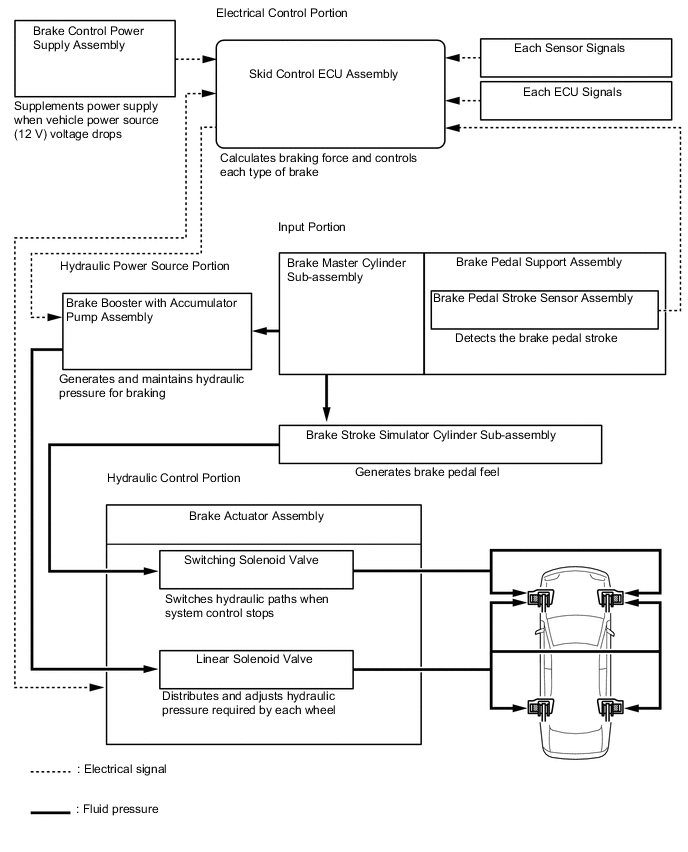
The electronically controlled brake system uses a sensor to detect the amount of brake pedal depression. Based on this, the skid control ECU calculates the braking force and the brake booster with accumulator pump assembly and brake actuator assembly control the brake fluid pressure of the 4 wheels.
-
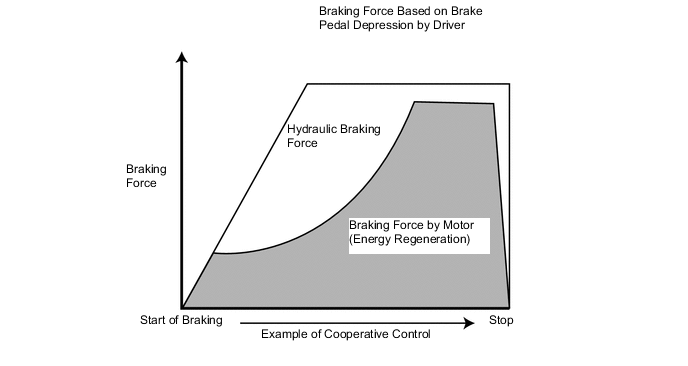
The electronically controlled brake system cooperates with the hybrid system to optimally control the brake fluid pressure and regenerative braking. This enhances the efficiency of energy regeneration and improves fuel economy.
-
When the system is malfunctioning, brake control continues via the use of non-malfunctioning parts. Also, when the system is not operating, the brake fluid pressure generated in the brake master cylinder by the depression of the brake pedal works as a back-up mechanism to ensure braking force. Furthermore, the brake control power supply assembly is used as an auxiliary power source to supply power to the brake system in a stable manner.
-
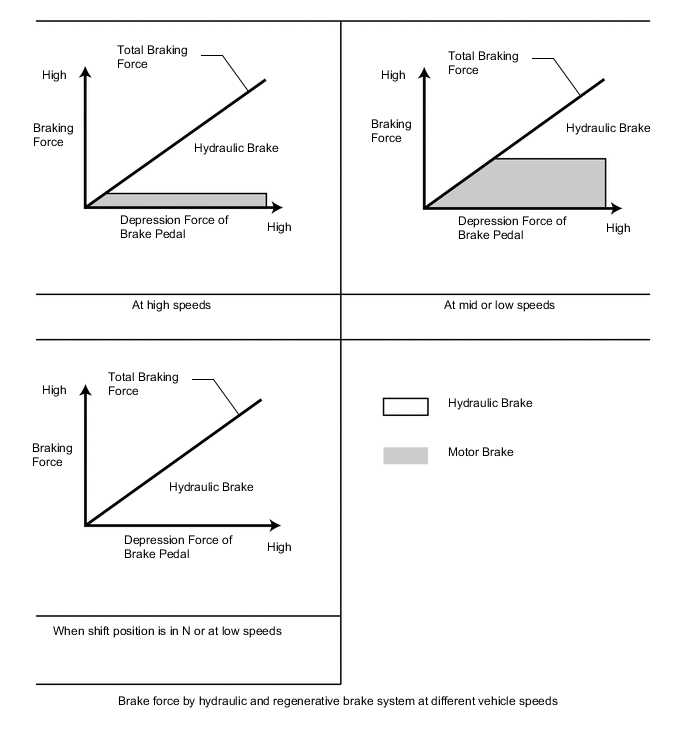
Brake control apportions brake force to the hydraulic brake system and regenerative brake system at varying vehicle speeds as follows.
-
-
Vehicle Dynamics Integrated Management (VDIM)
-
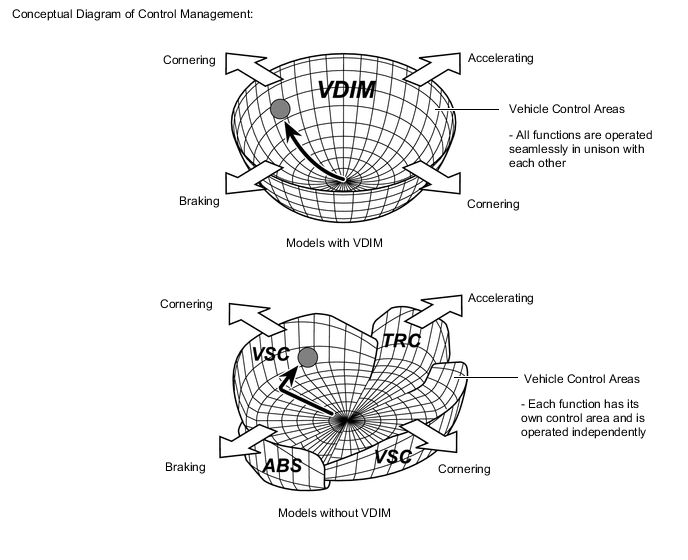
In contrast to the ABS, TRC and VSC functions that were controlled individually in the conventional brake control system, the VDIM manages these functions in the form of an integrated system.
-
Furthermore, the VDIM effects cooperative control together with the Electric Power Steering (EPS) system in order to improve the dynamic performance of the vehicle to "run, turn, and stop".
-
-
-
PRECAUTION
-
ABS
-
The ABS system cannot increase the performance limit of the tires. Always drive safely and be aware of the vehicle speed and distance to other vehicles.
-
Any non-standard components such as non-standard tires that are installed may have a negative effect on the ABS function.
-
When braking using ABS, the braking distance may be longer than models without ABS in the following conditions:
-
When driving on a dirt road or a road covered with fresh snow
-
When using tire chains
-
When driving over a joint in the road surface
-
When driving on a rough road such as an unpaved or stone-paved road
-
-
-
Brake Assist
-
Brake assist cannot increase the performance limit of the fundamental brake system. Always drive safely and be aware of the vehicle speed and distance to other vehicles.
-
-
TRC, VSC
-
The TRC and VSC systems ensure traction and vehicle stability. Do not disable the TRC and VSC functions unless necessary.
-
The TRC and VSC systems cannot increase the performance limit of the tires. Always drive the vehicle carefully in conditions in which drive wheel traction or vehicle stability may be lost.
-
-
Hill-start Assist Control
-
Hill-start assist control is not intended to keep the vehicle stationary on a hill for a prolonged period. As hill-start assist control only prevents the vehicle from rolling backwards for 2 seconds after the brake pedal is released, perform start-off within this period.
-
When hill-start assist control is operating and the power switch is turned off, hill-start assist control will be canceled without warning.
-
Hill-start assist control prevents the vehicle from rolling backwards by controlling the brake force to the 4 wheels. However, the vehicle may not remain stationary when on an extremely steep slope or a low friction surface such as ice.
-
-
Brake Hold
-
The brake hold is not for parking the vehicle for a long period of time in the same way as the parking brake.
-
If brake hold control does not operate even when the vehicle stops, depress the brake pedal again firmly to stop the vehicle. If the vehicle still does not stop, confirm the conditions for brake hold control to operate.
-
When the power switch is turned off during brake hold operation, control stops.
-
This function may not stop the vehicle on steep slopes and slippery roads.
-
-