LANE DEPARTURE ALERT SYSTEM(w/ Steering Control)
Info Added 2017-04-18 
-
OUTLINE
-
The Lane Departure Alert (LDA) system uses a forward recognition camera (camera sensor) to detect lane markers on the road surface, assists the driver's steering operation by using the warning buzzer and electric power steering, and activates the lane departure warning when needed.
-
The LDA system also operates on roads with only one lane marker.
-
The LDA system is controlled by the forward recognition camera (camera sensor).
-
This system has a last memory function which memorizes the state of the LDA switch just before the power switch is turned off and resumes the previous state when the power switch is turned on (IG) again.
-
-
MAIN FEATURES
-
Lane Departure Alert (LDA) Function
-
The LDA system consists of the LDA system (steering assist unavailable) function [steering assist off], LDA system (steering assist available) function [steering assist on] and vehicle sway warning function.
-
-
LDA System (Steering Assist Unavailable) Function
-
If the system judges that the vehicle may deviate from the lane it is in, the system blinks the lane marker in the multi-information display and sounds a buzzer so that the driver can take action to avoid lane departure.
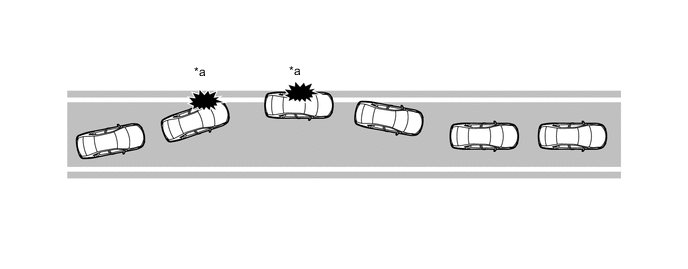
*a Warning - -
-
-
LDA System (Steering Assist Available) Function
-
If the system judges that the vehicle may deviate from the lane it is in, the system performs steering assist to help the driver correct the path of the vehicle. If the driver does not take appropriate action, the system sounds a buzzer.
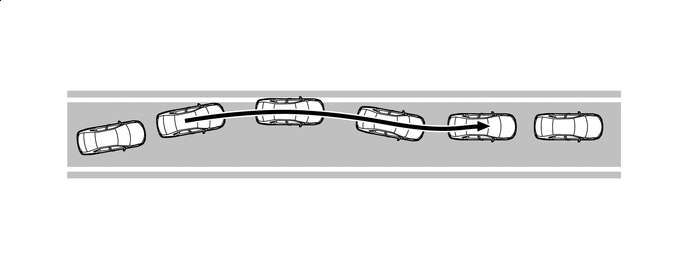

Steering Assist - -
-
-
Vehicle Sway Warning Function
-
The system detects drift of the vehicle within its lane, which is often the result of a driver who is tired, distracted or not looking ahead, based on the position of the vehicle within its lane and the steering inputs of the driver, and alerts the driver before a lane departure or collision occurs.
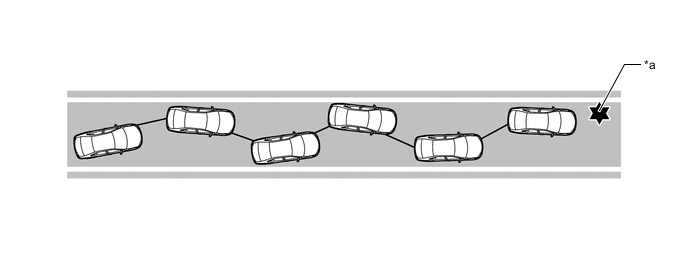
*a Alert - -
-
-
-
PRECAUTION
-
General Handling Precautions
-
Use the LDA system with clear lane markers.
-
The LDA system uses a forward recognition camera (camera sensor) installed on the front of the vehicle to recognize white lines. The LDA system does not operate when white lines cannot be recognized. Also, since unnecessary steering force and warning sounds may be produced when white lines are not properly recognized, make sure to drive appropriately using the steering wheel even when using the LDA system. However, the steering force generated is small and does not interfere with operation of the vehicle.
-
Keep the windshield glass clean around the area where the forward recognition camera (camera sensor) is mounted. The performance of the forward recognition camera (camera sensor) may be affected if dirt, raindrops, condensation, or snow is on the windshield glass.
-
Do not attach stickers or labels, nor affix any ornaments to the windshield glass.
-
Do not touch the lens of the forward recognition camera (camera sensor). Fingerprints left on the lens may cause inaccurate detection or non-detection and lane markers may not be detected accurately.
-
Do not remove the forward recognition camera (camera sensor). Since the angle of the forward recognition camera (camera sensor) is precisely adjusted, angle adjustment must be performed after the forward recognition camera (camera sensor) is reinstalled, otherwise the forward recognition camera (camera sensor) may not recognize lane markers properly.
-
Do not subject the forward recognition camera (camera sensor) to strong impacts.
-
When the system detects a malfunction, the buzzer sounds, the LDA indicator light illuminates in amber, "Lane Departure Alert Malfunction" appears on the multi-information display, and the LDA system stops operating.
-
Since this does not affect normal driving, keep driving carefully.
-
When the engine is stopped and started again and the LDA main switch is turned on, the lane departure alert system can be resumed when the engine is restarted and the system is restored back to normal.
-
-
Changing tires or changing suspension parts may lead to a decline in performance of the system.
-
Depending on road surface conditions, it may be difficult to hear the warning sound.
-
Do not modify the headlights or attach stickers to the surface of the light.
-
Do not install or place anything on the hood or the grille. Also, do not install a grille guard (bull bars, kangaroo bar, etc.).
-
If the windshield is fogged up, use the windshield defogger to remove fog from the windshield. When it is cold, using the heater with air blowing to the feet may cause the upper part of the windshield to fog up. This will have a negative effect on the images.
-
If the windshield needs to be replaced, contact your Toyota dealer.
-
When the system detects a fault, the buzzer sounds and a warning message will appear to alert the driver and the system stops operating. However, normal driving can continue. Contact your Toyota dealer if any error alert is output repeatedly after turning the power switch on (IG) again.
-
-
Precautions Concerning Road Conditions
-
If the system cannot recognize lane markers under the following conditions, the system will not operate.
-
When driving through an area with no lane markers, such as a tollbooth, a crossing or before a ticket checkpoint.
-
When driving on a sharp curve.
-
When lane markers are extremely narrow or extremely wide.
-
When the vehicle leans to one side an unusual amount due to a heavy load or improper tire inflation pressure.
-
When the following distance between your vehicle and the vehicle ahead is extremely short.
-
When the lane markers are yellow. (These may be more difficult for the system to recognize compared to white markers.)
-
When the lane markers are Botts' dots (raised pavement markers), stone or indistinct.
-
When the lane markers are on a curb etc.
-
When there are shadows on the road running parallel with lane markers, or if a shadow covers the lane markers.
-
When driving on a particularly bright road surface, such as concrete.
-
When driving on a road surface that is bright due to reflected light.
-
When driving in a location where the light level changes rapidly, such as the entrance to or exit from a tunnel.
-
When sunlight or the headlights of oncoming vehicles are shining directly into the camera lens.
-
When driving on roads that are branching or merging.
-
When driving on a road surface that is wet due to rain, previous rainfall, standing water, etc.
-
When the vehicle experiences strong up-and-down motion such as when driving on an extremely rough road or on a seam in the pavement.
-
When headlight brightness at nighttime is reduced due to dirt on the lenses, or when the headlights are misaligned.
-
When driving on winding roads or roads that are uneven.
-
When driving on rough or unpaved roads.
-
When driving on a road with a gradient.
-
When lane markers are obscured or partially obscured by sand, dirt, etc.
-
When driving with strong cross winds.
-
When there is a problem with the headlights. (Bulb is burned out, etc.)
-
When there are tire marks.
-
When there are rails for a streetcar or trolley in the road.
-
When driving in bad weather. (Fog, snow, sandstorm, heavy rain, etc.)
-
When the front windshield glass is cracked or broken.
-
When the temperature of the forward recognition camera (camera sensor) is extremely high.
-
-
If the distance between vehicles is extremely short, lane markers may not be recognized correctly. Maintain an appropriate distance from the vehicle ahead.
-
When the vehicle is parked during hot weather, the system will not operate for a while after the power switch is turned to on. When the temperature in the cabin reaches the appropriate level at which the forward recognition camera (camera sensor) can operate, the system can be resumed.
-
-