LIGHTING SYSTEM
-
OUTLINE
-
Exterior Light
-
The exterior lights consist of the following:
Figure 1. Front Exterior Lights
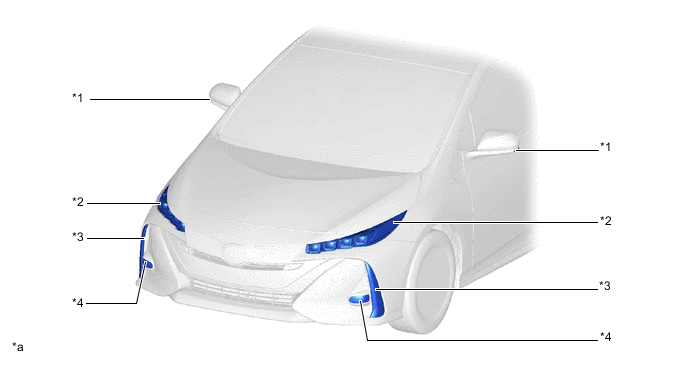
*1 Side Turn Signal Light Assembly *2 Headlight Assembly *3 Turn Signal Light Assembly *4 Front Fog Light (Turn Signal Light Assembly) *a The illustrations shown are examples only. - - Figure 2. Headlight Assembly
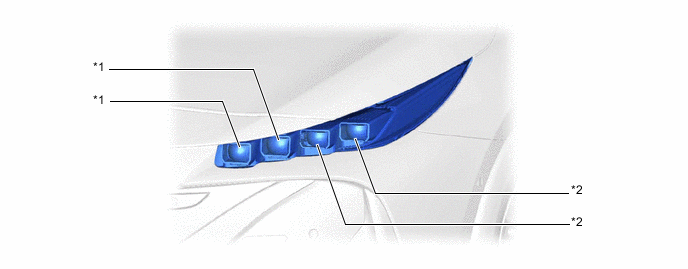
*1 High Beam/Clearance Light *2 Low Beam Figure 3. Turn Signal Light Assembly
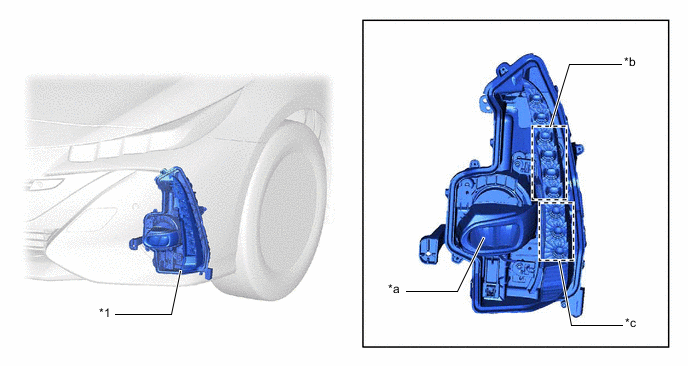
*1 Turn Signal Light Assembly - - *a Front Fog Light *b Front Turn Signal Light *c Daytime Running Light - - Figure 4. Rear Exterior Lights
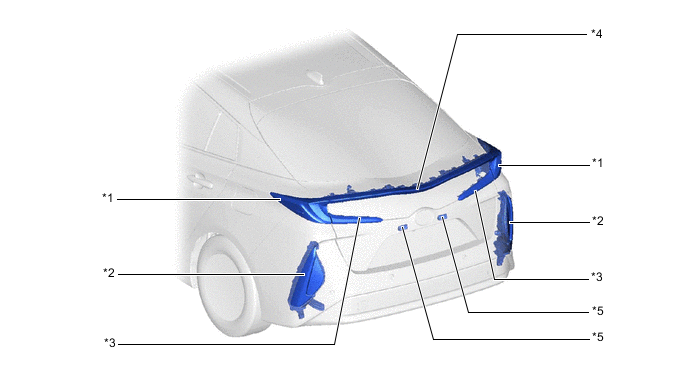
*1 Rear Combination Light Assembly *2 Rear Turn Signal Light Assembly *3 Rear Light Assembly *4 Center Stop Light Assembly *5 License Plate Light Assembly - - Figure 5. Rear Light Assembly/Rear Combination Light Assembly
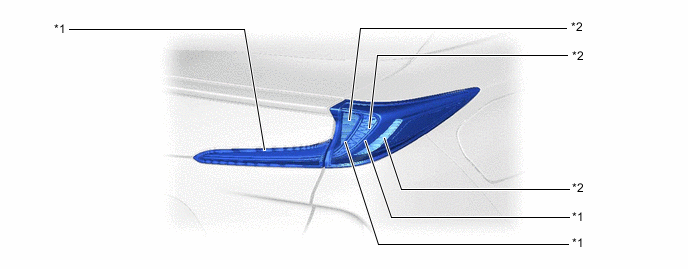
*1 Taillight *2 Stop Light Figure 6. Rear Turn Signal Light Assembly
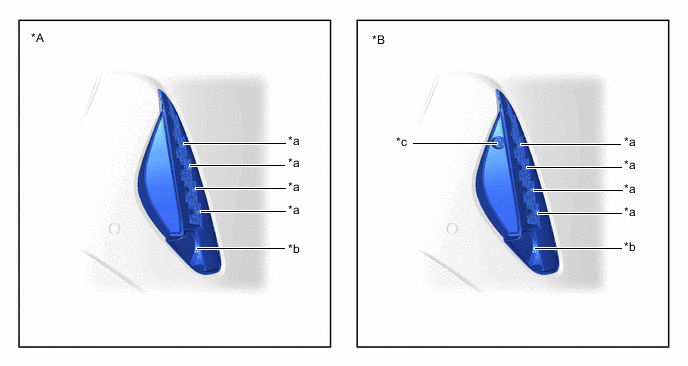
*A Models without Rear Fog Light *B Models with Rear Fog Light *a Rear Turn Signal Light *b Back-up Light *c Rear Fog Light - - Figure 7. Charger Lid Light
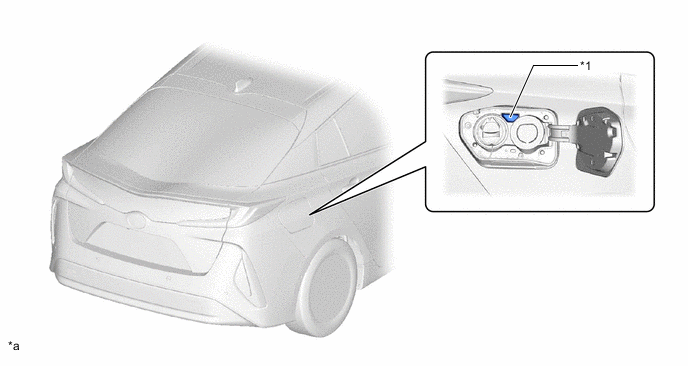
*1 Spot Light Assembly (Charger Lid Light) - - *a The illustrations shown are examples only. - -
-
-
Daytime Running Light System
-
The daytime running light system is designed to automatically illuminate the Light Emitting Diode (LED) lights during the daytime to keep the vehicle highly visible to other vehicles.
-
-
Light Auto Turn-off System
-
The light auto turn-off system is used to prevent the driver from leaving the vehicle with the headlights, front fog lights, clearance lights, taillights or license plate lights on.
-
-
Automatic Headlight Beam Level Control System
-
When the hybrid system and headlights are on, the automatic headlight beam level control system operates the headlight leveling motors in accordance with movement of the vehicle.
-
-
Automatic Light Control System
-
When the light control switch is in the AUTO position, the automatic light control sensor detects the ambient light level and automatically turns the headlights, taillights, clearance lights, and license plate lights on or off accordingly.
-
This system is controlled by the main body ECU (multiplex network body ECU).
-
-
Adaptive High Beam System (Models with Adaptive High Beam System)
-
By using the forward recognition camera to detect the lights of preceding and oncoming vehicles and subsequently optimizing the illumination area of the headlights accordingly, visibility is enhanced and the demands on the driver is reduced as they do not need to constantly switch between high beam and low beam.
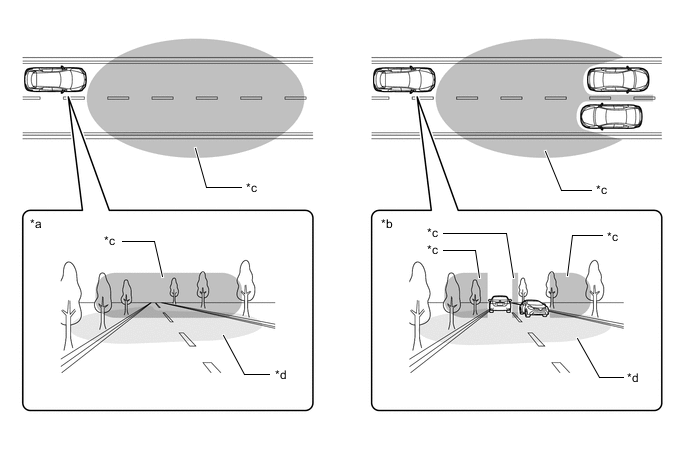
*a No Vehicles in Front *b Vehicles in Front *c Area Illuminated by High Beams *d Area Illuminated by Low Beams
-
-
Follow Me Home System (Models for Europe)
-
The follow me home system turns on the headlights (low beams) when the vehicle is parked in order to ensure visibility at night.
-
-
Lane Change Flasher System
-
The lane change flasher system flashes the turn signal light a certain number of times when the turn signal switch (headlight dimmer switch assembly) is moved to the lane change position. By using the lane change flasher system when changing lanes, it is no longer necessary to hold the turn signal switch in the lane change position.
-
-
-
SPECIFICATION
Light Type Wattage Headlight Assembly Low Beam LED (2 Units) 25 High Beam*1 LED (2 Units) 24 High Beam*2 LED (Inside) 17.8 LED (Outside) 12 Clearance Light LED x 4 3.2 Turn Signal Light Assembly Front Turn Signal Light LED x 4 6.8 Front Fog Light LED x 2 5.4 Daytime Running Light LED x 3 3.5 Side Turn Signal Light Assembly LED x 2 0.5 Rear Combination Light Assembly Taillights LED x 2 1.1 Stop Lights LED x 6 1.1 Rear Light Assembly Taillight LED x 1 0.3 Rear Turn Signal Light Assembly Rear Turn Signal Light LED x 4 3.8 Back-up Light W16W 16 Rear Fog Light LED x 4 1.0 Center Stop Light Assembly LED x 4 1.2 License Plate Light Assembly LED x 1 0.3 Spot Light Assembly (Charger Lid Light) LED x 1 3.1 *1: Models without Adaptive High Beam System
*2: Models with Adaptive High Beam System
-
PRECAUTION
-
Adaptive High Beam System
-
Conditions in which the light distribution control of the headlights changes automatically
-
When all of the following conditions are met, the high beams will be turned on automatically and the system will operate:
-
The vehicle speed is approximately 60 km/h (38 mph) or more.*1
-
The vehicle speed is approximately 15 km/h (10 mph) or more.*2
-
The area ahead of the vehicle is dark.
-
When all of the following conditions are met, the shaded high beams will turn on and the distance that the low beams are projected will be adjusted automatically, depending on the location of vehicles ahead:
-
The vehicle speed is approximately 60 km/h (38 mph) or more.*1
-
The vehicle speed is approximately 15 km/h (10 mph) or more.*2
-
The area ahead of the vehicle is dark.
-
There are vehicles ahead with headlights or tail lights turned on.
-
If any of the following conditions is met, the high beams or shaded high beams will be changed to the low beams automatically:
-
The vehicle speed is below approximately 40 km/h (25 mph).*1
-
The vehicle speed is below approximately 10 km/h (6 mph).*2
-
The area ahead of the vehicle is not dark.
-
There are many vehicles ahead.
-
Vehicles ahead are moving quickly and the high beams may blind the drivers of the other vehicles.
*1: Models for Europe
*2: Except models for Europe
-
-
Forward recognition camera detection information
-
The high beams may not be automatically changed to the shaded high beams in the following situations:
-
When vehicles ahead suddenly appear from a curve
-
When the vehicle is cut in front of by another vehicle
-
When vehicles ahead are hidden from sight due to repeated curves, road dividers or roadside trees
-
When vehicles ahead appear from the faraway lane on wide road
-
When vehicles ahead have no lights
-
The high beams may be changed to the shaded high beams if a vehicle ahead that is using fog lights without its headlights turned on is detected.
-
House lights, street lights, traffic signals, and illuminated billboards or signs and other reflective objects may cause the high beams to change to the shaded high beams, cause the high beams not to change to the shaded high beams, or change the area that is not illuminated.
-
The following factors may affect the amount of time taken to turn the high beam on or off, or the speed by which the areas not illuminated change:
-
The brightness of headlights, fog lights, and tail lights of vehicles ahead
-
The movement and direction of vehicles ahead
-
When a vehicle ahead only has operational lights on one side
-
When a vehicle ahead is a two-wheeled vehicle
-
The condition of the road (gradient, curve, condition of the road surface etc.)
-
The number of passengers and amount of luggage
-
The light distribution control of the headlights may change unexpectedly.
-
Bicycles or similar objects may not be detected.
-
In the following situations the system may not be able to correctly detect the surrounding brightness level. This may cause the low beams to remain on or the high beams to flash or dazzle pedestrians or vehicles ahead. In such a case, it is necessary to manually switch between the high and low beams.
-
When driving in inclement weather (heavy rain, snow, fog, sandstorms, etc.)
-
When the windshield is obscured by fog, mist, ice, dirt, etc.
-
When the windshield is cracked or damaged
-
When the camera sensor is deformed or dirty
-
When the temperature of the camera sensor is extremely high
-
When the surrounding brightness level is equal to that of headlights, tail lights or fog lights
-
When headlights or tail lights of vehicles ahead are turned off, dirty, changing color or not aimed properly
-
When the vehicle is hit by water, snow, dust, etc. from a preceding vehicle
-
When driving through an area of intermittently changing brightness and darkness
-
When frequently and repeatedly driving ascending/descending roads, or roads with rough, bumpy or uneven surfaces (such as stone-paved roads, gravel roads, etc.)
-
When frequently and repeatedly taking curves or driving on a winding road
-
When there is a highly reflective object ahead of the vehicle, such as a sign or mirror
-
When the back of a preceding vehicle is highly reflective, such as a container on a truck
-
When the vehicle's headlights are damaged or dirty, or are not aimed properly
-
When the vehicle is listing or tilting due to a flat tire, a trailer being towed, etc.
-
When the headlights are changed between the high beams and low beams repeatedly in an abnormal manner
-
When the driver believes that the high beams may be flashing or dazzling pedestrians or other drivers
-
When the vehicle is used in an area in which vehicles travel on the opposite side of the road of the country for which the vehicle was designed, for example using a vehicle designed for right-hand traffic in a left-hand traffic area, or vice versa
-
-
-