SOLAR CHARGING SYSTEM
-
CONSTRUCTION
-
The solar roof with built-in solar cells which is installed to the roof of the vehicle generates electricity from sunlight while the vehicle is parked or being driven.
-
The solar panel is divided into 7 modules, thereby reducing the drop in power output if the solar panel is partially shadowed.
-
Each module consists of 8 solar cells.
-
To prevent leakage of electrical noise generated within the solar energy control unit, or to prevent intrusion of noise generated outside the solar charging system, a noise filter is built in.
-
The solar panel has a white back sheet, thereby increasing reflected light, reducing temperature and increasing power generation.
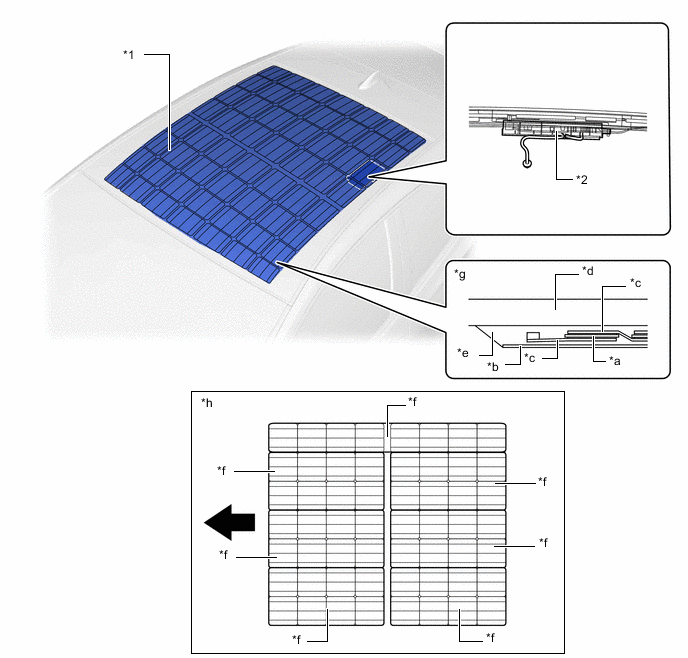
*1 Solar Roof (No. 1 Roof Window Glass Sub-assembly LH) *2 Noise Filter *a Battery Cell *b Back Sheet *c Copper Foil Lead Plate *d Glass *e Filling Material *f Module *g Cross Section *h Module Layout 
Vehicle Front - -
-
-
OPERATION
-
A structure in which 2 layers of semiconductor materials of differing electrical properties (N-type semiconductor and P-type semiconductor) are joined together is used for solar cells.
When sunlight strikes solar cells, free electrons (-) and holes (+) are created, with the holes migrating to the P-type semiconductor and the electrons migrating to the N-type semiconductor.
With this, current flows through the electrical load that is connected to both sides of the semiconductor.
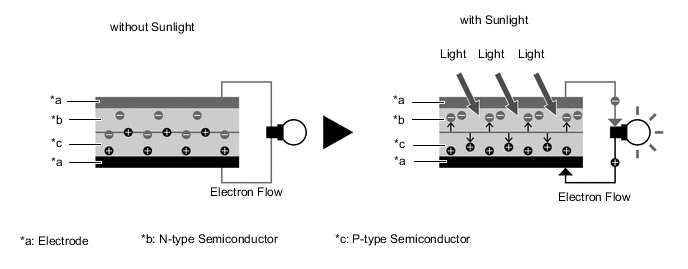
-
Solar cells have the following characteristics:
-
The generated voltage drops in proportion to the temperature.
-
Power generation increases in proportion to the amount of solar radiation.
Depending on the time or weather, the required output voltage to current ratio in order to maximize power generation changes.
-
-
-
SPECIFICATION
Item Specification Battery type Single-crystal hybrid type solar cells Maximum Output 180 W* *: Reference value